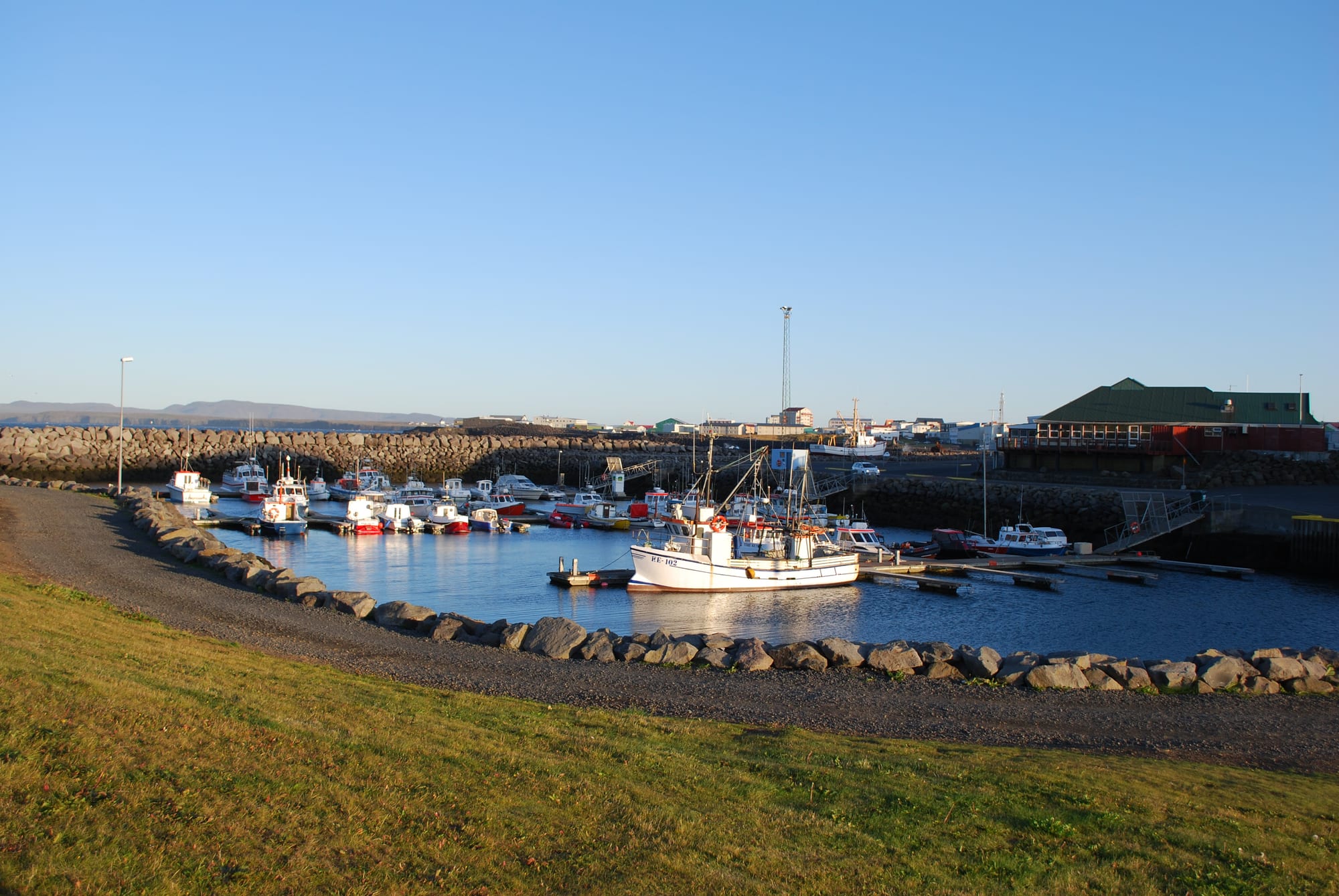
Small fishing boats moored inside a stone breakwater, with low town buildings behind under a clear blue sky

Reykjavík & the South, Iceland

Keflavík

Fishing boats in the small harbour at Grófin in Keflavík. (Chmee2/Valtameri / Wikimedia Commons · CC BY 3.0)

A harbour town on the Reykjanes peninsula, a few kilometres east of Iceland's main international airport. It grew on trade and fish, lived for decades beside an American air base that closed in 2006, and is now the largest part of Reykjanesbær, a fast-growing municipality known for its rock-music past and its lava coast.

Neighbourhoods

  • Keflavík town and Grófin
    • First-time visitors
    • Harbour
    • Museums

    The old trading town around the bay, with the small harbour at Grófin, where the Duus museum houses stand and whale-watching boats leave. The cliff of Keflavíkurberg rises north of the harbour and is lit up for the town festival, and a path follows the shore towards the lighthouse on the point.

    Open in Maps
  • Njarðvík
    • Museums
    • Quiet and residential

    Keflavík's neighbour, so closely grown together with it that for years a single street divided the two towns. It is home to the Viking World museum and its replica Viking ship.

    Open in Maps
  • Ásbrú
    • Students
    • Recent history

    The part of the former United States naval air station not needed for defence, taken over after the Americans left in 2006 and turned into a community of students, start-ups and residents in the old base buildings, close to the airport.

    Open in Maps
  • Hafnir
    • Quiet villages
    • History

    A small coastal village about ten kilometres from Keflavík, where an abandoned cabin has given early evidence of settlement in Iceland, and where the anchor of the American ship Jamestown, wrecked offshore in 1881, stands outside the church.

    Open in Maps

Things to do

Museums and the town

  • The Icelandic Museum of Rock 'n' Rollmuseum

    Opened in 2014 in the Hljómahöll concert hall, it tells the story of Icelandic pop and rock from 1920 to today, from Hljómar to Björk and Sigur Rós.

    Open in Maps
  • Viking Worldmuseum

    A museum in Njarðvík built around Íslendingur, a replica of the Gokstad Viking ship that sailed across the Atlantic in 2000.

    Open in Maps
  • Duus Safnahúsmuseum

    The Duus museum houses at Grófin harbour, holding exhibitions of the local heritage museum, the Reykjanesbær art museum and Grímur Karlsson's boat collection.

    Open in Maps
  • Whale watching from Keflavík harbourattraction

    Boat trips leave from the town harbour into the bay in search of whales.

    Open in Maps

Coast walks

  • Keflavíkurberg and the shore pathtrail

    A stone path along the water past seabirds towards the lighthouse on the point; the Keflavíkurberg cliff north of the harbour is floodlit each year for the town festival.

    Open in Maps
  • Garðskagavitilandmark

    Two lighthouses on Garðskagi, about 9 kilometres from Keflavík, the first built in 1897 and the second in 1944.

    Open in Maps

Short trips on the Reykjanes peninsula

  • Blue Lagoonattraction

    The geothermal spa in a lava field in front of Mount Þorbjörn near Grindavík, supplied by water from the nearby geothermal power plant; eruptions in the area have closed it for spells since 2023.

    Open in Maps
  • Reykjanesvitilandmark

    Iceland's oldest lighthouse, at the south-western tip of the peninsula, a landfall light for ships bound for Reykjavík and Keflavík.

    Open in Maps
  • Gunnuhverattraction

    An active hot spring and mud pool with steaming fumaroles near Reykjanesviti, in the Reykjanes UNESCO Global Geopark.

    Open in Maps

Seasonal events

  • Ljósanótt (Night of Lights)First weekend of September

    Reykjanesbær's town festival, held since 2000, with concerts, exhibitions and a Saturday-night gathering at Myllubakki that ends when the lights on the Keflavíkurberg cliff are switched on and fireworks follow.

Eat and drink

Long-standing places and food districts in Keflavík. Hours, ratings and directions come from your maps app, always current.

Keflavík food

  • Keflavík town centreneighborhood

    The town's restaurants, cafés and bakeries are spread through the centre near the bay and the harbour.

    Open in Maps
  • Njarðvíkneighborhood

    More places to eat in the neighbouring half of Reykjanesbær, near the Viking World museum.

    Open in Maps

Experience Keflavík

History

Keflavík — "driftwood bay" — grew up as a trading place on the shores of the bay. In 1579 the Danish king granted Hanseatic merchants the first licence to trade there, and from 1602 trade fell under the Danish monopoly. Settlement began to thicken after 1772, when Holger Jacobaeus was appointed merchant in Keflavík for the monopoly trading company, and the town developed on its fishing and fish processing. The trading lot was extended south into Njarðvík land in 1891, and Keflavík received town rights on 22 March 1949.

The Second World War changed it utterly. The United States Army built an air base beside the town to defend Iceland and secure the North Atlantic air routes, and after the war it became Naval Air Station Keflavik, home of the Iceland Defense Force and a long-running political issue; in the 1960s and 1970s protesters walked every year the 50 kilometres from Reykjavík to chant against NATO and the army. The airfield also became Iceland's main international airport. As aircraft ranges grew and the Soviet Union dissolved, the base mattered less, and the last American personnel left on 8 September 2006.

In the mid-1990s Keflavík merged with Njarðvík and the village of Hafnir to form Reykjanesbær. After 2006 part of the old base was reborn as Ásbrú, with an education centre, Keilir, and new businesses, while the main base area passed to Iceland's defence authorities and is used periodically by NATO aircraft for air policing. Since 2021, and above all since late 2023, eruptions on the peninsula near Grindavík have brought volcanic danger close to the town's doorstep.

Culture & Customs

Within Iceland, Keflavík is famous for its music. In the 1960s and 1970s it produced so many musicians that it became known as Bítlabærinn, "the Beatle town". The best known were Hljómar, who also recorded in English for export as Thor's Hammer; their 1966 EP Umbarumbamba is one of the rarest records sought by collectors. The town honours that past with the Icelandic Museum of Rock 'n' Roll, opened in 2014 in the Hljómahöll concert hall, which covers Icelandic pop and rock from 1920 onwards — Hljómar alongside Björk, Sigur Rós and Of Monsters and Men.

The town's festival is Ljósanótt, the Night of Lights, held on the first weekend of September since 2000. Shops, exhibitions and concerts fill the weekend, and on the Saturday night crowds gather at Myllubakki to hear well-known bands until dark, when the floodlights on the Keflavíkurberg cliff are switched on and fireworks follow. A competition chooses a song for each year's festival.

Sport has a loyal following through Keflavík ÍF, the town's sports and youth association, whose divisions include football, basketball and swimming. Viking World in Njarðvík, built around the replica longship Íslendingur that crossed the Atlantic in 2000 to mark the millennium of Leif Eriksson's voyage to Vinland, links the town to the saga past, and the Duus museum houses at the harbour hold its heritage collection and boat models.

Daily Life

Reykjanesbær had 21,957 residents in 2024, making it Iceland's fourth largest municipality; Keflavík is the largest of its three settlements and has grown together with Njarðvík into one continuous town. Growth has been fast, from about 18,900 in 2019, and immigrants and their children made up just over a quarter of the population in 2024 — Poles, Lithuanians and Ukrainians are the most common foreign citizens.

The airport is the economic engine. It handles almost all of Iceland's international journeys, is a hub for Icelandair and has been expanded several times, most recently with a new eastern wing opened between 2023 and 2025, and the peninsula as a whole lives largely off the airport and the visitors who pass through it. Ásbrú, the former base, now houses students, colleges and companies in its old buildings.

Keflavík and Njarðvík grew into each other over the second half of the 20th century until only a single street separated them, and Reykjanesbær is now the most populous municipality outside the capital area and in the wider Suðurnes region, which it shares with five neighbouring municipalities. The eruptions near Grindavík, whose residents were evacuated in November 2023, are close by, and magma has continued to accumulate beneath the area since the last eruption.

Food

Keflavík was built on fish, and its food is the Icelandic everyday kitchen of lamb, dairy and seafood. Icelanders today eat mostly haddock, plaice, halibut, herring and shrimp. Saltfiskur, salted cod, has a long history on the peninsula — in neighbouring Grindavík in the 13th century, the Bishop of Skálholt, who owned the fishing rights, took payment in stacks of salted cod.

The traditional staples turn up in shops and on menus here as anywhere in Iceland: skyr, a soft yoghurt-like cheese eaten with a spoon; rúgbrauð, a dense, dark and moist rye bread; hangikjöt, smoked lamb, often served in thin slices on flatkaka, a soft brown rye flatbread; and kleina, a small knotted bun of fried dough. At midwinter, þorramatur, the buffet of cured meat and fish, is served with rúgbrauð and brennivín, an Icelandic akvavit.

Because so many travellers spend a night here before or after a flight, the town's cafés and restaurants serve a steady passing trade. Supermarkets are the practical choice for anyone stocking up before setting off around the country or using up the last of their króna before flying home.

Planning tools

Budget

Keflavík shares Iceland's high prices, and many travellers stay here only for a first or last night beside the airport. Restaurant meals and alcohol are expensive; self-catering from supermarkets is the economical choice. A car or a tour is needed for most of the peninsula's sights.

Daily Budget Midrange
USD 280–520 (mid-range hotel or guesthouse, one restaurant meal a day, a hire car, one spa or boat trip)
Daily Budget Shoestring
USD 110–200 (hostel or guesthouse room, supermarket food, buses)

Many of the peninsula's lighthouses, coast paths and geothermal areas are free to visit; the spa is the big expense.

Best Time to Visit

June to August for the longest days and the calmest conditions on the coast; Ljósanótt fills the town on the first weekend of September. Winter is dark, windy and wet but brings a chance of the northern lights, and the town is busy all year with airport traffic.

Suggested Number of Days

The town itself needs about a day. Most visitors pass through at the start or end of a trip to Iceland; allow two or three days to see the rest of the Reykjanes peninsula as well, and more if eruptions close roads.

First Visit
1 day
With Surroundings
2–3 days

Transportation

Keflavík and Njarðvík are compact enough to walk or cycle, and Strætó buses link the town with the airport and with Reykjavík. The lighthouses, geothermal areas and the spa further out on the peninsula are reached by car or tour.

Check road conditions and Civil Protection notices before driving towards Grindavík and the Blue Lagoon, as eruptions have closed roads there.

Airport & Station Connections

Keflavík International Airport lies about 3 kilometres west of the town and about 50 kilometres south-west of Reykjavík; it handles nearly all of Iceland's international flights. Strætó buses run between the airport and the town, and from Reykjavík via Kópavogur and Hafnarfjörður, and many visitors pick up a hire car at the airport.

Walkability

The centre of Keflavík, the harbour at Grófin and the shore path are all easy on foot, and the walk along the shore is one of the pleasures of the town. A path along the airport perimeter fence links the town with the terminal. Wind and rain are the main obstacles.

Safety

Iceland has almost no violent crime and is one of the safest countries in the world. Keflavík itself is quiet. The risks are natural: the Reykjanes peninsula has had repeated volcanic eruptions near Grindavík since 2023, which have closed roads and the Blue Lagoon for spells, and its geothermal areas have scalding ground.

Follow Civil Protection alerts for Reykjanes, stay on marked paths at Gunnuhver and other hot springs, and dress for strong wind on the coast. Check current official travel advice before travelling.

Climate

A subpolar oceanic climate: windy, cloudy and changeable, with temperatures above 10°C only in July and August.

Summer
cool, with temperatures above 10°C only in July and August
Winter
mild for the latitude but wet and windy; in nearby Reykjavík temperatures very rarely fall below −15°C

Local Customs

Tipping is not done in Iceland. At the swimming pool, washing thoroughly before entering the water is expected. Respect for the land matters: stay on marked paths and never drive off-road on the lava.

Keep to signed paths at geothermal sites and give nesting seabirds space on the coast.

Common Payment Methods

The currency is the Icelandic króna (ISK). Cards, including contactless, are used for everything, from parking to fuel pumps, and cash is almost never needed.