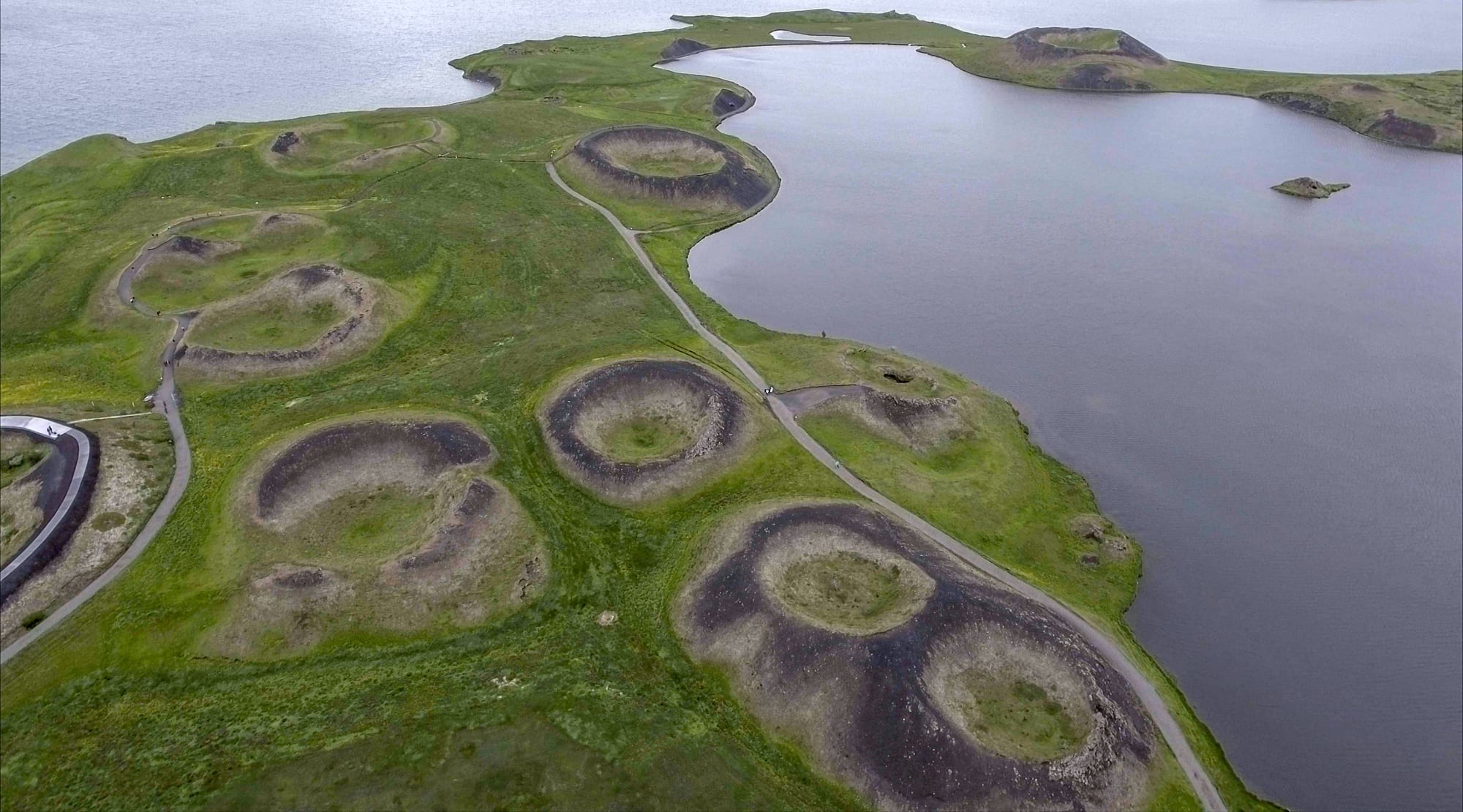
Aerial view of grassy pseudocraters with dark rims on a green headland in Lake Mývatn, linked by winding footpaths

Iceland

North Iceland

The Skútustaðir pseudocraters on the south shore of Lake Mývatn, formed when lava flowed over wet ground about 2,300 years ago. (Wojciech Strzelecki / Wikimedia Commons · CC BY-SA 4.0)

The northern third of Iceland, from the seal coasts and horse valleys of Húnaflói and Skagafjörður across the Tröllaskagi mountains to Akureyri on Eyjafjörður, the largest town outside the south-west, and east to the volcanic basin of Lake Mývatn, the whale-watching port of Húsavík and the Dettifoss canyon — drier and snowier than the south, and touching the Arctic Circle at Grímsey.

Explore North Iceland

History

Húsavík claims the first house in Iceland: the Swede Garðar Svavarsson wintered there around 870, before the settlement proper, and gave the bay its name. It was a northern chieftain, the lawspeaker Þorgeir of Ljósavatn, who ruled at the Althing in 1000 that Iceland should become Christian, and who by tradition threw his idols into the falls since called Goðafoss. The north received its own bishop at Hólar in Hjaltadalur in 1106, and for seven centuries Hólar was its capital in all but name: Iceland's first printing press was set up there around 1530, the first Icelandic Bible was printed on it in 1584, and its last Catholic bishop, Jón Arason, was beheaded in 1550 resisting the Reformation.

The Sturlung civil wars of the 13th century were fought largely in Skagafjörður, where the battle of Örlygsstaðir was fought in 1238. Húnaþing saw the country's last execution, in January 1830, when Agnes Magnúsdóttir and Friðrik Sigurðsson were beheaded for murder. Akureyri, a Danish trading post with twelve inhabitants when it was chartered in 1786, grew with the farmers' cooperatives that began in Þingeyjarsýsla in 1882 and came to run the north's trade. Hard winters and the ashfall of Askja's eruption in 1875 pushed thousands to emigrate to Canada and the United States, a story told at Hofsós.

Norwegian boats began landing herring at Siglufjörður in 1903, and within decades it was a town of some 3,000 people, living on a catch that in good years brought in a quarter or more of the country's export income; the herring vanished at the end of the 1960s and the town shrank by more than half. At Mývatn, farmers dynamited a dam on the Laxá in 1970 to protect the lake, and the Krafla fissures erupted nine times between 1975 and 1984.

Culture & Customs

Northerners regard their Icelandic as the clearest in the country: the harðmæli of Eyjafjörður and Þingeyjarsýsla keeps p, t and k hard and aspirated in the middle of words, where southerners soften them. Akureyri calls itself the capital of the north and keeps the institutions to match — the Hof culture house, an art museum in a former dairy, and the houses of two writers, the children's author Jón Sveinsson, "Nonni", and Matthías Jochumsson, the pastor who wrote the words of the national anthem. The town divides on football lines between KA and Þór.

Skagafjörður is horse country, the one district where horses are said to outnumber people, and its year turns on the autumn round-ups, when horses are driven down from the mountains and sorted. The district is also known for its choirs, its horsemanship and its gatherings.

Around Mývatn, farmers still collect duck eggs by an old rule that leaves at least four in every nest, and the thirteen Yule Lads of Icelandic folklore are said to live in the lava of Dimmuborgir with their mother Grýla and her husband Leppalúði. Siglufjörður holds a folk-music festival each July in the town of the pastor Bjarni Þorsteinsson, who collected many of the country's old folk songs. On Grímsey the islanders' devotion to chess so impressed the American scholar Willard Fiske that he sent the islanders supplies and left the island money in his will, without ever landing there.

Daily Life

Akureyri, with about 20,000 people, is by far the north's largest town. The rest are spread thinly: Sauðárkrókur (about 2,600) and Húsavík (about 2,400) are the only other towns of any size, followed by Dalvík, Siglufjörður, Blönduós and Ólafsfjörður, while Reykjahlíð, the village at Mývatn, has a few hundred people and Grímsey fewer than sixty.

Akureyri is the service centre for everything between the Westfjords and the east: the regional hospital, a university founded in 1987, an airport with flights to Reykjavík and seasonal services from Britain, and the offices of Samherji, one of Iceland's largest fishing companies, whose trawlers anchor the Eyjafjörður economy. Skagafjörður is run to a striking degree by its cooperative, Kaupfélag Skagfirðinga, which owns the dairy, the slaughterhouse and the shops. Elsewhere the work is sheep, dairy and horses, the Krafla and Þeistareykir geothermal power stations, and tourism, which has turned Húsavík from a fishing port into a whale-watching one and Mývatn into a village of hotels.

Winter sets the rhythm. Snow lies from November to April, children ski at Hlíðarfjall after school, the pass roads to Reykjavík and the east close several times a season, and the geothermal pool in every town is where people meet. Housing for seasonal workers at Mývatn and Húsavík, cruise-ship crowds in Akureyri and the slow emptying of the north-east corner around Raufarhöfn and Þórshöfn are the current worries.

Food

The north's kitchen runs on smoke and geothermal steam. At Mývatn rye dough is buried in the hot ground and dug up as dense hverabrauð, eaten with butter and smoked fish; in a land short of firewood, peat, dung and dried heather long served as fuel. Hangikjöt, smoked lamb, is eaten here as throughout Iceland, whose lamb is a point of national pride.

Laufabrauð, leaf bread, began here: paper-thin rounds cut into geometric patterns and fried, made by whole families as part of the Christmas preparations and now eaten throughout Iceland. Skyr, the soft yogurt-like cheese eaten across Iceland, is a staple here too.

Eyjafjörður is also craft-beer country: Kaldi has been brewed at Árskógssandur in the Czech tradition since 2006, and the brewery now has a beer spa beside it; Einstök is brewed in Akureyri; and Segull 67 brews in Siglufjörður. Siglufjörður's cafés serve pickled herring on rye, Húsavík's harbour restaurants the day's cod and haddock, and on Grímsey and Drangey guillemot eggs are still gathered from the cliffs each spring.

Attractions & Natural Wonders

Akureyri sits at the head of Eyjafjörður beneath snow-streaked mountains: the church of 1940 by Guðjón Samúelsson, the timber houses of the old town, the botanical garden, the Forest Lagoon baths across the fjord, and the ski lifts of Hlíðarfjall above. Ferries run to the quiet island of Hrísey from Árskógssandur, and from Dalvík to Grímsey, where a walk across the Arctic Circle passes puffin cliffs. North of Dalvík the road tunnels through the Tröllaskagi peninsula, a block of peaks over 1,000 metres high, by way of empty Héðinsfjörður to Siglufjörður, whose Herring Era Museum fills three harbour buildings, and continues round to the Hofsós swimming pool above the sea and the cathedral of 1763 at Hólar.

To the west, Skagafjörður offers the Glaumbær turf farm and boat trips to the bird island of Drangey, where the outlaw Grettir died; on the Vatnsnes peninsula beyond, seals haul out near the 15-metre sea stack of Hvítserkur.

East of Akureyri the Ring Road passes Goðafoss and reaches Lake Mývatn: the Skútustaðir pseudocraters, the lava towers of Dimmuborgir, the kilometre-wide Hverfjall crater, the Grjótagjá cave, the mud pots of Hverir below Námafjall, the Víti crater and still-warm lava of Krafla, and the Mývatn Nature Baths. Húsavík, to the north, is a centre of whale watching in Iceland, its boats meeting several species of whale on Skjálfandi bay, with a whale museum by the harbour and the GeoSea sea baths. The Diamond Circle continues to Ásbyrgi, a horseshoe canyon with 100-metre walls, and up the Jökulsárgljúfur gorge to Dettifoss, 44 metres high and 100 wide, reputedly the second most powerful waterfall in Europe after the Rhine Falls. Beyond lie the Arctic Henge at Raufarhöfn, the seabird cliffs of Langanes and, by summer 4x4 track, the Askja caldera and the table mountain Herðubreið.

Cities in North Iceland

Planning basics

Budget

Costs run a shade lower than in Reykjavík and the south, with two exceptions: beds around Mývatn and in Húsavík are few and expensive in July and August, and the big-ticket activities are all here — whale watching, super-jeep trips to Askja. Akureyri has hostels, guesthouses and the region's budget supermarkets, its town buses are free, and the geothermal baths at Mývatn, Húsavík and Akureyri cost well under the price of the Blue Lagoon. The Vaðlaheiði tunnel east of Akureyri charges a toll that is paid online; the old road over Víkurskarð is free and 16 kilometres longer.

Daily Budget Midrange
USD 290–490 (guesthouse or hotel, one restaurant meal a day, a hire car, a whale-watching trip or a geothermal bath)
Daily Budget Shoestring
USD 120–200 (hostel or campsite, supermarket food, buses or a shared hire car)

Akureyri has the widest choice of rooms; Mývatn and Húsavík can be visited from it as day trips when their own beds are full or overpriced.

Safety

Crime is scarcely a concern. The risks are natural: the rock at Dettifoss is slick with spray, and with ice in spring and autumn; at Hverir and Krafla the crust beside the marked paths can be thin over boiling mud; the water in the Grjótagjá cave grew too hot for bathing in the Krafla eruptions and is still close to 50°C; and the Tröllaskagi slopes avalanche, so ski touring calls for a guide and rescue gear. Winter driving is the main hazard, with whiteouts on the passes and on the plateau east of Mývatn, and the tracks to Askja involve river fords for proper 4x4s only. At sea off Húsavík it is cold even in July; the operators supply overalls.

Stay on the boardwalks in geothermal areas, keep back from the edge at Dettifoss, carry warm layers on whale-watching boats, and never drive past a closed-road barrier. Check current official travel advice before travelling.

Climate

The north is drier than the south, colder in winter and often warmer in summer. Akureyri, sheltered at the head of its fjord, receives much less precipitation than southern Iceland. Southerly winds bring clear skies and summer days above 20°C; northerlies bring fog, cold drizzle and, in winter, heavy snow off the Arctic Ocean. Snow lies in the towns from November to April, Mývatn freezes over, and the plateau east of the lake recorded -38°C in January 1918, among the lowest temperatures measured in Iceland. Grímsey, on the Arctic Circle, sees the midnight sun in June; Akureyri sees barely any sunshine from November to February.

Summer
10–15°C on average, with spells above 20°C inland under southerly winds; fog and 6–10°C on the outer coast under northerlies
Winter
-5 to 1°C in Akureyri with settled snow; -10°C and colder around Mývatn on still nights; blizzards close the passes

Transportation

Akureyri is about 390 kilometres from Reykjavík by the Ring Road, five hours' driving, longer by Strætó bus, or a short flight from Reykjavík's domestic airport; Akureyri airport also has seasonal international flights and onward services to Grímsey and the north-east. Strætó runs thin services from Akureyri to Siglufjörður, Húsavík and, via Mývatn, Egilsstaðir, but a hire car is needed for Dettifoss, Vatnsnes and the Arctic coast. Road 862 to Dettifoss from the west is paved; road 864 on the east bank is gravel and closed in winter. Ferries sail from Dalvík to Grímsey and from Árskógssandur to Hrísey.

In winter check road.is for Öxnadalsheiði, the pass between Akureyri and Skagafjörður, and for the plateau east of Mývatn before setting out; both close in storms.

Best Time to Visit

June to August for the full circuit: the Dettifoss roads and the highland tracks to Askja are open, whales are most numerous on Skjálfandi bay, puffins stay on Grímsey and Drangey until mid-August, and the sun barely sets. Mývatn's midges swarm in June and again in August — harmless, but a head net helps. September brings autumn colour, the horse round-ups and the first northern lights, and the north's clearer skies make it a better aurora bet than the south through to March. February to April is the ski season at Hlíðarfjall.