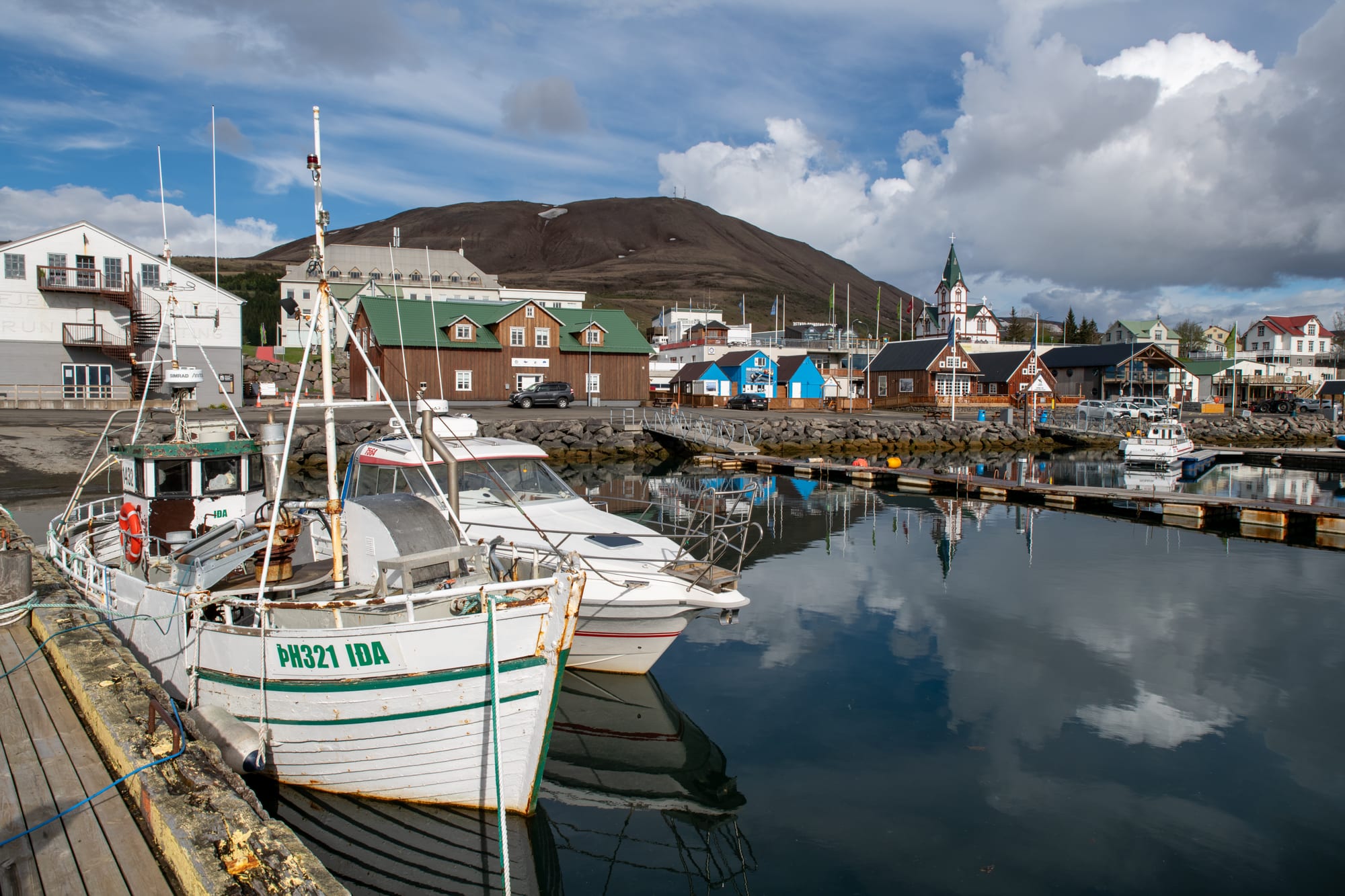
Fishing boats moored in Húsavík harbour, with timber houses and a bare hill behind

North Iceland, Iceland

Húsavík

The harbour at Húsavík, with Húsavíkurfjall behind the waterfront. (Hansueli Krapf / Wikimedia Commons · CC BY-SA 4.0)

A small fishing town on the eastern shore of Skjálfandi bay in North Iceland, named in the Book of Settlement as the place where the Swedish Viking Garðar Svavarsson wintered around 870. It is home to Iceland's oldest cooperative and has since become a centre of whale watching in Iceland, with a wooden church of 1907 above the harbour.

Neighbourhoods

  • The harbourfront
    • First-time visitors
    • Whale watching
    • Best for food

    The working harbour below the town, where the whale-watching boats leave from the quays beside the fishing fleet. The Whale Museum fills the town's old slaughterhouse here, and seafood restaurants occupy the timber buildings along the waterfront.

    Open in Maps
  • The town centre
    • Historic district
    • Museums
    • Close to the bus

    The main street, Garðarsbraut, runs along the slope just above the harbour, with the wooden Húsavíkurkirkja, the Exploration Museum and the town's shops close together. Everything is within a few minutes' walk.

    Open in Maps
  • The upper town
    • Quiet and residential
    • Views of the bay

    Streets of houses climb the slope towards Húsavíkurfjall, a hill 417 metres high on the eastern side of the town. From the higher streets the view runs across the bay to the Kinnarfjöll mountains on the far side.

    Open in Maps

Things to do

Landmarks and museums

  • Húsavíkurkirkjalandmark

    The wooden church built in 1907 by the Icelandic architect Rögnvaldur Ólafsson, the town's best-known landmark.

    Open in Maps
  • Húsavík Whale Museummuseum

    A non-profit museum founded in 1997 and housed since 2002 in the harbour's former slaughterhouse of 1931, with an exhibition on the ecology of whales.

    Open in Maps
  • The Exploration Museummuseum

    A museum of human exploration from the Vikings to the polar races and space, with photographs and objects from the Apollo astronaut training held near Húsavík in 1965 and 1967.

    Open in Maps
  • Húsavík Museummuseum

    The civic museum of culture and natural history, whose collection includes ancient boats and a stuffed polar bear that came ashore on Grímsey in 1969.

    Open in Maps

The bay and the sea

  • Whale watching on Skjálfandiattraction

    Boats leave the harbour for the bay, which whales of several species frequently enter; humpback and minke whales, white-beaked dolphins and harbour porpoises are among those seen, and puffins nest on the little island of Lundey.

    Open in Maps
  • GeoSea Geothermal Sea Bathsattraction

    Geothermal sea baths at Húsavík, opened in 2018.

    Open in Maps
  • Flateyattraction

    A low, flat island in the bay, left without residents since 1967, with only a few buildings, among them a schoolhouse of 1929 and a church; there is no ferry.

    Open in Maps

Short trips from the town

  • Tjörnesattraction

    The peninsula north of the town, between Skjálfandi and Öxarfjörður, known for its rock ptarmigan and its rich beds of Miocene and Pliocene fossils.

    Open in Maps
  • Ásbyrgipark

    A horseshoe-shaped canyon about 38 kilometres east of Húsavík, walled by cliffs up to 100 metres high, with birch woodland and a small lake inside; legend calls it the hoofprint of Odin's horse Sleipnir.

    Open in Maps
  • Dettifossattraction

    A waterfall 100 metres wide and 44 metres high on the Jökulsá á Fjöllum, reputed to be the second most powerful in Europe after the Rhine Falls.

    Open in Maps
  • Mývatnattraction

    A shallow lake created by a lava eruption 2,300 years ago, ringed by pseudocraters and lava pillars and known for its breeding ducks and summer midges.

    Open in Maps

Seasonal events

  • MærudagarJuly

    The 'Candy Days' town festival, held each year on the last weekend before the August bank holiday, which draws thousands of people from across Iceland for music, decorations, food and drink.

Eat and drink

Long-standing places and food districts in Húsavík. Hours, ratings and directions come from your maps app, always current.

Húsavík classics

  • Gamli Baukurrestaurant

    A restaurant in an old wooden building on the waterfront, known for fish and soups, with a small bar upstairs.

    Open in Maps
  • Naustiðrestaurant

    A simple seafood restaurant in a yellow house by the harbour.

    Open in Maps
  • Salkarestaurant

    A restaurant and pizzeria in a green house on the main road above the harbour.

    Open in Maps

Food on the harbour

  • Harbourfront restaurantsneighborhood

    The harbourside, where several of the town's restaurants stand in old timber and painted houses close to the boats, with fish and seafood as the speciality.

    Open in Maps

Experience Húsavík

History

According to the Landnámabók, the medieval Book of Settlement, Húsavík was the first place in Iceland settled by a Norseman. The Swedish Viking Garðar Svavarsson spent a winter here around 870, and when he sailed in the spring he left behind a man named Náttfari and two slaves, a man and a woman, who established a farm. The town's name means "bay of houses", probably a reference to Garðar's homestead, which may then have been the only house in the country.

In 1882 the town's cooperative society was founded, the oldest in Iceland. The wooden church, designed by Rögnvaldur Ólafsson, was completed in 1907. Fishing remained a mainstay, and until 2004 its harbour shipped the silica extracted from Lake Mývatn. In 1965 and 1967 American Apollo astronauts trained in the country near the town.

Whale watching later transformed the harbour. The Whale Museum opened in 1997 and moved into the old slaughterhouse in 2002, and Húsavík became a centre of whale watching in Iceland. In 2020 the town was the setting for the Netflix comedy Eurovision Song Contest: The Story of Fire Saga, whose song "Húsavík" was nominated for an Academy Award and performed on location in the town; residents reported a sharp rise in visitors, and a Eurovision museum opened in 2021. Regular flights to Reykjavík ended in 2024, after a new tunnel brought Akureyri within an hour by road.

Culture & Customs

Húsavík's public life turns on the sea and on the museums that explain it. The Whale Museum, the Exploration Museum — with its memorial to the Apollo astronauts outside — and the civic museum give a town of this size an unusual cultural weight, and the Eurovision museum plays on the fame the town gained from the 2020 film.

The year's great event is Mærudagar, the "Candy Days", held on the last weekend before the August bank holiday, when thousands of people from all over Iceland come for music, colourful decorations, food and drink. The town's football club, ÍF Völsungur, last played in the top division in 1988 but remains a focus of local loyalty, and the town has a music school with a brass band.

As in most Icelandic communities, the town has a heated pool, and swimming is hugely popular. Respect for the land, staying on paths and roads, is expected of visitors as much as of residents.

Daily Life

About 2,450 people lived in Húsavík in 2024, and it lies in Norðurþing municipality, with an upper secondary school, a primary school and a small airport that now handles only general aviation and medical flights. Income comes from tourism and fishing, as well as from retail and small industries.

The town climbs from the harbour up the slope towards Húsavíkurfjall, a hill 417 metres high on its eastern side, and from almost every street the view runs across the bay to the mountains of Kinnarfjöll; on a clear day Flatey is visible and sometimes Grímsey. The town has an outdoor public swimming pool, a nine-hole golf course and two gyms.

The light sets the rhythm of the year. The sun stays up through the night from 11 June until 29 June, and summer is the busy season, when the whale-watching boats run and the harbour fills with visitors. At the winter solstice there are less than three hours of daylight, and the town settles into a quieter pace of work, school and the pool.

Food

Húsavík eats from the bay and the hills. The harbour restaurants specialise in fish and seafood, and the quality of Icelandic lamb is a point of national pride. Traditional preserved foods remain part of the table: harðfiskur, fish dried by cold air and wind and traditionally eaten with butter, and hangikjöt, smoked lamb, a staple at Christmas.

Dairy gives skyr, which has the consistency of strained yogurt but a milder flavour and is classed as a fresh sour milk cheese. The everyday snack is the pylsa, a hot dog made from Icelandic lamb, pork and beef, served with raw and fried onion, ketchup, sweet brown mustard and remoulade. Kleinur, small knotted buns of fried dough, and snúður, a cinnamon roll usually topped with glaze or melted chocolate, are long-standing favourites at the bakery.

Beer and wine are served in the town's bars and restaurants; outside them, alcohol is sold only in the state shops. The supermarket is the place for picnic supplies before a day on the roads to the east.

Planning tools

Budget

Húsavík is as expensive as the rest of Iceland, and its beds are few and sought after in July and August, when the whale-watching season is at its height. A whale-watching trip and an evening at the sea baths are the main extra costs; a supermarket and the town pool keep the rest of the day affordable. Akureyri, about an hour away, has a much wider choice of rooms.

Daily Budget Midrange
USD 290–490 (guesthouse, one restaurant meal a day, a hire car, a whale-watching trip or the sea baths)
Daily Budget Shoestring
USD 120–200 (hostel or campsite, supermarket food, the bus or a shared hire car)

Book summer rooms early, or stay in Akureyri and come for the day; whale-watching operators typically supply wet-weather gear.

Best Time to Visit

June to August is the main season, when whales are seen on almost every trip, the sun stays up all night from mid to late June and the gravel road to the east side of Dettifoss is usually passable. Whale-watching boats sail from spring into autumn. Winter brings snow, very short days — under three hours of daylight at the solstice — and the chance of northern lights.

Suggested Number of Days

A day or two covers the town, its museums and a trip on the bay. Three or four days allow time for the lake district inland and the canyon country to the east. Weather at sea can cancel a sailing, so a spare day helps.

First Visit
1–2 days
With Surroundings
3–4 days

Transportation

The town itself is small enough to cover on foot, and there is no local public transport. Strætó bus 79 links Húsavík with Akureyri one to three times a day, but a hire car is needed for the peninsula, the canyon and the waterfalls beyond. Horse-riding tours run from a farm about 5 kilometres from town.

In winter check road.is before driving to or from Akureyri or Mývatn; snow and storms close mountain roads in the north.

Airport & Station Connections

Akureyri Airport, with domestic flights and seasonal international services, is about 75 kilometres away by road — around an hour's drive since the Vaðlaheiðargöng tunnel shortened the route. Húsavík's own airport, with a runway about 10 kilometres south-west of town, has had no scheduled flights since March 2025. Most visitors arrive by hire car or by bus from Akureyri.

Walkability

Very walkable: the harbour, the church, the museums, the main street and the pool lie within a few minutes of one another, and walking paths lead out of town and up the slopes behind. Winter brings snow and ice on the steeper streets, so good footwear matters.

Safety

Iceland has almost no violent crime and is one of the safest countries in the world. In Húsavík the risks come from the weather and the sea: it is cold and windy on the water even in July, and phones and cameras are easily dropped overboard. Winter driving on the roads out of town is the main hazard.

Dress warmly in layers for any sailing, keep a strap on cameras and phones at sea, and never drive past a closed-road barrier. Check current official travel advice before travelling.

Climate

Húsavík's climate is classed as either humid continental or oceanic, depending on the measure used, similar to much of coastal Iceland. The south coast of Iceland is generally warmer, wetter and windier than the north. The town has midnight sun from 11 June to 29 June.

Summer
across Iceland, warm summer days can reach 20–25°C, with continuous daylight in Húsavík from 11 June to 29 June
Winter
Iceland's northern lowland coast averages around −1°C in winter, with under three hours of daylight at the solstice

Local Customs

Tipping is not practised in Iceland, and verbal thanks for good service is the better gesture. Like most Icelandic communities, the town has a heated swimming pool, and swimming is hugely popular. Staying on marked paths and roads is expected everywhere, out of respect for the land. Dress is casual and practical.

Outside bars and restaurants, alcohol is sold only in the state shops, Vínbúðin, and the buying age is 20. The blood alcohol limit for drivers is 0.05 per cent.

Common Payment Methods

The currency is the Icelandic króna (ISK). Cards are accepted almost everywhere, including petrol stations and remote guesthouses, so there is little need to carry much cash.