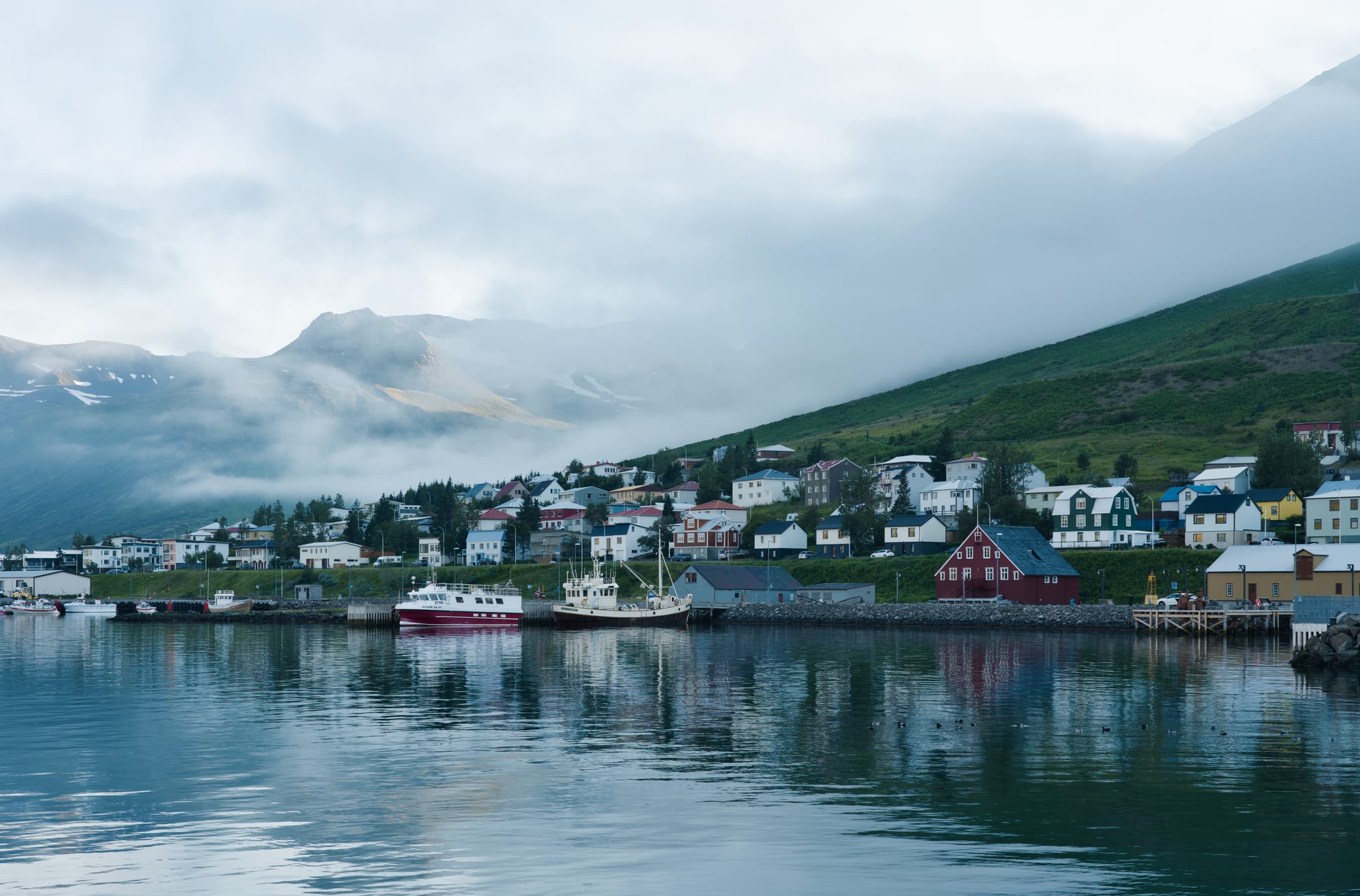
Painted houses and two fishing boats along Siglufjörður's waterfront, below a green slope and low mist on the mountains

North Iceland, Iceland

Siglufjörður

The town of Siglufjörður seen from the harbour on a misty evening. (ThibautRe / Wikimedia Commons · CC BY-SA 4.0)

A small fishing town in a narrow fjord at the northern tip of the Tröllaskagi peninsula, which grew from a hamlet into Iceland's herring capital after 1903 and has lost more than half its people since the herring vanished in the 1960s. Tunnels now link it to the rest of the north, and its award-winning Herring Era Museum, folk-music heritage and harbour draw visitors.

Neighbourhoods

  • The harbour and town centre
    • First-time visitors
    • Museums
    • Best for food

    The flat land by the harbour holds the buildings of the Herring Era Museum, the cafés and the town's shops. Everything is within a short walk.

    Open in Maps
  • The hillside streets
    • Quiet and residential
    • Views of the fjord

    Rows of houses climb the steep slope above the centre. The view runs down the narrow fjord to the open sea, and the longest walk across town is only a couple of kilometres.

    Open in Maps

Things to do

Museums and landmarks

  • Herring Era Museummuseum

    Iceland's largest maritime museum and the only Icelandic museum to have won the European Museum Award, opened in 1994 in Róaldsbrakki, a salting station abandoned after the herring collapsed, with a herring factory and a boathouse beside it.

    Open in Maps
  • Folk Music Centremuseum

    The town's oldest house, from 1884, opened in 2006 as a centre devoted to Bjarni Þorsteinsson, the pastor who collected Iceland's old folk songs, with historical musical instruments visitors may try.

    Open in Maps
  • Siglufjarðarkirkjalandmark

    The large church consecrated in 1932, with 400 seats, a 30-metre clock tower, an altar painting of the Last Supper from 1726 and coloured windows by Maria Katzgrau added in 1974.

    Open in Maps
  • Lífsbjörg memoriallandmark

    A memorial near the harbour, unveiled in 1988, to the 62 seamen from Siglufjörður lost at sea between 1900 and 1988.

    Open in Maps
  • Norwegian Seamen's Homelandmark

    A large wooden building of 1915, prepared in Haugesund in Norway, which housed Norwegian herring fishermen and treated the sick and injured; it is now a music school.

    Open in Maps

Walks and the fjords

  • Siglufjarðarskarðtrail

    The old mountain road over the pass above the town, the town's first road link and Iceland's highest mountain road, open in summer for hiking, horse riding and driving.

    Open in Maps
  • Héðinsfjörðurviewpoint

    The empty fjord between the two tunnels to Ólafsfjörður, where the road briefly emerges into daylight; the tunnels opened access to its mountain tracks and trout fishing.

    Open in Maps

Short trips from the town

  • Ólafsfjörðurattraction

    The neighbouring fishing town, joined to Siglufjörður in the municipality of Fjallabyggð and reached through the Héðinsfjörður tunnels, about 15 kilometres away.

    Open in Maps
  • Dalvíkattraction

    The main town of Dalvíkurbyggð on Eyjafjörður, beyond Ólafsfjörður and the one-lane Múli tunnel, from where ferries sail to Grímsey.

    Open in Maps
  • Hofsósattraction

    One of the oldest trading ports in northern Iceland, a village with walks along a shore of hexagonal basalt columns.

    Open in Maps

Seasonal events

  • Siglufjörður Folk Music FestivalJuly

    An annual festival of folk music in the town where the pastor Bjarni Þorsteinsson collected many of Iceland's old folk songs.

  • Síldarævintýrið (Herring Adventure)August bank holiday weekend, early August

    The town's herring festival, held every year to remember the herring era.

Eat and drink

Long-standing places and food districts in Siglufjörður. Hours, ratings and directions come from your maps app, always current.

Siglufjörður classics

  • Herring Cafecafe

    A café next to the Herring Era Museum.

    Open in Maps
  • Fish and Chips Siglufjörðurrestaurant

    A small restaurant on Aðalgata serving only fish and chips and fish stew.

    Open in Maps

Cafés and bars

  • Segull 67restaurant

    The town's own brewery, with a taproom.

    Open in Maps
  • Restaurants around the harbourneighborhood

    Beyond the cafés, the town's few restaurants include a Moroccan restaurant and a seafood dining room.

    Open in Maps

Experience Siglufjörður

History

The fjord belonged to the old district of Siglunes, named after the farm at its mouth, which was long the main estate of the area and a large fishing station. Trade began in the district in 1788, and Siglufjörður became a licensed trading place in 1818, when only eight people lived at the trading post itself. Before the herring came, the town was best known for shark fishing. In April 1919 an avalanche killed nine people in a small settlement on the east side of the fjord, one of several that took 18 lives in the district that spring.

Norwegians began fishing for herring off the north coast in 1903, and Icelanders soon followed. With its fine natural harbour close to the fishing grounds, Siglufjörður became the herring town: it had several herring factories, among them the largest in the country, and more than 20 salting stations at the height of the boom. The population grew from 146 in 1901 to about 3,000 in 1950, when it was the fifth-largest town in Iceland, and in some years herring exports from Siglufjörður made up more than a fifth of all Iceland's exports. Siglufjörður gained town status in 1918.

The catch failed for several years in the 1950s, and the herring vanished from the northern grounds in 1964 and from Icelandic waters altogether in 1968. The salting stations and factories closed, many people left, and trawlers, capelin and later shrimp processing took over. In 2006 the town merged with Ólafsfjörður to form Fjallabyggð, and in 2010 the Héðinsfjörður tunnels opened a year-round road east to Ólafsfjörður; until then the single-lane Strákagöng tunnel of 1967, to the west, had been the town's only road link open all year. In January 2021 an avalanche destroyed the town's ski area.

Culture & Customs

Siglufjörður's cultural life rests on two inheritances. The first is the herring: the Herring Era Museum, which opened in 1994 in a salting station abandoned after the collapse, has become Iceland's largest maritime museum and the only Icelandic museum to have won the European Museum Award, and every August bank holiday weekend the town remembers the boom years with its herring festival.

The second is folk music. Bjarni Þorsteinsson became parish priest in 1888 and served for half a century; he is remembered above all for collecting Iceland's old folk songs, many of them nearly forgotten, and publishing them between 1906 and 1909. A folk-music centre in his name opened in 2006, a hundred years after his collection first appeared, and a folk-music festival is held every July. Poetry has a home here too: Ljóðasetur Íslands, a centre for Icelandic verse, was opened in 2011 by the former president Vigdís Finnbogadóttir, and the poetry festival Glóð has been held every year since 2007.

The town has a second life on screen and on the page. Baltasar Kormákur's television series Trapped was filmed almost entirely here, and Ragnar Jónasson's Dark Iceland crime novels are set in the town.

Daily Life

About 1,165 people lived in Siglufjörður in 2024, far fewer than at the town's peak around 1950. Together with Ólafsfjörður, 15 kilometres away through the tunnels, it forms the municipality of Fjallabyggð. The town remains dependent on the fishing industries, and the government has tried to slow the decline in population by improving roads and promoting tourism; in recent years the fall has slowed.

The fjord is small and narrow, ringed by high, steep mountains, with very good natural shelter for boats but little flat land, so the town quickly ran short of room as it grew, and avalanche danger is high in many parts of the fjord. For most of its history nearly everything arrived by sea; the first road over the mountain pass was open only a few months of the year, and the tunnels have transformed daily life by making Akureyri an hour's drive away.

The year swings between extremes of light. The sun does not set from 9 June to 1 July, and the summer festivals bring crowds to the harbour. At the December solstice daylight lasts under three hours, and the town turns inward to work, school and the long winter.

Food

Herring built the town: salting it was the work of the old salting stations, and herring is still among the fish Icelanders eat most, alongside haddock, plaice, halibut and shrimp. One small restaurant on Aðalgata serves only fish and chips and fish stew. Before the herring era, the town was best known for shark fishing; fermented shark, hákarl, is most often served at the midwinter þorrablót feast.

Icelandic staples fill the rest of the table: hangikjöt, smoked lamb; harðfiskur, fish dried by cold air and wind and traditionally eaten with butter; and skyr, which has the consistency of strained yogurt but is classed as a fresh sour milk cheese. Laufabrauð, the thin patterned leaf bread fried at Christmas, began in the north and is still made by families in the weeks before the holiday.

Siglufjörður has its own brewery, Segull 67, with a taproom in the town. The town's handful of restaurants is broader than its size suggests, with seafood dining and even a Moroccan kitchen.

Planning tools

Budget

Siglufjörður costs much the same as the rest of North Iceland. Beds are limited and fill in summer and at festival weekends; a campground by the harbour serves camper vans. The Herring Era Museum ticket also covers the boathouse and the folk-music centre. Akureyri, about an hour away, has the region's widest choice of rooms and budget supermarkets.

Daily Budget Midrange
USD 290–490 (guesthouse or hotel, one restaurant meal a day, a hire car, museum tickets)
Daily Budget Shoestring
USD 120–200 (campsite or hostel, supermarket food, the bus or a shared hire car)

Book summer rooms early, above all for the festival weekends in July and early August.

Best Time to Visit

June to August, when the mountain tracks and the old pass road are open, the sun does not set from early June to the start of July, and the folk music and herring festivals fill the town. Winter is dark and snowy, with under three hours of daylight at the solstice, and avalanche danger on the slopes can close roads and paths.

Suggested Number of Days

One or two days are enough for the town and its museums. Three or four allow time for walks in the mountains and the other towns of the peninsula. In winter, allow slack for roads closed by snow.

First Visit
1–2 days
With Surroundings
3–4 days

Transportation

There is no bus system within the town, but none is needed: the longest walk across Siglufjörður is a little over two kilometres. Strætó bus 78 links the town with Akureyri. By car, road 82 through the Héðinsfjörður tunnels leads east towards Akureyri, and road 76 through the one-lane Strákagöng tunnel leads west towards Skagafjörður and the Ring Road.

Strákagöng is a single-lane tunnel; in winter check road.is before setting out, as snow closes the roads around the peninsula.

Airport & Station Connections

The nearest airport with scheduled flights is Akureyri, about an hour's drive away through the tunnels; the town's own small airfield has had no regular flights for many years. Most visitors come by hire car, either from Akureyri on road 82 or from the west on road 76, or by bus from Akureyri.

Walkability

Compact and easy on foot: the harbour, the museum buildings, the church, the cafés and the campground are a few minutes apart on flat ground, and only the upper streets are steep. Snow and ice make the slopes slippery in winter.

Safety

Iceland has almost no violent crime and is one of the safest countries in the world. In Siglufjörður the hazards are natural: the narrow fjord has a long history of avalanches, an avalanche destroyed the ski area in January 2021, and winter storms close the roads in and out. The mountain tracks are remote and the weather turns quickly.

Heed avalanche warnings and road closures, keep to marked trails in the mountains, and carry warm layers in any season. Check current official travel advice before travelling.

Climate

Across Iceland the south coast is generally warmer, wetter and windier than the north. Siglufjörður has midnight sun from 9 June to 1 July, and at the winter solstice about two hours and forty minutes of daylight.

Summer
across Iceland, warm summer days can reach 20–25°C, and the sun does not set in Siglufjörður from 9 June to 1 July
Winter
Iceland's northern lowland coast averages around −1°C in winter, with under three hours of daylight at the solstice

Local Customs

Tipping is not practised in Iceland, and verbal thanks for good service is the better gesture. Most Icelandic communities have a heated swimming pool and swimming is hugely popular, and respect for the land — staying on marked paths and roads — is expected of visitors. Siglufjörður still remembers its herring past and its folk-music heritage.

Outside bars and restaurants, alcohol is sold only in the state shops, Vínbúðin, and the buying age is 20. The blood alcohol limit for drivers is 0.05 per cent.

Common Payment Methods

The currency is the Icelandic króna (ISK). Cards are accepted almost everywhere, including petrol stations and remote guesthouses, so there is little need to carry much cash.