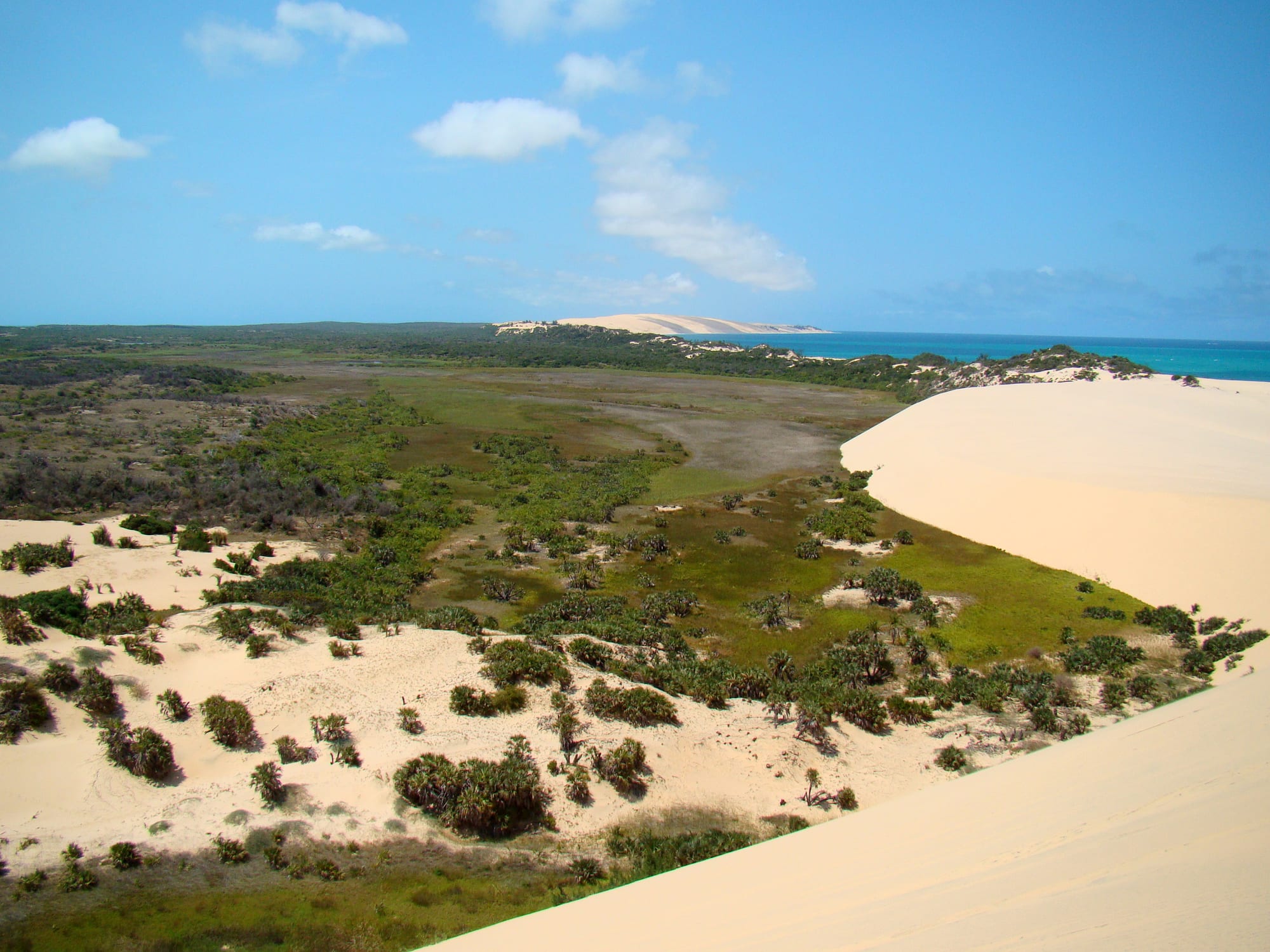
Tall pale sand dunes and green marshy hollows with palms, running towards a turquoise sea under blue sky

Mozambique

Maputo & the South

Dunes and freshwater hollows near the southern end of Bazaruto Island, looking north along the east coast. (Bjørn Christian Tørrissen / Wikimedia Commons · CC BY-SA 3.0)

Mozambique's southern third, from the capital Maputo and the South African border up the Limpopo valley and along the Indian Ocean coast of Gaza and Inhambane to Vilankulo — the country's most developed region and its main beach coast, with Tofo's whale sharks, the Bazaruto islands and Ponta do Ouro.

Explore Maputo & the South

History

Bantu-speaking farmers settled the south in the first millennium AD, and by the time Portuguese ships arrived the coast was home to Tsonga, Chopi and Tonga chiefdoms trading with Swahili and Arab merchants. Vasco da Gama put in at Inhambane in 1498 and called the area the land of good people, and Portuguese traders later worked Delagoa Bay, where the explorer Lourenço Marques gave his name to the settlement that became Maputo.

In the nineteenth century Nguni invaders from the south founded the Gaza kingdom under Soshangane, which came to dominate much of southern and central Mozambique. Its last ruler, Ngungunhane, was defeated by Portuguese forces in 1895 and exiled to the Azores. Lourenço Marques grew rapidly after a railway to the Transvaal opened in the 1890s, becoming the colony's capital in 1898 and a port for South Africa's mines, while southern men went by the thousands to work underground there.

The south produced FRELIMO's leaders: Eduardo Mondlane and Samora Machel were both born in Gaza province. At independence in 1975 Lourenço Marques was renamed Maputo. During the 1977–92 civil war between the government and Renamo, the southern countryside suffered attacks on villages and roads, including a massacre at Homoíne in Inhambane in 1987. The Limpopo floods of 2000 devastated Chókwè and Xai-Xai. Since the peace, Maputo has boomed, and after the disputed 2024 election its streets saw deadly protests and clashes with the security forces.

Culture & Customs

The south is Tsonga country in the broad sense: Changana is spoken across Gaza and Maputo Province, Ronga around the capital, Chopi in the Zavala and Inharrime districts of Inhambane, and Bitonga around Inhambane town. A century of migrant work in South Africa means many southerners speak some English or Zulu, follow South African football and music, and have relatives across the border.

The Chopi timbila orchestras, groups of wooden xylophones playing long composed suites with dancers, are recognised by UNESCO as intangible heritage and are rooted in the Zavala district. Marrabenta, the guitar-based dance music developed in Lourenço Marques in the 1930s and 1940s, remains Maputo's signature sound, alongside pandza and hip-hop. Maputo is also the country's arts capital, home to the painter Malangatana, whose murals and paintings still appear around the city, and to theatre groups and galleries.

Christianity dominates, from Catholic cathedrals to evangelical and Pentecostal churches, and ancestral ceremonies remain important. Lobolo, the bride-wealth negotiation between families, is still central to marriage.

Daily Life

About six million people live in the south. Maputo has about 1.1 million residents and its neighbour Matola about a million more, together the country's largest urban area; Xai-Xai, Chókwè, Inhambane, Maxixe and Vilankulo are the main provincial towns.

The Maputo corridor is the core of Mozambique's formal economy: the port, the railway and toll road to South Africa, the Mozal aluminium smelter outside Maputo, breweries, banks and the government. Irrigated farming around Chókwè in the Limpopo valley, cashew and coconut groves in Inhambane, fishing, and tourism on the coast support the rest, and money sent home by workers in South Africa matters to many families.

Maputo's day runs from crowded chapas and markets at dawn to the cafés of the Baixa and evenings on the Marginal seafront. Unemployment among the young and the cost of living were among the grievances behind the 2024–25 protests, and crime in the fast-growing suburbs is a constant worry.

Food

The southern table is built on the sea and the coconut. Prawns are a coastal favourite, grilled with garlic and piri-piri or cooked in coconut sauces, along with crab, clams and grilled line fish sold in the city's markets. Matapa, cassava leaves stewed with ground peanuts, onions and tomatoes, sometimes with prawns, is eaten across the south, usually with rice or xima, the stiff maize porridge.

Frango à piri-piri, chicken grilled with a hot chilli, garlic and lemon sauce, is everywhere from roadside grills to restaurants, and chamussas, the Mozambican version of the samosa, are café staples. Inhambane's coconut and cashew groves supply the coastal kitchens, and cashew nuts are sold in its markets.

The south's beers, 2M and Laurentina, are brewed in Maputo, and Laurentina takes its name from the city's colonial name.

Attractions & Natural Wonders

Maputo rewards a few days: the domed railway station of 1910, the prefabricated Iron House, the Fortaleza, the Art Deco and modernist buildings of the Baixa and Polana, and the central market, with Inhaca Island a boat ride away. South, over the bridge to Katembe, Maputo National Park protects coastal lakes, forest and elephants, and Ponta do Ouro's beaches sit beside the park's protected marine area, known for dolphins and diving.

Up the coast in Gaza, Xai-Xai and the lagoon at Bilene are weekend escapes from the capital. Inhambane town, one of the oldest settlements on the coast, has colonial houses, a cathedral and a waterfront, and nearby Tofo and Barra are the south's diving centre, where whale sharks and manta rays are the great draw and humpback whales pass in winter.

Further north, Vilankulo is the gateway to the Bazaruto Archipelago, a national park of dune islands — Bazaruto, Benguerra, Magaruque, Santa Carolina and Bangué — with coral reefs, dugongs and turtles. Inland, Limpopo National Park, joined to South Africa's Kruger and Zimbabwe's Gonarezhou in the Great Limpopo Transfrontier Park, offers remote bush camping, 4x4 trails and the Massingir dam, with Zinave and Banhine parks further north.

Cities in Maputo & the South

Planning basics

Budget

The south is the easiest part of Mozambique to travel on a budget, with backpacker lodges in Tofo, Vilankulo and Ponta do Ouro and cheap chapa minibuses along the EN1. Maputo's hotels and restaurants are priced for business visitors, and the Bazaruto island lodges are among the most expensive stays in the country. Diving, boat trips and park fees add up.

Daily Budget Midrange
USD 100–280 (beach lodge or city hotel, seafood dinners, a dive or ocean safari)
Daily Budget Shoestring
USD 35–60 (backpacker lodge, market food, chapas)

Rand is widely accepted near the border and US dollars at lodges, but carry meticais for chapas, markets and fuel.

Safety

The south is well away from the northern conflict. In Maputo and Matola, muggings, bag snatching and occasional carjackings are the main risks, especially after dark, and the post-election protests of late 2024 and early 2025 reached the capital's streets, with roadblocks and deadly clashes. On the coast, the EN1's traffic, rip currents and theft from beach lodges and cars need care.

Avoid walking in Maputo at night, keep away from demonstrations, and swim only where local advice says it is safe. Check current official travel advice before travelling.

Climate

The south is the driest and least tropical part of Mozambique. Maputo and the coast have hot, humid summers and mild, sunny winters, while inland Gaza, around the Limpopo valley, is hot and semi-arid. The Inhambane coast is warmer and wetter and occasionally hit by cyclones, though less often than the centre.

Summer
hot and humid, November–April, often above 30°C, with heavy downpours and occasional cyclones on the Inhambane coast
Winter
dry and pleasant, May–August, around 25°C by day, with cool nights inland and in Maputo

Transportation

Maputo's airport has regional and domestic flights, and Inhambane and Vilankulo have airports for the beaches and Bazaruto. The EN1 runs north along the coast; Maputo to Tofo is a long day by road. The bridge to Katembe has shortened the drive to Ponta do Ouro. Bazaruto is reached by boat from Vilankulo, and Limpopo National Park by 4x4, often through the Giriyondo border from Kruger.

Drive only in daylight, carry vehicle papers for police checks, and use a 4x4 on the sand roads to Ponta do Ouro and the beach lodges.

Best Time to Visit

May to November brings dry, sunny weather and calmer seas. Humpback whales pass the coast in the southern winter, and whale sharks are seen off Tofo for much of the year, most reliably in the warmer months. December and January are busy with South African holidaymakers, and the peak of the wet season brings heat and storms.