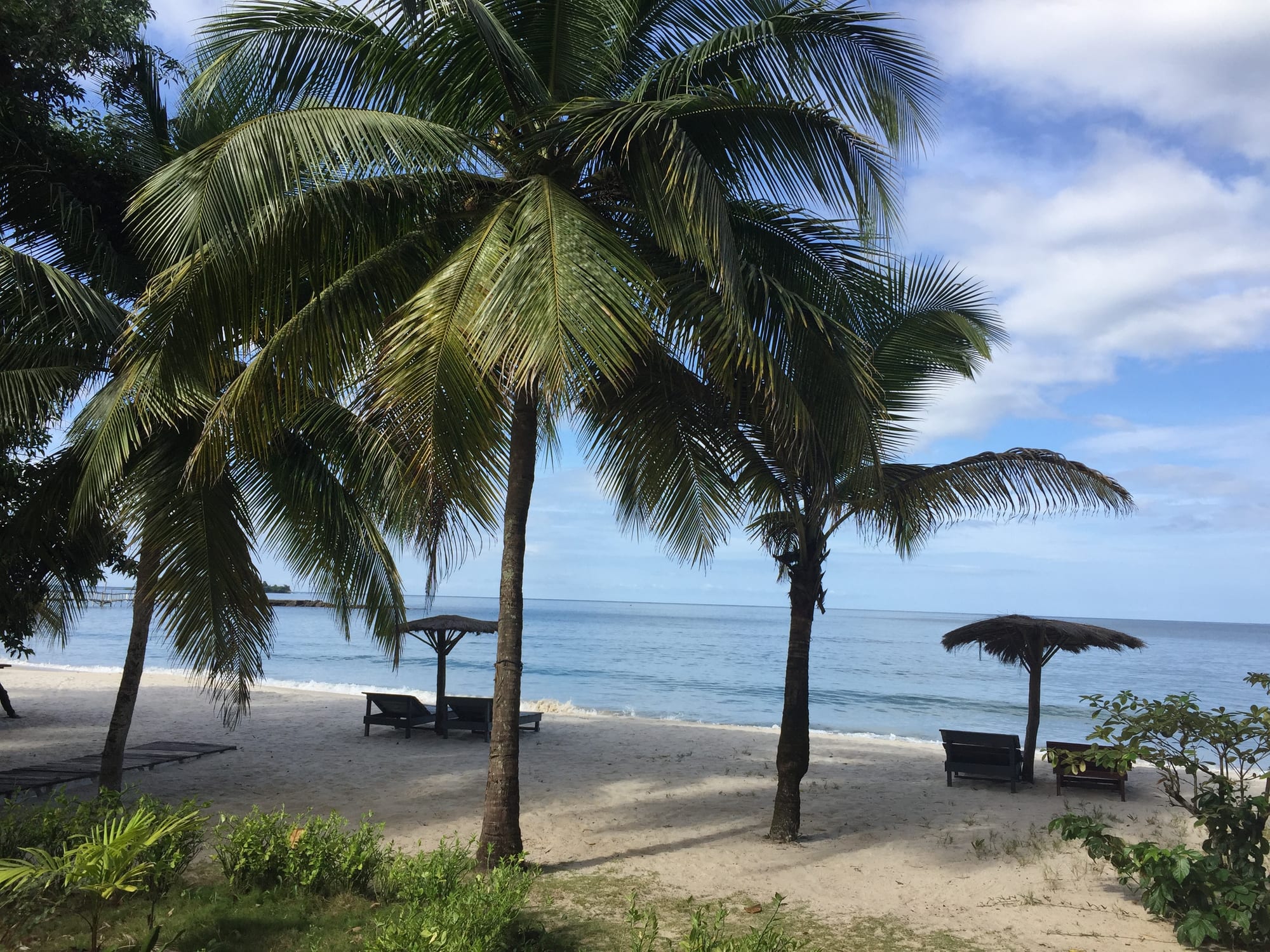
Coconut palms and thatched sunshades on a sandy beach, with a calm blue sea under scattered cloud

Sierra Leone

Freetown & the North

Tokeh Beach, one of the beaches of the Freetown peninsula. (Lars Bessel / Wikimedia Commons · CC BY-SA 4.0)

The western and northern half of Sierra Leone, running from the mountainous Freetown peninsula and its beaches up through the Temne and Limba heartlands around Port Loko and Makeni to the savanna and hills of the Guinea border, where Mount Bintumani rises in the Loma Mountains.

Explore Freetown & the North

History

The Freetown peninsula was home to Temne and Bullom-speaking peoples when Portuguese sailors named its mountains Serra Leoa in the 15th century. In 1787 British abolitionists landed a first group of settlers, most of them poor Black Londoners, and in 1792 some 1,100 Black Loyalists from Nova Scotia — Africans who had sided with Britain in the American Revolution — founded Freetown. Jamaican Maroons followed in 1800, and after 1808, when Freetown became a Crown colony, the Royal Navy landed tens of thousands of Africans freed from slave ships there. From this mix grew the Krio people and their language.

Freetown became a centre of Western education in West Africa, with Fourah Bay College, founded in 1827, training clergy and teachers for much of the coast. The north stayed under Temne, Limba, Loko, Susu and other rulers until Britain declared a protectorate over the hinterland in 1896. A new house tax sparked the Hut Tax War of 1898, in which the Temne leader Bai Bureh fought British forces around Port Loko for months; he is now a national hero.

After independence the north became the heartland of the All People's Congress party. The civil war of 1991–2002 reached much of the country, and in January 1999 AFRC and RUF forces attacked Freetown, where over 7,000 people were killed, at least half of them civilians. In recent years the capital has faced floods, the 2017 mudslide at Regent, and the loss in 2023 of the old Cotton Tree, which fell in a storm.

Culture & Customs

Freetown is the home of Krio culture: the language, spoken as a first language by a small community but as the lingua franca across the country, the steep-roofed wooden board houses, the church and lodge life, and the awujoh feast for the ancestors. Families of settler descent still trace their roots to Nova Scotia, Jamaica or the recaptive villages of the peninsula such as Regent, Gloucester and Wellington.

The north belongs mainly to the Temne, the country's largest group together with the Mende of the south, and to the Limba, Loko, Susu, Koranko, Yalunka, Fula and Mandingo. Islam is stronger here than in the south, and the north's towns keep Eid with large public prayers, though Christians and Muslims mix freely. The Poro and Bondo societies remain powerful in rural communities, and paramount chiefs still carry real authority.

Freetown's streets fill for Christmas street parades, society masquerades and football. Politics has a regional edge: the north and west lean towards the All People's Congress, while the south and east favour the Sierra Leone People's Party, and election seasons can be tense.

Daily Life

Freetown holds well over a million people, packed between the mountains and the estuary. The day starts early to beat the traffic along the few roads between the east end, the central business district and the western suburbs of Aberdeen, Lumley and Hill Station. Markets, street trading and small businesses keep most households going, while ministries, aid agencies, the port and mining companies provide formal jobs. Informal settlements have spread up the hillsides and along the shore, and flooding, water shortages and power cuts are constant concerns.

Makeni, with about 85,000 people, is the north's commercial hub and a growing university town; Port Loko, capital of the North West province created in 2017, and Kabala in the hills near the Guinea border are much smaller. Iron-ore mining around Tonkolili and Lunsar, the Bumbuna hydroelectric dam and large-scale farming schemes have brought investment and disputes over land. Most people in the north farm rice, cassava and groundnuts, and many young men work as okada riders.

Food

Freetown eats from every corner of the country, and Krio cooking gives it its own flavour. Cassava leaf and potato leaf plasas over rice are daily staples, while Krio families serve jollof rice, fufu with okra or bitterleaf soup, and awujoh dishes such as black-eyed beans and akara fritters. Grilled barracuda, fried bonga fish and lobster come from the peninsula villages, especially Tombo and the beach bars of Lumley and River No. 2.

Street stalls sell binch akara, roasted groundnuts, and fried plantain. In the north groundnut stew is a staple, and cattle-herding Fula communities bring milk and sour milk to the markets. Ginger beer and poyo palm wine are the drinks of the street.

Attractions & Natural Wonders

Freetown itself has the National Museum, the Krio board houses of the older neighbourhoods, the King's Yard Gate through which freed Africans entered the city, the site of the Cotton Tree beside the museum, and views from Leicester Peak. In the forested hills above the city, within the Western Area Peninsula National Park, the Tacugama Chimpanzee Sanctuary cares for rescued chimpanzees and offers guided visits and forest walks.

The beaches of the Freetown peninsula run south from Lumley: Sussex, River No. 2 with its creek and white sand, Tokeh, and Bureh, the country's surfing beach. Kent, at the peninsula's tip, is the jumping-off point for the Banana Islands, with old settler villages.

Inland, Makeni is the base for the north, with its markets and university. In the far north-west, Outamba-Kilimi National Park protects savanna and forest near the Guinea border, with hippos, chimpanzees and other primates, over a hundred bird species and forest elephants. In the north-east, the Loma Mountains culminate in Mount Bintumani, at about 1,945 metres the highest point in Sierra Leone, reached on a multi-day trek from villages near Kabala and Koinadugu; the hills around Kabala offer easier walks.

Cities in Freetown & the North

Planning basics

Budget

Freetown is by far the most expensive place in Sierra Leone: hotels, restaurants and imported goods along Lumley and Aberdeen are priced for aid workers, mining staff and business visitors. The peninsula beaches have simple community-run huts as well as pricier lodges. Makeni and the northern towns are much cheaper, though comfortable rooms are scarce, and trips to Outamba-Kilimi or Bintumani need a vehicle, a guide and supplies.

Daily Budget Midrange
USD 100–220 (Freetown hotel, restaurants, a car with driver for beach and upcountry trips)
Daily Budget Shoestring
USD 30–55 (guesthouse or beach hut, local chop bars, poda-podas and shared taxis)

Carry enough cash in leones (SLE) for trips beyond Freetown, where ATMs are few and cards rarely work.

Safety

The north and the capital are peaceful. The main risks are petty theft and bag snatching in crowded parts of Freetown and on Lumley beach at night, road accidents on the highways and with okadas, strong rip currents off the peninsula beaches, and flooding and landslides in the rainy season. Malaria is widespread.

Swim only where locals do and never alone, avoid night driving between towns, and take malaria precautions. Check current official travel advice before travelling.

Climate

Hot and humid all year, with one long rainy season from about May to October. Freetown and the peninsula mountains catch some of the heaviest rain in West Africa, with torrential downpours in July and August that cause floods and landslides. The north is drier and more seasonal, with the dusty harmattan wind from December to February; the hills around Kabala and the Loma Mountains are noticeably cooler at night.

Summer
the wet season, about 24–30°C, with very heavy rain on the peninsula in July and August
Winter
the dry season, 25–33°C, hazy with harmattan dust inland and hottest in March and April

Transportation

Lungi International Airport lies across the Sierra Leone River estuary from Freetown, linked by sea-coach and water taxi or by a long drive round by road. Paved highways run from Freetown to Port Loko, Makeni and Kabala, and shared taxis and poda-poda minibuses serve the main towns. Freetown's traffic is heavy, and okada motorbike taxis fill the gaps. Outamba-Kilimi and the Loma Mountains need a four-wheel-drive vehicle, especially in the rains.

Freetown to Makeni takes roughly three hours by road; allow extra time to cross the city at rush hour.

Best Time to Visit

November to April is the dry season and the best time for the beaches, road travel upcountry and the Bintumani trek; December to February is the most comfortable, though harmattan haze can dull the views. The rains from June to September make northern roads slow and trails muddy, but the peninsula is at its greenest and quietest.