Culture & Customs · Singapore
Singapore: Red Packets and Green Packets
Chinese, Malay, Indian and Eurasian traditions sharing one small island, a calendar of festivals kept by everyone, manners built on face and harmony, and laws that visitors notice quickly
By Globeway Editorial · 30 September 2026
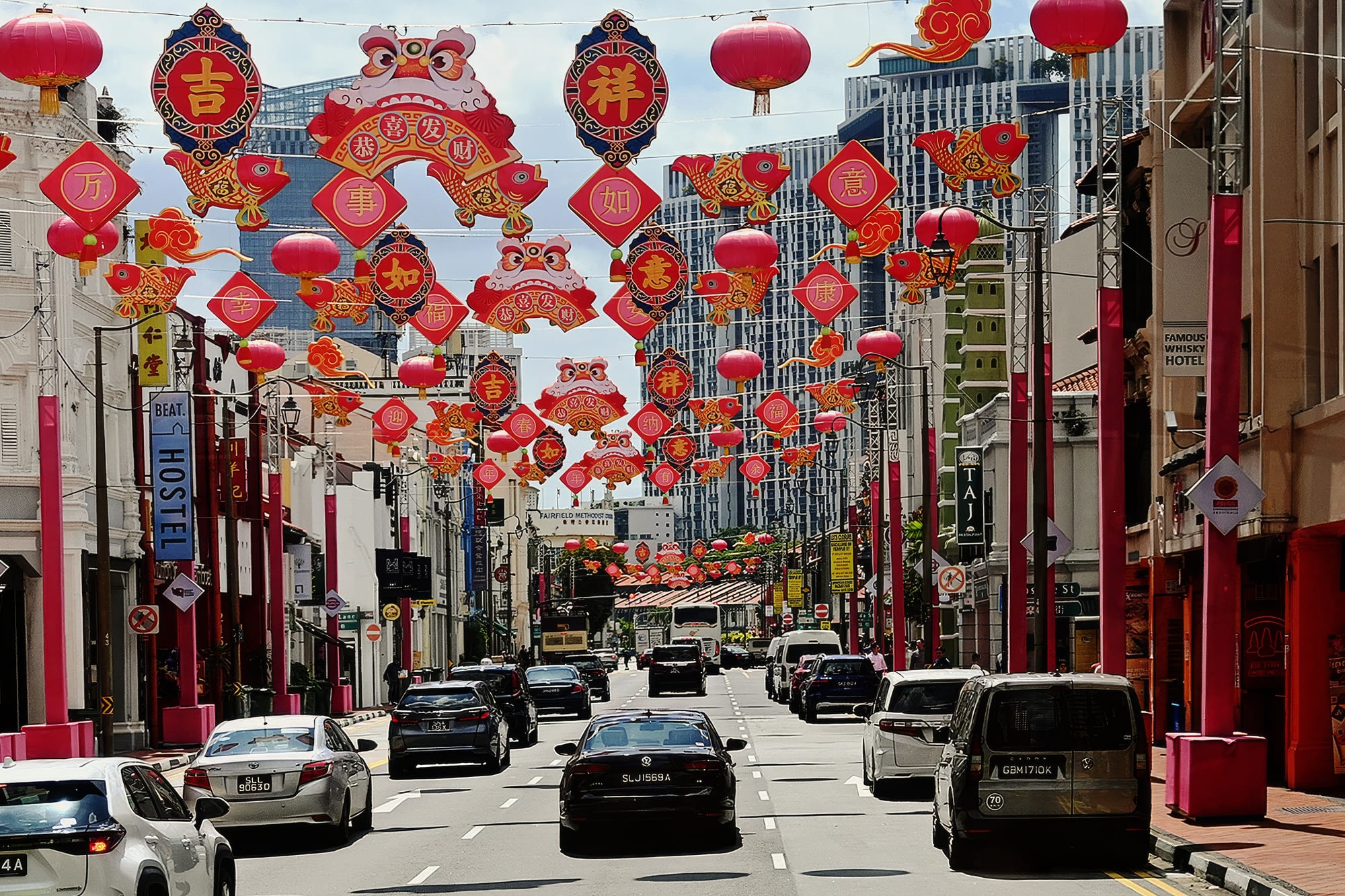
On the first morning of Chinese New Year, a family arrives at the door of a relative's flat. Shoes come off at the threshold, greetings are exchanged, and two mandarin oranges are offered with both hands; before the visitors leave, two different oranges are handed back. The children, and any unmarried younger relatives, are given red packets of money. When Hari Raya comes round, the Malay family along the corridor will hand out green packets of their own, a custom that echoes the red ones. In a country of several peoples and many faiths, customs travel between communities as easily as neighbours do, and the courtesies that keep daily life smooth are shared by almost everyone.
Faith, identity and values
Singapore has no majority religion, and by some measures it is the most religiously diverse society in the world. The 2020 census counted about 31 per cent of residents as Buddhist, 19 per cent Christian, 16 per cent Muslim, 9 per cent Taoist and 5 per cent Hindu, with a fifth reporting no religion. Christianity has roughly doubled its share since 1980, while the share identifying as Taoist has declined. Belief often crosses boundaries: many Chinese Singaporeans take part in Hindu festivals such as Deepavali and give money to Hindu temples.
This diversity is guarded carefully. The Maintenance of Religious Harmony Act of 1990 exists to keep religion out of politics and prevent it being used to stir up conflict, and racial and religious harmony is treated by the state as a matter of national security. Every 21 July, schools mark Racial Harmony Day, introduced in 1997 to remember the communal riots between Malays and Chinese that broke out on that date in 1964 during a procession for the Prophet's birthday. Pupils come to school in the traditional costumes of Singapore's different communities, and try one another's food and games.
The population is roughly three-quarters Chinese, with substantial Malay and Indian communities and smaller groups, including Eurasians, and there are four official languages. Common values run across all of them. Harmony and consensus are prized, and so is face, a person's reputation and dignity, which people take care to protect in themselves and others. Filial piety runs deep: elders are honoured, and since 1996 the law has even allowed parents to seek financial support from their adult children. Meritocracy, the belief that effort and education rather than background should determine success, is close to a national creed, and the self-mocking word kiasu, "afraid to lose", captures the competitive streak that comes with it.
Greetings and meeting people
A handshake is the usual greeting, generally light and held a little longer than in many Western countries; older people sometimes place a second hand on the other person's wrist. Some Malay and Indian Singaporeans prefer not to shake hands with someone of the opposite sex, so it is courteous to wait for a hand to be offered. A familiar traditional greeting is "Have you eaten yet?" — a ritual pleasantry rather than a real question, to which "Yes, thank you" is the right answer.
Communication tends to be indirect and quiet. Raising the voice or showing anger in public is seen as rude, and a direct "no" is often avoided, so a hesitant reply may mean a polite refusal. Pausing before answering is a sign of thought, not awkwardness. Pointing with the index finger is impolite; people gesture with the whole hand or a nod instead. Touching someone's head is offensive, and public displays of affection are often frowned upon. Criticising someone in front of others, or asking a Eurasian Singaporean to explain their racial make-up, can cause real embarrassment.
Hospitality and being a guest
Shoes are normally removed before entering a home. A guest is expected to bring a small gift, well wrapped and presented with both hands, and the host will usually set it aside to open later rather than unwrapping it in front of the giver. The right gift depends on the host's background. For Chinese Singaporeans, clocks, sharp objects, handkerchiefs, umbrellas, mirrors, green hats and yellow or white flowers carry unlucky associations. For Malay Muslims, anything containing alcohol or pork is unsuitable, and for Hindu Indians, leather goods and alcohol are best avoided. Gifts are both given and received with two hands.
At the table, guests wait for the host to invite them to begin. Chopsticks should never be left standing upright in a bowl, and leaving a little food on the plate signals that the host has provided more than enough, whereas a clean plate can suggest the opposite. Many Malays avoid pork and many Indians avoid beef, so shared meals are planned with care. Outside the home, hawker centres serve as the country's community dining rooms, where people of every background and income eat side by side; the tradition was added to UNESCO's list of intangible cultural heritage in 2020.
Festivals and life's big moments
The public holidays read like a map of the population: New Year's Day, two days of Chinese New Year, Hari Raya Puasa and Hari Raya Haji, Good Friday, Vesak Day, Deepavali and Christmas, as well as Labour Day and National Day on 9 August. Chinese New Year opens with a reunion dinner on the eve, when families gather round the table. On the first day, relatives visit one another bearing pairs of mandarin oranges, symbols of togetherness and good fortune, and married people give red packets of money, in even amounts, to their unmarried younger relatives. Over the festive season comes lo hei, the noisy tossing of a raw fish salad with wishes for the year ahead, and the festivities end on the fifteenth day. Sweeping the floor on the first day is avoided, for fear of sweeping away good luck.
At Hari Raya Puasa, which ends the fasting month of Ramadan, younger family members kneel before their elders, touch their forehead to the elder's hand and ask forgiveness with the words "maaf zahir dan batin", seeking pardon "in body and spirit". Families visit relatives, starting with the eldest, and green packets are given to children, guests and elders.
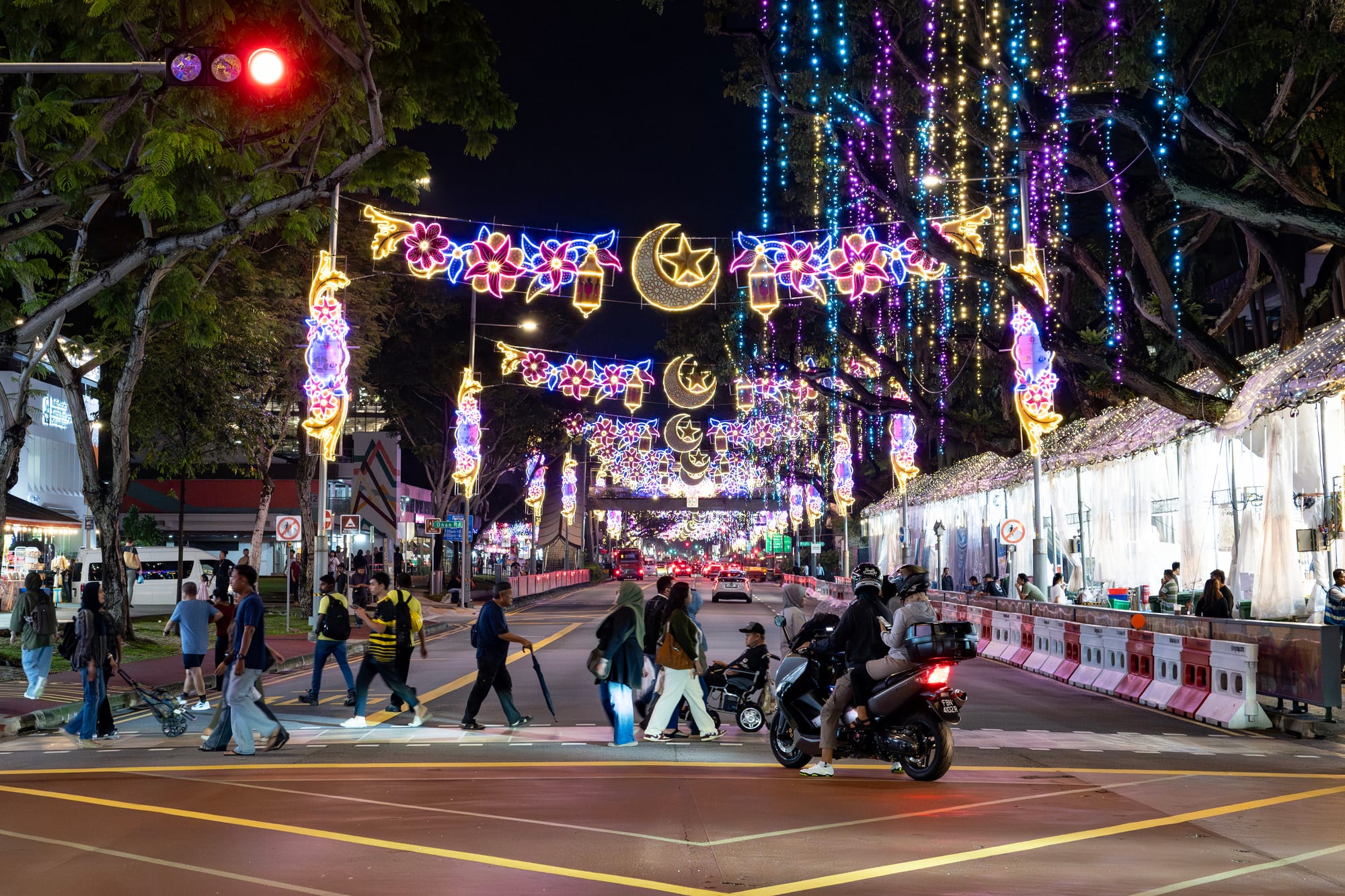
Deepavali, the Hindu festival of lights, begins for many South Indian families with an oil bath before dawn, the eldest member of the household touching oil to the foreheads of the others. Lamps are lit at doorways to draw good fortune into the home, and kolam, intricate patterns of rice powder, often coloured for the festival, are laid on the ground at the entrance, doubling as food for birds and insects. Younger family members bow before their elders to receive blessings. Thaipusam, in honour of the Hindu god Murugan, brings a foot procession of three to four kilometres between two temples, in which devotees fulfil vows by carrying milk pots or kavadi, decorated frameworks borne on the shoulders, some of them attached to the body with piercings. In the seventh lunar month, the Chinese Zhong Yuan or Hungry Ghost Festival sees offerings and paper goods burned for wandering spirits, and open-air getai concerts and Chinese opera staged as entertainment for them.
Life's milestones follow each community's traditions. Chinese families mark a baby's first month with a feast and red-dyed eggs; Malay families may hold a hair-shaving ceremony on the seventh day; and among Indian families, the valaikaapu bangle ceremony blesses a mother-to-be in the later months of pregnancy. A Malay wedding centres on the akad nikah, the religious solemnisation, and the bersanding, when the couple sit in state on a decorated dais like a king and queen for the day, the groom arriving to the beat of the kompang hand drum. Once held in village compounds and later in the open ground floors of public housing blocks, such receptions are now also staged in hotels and gardens. At a Chinese funeral wake, which usually lasts several nights, mourners give condolence money in a plain white envelope — never in a red packet, the colour of celebration.
Arts, crafts and music
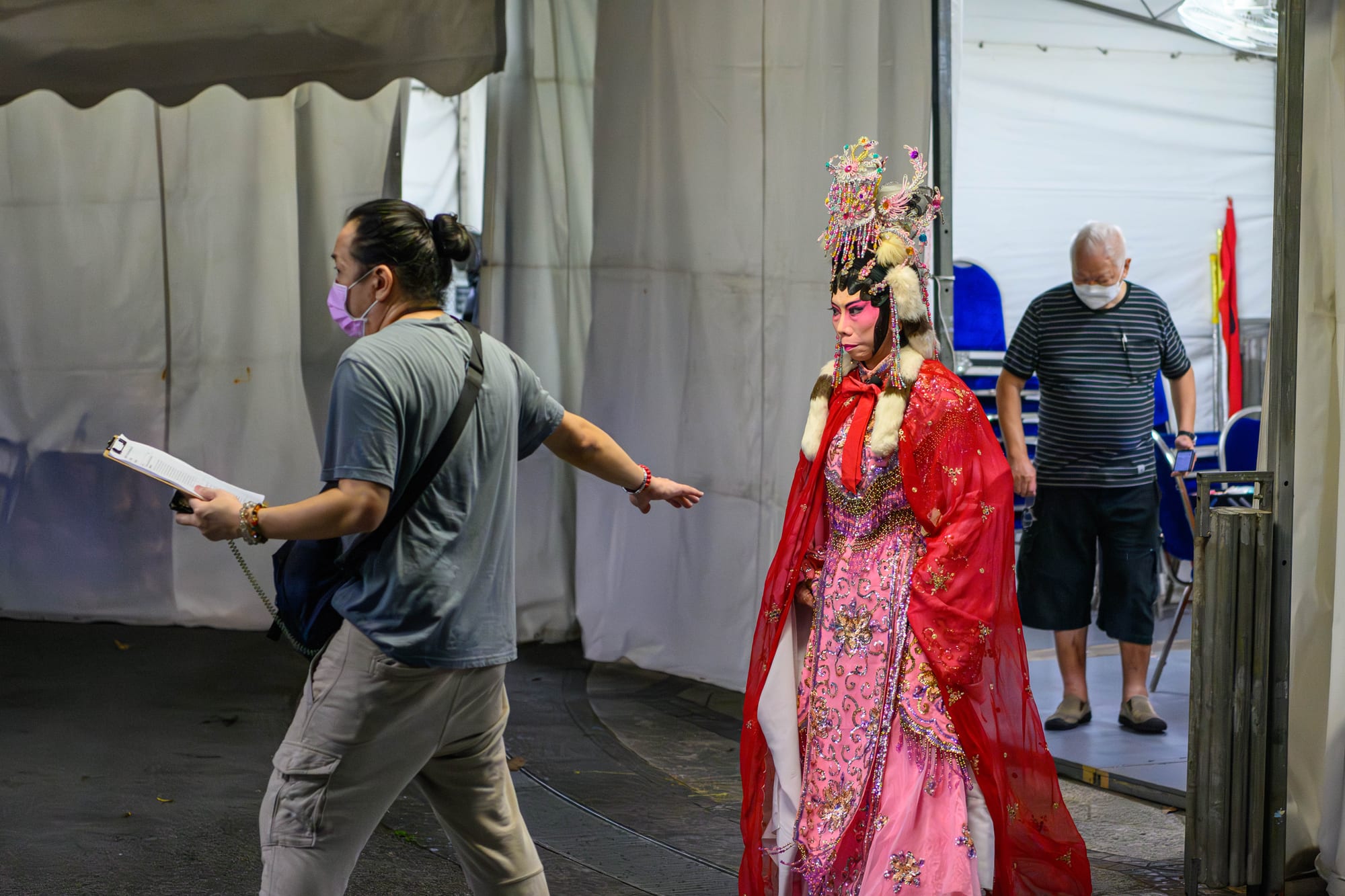
Many of the arts that migrants brought with them are still practised and recorded in the national inventory of intangible cultural heritage. Chinese opera arrived with nineteenth-century immigrants and survives in several dialect forms: Teochew opera with its choral accompaniment, Cantonese opera with its acrobatics, and Hokkien opera with its characteristic "crying" melodies. It is performed in theatres and at temple festivals, sometimes now with English surtitles, though the decline of dialects among the young has made audiences harder to find.
The inventory also includes traditional Malay music, Indian dance forms, the shadow-puppet theatre of wayang kulit, and the Jinkli Nona song and Branyo dance of the Eurasian community, alongside crafts such as cheongsam tailoring and the making of the baju kurung and the songkok cap. The kebaya, a front-opening blouse often finely embroidered and worn with a sarong, is shared across communities and borders; in 2024 it was inscribed on UNESCO's list of intangible cultural heritage in a joint nomination by Singapore, Brunei, Indonesia, Malaysia and Thailand.
Dos and don'ts for visitors
- Do remove shoes before entering a home, and give and receive gifts with both hands.
- Do wait for a hand to be offered when greeting someone of the opposite sex; some Malay and Indian Singaporeans prefer not to shake hands.
- Don't point with a finger or touch anyone's head, and avoid raising the voice or showing anger in public.
- Do choose gifts with the host's background in mind: no clocks or sharp objects for Chinese hosts, no alcohol or pork for Muslims, no leather or alcohol for Hindus.
- Don't litter or spit; on-the-spot fines apply, and the sale and import of chewing gum has been banned since 1992, apart from therapeutic gum sold by pharmacists and dentists.
- Don't bring vapes or e-cigarettes into the country; they are banned, users are fined, and vapes laced with etomidate are treated as a drug offence that can lead to deportation.
- Don't carry or use illegal drugs; penalties are severe and include the death penalty.
- Do keep drinking to licensed venues late at night; drinking alcohol in public places is illegal between 10.30 p.m. and 7 a.m.
What to take away
Singapore's customs can look like a set of rules, but at their heart lies a simple habit of accommodation — of taking others' faiths, foods and feelings into account — and visitors who do the same will fit in easily.