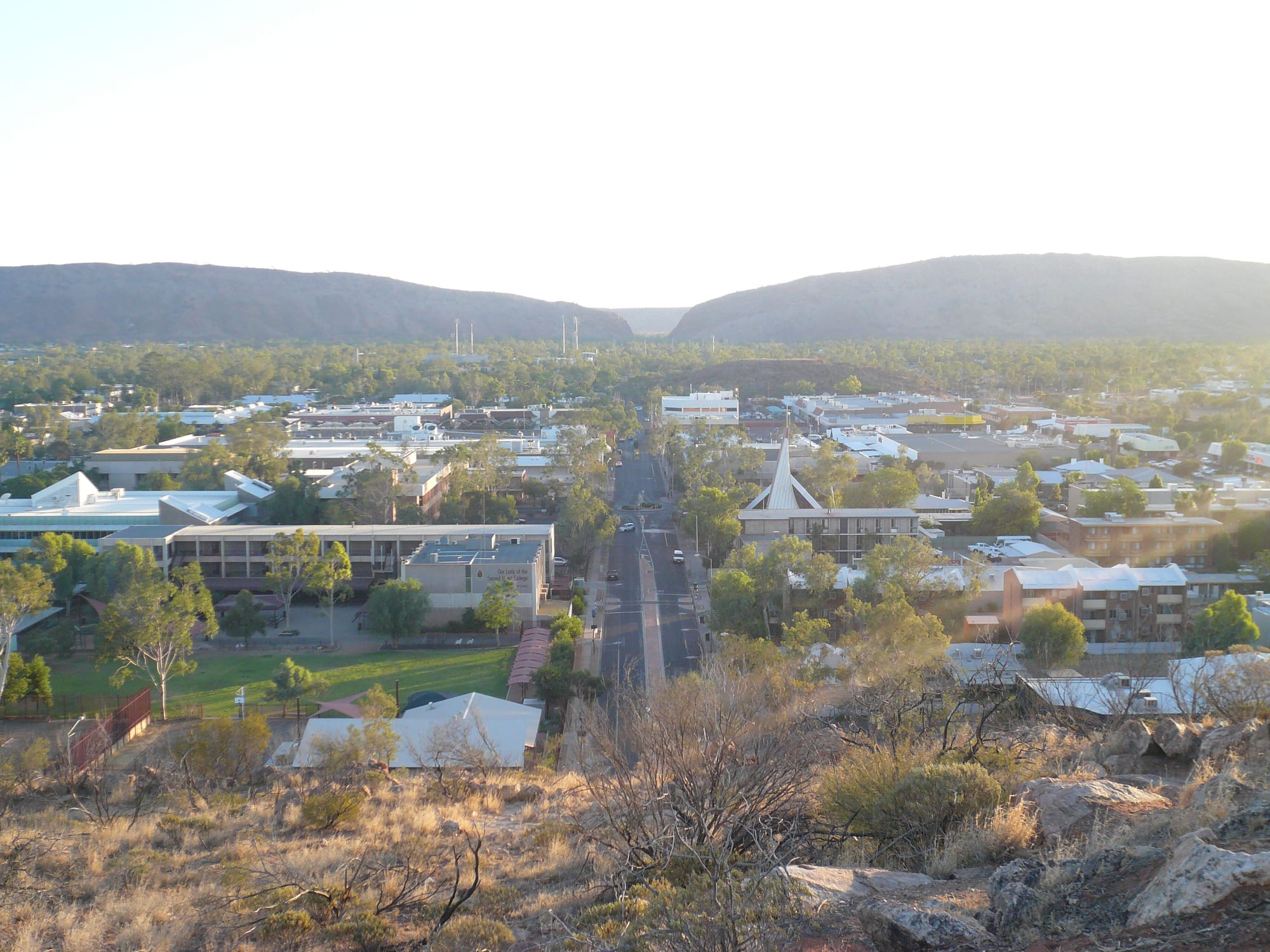
A low desert town of pale buildings and gum trees below a long red range with a notch cut through it

The Northern Territory, Australia

Alice Springs

Alice Springs from Anzac Hill, looking south towards Heavitree Gap in the MacDonnell Ranges. (eyeintim / Wikimedia Commons · CC BY 2.0)

Alice Springs, known to Arrernte people as Mparntwe, sits near the centre of the continent beside a gap in the MacDonnell Ranges, about 1,500 kilometres from both Adelaide and Darwin. It grew from an 1871 telegraph station into the service town for a vast desert region, and is the base for the ranges, the gorges and Central Australian Aboriginal art.

Neighbourhoods

  • Todd Mall and the town centre
    • First-time visitors
    • Art galleries
    • Close to public transport

    A small grid of streets between the dry Todd River and the railway, with the pedestrian Todd Mall at its heart. Aboriginal art galleries, cafés, tour desks, the library and most of the town's hotels are here, and a hill with a war memorial and a long view stands at the northern end.

    Open in Maps
  • East Side
    • Quiet and residential
    • Close to the centre

    The older residential streets across the sandy bed of the Todd River from the centre, shaded by river red gums, with low brick houses, small parks and a short walk or cycle into town along the riverside path.

    Open in Maps
  • The Gap and the southern entrance
    • Caravans and camping
    • Close to the airport

    South of the town the road, the railway and the river all squeeze through one narrow gap in the range, a place of deep significance to Arrernte people. Beyond it are caravan parks, motels, the road transport museums and the airport turn-off.

    Open in Maps
  • Araluen and the western suburbs
    • Museums
    • Families

    Spread-out suburbs west of the centre where the town's cultural precinct stands, with an arts centre, museums and outdoor sculpture together on one site, and the road out to the desert park and the western ranges.

    Open in Maps
  • The northern suburbs and the Telegraph Station
    • Walks
    • Historic district

    Residential streets north of the centre give way to the reserve around the original telegraph station and the waterhole the town was named after. Walking and cycling tracks, a golf course and the start of a long-distance trail are all on this side.

    Open in Maps

Things to do

In the town

  • Anzac Hillviewpoint

    A short climb or drive to a war memorial on a hilltop above the centre, with the whole town laid out towards the gap in the range.

    Open in Maps
  • Olive Pink Botanic Gardenpark

    An arid-zone botanic garden on the edge of the centre, planted with Central Australian species and named after Olive Pink, the anthropologist, artist and campaigner for Aboriginal social justice who founded it.

    Open in Maps
  • Adelaide Housemuseum

    The stone building on Todd Mall that opened in 1926 as the first hospital in Central Australia, designed by the Reverend John Flynn with an early cooling system of cellar ducts modelled on the Coolgardie safe.

    Open in Maps
  • Alice Springs School of the Airattraction

    The base from which lessons have been broadcast to children on remote stations and communities since the 1950s, with a visitor centre explaining how it works.

    Open in Maps

Museums and galleries

  • Araluen Arts Centremuseum

    The town's main gallery and theatre, with four galleries holding a collection of art from across the region, among them the Albert Namatjira Gallery, and a theatre seating about five hundred.

    Open in Maps
  • Museum of Central Australiamuseum

    Natural history and archival collections of the centre of the continent, incorporating the Strehlow Research Centre, in the same precinct as the arts centre.

    Open in Maps
  • Alice Springs Desert Parkattraction

    A large open-air park west of town recreating desert habitats, with free-flying birds, nocturnal animals and displays on Aboriginal use of desert plants.

    Open in Maps

The edge of town

  • Alice Springs Telegraph Stationlandmark

    The stone buildings of the 1871 Overland Telegraph repeater station beside the waterhole that gave the town its name, now a historical reserve with walking tracks.

    Open in Maps
  • Emily and Jessie Gaps Nature Parkpark

    Two gaps in the range a short drive east, registered sacred sites tied to the three caterpillar ancestors of Mparntwe, with Aboriginal rock art at Emily Gap.

    Open in Maps

Short trips into the ranges

  • Simpsons Gappark

    A narrow gap in the West MacDonnell Ranges west of town with a permanent waterhole and a colony of black-footed rock-wallabies on the scree.

    Open in Maps
  • Standley Chasmattraction

    A narrow cleft in the ranges within West MacDonnell National Park, in a reserve owned by the Iwupataka Land Trust, whose red walls light up when the sun stands overhead around the middle of the day.

    Open in Maps
  • Hermannsburgattraction

    A former Lutheran mission west of town, now the Arrernte community of Ntaria, where Albert Namatjira and the Hermannsburg watercolour school began.

    Open in Maps

Seasonal events

  • ParrtjimaApril

    A festival of light held over about ten nights in the desert outside the town, with Aboriginal artworks projected onto the MacDonnell Ranges, and workshops, films, music and dance at the desert park and the cultural precinct.

  • Finke Desert RaceJune

    An off-road race for motorcycles, buggies and cars from Alice Springs south along a rough desert track to the community of Aputula and back over a long weekend.

  • Alice Springs Beanie FestivalJune

    Thousands of knitted, crocheted and felted beanies, sent in from around the world, displayed and sold over four days at the cultural precinct in the middle of winter.

  • Camel CupJuly

    Camel races at Blatherskite Park, part of the show society grounds, organised by the local Lions Club and run as a day of carnival with novelty events, and one of several deliberately absurd fixtures in the local calendar.

  • Henley-on-Todd RegattaAugust

    Boat races run on the dry sand of the Todd River in bottomless boats carried by their crews, held on the third Saturday of August and cancelled only once, in 1993, when there was water in the river.

Eat and drink

Long-standing places and food districts in Alice Springs. Hours, ratings and directions come from your maps app, always current.

Eating in the centre

  • Todd Mall's cafés and restaurantsneighborhood

    The pedestrian mall and the streets around it hold most of the town's eating places, a wider choice than the size of the town suggests, including Thai, Indian, Italian and Greek kitchens alongside cafés.

    Open in Maps
  • Todd Mall Marketsmarket

    A fortnightly street market in the mall, with food stalls, coffee, produce, crafts and artists selling their own work.

    Open in Maps
  • The town's pubsrestaurant

    Hotel bars and dining rooms in and near the centre serve the standard Australian counter meals and are where much of the town's social life happens.

    Open in Maps

Outback and bush flavours

  • Outback grillsrestaurant

    Several restaurants aimed at visitors put a mixed grill of camel, kangaroo, emu and crocodile on the menu alongside beef from Territory cattle stations.

    Open in Maps
  • Bush foodsneighborhood

    Cafés, bakeries and food producers in town use desert ingredients such as bush tomato, wattleseed, quandong and desert lime, several of them harvested by Aboriginal enterprises.

    Open in Maps

Experience Alice Springs

History

The town stands on Mparntwe, the country of the Central Arrernte, whose ancestral stories place the caterpillar beings of the ranges, the gaps and the riverbed at the heart of the landscape; several registered sacred sites lie inside the modern town. European settlement followed a telegraph line. In 1871 a repeater station was built beside a waterhole in the Todd River and named Alice Springs after Alice Todd, wife of Charles Todd, the South Australian superintendent of telegraphs, for whom the river itself was named.

Alluvial gold found at Arltunga, about 100 kilometres east, in 1887 brought the first significant European settlement, and a township was surveyed a few kilometres south of the station and called Stuart. It grew slowly as a base for cattle stations and prospectors, took the name Alice Springs in 1933, and was connected to Adelaide by rail in 1929 by the narrow-gauge train that became known as the Ghan. The Second World War transformed it: the town became a staging post for the defence of the north, the road to Darwin was pushed through, and the population multiplied.

Alice Springs also became the administrative centre of policies that removed Aboriginal children from their families, among them the institution known as the Bungalow. From the 1970s the land rights movement, the Central Land Council and Aboriginal-controlled health and legal services reshaped the town's role. Tourism grew with the sealing of the highways, and in 2004 the railway was finally completed north to Darwin.

Culture & Customs

Alice Springs is the commercial heart of Central Australian Aboriginal art. The Western Desert painting movement that began at Papunya in the 1970s is sold and exhibited here, the Hermannsburg watercolour tradition founded by Albert Namatjira hangs in the town's gallery, and galleries and dealers line the mall, which makes the difference between community-owned art centres and opportunistic sellers something visitors are asked to understand.

It is a town of many languages. Arrernte is spoken alongside Warlpiri, Luritja, Pitjantjatjara, Western Arrarnta and Kriol, and people travel in from communities hundreds of kilometres away for hospital appointments, court, football and shopping. The town is at once a tourist destination, a government centre and the service hub of a desert region, and the tension between those roles is a constant subject of local conversation.

Its public calendar is famously eccentric: boat races on a dry river, camel racing, a festival devoted to woollen beanies, and a brutal off-road race south into the desert. Australian rules football is followed intensely, with a Central Australian league whose teams draw players from remote communities. Manners are informal and direct. Sacred sites, including hills and gaps within the built-up area, are protected by law, and mourning periods take precedence over everyday arrangements.

Daily Life

About 35,000 people live in Alice Springs, about a fifth of them Aboriginal, in a town that provides services to a region the size of a European country. The economy rests on government and public administration, health, education, tourism, freight and road transport, Aboriginal organisations, cattle stations and the joint Australian and United States surveillance facility at Pine Gap, south-west of town, which is a significant employer and closed to the public.

Distance and heat set the pattern of the day. Work and school start early, outdoor activity stops in the middle of summer afternoons, and evenings are spent outside for much of the year. Freight arrives by road and rail, which keeps grocery and fuel prices above those in the southern cities, and the hospital, the airport and the courts serve communities far beyond the town.

Housing costs, overcrowding, a professional workforce on short contracts and a high turnover of staff in health and education are long-standing issues. Youth crime, alcohol harm and the wellbeing of remote communities have made the town the subject of repeated national debate and of shifting restrictions, including limits on takeaway alcohol and a curfew in the centre in 2024. The Todd River is dry sand for most of the year, and residents still go out to watch when it runs.

Food

For a town of its size Alice Springs eats well. The mall and the streets around it hold Thai, Indian, Italian, Greek and Chinese kitchens, cafés that take their coffee seriously, bakeries and a handful of more ambitious restaurants, and the hotel dining rooms serve the counter meals that are the Australian standard. A fortnightly street market in the mall sells food alongside crafts and the work of local artists.

The local speciality for visitors is the outback grill: camel, kangaroo, emu and crocodile served as a mixed plate, usually with beef from Territory stations. Kangaroo is the one that has become ordinary rather than novel, a lean red meat best cooked quickly. Barramundi comes down from the Top End rivers, and market gardens north of the town supply table grapes and melons in season.

Desert ingredients have moved from bush to menu. Bush tomato, known as kutjera, wattleseed, quandong, desert lime and native basil appear in bread, ice cream, sauces and dukkah-style mixes, and several of them are harvested and processed by Aboriginal enterprises. Arrernte and other Central Australian people still gather maku, the witchetty grub found in the roots of the witchetty bush, along with honey ants and bush seeds. Alcohol is sold under restrictions that have changed repeatedly, and bottle shops ask for identification.

Planning tools

Budget

Alice Springs is the cheapest base in Central Australia, and much less expensive than Uluru, though freight still pushes up the price of food and fuel. Accommodation runs from hostels and caravan parks to mid-range hotels, and prices rise sharply around the big events in winter. A hire car is the main variable cost, since the gorges and ranges all need one.

Daily Budget Midrange
USD 160–290 (mid-range hotel, restaurant meals, museum and park entries, a hire car)
Daily Budget Shoestring
USD 70–120 (hostel bed or campsite, self-catering, town buses and walking)

Book rooms months ahead for June, July and August, when the festivals and races fill the town, and share a hire car if possible, because distances in the ranges are long.

Best Time to Visit

April to September. Winter days are mild and clear, the nights are cold, and the walking in the ranges is at its best; June to August also holds most of the town's festivals and races. Summer, from December to February, is very hot, with average maximums in the mid-30s and some days above 40°C, and long walks become unsafe by mid-morning.

Suggested Number of Days

Two or three days cover the town itself and its museums and galleries. Five to seven allow the ranges on both sides and a longer loop through Central Australia. Distances, heat and the need to start early are what lengthen a stay, not the number of places to see.

First Visit
2–3 days
With Surroundings
5–7 days

Transportation

The centre is walkable, and a small network of town buses reaches the suburbs and the cultural precinct, though services thin out in the evenings and at weekends. A hire car, a tour or a bicycle is needed for the desert park and everything beyond the town; most gorges lie between 20 and 150 kilometres away on sealed or graded roads, and a few need a four-wheel drive. Taxis and ride-hailing operate in town.

Avoid driving out of town at dawn, dusk and night, when kangaroos, camels and cattle are on the road; carry water in the car, and check whether a track needs high clearance before taking it.

Airport & Station Connections

Alice Springs Airport is about 13 kilometres south of the town, past the gap in the range, with flights from Darwin, Adelaide and several eastern capitals. The Ghan stops here on its run between Adelaide and Darwin, and the Stuart Highway gives a sealed road north and south, roughly 1,500 kilometres either way. Long-distance coaches and multi-day tours also serve the town, and many visitors arrive as part of a drive across the continent.

Walkability

The centre is compact and flat, and Todd Mall, the galleries, the riverside path and the hill above the town can all be covered on foot in an afternoon. The suburbs are spread out, with wide roads and long gaps between destinations, and the cultural precinct and desert park are too far to walk comfortably. Shade is limited, and in summer walking is only sensible in the early morning and evening.

Safety

Property crime and youth crime in Alice Springs run well above the national average, and the town's social problems have drawn sustained national attention, with measures including a curfew in the town centre used in 2024. Most visitors are not affected, but break-ins to vehicles and accommodation and antisocial behaviour after dark are the usual complaints. Heat, dehydration on walks and flash flooding in gorges after storms are the environmental risks.

Lock vehicles and rooms, leave nothing visible in a parked car, take a taxi rather than walking across town late at night, and carry plenty of water on any walk in the ranges. Check current official travel advice before travelling.

Climate

Arid, with very hot summers, mild bright winter days and cold winter nights, with frost and about a dozen nights below freezing each year. In the southern hemisphere summer falls in December to February and winter in June to August. Rainfall is low and erratic, mostly from summer thunderstorms, and the Todd River runs only after heavy rain.

Summer
very hot and dry — average maximums in the mid-30s, sometimes above 40°C, with warm nights and occasional storms
Winter
mild and sunny by day, cold at night — days around 20–23°C, nights averaging about 5°C, with frost on about a dozen nights a year

Local Customs

This is Arrernte country, and sacred sites within and around the town are protected by law, some of them in the middle of built-up areas. People from many language groups — Warlpiri, Luritja, Pitjantjatjara, Western Arrarnta and others — come into town from remote communities, and English is one language among several on the street. Tipping is not expected in Australia. Funerals and mourning, spoken of as sorry business, take precedence over other commitments and can close businesses and empty communities for days.

Ask before photographing people, buy Aboriginal art through community-owned art centres and galleries that name the artist rather than from street sellers, and expect identity checks and limits on takeaway alcohol, which have changed repeatedly in recent years.

Common Payment Methods

The currency is the Australian dollar. Cards and contactless payment are accepted almost everywhere in town, and there are banks and cash machines in the centre. Cash is useful at markets and in the small roadhouses and community stores outside town, where card facilities can be unreliable. Prices for groceries and fuel are higher than in the southern cities.