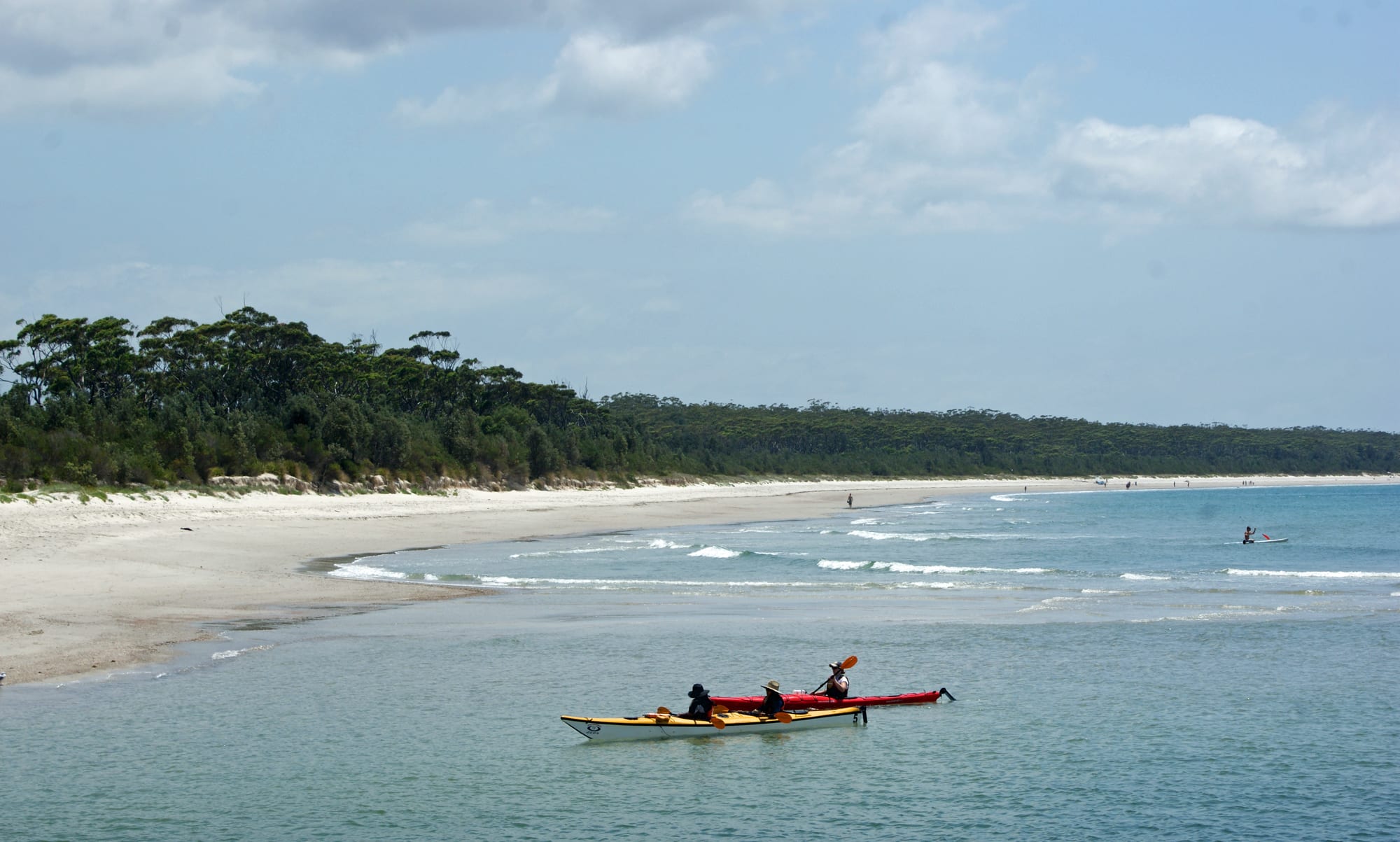
White sand beach backed by low bush curving along a bay, with two kayakers paddling in shallow green water

Sydney, New South Wales & the ACT, Australia

Huskisson

A white sand beach on the shore of Jervis Bay near Huskisson, New South Wales. (albinfo / Wikimedia Commons · CC BY-SA 3.0)

A small town on the western shore of Jervis Bay, on the South Coast of New South Wales about 200 kilometres south of Sydney. Timber and boat building made it in the 19th century; today its white sand beaches and clear water draw holidaymakers, and the bay around it has been protected as a marine park since 1998.

Neighbourhoods

  • Owen Street and the town centre
    • First-time visitors
    • Best for food
    • Close to the beach

    Huskisson's short main street, a few blocks back from the water, holds the shops, bakeries, cafés, pubs and tour offices in a row of low buildings. Almost everything in town is within a ten-minute walk of it, and most of the boat trips leave from the wharf at the end of it.

    Open in Maps
  • The waterfront and Currambene Creek
    • Boat trips
    • Quiet and residential

    The bay front runs south from the mouth of Currambene Creek past Huskisson Beach and a grassy reserve. The creek behind it is the working edge of the town, with the boat harbour, moorings and the maritime museum on its bank.

    Open in Maps
  • Vincentia
    • Quiet and residential
    • Beaches
    • Families

    The neighbouring settlement immediately south, larger and almost entirely residential, with holiday houses under the trees behind the long curve of its bay-front beach. A shoreline path links it to Huskisson in about half an hour on foot.

    Open in Maps
  • Hyams Beach
    • Beaches
    • Quiet and residential

    A cluster of houses around a very white beach on the southern side of the bay, roughly eight kilometres from Huskisson. There is little here beyond the sand, the water and a small store, and parking is limited in the summer holidays.

    Open in Maps

Things to do

Beaches and the bay

  • Hyams Beachbeach

    A short beach of fine, squeaky, brilliantly white quartz sand on the south side of Jervis Bay; the long-standing local claim to the whitest sand in Australia is a myth, and the record belongs to beaches in Western Australia and Queensland.

    Open in Maps
  • Jervis Bay Marine Parkattraction

    The protected waters of the bay and the coast beyond it, established in 1998 and known for clear visibility and dive sites such as the Gorgonian Wall, Ten Fathom Reef and Bowen Island, with boat operators leaving from Huskisson.

    Open in Maps

The town and its history

  • Jervis Bay Maritime Museummuseum

    A museum on Currambene Creek built around the town's shipbuilding past, whose best-known exhibit is the wooden Sydney Harbour ferry Lady Denman, launched at Huskisson in 1911.

    Open in Maps
  • Jervis Bay National Parkpark

    Heath, forest and sandstone headlands in sections around the bay, with short walking tracks linking a string of white beaches.

    Open in Maps

Short trips from the town

  • Booderee National Parkpark

    A park of beaches, heath and botanic gardens at the southern entrance to the bay, owned by the Wreck Bay Aboriginal Community and managed jointly with the Australian government.

    Open in Maps
  • Cape St George Lighthouselandmark

    The ruins of a lighthouse built in 1860 on the cliffs inside what is now Booderee National Park, poorly sited from the start, disused after 1889 and destroyed by naval target practice between 1917 and 1922.

    Open in Maps
  • Point Perpendicular Lighthouselandmark

    A lighthouse first lit in 1899 on the high cliffs at the northern entrance to Jervis Bay, on the Beecroft Peninsula, reached across defence land that is closed during firing exercises.

    Open in Maps
  • HMAS Creswelllandmark

    The Royal Australian Navy's officer training establishment on the southern shore of the bay, home to the Royal Australian Naval College from 1915 to 1930 and again since 1958.

    Open in Maps
  • Kangaroo Valleyattraction

    A farming valley in the escarpment country inland, with a village, the castellated Hampden Bridge of 1898 over the Kangaroo River — Australia's oldest suspension bridge — and Fitzroy Falls a little to the north.

    Open in Maps

Eat and drink

Long-standing places and food districts in Huskisson. Hours, ratings and directions come from your maps app, always current.

Huskisson classics

  • Seafood on the waterfrontrestaurant

    Fish and chips eaten on the grass above Huskisson Beach is the standard local meal, usually flathead, snapper or prawns landed on the South Coast.

    Open in Maps
  • Huskisson Hotelrestaurant

    The town's pub, known locally as the Husky, a short walk from the water and the main gathering place for counter meals and live music in summer.

    Open in Maps

Cafés and the main street

  • Owen Street cafés and bakeriesneighborhood

    A handful of cafés, bakeries and takeaways along the main street, busy with breakfast and coffee before the boats leave and with ice creams in the afternoon.

    Open in Maps

Markets and producers nearby

  • Greenwell Point oystersmarket

    A fishing village in the Shoalhaven estuary north-west of Huskisson, where Sydney rock oysters are farmed in the sheltered water and sold beside it.

    Open in Maps

Experience Huskisson

History

Jervis Bay and the land around it are the country of the Yuin peoples, whose sub-groups include the Jerrinja and the Wandandian, and whose descendants include the Wreck Bay community on the bay's southern shore; middens and campsites around the shoreline record thousands of years of fishing and gathering. British ships charted the inlet in the 1790s and named it after Admiral Sir John Jervis.

Town allotments were sold here in the early 1840s, but Huskisson only began to grow when shipbuilding started on Currambene Creek in the 1860s, and for more than a century it lived on timber and boats. Timber cut from the forests behind the bay was shipped out through the creek, and at least 131 wooden vessels were built in the yards along it between 1864 and 1977 — among them the wooden Sydney Harbour ferry Lady Denman, launched at Huskisson in 1911 and now the centrepiece of the town's maritime museum. The village took its name from William Huskisson, the British politician killed at the opening of the Liverpool and Manchester Railway in 1830.

Grander plans repeatedly passed the town by. New South Wales handed the southern shore of the bay to the Commonwealth in 1915 so that the new federal capital would have access to the sea, and the naval college opened there the same year, but the port city that was imagined never followed. A nuclear power station proposed near Murrays Beach in 1969 got as far as an access road and a levelled site before it was cancelled in 1971. Holidaymakers proved the more lasting industry, and protection came late: the marine park was declared in 1998, and the park on the southern shore was transferred to the Wreck Bay Aboriginal Community in 1995 and renamed Booderee.

Culture & Customs

Huskisson is a holiday town with a working past, and both sides show. Currambene Creek still serves as an anchorage and fishing port, the museum keeps the shipwright trade in public view, and the fishing fleet is small but real. Alongside it runs the culture of the Australian coastal summer: surf life-saving club patrols, cricket on the sand, boats towed behind cars, and families who have taken the same house for the same fortnight in January for decades.

The bay itself shapes local identity. Cruises, whale watching and diving are the town's best-known business, and the clear water draws divers, kayakers and anglers from Sydney and Canberra. Conservation arguments have been part of local life for two generations, from the abandoned power station to the creation of the marine park, and residents follow questions about boat numbers, fishing zones and coastal development closely.

Aboriginal culture is present rather than historical. The Wreck Bay community owns Booderee and manages it jointly with the Australian government, and chose its name, a Dhurga word usually translated as bay of plenty. Winter is the quiet season, when the population falls back to its residents, the sporting clubs and the pub take over the social calendar, and the beaches belong to dog walkers and fishers.

Daily Life

About 840 people live in Huskisson itself, part of a ring of settlements around the bay — Vincentia, Hyams Beach, Callala Bay and Woollamia among them — that together hold several thousand residents and many more in the holidays. All lie within the City of Shoalhaven, a large coastal council of roughly 110,000 people administered from Nowra, where the hospital, the high schools and the big shops are.

Tourism, hospitality, building trades and aged care provide most of the work, along with commercial fishing and oyster farming in the nearby estuaries. Two defence establishments are significant employers: the naval college on the bay and the navy's air station at Nowra. The population is older than the state average, with many retirees and long-distance commuters, and it swells sharply between Boxing Day and the end of January, when the resident population is outnumbered several times over.

The rhythm of the day is early. Boats and tradesmen start at first light, the cafés fill by eight, and the town is quiet by mid-evening outside the main season. The pressing local issues are housing — holiday letting has pushed rents and prices beyond what seasonal wages can carry — the reliability of water and roads, bushfire preparation each summer after the 2019–20 fires, and the balance between visitor numbers and the beaches and bay that attract them.

Food

Seafood comes first. Sydney rock oysters, a small native oyster farmed in the estuaries along this coast, are farmed in the estuaries just north of the bay, sold beside the water at villages such as Greenwell Point, and appear on menus all over town. Flathead, snapper, whiting and prawns are the everyday catch, usually fried in batter and eaten on the grass above Huskisson Beach, and hot chips with a wooden fork and a paper wrapper are as much a part of the town as the boats.

Beyond fish, the food is that of a small Australian coastal town: meat pies and sausage rolls from the bakery, steak and schnitzel at the pub, the chicken parma that appears on counter menus across the country, and a barbecue in the reserve on a summer evening. Cafés along Owen Street take coffee seriously in the Australian way, with flat whites and long blacks made on espresso machines, and serve brunch dishes such as smashed avocado on toast.

The wider Shoalhaven supplies dairy from the river flats, beef from the escarpment farms, and berries and stone fruit sold at roadside stalls in summer. Vineyards of the Shoalhaven Coast wine region lie around the bay and the Shoalhaven River, and the district is best known for Chambourcin, a red grape first planted in the region at Coolangatta Estate's older vineyards. Bush foods, including native fruits and seeds used by the Yuin, appear in local dishes and preserves.

Planning tools

Budget

Prices follow the holidays rather than the calendar. From late December to the end of January, and over Easter and long weekends, accommodation in Huskisson and Vincentia is scarce and dear, and many places set minimum stays. Outside those weeks the same rooms cost far less. Boat cruises, diving and a hire car are the other main costs, while the beaches, the walking tracks and the shoreline path are free.

Daily Budget Midrange
USD 190–320 (motel room or holiday apartment, restaurant meals, a dolphin or whale cruise, a hire car)
Daily Budget Shoestring
USD 75–130 (campsite or hostel bed, self-catering, fish and chips, free beaches and walks)

Book accommodation months ahead for January and school holidays, and expect national park entry fees for Booderee, paid per vehicle at the gate.

Best Time to Visit

October to April has the warmest water and the longest days, with January the busiest and most expensive month. Humpback whales pass the bay on their migration between roughly May and November. Autumn, from March to May, combines warm sea, settled weather and far fewer people, and winter is quiet, cool and clear, with some cafés and tour operators on shorter seasons.

Suggested Number of Days

Two or three days suit the town, its beaches and a trip out on the water. Four or five allow the far side of the bay, the national parks and the escarpment country inland. Weather decides much of it: boat trips and diving are cancelled in strong winds.

First Visit
2–3 days
With Surroundings
4–5 days

Transportation

A car is close to essential. Buses connect Huskisson with Vincentia and Nowra on a limited timetable, and taxis and ride-hailing are scarce outside the main season. Within the town nothing is far enough to need transport, and bicycles work well on the flat shoreline roads. Reaching Hyams Beach, Booderee or the Beecroft Peninsula without a vehicle is difficult.

Parking near the beaches fills early on hot days in January; drive slowly at dusk, when kangaroos and wombats come onto country roads.

Airport & Station Connections

Most visitors drive. Huskisson is about 200 kilometres from Sydney, some two and a half to three hours by the Princes Highway, and a similar distance from Canberra through the ranges. Trains on the South Coast line from Sydney end at Bomaderry, next to Nowra and about 25 kilometres away, where a connecting bus or taxi is needed. Long-distance coaches stop at Nowra. The nearest major airport is Sydney.

Walkability

The town is small, flat and easily covered on foot: the main street, the wharf, the museum and Huskisson Beach are all within a few hundred metres of each other. A sealed path follows the shore south through Vincentia, and bush tracks link the beaches further round the bay. Anything beyond that, including Hyams Beach, means a drive or a long walk on road verges.

Safety

Huskisson is a quiet town with little crime. The risks are natural: rip currents and sudden drop-offs on the ocean-facing beaches, which are far less sheltered than the bay, strong sun, and bushfire in summer — the 2019–20 fires burned large areas of the Shoalhaven. Snakes and ticks live in the surrounding bush, and boat trips are called off in rough weather rather than run.

Swim between the flags where beaches are patrolled, check fire danger ratings and the local emergency service in summer, carry water on bush walks and follow signs closing defence land near Point Perpendicular. Check current official travel advice before travelling.

Climate

A mild maritime climate with no dry season and a strong sea breeze most afternoons. The bay moderates both extremes, so heatwaves are cooler here than inland and frost is rare. Rain falls through the year, with the heaviest falls usually in late summer and autumn. Seasons are reversed from the northern hemisphere: summer runs from December to February and winter from June to August.

Summer
warm rather than hot — typically 18–26°C, with occasional hot northerly days above 35°C broken by a cool southerly change; sea temperatures around 21–23°C
Winter
cool and often clear — roughly 7–17°C by day, with cold nights, southerly storms and a sea of about 16°C

Local Customs

This is a relaxed beach town where shorts and bare feet are normal in the street, though not in restaurants. Tipping is not expected; rounding up or leaving small change for good service is enough. Alcohol is sold in licensed premises and bottle shops, and drinking in public places and on beaches is restricted. The land and waters here are Yuin country, and Booderee National Park is Aboriginal-owned: signs asking visitors to keep off certain areas are a condition of entry rather than a suggestion.

Take rubbish away from the beaches, keep well back from seals and nesting birds, do not feed wildlife, and ask before photographing people or cultural sites.

Common Payment Methods

The currency is the Australian dollar. Cards and contactless payment, including phones, are accepted almost everywhere, and some cafés and tour operators no longer handle cash. ATMs stand on the main street, though queues form in the holidays. A small amount of cash is useful for market stalls, honesty boxes at farm gates and parking machines.