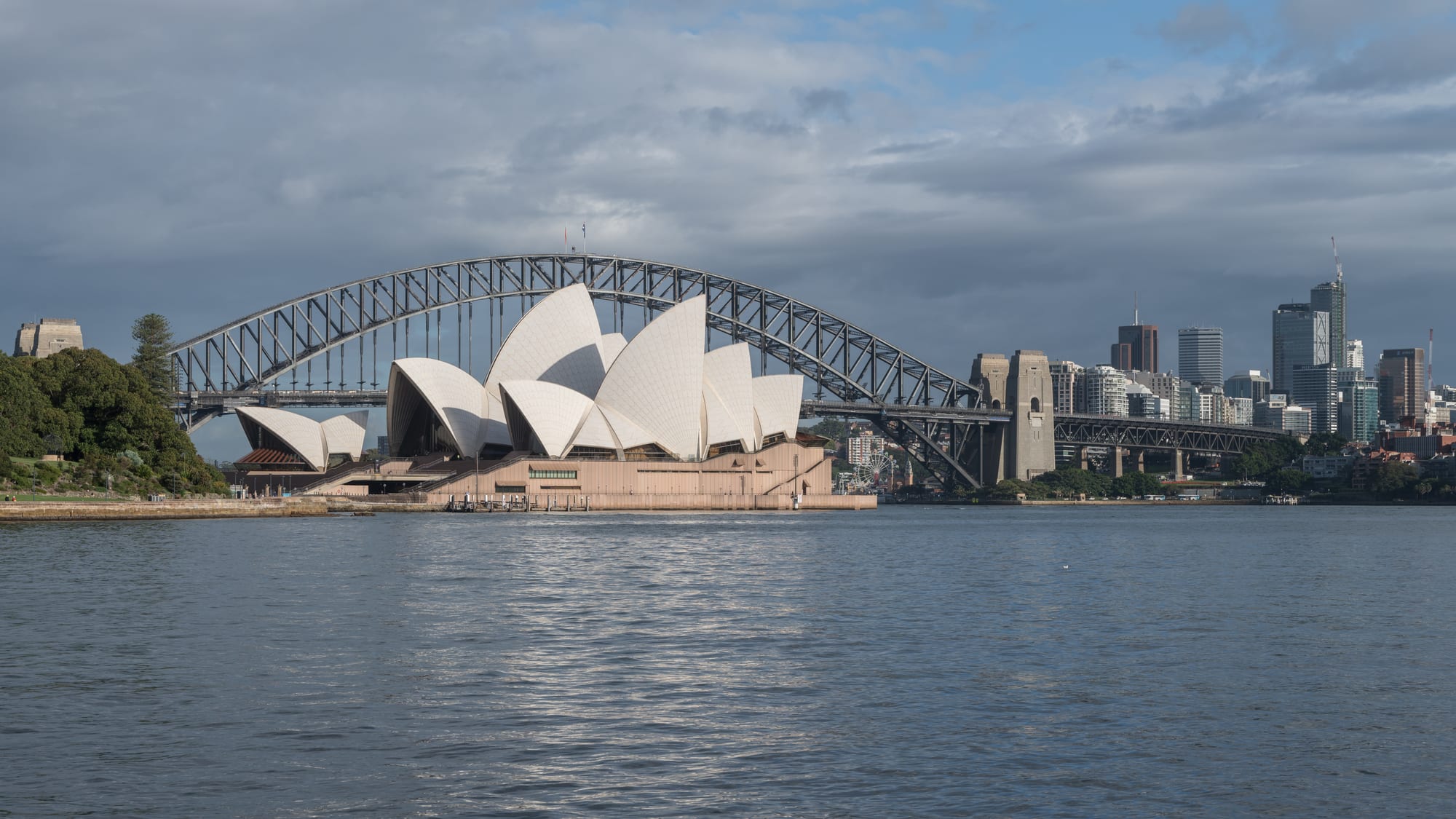
The white shells of the Sydney Opera House on the harbour, with the steel arch of the Harbour Bridge behind and city towers to the right

Sydney, New South Wales & the ACT, Australia

Sydney

The Opera House, the Harbour Bridge and the city towers seen across Sydney Harbour. (DXR / Wikimedia Commons · CC BY-SA 4.0)

Australia's oldest and largest city, built around one of the world's great natural harbours on the land of the Gadigal. It began in 1788 as a British penal settlement and grew into the country's financial centre and busiest gateway, a low, sprawling metropolis of about five and a half million people where ferries, ocean pools and surf beaches shape everyday life.

Neighbourhoods

  • The Rocks and Circular Quay
    • First-time visitors
    • Historic district
    • Close to public transport

    The oldest European-settled part of the city, on the harbour beside the southern approach to the Harbour Bridge, with sandstone warehouses, narrow lanes and stone stairways saved from demolition by union green bans in the 1970s. Circular Quay next to it is the hub for ferries, trains and light rail, and the Opera House is a few minutes' walk away.

    Open in Maps
  • Sydney central business district
    • Shopping
    • Museums
    • Close to public transport

    The commercial core runs south from Circular Quay along George and Pitt streets to Central station, mixing Victorian arcades and the Queen Victoria Building with glass towers and the Sydney Tower. Hyde Park, the Domain and the Royal Botanic Garden line its eastern edge, and most of the large hotels and underground stations are here.

    Open in Maps
  • Darling Harbour and Barangaroo
    • Families
    • Waterfront walks
    • Close to public transport

    Two stretches of reclaimed waterfront on the western side of the centre. Darling Harbour holds the maritime museum, an aquarium and the convention centre around a pedestrian basin; Barangaroo, built on former docks to the north of it, adds office towers, a harbourside park and a line of restaurants and bars.

    Open in Maps
  • Surry Hills and Darlinghurst
    • Best for food
    • Nightlife
    • Cafés

    Streets of brick terraces just south-east of the centre, once a garment-trade district and now the densest run of small restaurants, bakeries and bars in the city, around Crown and Bourke streets. Darlinghurst beside it takes in Oxford Street, long the centre of gay Sydney and the route of the Mardi Gras parade.

    Open in Maps
  • Newtown and the inner west
    • Live music
    • Nightlife
    • Best for food

    King Street and Enmore Road, about four kilometres south-west of the centre, form a long strip of pubs, music rooms, bookshops and inexpensive kitchens from a dozen countries, with the University of Sydney at one end. The inner west around it — Marrickville, Erskineville, Annandale — is residential, with breweries and Greek and Vietnamese shops.

    Open in Maps
  • Bondi and the eastern beaches
    • Beaches
    • Swimming
    • Coastal walks

    A wide arc of sand about seven kilometres east of the centre, reached by bus or by train to Bondi Junction, with a promenade, surf clubs and an ocean pool at each end. Cafés, hotels and surf shops crowd Campbell Parade, and the clifftop path south passes Tamarama, Bronte and Clovelly on the way to Coogee.

    Open in Maps
  • Manly and the northern beaches
    • Beaches
    • Family-friendly
    • Ferry rides

    A suburb with a harbour beach on one side and the ocean on the other, reached by ferry from Circular Quay in about half an hour. A short pedestrian street, the Corso, links the two shores, and Manly is the southern end of the northern beaches, a chain of surf suburbs running up to Palm Beach.

    Open in Maps
  • Parramatta
    • Local life
    • Value for money
    • Close to public transport

    Greater Sydney's second centre, on the river about 20 kilometres west of the harbour and settled in 1788, with a riverside walk, colonial buildings including Old Government House and a fast-growing cluster of towers. Rooms cost less than near the coast, trains and a river ferry run to the city, and the restaurants of western Sydney are close by.

    Open in Maps

Things to do

Famous landmarks

  • Sydney Opera Houselandmark

    Jørn Utzon's shell-roofed performing arts centre on Bennelong Point, opened in 1973 and inscribed as a World Heritage Site, with concert halls, theatres and a forecourt used for open-air events.

    Open in Maps
  • Sydney Harbour Bridgelandmark

    The steel arch bridge of 1932, carrying road, rail, a footway and a cycleway across the harbour, with a lookout in its south-eastern pylon and guided climbs over the arch.

    Open in Maps
  • Queen Victoria Buildinglandmark

    A sandstone shopping arcade of 1898 filling a block of George Street, with a central dome, stained glass, tiled floors and galleries of small shops.

    Open in Maps
  • Sydney Towerviewpoint

    The tallest structure in the city, a golden turret on a shaft above the Pitt Street shops, with an enclosed observation deck and an outdoor skywalk.

    Open in Maps
  • St Mary's Cathedrallandmark

    The Gothic Revival Roman Catholic cathedral facing Hyde Park, built in local sandstone from 1868 and completed with its twin spires in 2000.

    Open in Maps

Museums and galleries

  • Art Gallery of New South Walesmuseum

    The state gallery on the edge of the Domain, with Australian, European and Asian collections and a dedicated gallery of Aboriginal and Torres Strait Islander art, extended by the Sydney Modern building.

    Open in Maps
  • Australian Museummuseum

    Australia's oldest natural history museum, founded in 1827 and standing beside Hyde Park, with natural history galleries and large Aboriginal and Pacific collections.

    Open in Maps
  • Museum of Contemporary Art Australiamuseum

    Contemporary art in an Art Deco former maritime services building at Circular Quay, with a rooftop terrace facing the Opera House.

    Open in Maps
  • Australian National Maritime Museummuseum

    At Darling Harbour, telling the country's story through its waters, with historic vessels moored alongside, among them a submarine and a naval destroyer.

    Open in Maps
  • Hyde Park Barracksmuseum

    Francis Greenway's convict barracks of 1819, now a museum about transportation and part of the Australian Convict Sites World Heritage listing.

    Open in Maps

The harbour

  • Circular Quaytransit hub

    The waterfront interchange where ferries, trains, buses and light rail meet, and the departure point for crossings to Manly, Taronga, Watsons Bay and the inner-harbour suburbs.

    Open in Maps
  • Taronga Zooattraction

    A hillside zoo above the harbour at Mosman, opened in 1916 and reached by ferry, known almost as much for the view back over the city as for its animals.

    Open in Maps
  • Cockatoo Islandattraction

    A former convict prison and naval shipyard on an island in the middle of the harbour, now part of the Australian Convict Sites World Heritage listing, with sandstone workshops and dry docks.

    Open in Maps
  • Watsons Bayneighborhood

    A small harbourside village near South Head, with a ferry wharf, a sheltered beach and a short walk across to The Gap, a cliff facing the open sea.

    Open in Maps
  • Luna Park Sydneyattraction

    An amusement park of 1935 at the north end of the Harbour Bridge, entered through a large smiling face, with heritage-listed rides and a harbour boardwalk.

    Open in Maps

Beaches and coastal walks

  • Bondi Beachbeach

    One of the most visited beaches in Australia, a kilometre of sand backed by a promenade, surf clubs and a skate bowl, patrolled through the summer.

    Open in Maps
  • Bondi Icebergs Clubattraction

    A winter swimming club founded in 1929 whose saltwater pool sits on the rocks at the southern end of Bondi, washed over by the surf at high tide.

    Open in Maps
  • Coogee Beachbeach

    A sheltered beach at the southern end of the clifftop walk from Bondi, with rock pools, a grassy slope above the sand and a row of pubs across the road.

    Open in Maps
  • Manly Beachbeach

    An ocean beach lined with Norfolk Island pines a short walk from the Manly ferry wharf, with a path south past Fairy Bower to Shelly Beach and the North Head headland.

    Open in Maps

Parks, gardens and viewpoints

  • Royal Botanic Gardenpark

    Gardens begun in 1816 on the harbour shore beside the Opera House, on the site of the colony's first farm, free to enter and open to the water on two sides.

    Open in Maps
  • Hyde Parkpark

    The city centre's formal park, with an avenue of figs, the Archibald Fountain and the Art Deco Anzac Memorial at its southern end.

    Open in Maps
  • Centennial Parklandspark

    A large park east of the centre with ponds, avenues of figs and paddocks for horses, dedicated in 1888 for the centenary of the colony.

    Open in Maps
  • Mrs Macquarie's Chairviewpoint

    A bench cut into the sandstone at the tip of the botanic garden headland in 1810, giving the classic view of the Opera House and the bridge together.

    Open in Maps

Short trips from the city

  • Royal National Parkpark

    Gazetted in 1879 and among the oldest national parks in the world, about 30 kilometres south of the centre, with clifftop coast walks, beaches and the Hacking River.

    Open in Maps
  • Ku-ring-gai Chase National Parkpark

    Bushland, Aboriginal rock engravings and drowned river valleys on the northern edge of the city, above Pittwater and the Hawkesbury River.

    Open in Maps

Seasonal events

  • Sydney FestivalJanuary

    Three weeks of theatre, music, dance and free outdoor events across the city in the middle of the school holidays.

  • Sydney Gay and Lesbian Mardi Graslate February to early March

    A festival ending in a night parade through Darlinghurst, descended from a protest march in 1978 at which marchers were arrested.

  • Sydney Royal Easter Showaround Easter, March or April

    The state agricultural show at Sydney Olympic Park, with livestock competitions, woodchopping, showbags and a funfair.

  • Vivid Sydneylate May to mid-June

    A festival of light, music and ideas in the early winter evenings, with projections on the Opera House and buildings around the harbour.

  • Sydney to Hobart Yacht RaceBoxing Day, late December

    The blue-water race that starts on the harbour each Boxing Day and is watched from the headlands as the fleet turns south for Tasmania.

  • Sydney New Year's EveNew Year's Eve, late December

    Fireworks fired from the Harbour Bridge and barges on the water, watched from foreshore parks that fill during the day.

Eat and drink

Long-standing places and food districts in Sydney. Hours, ratings and directions come from your maps app, always current.

Food districts and markets

  • Chinatown and Haymarketneighborhood

    The blocks around Dixon and Hay streets at the southern end of the centre, with Cantonese roast meats, yum cha, Sichuan and Thai kitchens, bakeries and Asian grocers, and a market hall at Paddy's Markets.

    Open in Maps
  • Sydney Fish Marketmarket

    A working wholesale market that moved to a new building at Glebe in 2026 and also sells to the public, with counters for oysters, prawns and cooked fish among the trading floors.

    Open in Maps
  • King Street, Newtownneighborhood

    A long, busy strip of Thai, Lebanese, Nepalese, Italian and vegetarian kitchens, pubs serving food and late-night bakeries, at prices well below the harbour.

    Open in Maps
  • Surry Hillsneighborhood

    The city's small-restaurant district, where terraced houses and former warehouses hold bakeries, coffee roasters, wine bars and kitchens of every kind within a few walkable blocks.

    Open in Maps

Sydney classics

  • Harry's Café de Wheelsrestaurant

    A pie cart at the Woolloomooloo wharf that began trading in the 1930s, known for a meat pie topped with mushy peas, mashed potato and gravy.

    Open in Maps

Experience Sydney

History

The harbour is the country of the Gadigal, one of the clans of the Eora, whose shell middens, fishing grounds and rock engravings ring its bays. In January 1788 the First Fleet, sent to establish a penal colony, found Botany Bay unsuitable and moved north to a cove with a stream of fresh water; Arthur Phillip named the settlement after Thomas Townshend, Lord Sydney, the British home secretary who had authorised the expedition. A smallpox epidemic in 1789 killed a large part of the harbour's Aboriginal population, and armed resistance continued for years on the colony's fringes.

Convict labour built the town, and under Governor Lachlan Macquarie, from 1810, the convict architect Francis Greenway gave it barracks, churches and public buildings of local sandstone. Wool, whaling and the gold rushes of the 1850s turned Sydney into a port and trading city; trams and railways spread its suburbs outwards, and an outbreak of plague at the wharves in 1900 was followed by the clearance of much of The Rocks. The Harbour Bridge, opened in 1932, was built through the Depression, and Japanese submarines entered the harbour in 1942.

Post-war migration arrived by ship at Circular Quay, first from Britain, Italy and Greece and later from Lebanon, Vietnam, China and India, remaking whole districts. The Opera House, begun in 1959 to Jørn Utzon's design, opened in 1973 after he had resigned from the project. In the 1970s building workers' green bans saved The Rocks and parts of Woolloomooloo from demolition. The 2000 Olympic Games, held on reclaimed industrial land at Homebush Bay, left the city a second sports and events precinct.

Culture & Customs

Sydney's culture turns on water. Surf lifesaving grew out of clubs formed at the beaches in the first years of the 20th century, and volunteers in red and yellow caps still patrol the sand; ocean pools cut into the rocks let people swim when the surf is too rough; and the ferry is both commuter transport and the way residents show off their city. Summer belongs to the beach, cricket and backyard barbecues, and the Test match at the Sydney Cricket Ground in the new year is a fixture of the calendar.

Rugby league is the city's game — the competition that became the National Rugby League began in Sydney in 1908, and nine of the competition's seventeen clubs are based in the city — though rugby union, football and Australian rules all have a following. The arts run from the Opera House and the state gallery to the pubs and theatres of Newtown and Enmore, where much of the country's live music is heard; licensing restrictions imposed in 2014 emptied parts of the nightlife district around Kings Cross before most were wound back.

More than forty per cent of residents were born overseas, and Mandarin, Cantonese, Arabic and Vietnamese are widely spoken at home, which shows in the shopfronts of Hurstville, Lakemba, Cabramatta and Strathfield. Redfern, just south of the centre, has been a focus of Aboriginal political life since the late 1960s, when a black power movement there set up health, legal and housing services, and activists from Redfern helped create the Aboriginal Tent Embassy in Canberra. Sydney also holds one of the world's best-known LGBTQ+ celebrations in the Mardi Gras parade, whose first march in 1978 ended in arrests.

Daily Life

About five and a half million people live in Greater Sydney, which stretches some eighty kilometres from the coast to the foot of the Blue Mountains, though the inner council area holds only a few hundred thousand of them. Most residents live in detached houses or low-rise flats in suburbs organised around a railway station and a shopping strip, and the centre of population has moved steadily west: Parramatta is close to the geographic middle of the metropolis, and the outer west and south-west are where most new housing is built.

The economy is service-based. Banks, insurers, law firms and media companies fill the towers of the central business district and Barangaroo, technology and design work clusters in Surry Hills and Pyrmont, and the universities, hospitals, Port Botany and the airport are all major employers. Housing costs dominate household budgets, with prices among the highest in the world relative to income, and long commutes, rental shortages and the expansion of the metro and motorway networks are constant subjects of public argument.

The daily rhythm starts early, with swimmers and runners out before work and coffee taken standing up; weekends go to children's sport, markets and the beach. Summers bring water restrictions in dry years, smoke from distant bushfires in the worst seasons, and days over 40°C in the western suburbs, which are markedly hotter than the coast. Winter is mild enough that outdoor life barely pauses.

Food

Sydney eats seafood. The Sydney rock oyster, farmed in estuaries up and down the coast, is the local delicacy; prawns are bought by the kilogram for Christmas; and the fish market, now at Glebe, sells snapper, kingfish, Balmain bugs and cooked fish to restaurants and the public alike. Fish and chips eaten out of paper at a harbour or ocean beach is close to a civic ritual.

Migration built the rest of the city's food. The blocks around Dixon Street in Haymarket hold Cantonese roast meat shops, yum cha halls and Sichuan and Thai kitchens; Cabramatta in the south-west is known for Vietnamese pho and bánh mì; Lakemba's Haldon Street fills with Lebanese and South Asian food stalls through the nights of Ramadan; and Strathfield and Eastwood are centres of Korean and Chinese cooking. In the inner suburbs, small restaurants and wine bars multiplied after licensing rules were eased to allow very small venues.

The pub counter meal — chicken schnitzel or parmigiana, steak, salt-and-pepper squid — is the everyday standard, and the meat pie remains the standard snack, served at the Woolloomooloo pie cart with mushy peas, mashed potato and gravy. Café culture is taken seriously, built on espresso brought by Italian and Greek migrants and now on flat whites and long brunches of eggs, smashed avocado and ricotta hotcakes. The halal snack pack, chips topped with kebab meat, cheese and sauces, is a kebab-shop staple, and Marrickville's breweries and the wines of the Hunter and Orange fill the drinks lists.

Planning tools

Budget

Sydney is the most expensive city in Australia, and a room is the main cost: harbour views, school holidays, New Year's Eve, Mardi Gras and Vivid all push prices up, while the inner west, the beaches away from Bondi and Parramatta are cheaper. Food ranges widely, from food courts and pub meals to some of the country's priciest restaurants, and much of the best of the city — the beaches, the coast walks, the botanic garden and the state gallery — costs nothing.

Daily Budget Midrange
USD 220–360 (mid-range hotel, restaurant meals, a museum or two, ferries and the occasional taxi)
Daily Budget Shoestring
USD 95–150 (hostel dorm, supermarket and food-court meals, public transport, beaches and coastal walks)

Public transport fares are capped for the day and lower at weekends, so a single card covers a lot of ground; book accommodation months ahead for late December and for festival weeks.

Best Time to Visit

October to April is warm enough for the beaches, with the most settled weather in spring and early autumn. December to February is the peak, hottest and busiest, with the highest prices and heatwaves that can push the western suburbs past 40°C. Winter is mild and often clear, good for walking and for the Vivid light festival, and humpback whales pass the headlands on their winter migration.

Suggested Number of Days

Three or four days covers the harbour, the centre and a beach at a reasonable pace. Six or seven leave room for the national parks and the country areas within reach of the city as well. The metropolitan area is large and spread out, so visitors relying only on trains and buses should allow extra time.

First Visit
3–4 days
With Surroundings
6–7 days

Transportation

Trains, a driverless metro, light rail, buses and ferries all use the same contactless fare system, and the metro line under the harbour through the city centre opened in 2024. Ferries from Circular Quay reach Manly, Taronga, Watsons Bay, Darling Harbour and the inner harbour; light rail runs down George Street and out to the eastern suburbs; buses cover the beaches, which have no train line of their own. Driving in the centre is slow, parking is expensive and most harbour crossings and motorways are tolled.

Tap on and off with a contactless card or phone on every train, metro, bus, tram and ferry, and treat the Manly ferry as sightseeing as well as transport.

Airport & Station Connections

Sydney Airport at Mascot, about nine kilometres south of the centre, is the country's busiest and handles most long-haul arrivals; a train from the terminals reaches the centre in around a quarter of an hour, and taxis and ride-hailing take a little longer in traffic. Domestic flights link every other Australian capital, Melbourne and Brisbane in about an hour and a half to two hours. Long-distance trains and coaches use Central station, and Canberra is roughly three hours away by road. A second airport, Western Sydney International at Badgerys Creek, about 44 kilometres west of the centre, opened to cargo flights in July 2026, with passenger flights scheduled from late October 2026.

Walkability

The centre is compact and best seen on foot, though the walk from Circular Quay to Central station is uphill in places and takes around forty minutes. The Rocks, the botanic garden, Barangaroo and Darling Harbour join up in a continuous waterside circuit, and the coast paths at Bondi and Manly are among the finest walks in any Australian city. Beyond the inner suburbs, distances are long and public transport or a car becomes necessary.

Safety

Sydney is a safe city by international standards, with most crime confined to disputes between people who know each other. Pickpocketing and bag theft occur in crowds and around late-night drinking strips, and theft from parked cars happens at beach car parks. The greater risks are natural: rip currents at surf beaches, strong ultraviolet radiation, summer heatwaves, and bushfire smoke in bad fire seasons such as 2019 to 2020.

Swim between the red and yellow flags on patrolled beaches, use sunscreen and shade even on cloudy days, and carry water in hot weather. Check current official travel advice before travelling.

Climate

A temperate climate with warm, humid summers and mild winters, moderated by the sea. Seasons are reversed from the northern hemisphere: summer runs from December to February and winter from June to August. Rain falls through the year and is heaviest in the first half, often in short, intense storms.

Summer
warm and humid from December to February, typically 19–27°C, with hot spells above 35°C and afternoon thunderstorms
Winter
mild and often sunny from June to August, typically 8–17°C, with cool nights, no snow and occasional wet spells

Local Customs

Manners are informal: first names, casual dress almost everywhere, and an expectation that people take turns buying rounds of drinks. Tipping is not required, as wages do not depend on it, though rounding up or leaving around ten per cent after a good meal is common. Alcohol is sold in bottle shops and licensed venues rather than supermarkets, the legal drinking age is 18, and drinking in public is restricted in many areas. Public events often begin with an Acknowledgement of Country recognising the Gadigal and the wider Eora nation.

Beaches are casual but topless sunbathing is uncommon outside a few areas, so follow what others are doing; ask before photographing people, and be careful with cameras around children at pools and beaches.

Common Payment Methods

The currency is the Australian dollar. Cards and phone payments are accepted almost everywhere, including on public transport, and a growing number of cafés, bars and museums take no cash at all; a card surcharge of a percent or two is often added and must be disclosed. Cash is still useful at small markets and some food stalls. ATMs are widespread, and displayed prices include the ten per cent goods and services tax.