💰 Budget
Thredbo is expensive in winter and much cheaper the rest of the year. Lodge and apartment rates roughly double or triple between June and September, minimum stays are common, and a lift pass, hire gear and lessons are the largest single costs of a ski trip. Every vehicle entering Kosciuszko National Park pays a daily fee. In summer the walking tracks, the village and the valley cost nothing beyond that fee and the chairlift.
- Daily Budget Midrange
- USD 200–350 (village apartment or lodge room, restaurant meals, a lift pass or chairlift ticket, a hire car)
- Daily Budget Shoestring
- USD 90–150 (bunk in a club lodge or a bed in Jindabyne, self-catering, park entry, walking rather than lifts)
Book winter accommodation months ahead and compare staying in Jindabyne with staying in the village; multi-day lift passes and gear hire booked in advance cost less than at the window.
📅 Best Time to Visit
Two separate seasons. Snow cover is most reliable from late June to early September, with the school holidays in July the busiest weeks of the year. December to March is the walking and mountain-biking season, when the alpine wildflowers come out, the days are long and mild and prices fall. Late autumn and late spring are quiet, cold and wet, with many businesses on reduced hours.
⏳ Suggested Number of Days
Two or three days suit a first stay, in snow or in summer. Four or five allow the wider high country and the lake and plains below the range. Weather governs everything here, and a day lost to storm or closed lifts is common enough to plan for.
- First Visit
- 2–3 days
- With Surroundings
- 4–5 days
🚆 Transportation
Most visitors drive up the Alpine Way from Jindabyne, and a car is the simplest way to reach the village. Coaches run from Sydney and Canberra in the snow season, and transfers meet flights at Cooma. Inside the village a free shuttle bus loops between the car parks, Friday Flat and the square in winter. The lifts themselves work as transport on the mountain, and Perisher is reached either over the range by road or by the Skitube from Bullocks Flat.
Snow chains must be carried in the park during the declared snow season, and hired with the car if it is not four-wheel drive; day visitors park in the numbered car parks at the village entrance.
🛬 Airport & Station Connections
There is no airport in the village. Cooma, the nearest town with an airport, has seasonal flights from Sydney, and in the snow season those flights are met by shuttles to Jindabyne, Thredbo and the Skitube at Bullocks Flat. Canberra Airport is about three hours by road, and Sydney about 500 kilometres and six hours. The final stretch is the Alpine Way from Jindabyne, some 35 kilometres of mountain road that is snow-cleared in winter but can close briefly in storms.
🚶 Walkability
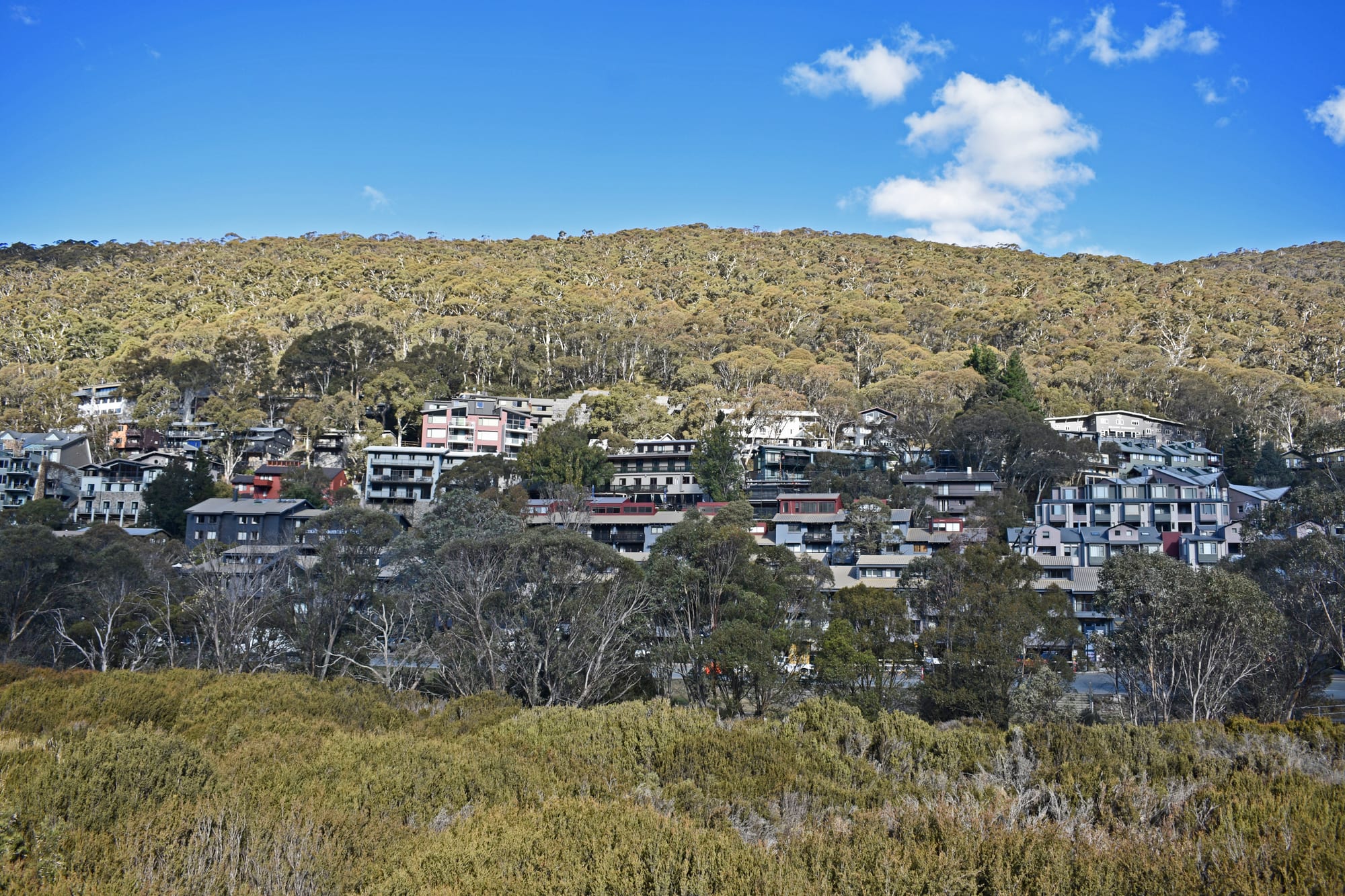
The village is small enough to cross on foot in fifteen minutes, but it is built on a steep slope, and moving between the square, the lodges above and Friday Flat means stairs, ramps and gradients, which are hard work with ski boots, luggage or a pram. Paths are cleared of snow in winter and can still be icy. A sealed shared path follows the river along the valley floor.
🛡️ Safety
The village itself is quiet and safe. The real risks are alpine. Weather changes within an hour, and the exposed walk to Mount Kosciuszko can turn from warm sunshine to cold rain, wind or snow in any month, with hypothermia the usual cause of trouble. Ultraviolet levels are high at altitude, snow and ice injuries are common on the slopes, and mobile coverage fails in the valleys. In 1997 a landslide destroyed two lodges in the village, killing 18 people, and the slopes above the road have since been extensively stabilised and monitored.
Carry warm and waterproof layers, water and a map on any walk above the chairlift even on a clear summer morning, tell someone the route, check the resort and park websites for closures, and keep to the raised walkway to protect the alpine plants. Check current official travel advice before travelling.
🌦️ Climate
An alpine climate, the coldest inhabited part of Australia along with the neighbouring resorts, with snow lying for months on the higher ground and frost possible in any season. Rain and snow fall through the year, and conditions differ sharply between the valley floor and the tops. Seasons are reversed from the northern hemisphere, so summer runs from December to February and winter from June to August.
- Summer
- cool and changeable — village days typically 17–24°C, colder and windier on the summits, with nights that can drop close to freezing
- Winter
- cold and snowy — village days around 0–5°C with nights well below freezing, and snow cover on the upper slopes usually from late June to September
🤝 Local Customs
Dress is practical rather than smart, and ski or snow gear is normal everywhere in winter. Tipping is not expected. Alcohol is served in licensed bars and hotels, and the village is patrolled at night in the busy season because it is a small place with a lot of visitors in it. The Snowy Mountains are the country of the Ngarigo people, and the high country carries cultural significance as well as being an extremely fragile environment.
Stay on marked tracks and the metal walkway above the treeline, take all rubbish out, leave dogs at home because they are not allowed in the national park, and give way to skiers below on the slopes.
💳 Common Payment Methods
The currency is the Australian dollar. Cards and contactless payment work throughout the village, lift passes and hire are sold online and at counters, and many venues do not handle cash at all. There is an ATM in the village, but it is worth drawing cash in Jindabyne if any is needed.