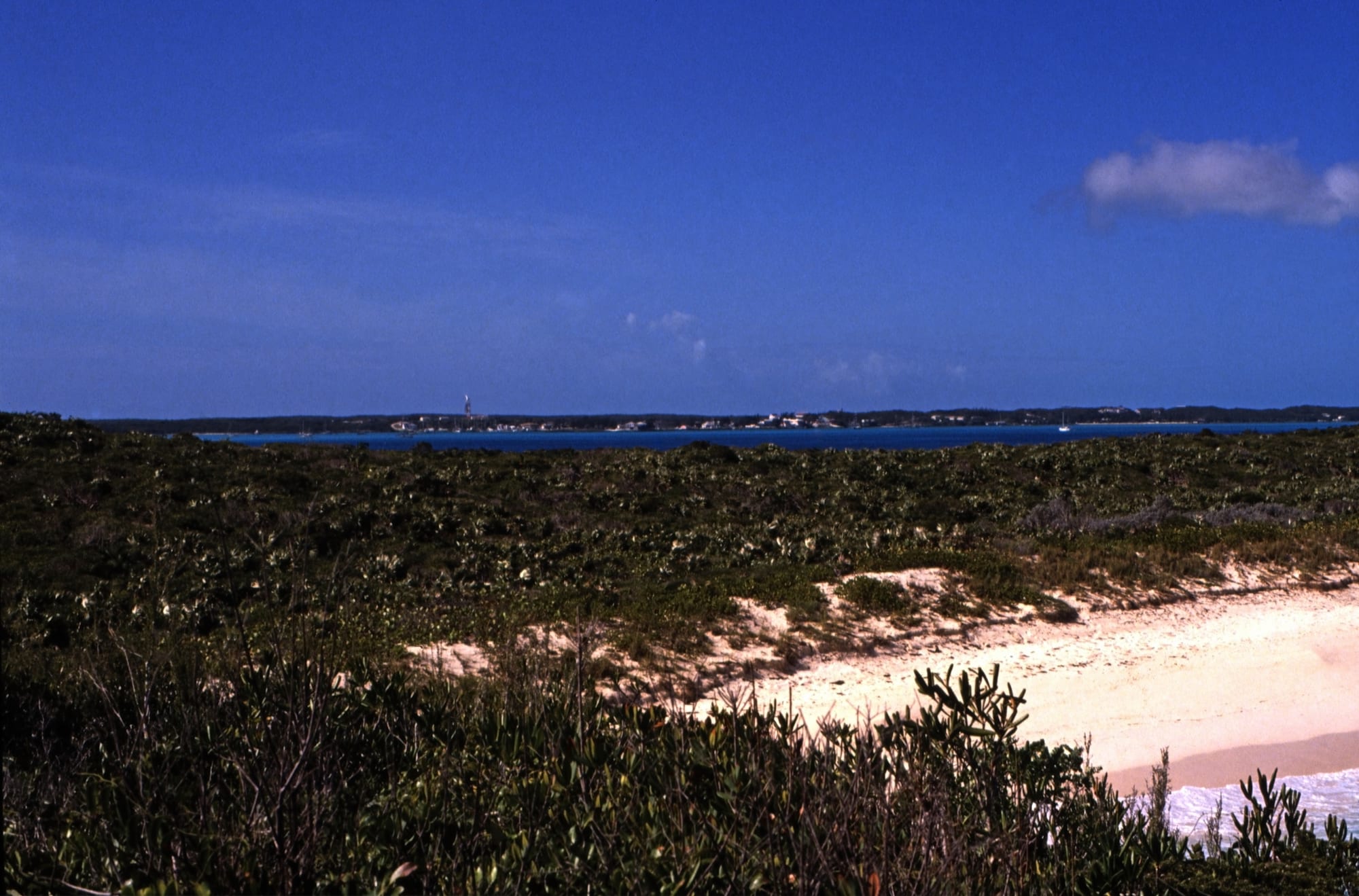
Low green scrub and a pale sandy beach on Stocking Island, with the deep blue harbour and the low shore of Great Exuma beyond

The Bahamas

Exuma

The view from Stocking Island across Elizabeth Harbour to George Town on Great Exuma. (Rüdiger Stehn from Kiel, Deutschland / Wikimedia Commons · CC BY-SA 2.0)

A district of more than 365 islands and cays strung over 130 miles of shallow turquoise water south-east of Nassau. Loyalist cotton planters settled it in the 1780s; today George Town on Great Exuma is the small capital, and resorts, sailing, a national marine park and the swimming pigs of the northern cays draw visitors.

Neighbourhoods

  • George Town
    • First-time visitors
    • Close to services
    • Sailing

    The capital of the district, on Great Exuma beside the deep water of Elizabeth Harbour, with shops, restaurants, churches, a hospital and the government building. Lake Victoria sits in the middle of town, and yachts anchor in the harbour through the winter.

    Open in Maps
  • Stocking Island
    • Beaches
    • Walks

    A long, narrow island across the harbour from George Town, reached by water taxi, with beaches, walking trails and several resorts.

    Open in Maps
  • Little Exuma
    • Beaches
    • Quiet and residential

    The smaller island joined to Great Exuma by a bridge, near George Town, where the Tropic of Cancer crosses Pelican Beach. Settlements are small and quiet.

    Open in Maps

Things to do

Beaches and the water

  • Stocking Islandbeach

    The narrow island off George Town, with beaches, several resorts and a nature trail.

    Open in Maps
  • Tropic of Cancer Beachbeach

    Pelican Beach on Little Exuma, crossed by the Tropic of Cancer, which gives it its other name.

    Open in Maps
  • Moriah Harbour Cay National Parkpark

    A protected area of 16,800 acres of cays, beaches and shallows in Exuma, established in 2002 and enlarged in 2015.

    Open in Maps
  • Bonefishing on the flatsattraction

    The shallow flats around Great and Little Exuma are known for bonefishing, with fishing guides for hire.

    Open in Maps

Short trips to the northern cays

  • Staniel Cayneighborhood

    A village of fewer than 120 full-time residents on the western shore of its cay, home of the Staniel Cay Yacht Club, with a few restaurants and a church; guided tours visit the nearby swimming pigs.

    Open in Maps
  • Thunderball Grottoattraction

    A cave in a small cay a few hundred yards off Staniel Cay, where scenes of the James Bond film Thunderball were shot, now a snorkelling spot.

    Open in Maps
  • Pig Beachbeach

    A beach on uninhabited Big Major Cay, home to a colony of swimming pigs; the animals can be pushy around food.

    Open in Maps
  • Exuma Cays Land and Sea Parkpark

    A protected area of cays, reefs and sea from Shroud Cay south to Bell Cay, established in 1958 under the Bahamas National Trust, with its headquarters on Warderick Wells.

    Open in Maps

Seasonal events

  • National Family Island Regattaearly in the year

    The biggest of the many sailing regattas held across the Bahamas, hosted each year by George Town.

Eat and drink

Long-standing places and food districts in Exuma. Hours, ratings and directions come from your maps app, always current.

Exuma classics

  • Chat 'N' Chillrestaurant

    A beach bar and grill on Stocking Island, reached by water taxi from George Town.

    Open in Maps
  • George Town restaurantsneighborhood

    Small restaurants and takeaways around the harbour and Lake Victoria serving conch, fish and peas 'n' rice.

    Open in Maps
  • Staniel Cayneighborhood

    A handful of restaurants in the village and at the marina, the main places to eat in the northern cays.

    Open in Maps

Experience Exuma

History

Pirates used the deep, sheltered water of Elizabeth Harbour in the 17th century, but permanent settlement came in or around 1783, when Loyalists fleeing the American Revolution brought enslaved Africans and a cotton plantation economy to the islands. Planters from Virginia laid out George Town in 1793. The best-known Loyalist landowner, John Rolle, gave his name to the settlements of Rolleville and Rolletown on Great Exuma.

The plantations failed, as they did across the Bahamas, and the islands turned to the sea. During the Second World War the US Navy used the port of George Town. In 1958 the Exuma Cays Land and Sea Park was established in the northern cays, with the newly created Bahamas National Trust set up to oversee it. The cays later reached a wider audience when scenes of the James Bond film Thunderball were filmed at a grotto off Staniel Cay.

Between 2000 and 2010 the district's population more than doubled as large and small resorts were built and direct flights began from cities as far away as Toronto. George Town's historic straw market burned down in 2015, and in 2020 the National Family Island Regatta was cancelled for the first time in 67 years because of COVID-19. Moriah Harbour Cay National Park, created in 2002, was expanded in 2015.

Culture & Customs

Sailing is Exuma's great tradition. George Town hosts the National Family Island Regatta, the biggest of the many regattas held across the Bahamas, and other events such as the George Town Cruising Regatta and the Black Point Regatta continue the tradition. George Town also holds an annual Winter Residents' Reception to welcome the seasonal residents and boaters who fill the harbour each winter.

The Bahamian Music and Heritage Festival, Junkanoo and the homecoming events of the smaller settlements are eagerly awaited by islanders and visitors alike, and the Run for Pompey marathon starts and ends in George Town each year.

Settlements are small and close-knit, and church is central to community life. Until recently the tourist population was very small, and the islands kept a reputation for privacy.

Fishing is part of island identity as well as a draw for visitors: guides take anglers after bonefish on the flats around Great and Little Exuma, boats head into Exuma Sound for mahi-mahi, wahoo and tuna, and local fishing still mainly feeds island households.

Daily Life

Exuma had about 6,900 people at the 2010 census, more than double the figure a decade earlier, and George Town had about 2,500 by a 2012 estimate. Most people live on Great and Little Exuma, along the main road through settlements such as Rolleville and Rolletown; the northern cays have only small villages such as Staniel Cay and Black Point.

Tourism is the main source of income — resorts, a golf course that has hosted a professional tour event, guesthouses, boat tours and the yachts that winter in Elizabeth Harbour — alongside fishing, which mainly feeds local households. George Town has a hospital, schools, a police station, grocery stores and fuel.

Life follows the water and the weather: boats carry people and goods between the cays, the mail boat and the plane connect the islands to Nassau, and the hurricane season is watched closely each year. Staniel Cay and Black Point have small airstrips of their own, served by charter flights.

Food

Exuma's cooking is built on the sea. Conch is eaten as conch salad, chopped raw and "cooked" in lime and citrus juice with onion, sweet pepper and tomato; as cracked conch, battered and fried; as fritters; and as conch chowder. Fried and grilled fish, spiny lobster and grouper are everyday fare, and the deep water of Exuma Sound supplies mahi-mahi, wahoo and yellowfin tuna to sport fishermen and restaurants.

Plates come with peas 'n' rice, baked macaroni "pie" and coleslaw. Breakfasts bring souse, a lime-and-pepper broth, with johnnycake, and guava duff is the classic dessert, a boiled pudding with guava folded into the dough and served with a sweet sauce. On Stocking Island, a beach bar and grill across the harbour from George Town is reached by water taxi.

Kalik and Sands beer and Bahamian rum are the usual drinks, and rum punches are a fixture of the island's beach bars and marina restaurants.

Planning tools

Budget

Exuma is expensive: food and fuel are imported, many visitors stay in resorts, and boat trips to the northern cays are the largest single cost. Guesthouses and self-catering in George Town keep daily spending lower.

Daily Budget Midrange
USD 300–600 (hotel or small resort, restaurants, a boat trip, car hire)
Daily Budget Shoestring
USD 130–200 (guesthouse, self-catering, water taxi to Stocking Island)

Boat tours to the northern cays are the biggest expense, so budget for them separately.

Best Time to Visit

Mid-December to mid-April brings the most reliable weather and the winter sailing season in Elizabeth Harbour, along with the highest prices. May and early June are a good-value shoulder. Late summer and autumn are hotter and wetter, with a real risk of hurricanes.

Suggested Number of Days

Three or four days allow time around George Town and its beaches. Five to seven days leave room for a boat trip to the northern cays, which takes a full day and depends on the weather.

First Visit
3–4 days
With Surroundings
5–7 days

Transportation

Great Exuma and Little Exuma, joined by a bridge, can be explored by car, and cars and boats can be hired in George Town and at the airport. Traffic drives on the left. A water taxi crosses from George Town harbour to Stocking Island, and the outer cays are reached by boat tour, by private boat or from Staniel Cay.

Weather decides boat trips; keep a spare day in case one is cancelled.

Airport & Station Connections

Exuma International Airport, near Moss Town, north-west of George Town, has flights from Nassau and from Miami, Fort Lauderdale, Atlanta, Charlotte and Toronto. Staniel Cay lies about 75 miles south of Nassau. Mail boats and ferries from Nassau are slower alternatives.

Walkability

George Town is small enough to walk, from the harbour round Lake Victoria to the shops and the water-taxi dock. The rest of Great and Little Exuma is spread along a single main road, and a car is needed to reach the beaches and settlements.

Safety

The Family Islands are very safe and quiet. Nassau needs more care: there is significant gun and gang violence, but it is concentrated in specific residential districts away from the tourist areas, and armed robberies and thefts targeting visitors do occur. In Exuma the main risks are at sea — boat traffic, currents and the sun.

Watch boat traffic and currents when swimming and snorkelling, and keep food away from the pigs on Pig Beach. Check current official travel advice before travelling.

Climate

Tropical and warm all year, steadied by the trade winds. The drier, slightly cooler season runs from December to April; May to October is hotter, more humid and wetter, and overlaps the hurricane season, which runs from June to November.

Summer
hot and humid, with frequent afternoon showers; in Nassau, summer highs are about 86–90°F
Winter
highs across the Bahamas around 77–82°F, with low rainfall and some cool northerly spells

Local Customs

English is spoken everywhere, and Bahamian dialect is the everyday speech. Exuma's settlements are small and close-knit, church is central to community life, and homecomings and regattas are eagerly awaited. Many hotels and restaurants add a service charge, so check the bill before tipping.

Ask before photographing people, and respect the protected status of the Land and Sea Park.

Common Payment Methods

The Bahamian dollar is pegged one-to-one to the US dollar, and US dollars circulate freely. Cards are accepted in resorts and many businesses in George Town, which has a bank; carry cash for the smaller settlements, water taxis and the cays.