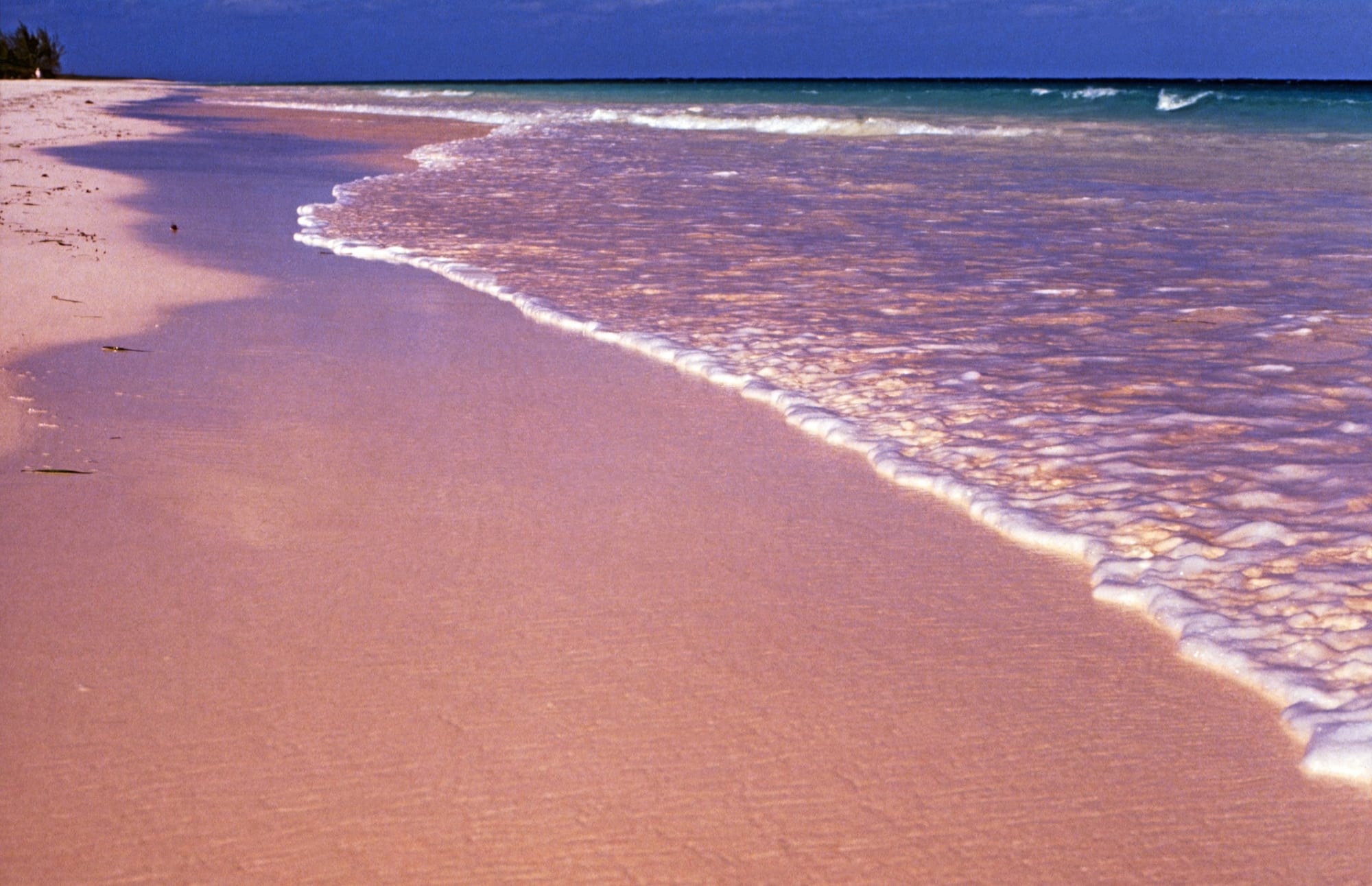
Gentle surf washing over a wide, empty beach of pink-tinted sand under a deep blue sky

The Bahamas

Harbour Island

The pink-sand beach on the Atlantic side of Harbour Island. (Rüdiger Stehn from Kiel, Deutschland / Wikimedia Commons · CC BY-SA 2.0)

A small island off the north-east coast of Eleuthera, known locally as Briland, with a single town, Dunmore Town, of colourful colonial-style houses and flower-lined streets. Its long Atlantic beach of pink sand, coloured by tiny red-shelled organisms, has made it a retreat for the travel elite, reached by water taxi from North Eleuthera.

Neighbourhoods

  • Dunmore Town
    • First-time visitors
    • Historic district
    • Best for food

    The island's only town, on the harbour side facing Eleuthera, named after the 18th-century governor Lord Dunmore. Its streets of colourful colonial-style houses, churches, shops and restaurants run along Bay Street from the government dock, where the water taxis arrive.

    Open in Maps
  • The pink-sand shore
    • Beaches
    • Quiet stays

    The Atlantic side of the island, a few minutes over the hill from town, where the pink-sand beach runs for about three miles. Hotels, many of them upscale, and large holiday homes sit back from the sand.

    Open in Maps

Things to do

Beaches and the town

  • Pink Sand Beachbeach

    About three miles of pink sand along the east side of the island, its colour coming from foraminifera, microscopic organisms with reddish-pink shells.

    Open in Maps
  • Dunmore Townneighborhood

    The island's single town of colourful colonial-style houses and flower-lined streets, easily seen on foot or by golf cart.

    Open in Maps

Short trips to North Eleuthera

  • Spanish Wellsneighborhood

    A small town on St George's Cay just off the northern tip of Eleuthera, reached by ferry or water taxi.

    Open in Maps
  • Preacher's Caveattraction

    The cave in North Eleuthera where the Eleutheran Adventurers, shipwrecked in the 1640s, took refuge; a service of thanks was held there every year for the next 100 years.

    Open in Maps
  • Glass Window Bridgeviewpoint

    The narrowest point of Eleuthera, where the island is about 30 feet wide between the Atlantic Ocean and the Great Bahama Bank.

    Open in Maps

Eat and drink

Long-standing places and food districts in Harbour Island. Hours, ratings and directions come from your maps app, always current.

Harbour Island classics

  • Queen Conchrestaurant

    A conch stand on Bay Street north of the government dock, known for conch salad.

    Open in Maps
  • Dunmore Town restaurantsneighborhood

    Restaurants of every level spread through the town and along the harbour, from local takeaways to hotel dining rooms.

    Open in Maps
  • Beach bars on the pink-sand shoreneighborhood

    Hotel and beach bars along the Atlantic side serving drinks and simple meals by the sand.

    Open in Maps

Experience Harbour Island

History

Before Europeans arrived, the Eleuthera islands were home to Lucayans, who were enslaved and removed by the Spanish within a few decades of Columbus's arrival. In 1648 English Puritans from Bermuda, the Eleutheran Adventurers led by William Sayle, arrived in search of religious freedom; their ship ran aground on rocks north of Spanish Wells, and they sheltered in Preacher's Cave, a short boat and road trip from Harbour Island. Theirs was the first concerted European effort to colonise the Bahamas.

Harbour Island sits on the outer edge of a lagoon in the north-east corner of Eleuthera, protected by a line of islands — Harbour, Jacobs, Man and Pierre — that looks like a reef. Its only town takes its name from John Murray, 4th Earl of Dunmore, governor of the Bahamas from 1786 to 1798, who kept a summer residence on the island.

Tourism grew in the second half of the 20th century, and hotels were being established by the mid-1960s. The pink-sand beach, the old town and the island's seclusion drew American visitors, and Harbour Island is now known as a retreat for the travel elite, with many upscale hotels and large holiday homes. The population has grown slowly, from about 1,760 at the 2010 census to about 1,860 in 2022.

Culture & Customs

Dunmore Town is one of the few settlements in the Bahamas whose population is predominantly of European descent, and the island's English colonial-style architecture — colourful buildings and flower-lined streets — has been likened to New England. Locals call their island Briland.

Life in Dunmore Town revolves around the harbour, the churches and the dock, where the water taxis arrive from North Eleuthera and porters handle the luggage. The island is part of the Out Islands, or Family Islands, and keeps their slower rhythm despite its fame. The pink sand itself has become the island's emblem: its colour comes from foraminifera, microscopic organisms with reddish-pink shells, washed ashore along the whole east side of the island.

Visitors and residents share the island closely. Holiday homes and hotels bring in a seasonal population of wealthy visitors, and many islanders work in the hotels, restaurants, golf cart rentals and boats that serve them.

Daily Life

About 1,860 people lived on Harbour Island at the 2022 census, making Dunmore Town one of the largest settlements in the Eleuthera group. Harbour Island is more densely populated than mainland Eleuthera and has the highest concentration of hotels in the area.

Tourism is the base of the economy. Hotels, restaurants, beach bars, holiday home management, golf cart rentals, porters and water taxis employ much of the population. Cars cannot be hired, and golf carts fill the narrow streets of the town.

The island depends on Eleuthera and Nassau for almost everything. Supplies come by boat, residents cross to North Eleuthera for the airport and many services. Hurricane season is watched closely each year.

The island is a popular holiday destination for Americans, and it is known as a retreat for the travel elite: luxurious holiday homes line the Atlantic side, while islanders live mostly in and around Dunmore Town, on the harbour side facing Eleuthera.

Food

Harbour Island eats like the rest of the Family Islands, with conch at the centre. Conch salad — raw conch chopped and "cooked" in lime and citrus juice with onion, sweet pepper and tomato — is sold at Queen Conch, a stand on Bay Street north of the government dock, and cracked conch and conch fritters are on almost every menu. Fried and grilled fish, spiny lobster and grouper are everyday fare.

Plates come with peas 'n' rice, baked macaroni "pie" and coleslaw. Souse, a lime-and-pepper broth, and johnnycake are breakfast food, and guava duff, a boiled pudding with guava folded into the dough and served with a sauce, is the classic dessert.

The island also has many restaurants for its wealthy visitors, from hotel dining rooms to beach bars on the pink-sand shore serving rum cocktails and light meals. Kalik and Sands beer and Bahamian rum are the usual drinks.

Planning tools

Budget

Harbour Island is expensive: many hotels are upscale, holiday homes are luxurious, and almost everything is brought in by boat. A few modest guesthouses with shared kitchens exist, and conch stands and takeaways are the cheapest way to eat.

Daily Budget Midrange
USD 350–650 (hotel, restaurants, golf cart hire, a boat trip)
Daily Budget Shoestring
USD 150–220 (modest guesthouse with a shared kitchen, conch stands, walking)

Golf cart hire is the main transport cost; many visitors share one for the whole stay.

Best Time to Visit

Mid-December to mid-April brings the most reliable weather along with the highest prices and the busiest season. May and early June are a good-value shoulder. Late summer and autumn are hotter and wetter, with a real risk of hurricanes.

Suggested Number of Days

Getting there takes much of a day, so three or four days make sense for a first stay. Five to seven allow a slower pace and time on the neighbouring islands.

First Visit
3–4 days
With Surroundings
5–7 days

Transportation

Cars cannot be hired on Harbour Island; visitors walk or hire a golf cart, the usual way of getting around. The town is compact, and the beach is a short ride or walk over the hill. Water taxis link the island with North Eleuthera.

Hire a golf cart for longer stays, and drive on the left.

Airport & Station Connections

The nearest airport is North Eleuthera Airport, which serves Harbour Island, Spanish Wells and the north of Eleuthera. From there a short taxi ride reaches the dock, and a water taxi crosses to Dunmore Town in about ten minutes; porters handle luggage along the way. Ferries from Nassau also call at Harbour Island, and the town has a marina for yachts.

Walkability

Dunmore Town is small and easy to walk, and the pink-sand beach is within walking distance over the hill. The north and south ends of the island are easier by golf cart.

Safety

The Family Islands are very safe and quiet. Nassau needs more care: there is significant gun and gang violence, but it is concentrated in specific residential districts away from the tourist areas, and armed robberies and thefts targeting visitors do occur. Harbour Island is one of the Family Islands, and the main risks are in the water.

Watch the surf and currents on the Atlantic beach and boat traffic in the harbour. Check current official travel advice before travelling.

Climate

Tropical and warm all year, steadied by the trade winds. The drier, slightly cooler season runs from December to April; May to October is hotter, more humid and wetter, and overlaps the hurricane season, which runs from June to November.

Summer
hot and humid, with frequent afternoon showers; in Nassau, summer highs are about 86–90°F
Winter
highs across the Bahamas around 77–82°F, with low rainfall and some cool northerly spells

Local Customs

English is spoken everywhere, and locals call the island Briland. Porters at the airport and docks expect a tip for carrying bags, and many hotels and restaurants add a service charge. Church is central to community life.

Ask before photographing residents and their homes.

Common Payment Methods

The Bahamian dollar is pegged one-to-one to the US dollar, and US dollars circulate freely. Hotels and many restaurants take cards, but cash is useful for taxis, water taxis, porters and conch stands.