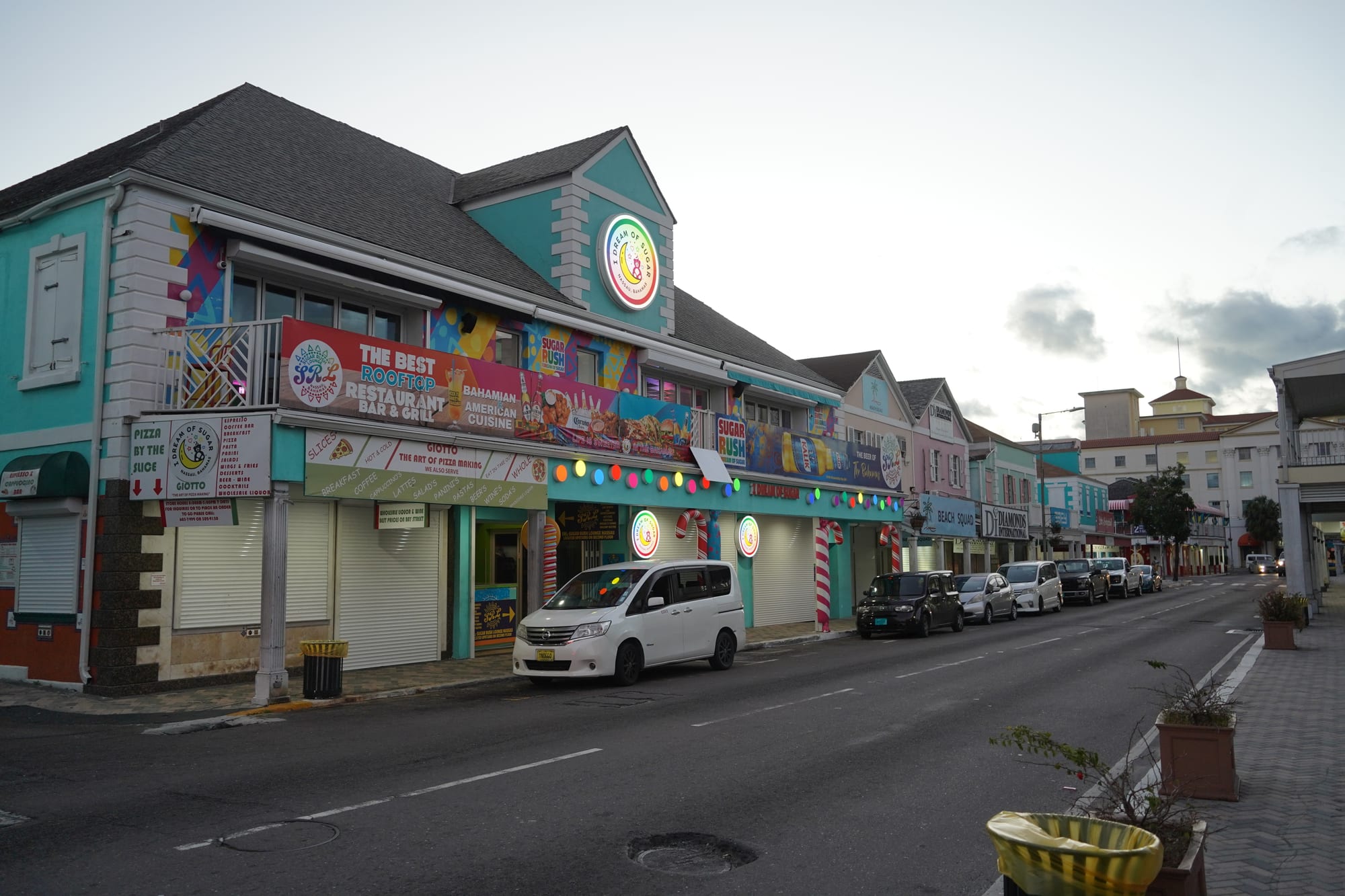
Pastel two-storey shopfronts with painted signs along a quiet stretch of Bay Street in downtown Nassau at dusk

The Bahamas

Nassau

Shops and restaurants along Bay Street in downtown Nassau. (Bluerasberry / Wikimedia Commons · CC BY 4.0)

The capital of the Bahamas, on the north shore of New Providence, founded by English settlers in 1670 and once the base of a pirate republic. Loyalists, liberated Africans and later tourism shaped the city, which now dominates the whole island; cruise ships tie up beside Bay Street, and old forts look over the harbour towards Paradise Island.

Neighbourhoods

  • Downtown and Bay Street
    • First-time visitors
    • Historic district
    • Shopping

    The old town along the harbour, where the cruise ships dock across from Bay Street and the Woodes Rogers Walk. A few blocks of boutiques, restaurants and the Straw Market give way to Parliament Square, Christ Church Cathedral and the hill rising to Fort Fincastle and the government buildings.

    Open in Maps
  • Cable Beach
    • Beaches
    • Resort hotels

    A two-and-a-half-mile beach on the north coast west of downtown, a centre of hotel development since the 1950s. Large beachfront hotels line the shore, and jitney buses run to it from Bay Street in the centre.

    Open in Maps
  • Paradise Island
    • Beaches
    • Resort hotels
    • Families

    The small island just off the city, formerly called Hog Island, joined to New Providence by two bridges across Nassau Harbour. It is dominated by a very large resort complex with a water park, aquarium and casino, and water taxis cross from downtown.

    Open in Maps

Things to do

Forts and landmarks

  • Queen's Staircaselandmark

    A flight of 65 steps cut out of solid limestone by about 600 enslaved people in 1793–94 to link Fort Fincastle with the town, later named after Queen Victoria.

    Open in Maps
  • Fort Fincastlelandmark

    A fort shaped like a paddle steamer, built by Lord Dunmore in 1793 on the hill above the town, with views over Nassau and Paradise Island; it doubled as a lighthouse until 1817.

    Open in Maps
  • Fort Charlottelandmark

    A late-18th-century British fort on a hill overlooking the harbour a short walk west of downtown, built under Lord Dunmore and never used in battle.

    Open in Maps
  • Fort Montagulandmark

    A small four-cannon fort on the eastern shore, begun in 1741 against the Spanish and raided by American Continental Marines in 1776.

    Open in Maps
  • Parliament Buildinglandmark

    The coral-pink home of the House of Assembly on Parliament Square, built in 1815 by Loyalist refugees, with a statue of Queen Victoria in front.

    Open in Maps
  • Nassau Public Librarylandmark

    A former colonial jail of 1797, the first building on Parliament Square, whose small cells now hold old documents, prints and Arawak artefacts.

    Open in Maps

Museums and gardens

  • National Art Gallery of The Bahamasmuseum

    The country's first national art museum, which collects, exhibits and interprets Bahamian art.

    Open in Maps
  • Pirates of Nassau Museummuseum

    A museum on George Street devoted to the pirate era, when Nassau was a haven for Blackbeard and his contemporaries.

    Open in Maps
  • Ardastra Gardens, Zoo and Conservation Centrepark

    Gardens opened in 1937 and a zoo of about 200 animals, best known for its flamingos.

    Open in Maps

Parks and beaches

  • Cable Beachbeach

    The long north-shore beach west of the centre, backed by large hotels.

    Open in Maps
  • Paradise Islandneighborhood

    The island across the harbour bridges, with beaches and the big resort that brings more visitors to Nassau than any other hotel property.

    Open in Maps
  • Clifton Heritage National Parkpark

    A 208-acre park at the western end of New Providence, opened to the public in 2009 as a tribute to the cultural history of the islands, on land once worked as a Loyalist plantation.

    Open in Maps

Markets

  • Straw Marketmarket

    The downtown craft market off Bay Street, replaced by a new market in 2011 after a fire in 2001 destroyed the original.

    Open in Maps
  • Potter's Caymarket

    Stalls under the Paradise Island bridge, best known for the fish market and for conch salad and fritters made to order.

    Open in Maps
  • Arawak Caymarket

    A man-made island built from harbour dredgings in 1969, known as the Fish Fry for the local seafood eateries along West Bay Street.

    Open in Maps

Seasonal events

  • JunkanooBoxing Day (26 December) and New Year's Day

    The city's chief festival: a street parade of costumed groups dancing to cowbells, drums and whistles, with judges awarding prizes for music, costumes and overall presentation.

Eat and drink

Long-standing places and food districts in Nassau. Hours, ratings and directions come from your maps app, always current.

Food districts and markets

  • The Fish Fry at Arawak Caymarket

    A row of local eateries on West Bay Street serving fried and grilled fish, conch and Bahamian side dishes.

    Open in Maps
  • Potter's Cay Dockmarket

    Fish-market stalls under the bridge to Paradise Island, where conch salad, conch fritters and other seafood are prepared fresh.

    Open in Maps
  • Bay Street restaurantsneighborhood

    Restaurants and bars scattered among the boutiques of the downtown waterfront, busiest when the cruise ships are in.

    Open in Maps

Experience Nassau

History

The town began in 1670 as Charles Town, founded by English settlers on the harbour of New Providence and named after King Charles II. It lived largely on privateering against the Spanish, who burned it to the ground in 1684. Renamed in honour of William III, Prince of Orange-Nassau, the sparsely settled town became a pirate haven in the early 18th century: the Governor of Bermuda reported more than a thousand pirates outnumbering about a hundred inhabitants, and Benjamin Hornigold, Charles Vane, Anne Bonny, Mary Read and Blackbeard all spent time here. In 1718 Woodes Rogers arrived as royal governor, clamped down on the pirates, rebuilt the fort and restored commerce.

During the American War of Independence, Continental Marines raided Fort Montagu and briefly occupied the town in 1776, and in 1783 the Loyalist Andrew Deveaux recaptured it for Britain. Loyalist planters and the people they enslaved arrived in large numbers, and under Lord Dunmore Fort Charlotte and Fort Fincastle were built, with enslaved workers cutting the Queen's Staircase through the limestone in 1793–94. After Britain abolished the slave trade in 1807, Africans freed from slave ships were resettled at Adelaide and Gambier villages, while the Over-the-Hill suburbs of Grants Town and Bain Town grew up south of the ridge.

Nassau profited from Prohibition in the United States in the 1920s and 1930s, and after 1959 restrictions on American travel to Cuba sent more tourists its way. A bridge to Paradise Island opened in 1966, and resort building followed. Until after the Second World War the outer suburbs scarcely existed; today the city dominates the entire island. A fire in 2001 destroyed the old market on Bay Street, replaced in 2011, the same year the Nassau Container Port was built on Arawak Cay.

Culture & Customs

Junkanoo is the city's great festival. In the early hours of Boxing Day and New Year's Day, organised groups parade through downtown in huge crepe-paper costumes, dancing to goatskin drums, cowbells, whistles and brass, and judges award prizes for music, costumes and overall presentation.

Nassau is also the seat of government, and colonial ceremony survives around Parliament Square, where the pink House of Assembly faces a statue of Queen Victoria and the old jail has served as the public library since 1873. Christ Church Cathedral and many other churches anchor the city's neighbourhoods, and the National Art Gallery, conceived after independence to tell the nation's own story, shows Bahamian painting and sculpture. Straw-plaiting is the traditional craft, sold in the Straw Market.

Sport means athletics above all: Nassau hosted the World Athletics Relays in 2014, 2015, 2017 and 2024, and Bahamian sprinters are national heroes. Family, church and the weekend gathering are the anchors of social life.

Daily Life

Nassau is a classic primate city, dwarfing every other town in the country and holding its commerce, education, law, government and media. The city had 292,522 people at the 2022 census, and nearly three-quarters of all Bahamians live on New Providence, the island it now dominates, a population swollen by generations of migration from the Family Islands.

Tourism is the base of the economy. Cruise ships bring large numbers of passengers onto Bay Street, the big hotels of Cable Beach and Paradise Island are major employers, and banking, government and the port provide much of the rest. Residents and visitors experience the waterfront very differently: for cruise passengers it is a shopping street, for Nassuvians a working centre of offices, courts and parliament. By the end of the 1950s land on Bay Street had become very expensive.

Most people live in the suburbs that spread south and west over the island, from the older Over-the-Hill neighbourhoods to newer subdivisions, and nearly everything depends on the car or the jitney. The high cost of imported goods is an everyday complaint, and every summer the city watches the hurricane forecasts.

Food

Conch is the city's staple, eaten as conch salad — raw conch "cooked" in lime and citrus juice with onion, sweet pepper and tomato, chopped to order — as cracked conch, battered and fried, and as fritters. Popular places to eat it are the stalls at Potter's Cay under the Paradise Island bridge and the Fish Fry at Arawak Cay on West Bay Street, a row of local eateries where Nassuvians gather for fried and grilled fish, music and drinks.

Plates come with peas 'n' rice, baked macaroni "pie" and coleslaw, and fried grouper and stew fish are as common as conch. Souse, a lime-and-pepper broth, and johnnycake are breakfast food, and guava duff is the classic pudding.

Rum-based drinks such as rum punch are popular; Kalik and Sands are the local beers. Downtown also has plenty of international chains for the cruise crowds, but local cooking is at the markets and the fish fry.

Planning tools

Budget

Nassau is expensive, because almost everything is imported and hotel taxes and service charges add up. Paradise Island and Cable Beach are the dearest places to stay. Jitney buses, the markets and the fish fry keep daily costs down for those staying in or near downtown.

Daily Budget Midrange
USD 300–600 (hotel or small resort, restaurants, a boat trip, taxis or car hire)
Daily Budget Shoestring
USD 130–200 (guesthouse, conch stalls and the fish fry, jitney buses)

The forts, the Queen's Staircase, Parliament Square and the waterfront cost little or nothing to see.

Best Time to Visit

Mid-December to mid-April brings the most reliable weather, the highest prices and the biggest crowds; Junkanoo falls at the start of it. May and early June are a good-value shoulder. Late summer and autumn are hot, humid and wetter, with a real risk of hurricanes.

Suggested Number of Days

Two or three days cover the historic centre and a beach. Four or five allow a slower stay and boat trips to the nearby cays. Many visitors arrive by cruise ship and have only a single day in port.

First Visit
2–3 days
With Surroundings
4–5 days

Transportation

Shared minibuses called jitneys are the city's bus system, leaving from Bay Street for Cable Beach and the rest of New Providence; they stop running in the early evening, and none goes to Paradise Island. Licensed taxis carry yellow plates, and water taxis cross from downtown to Paradise Island. Traffic drives on the left.

Use licensed taxis after dark, when the jitneys have stopped.

Airport & Station Connections

Lynden Pindling International Airport, the country's main gateway, is in western New Providence about 10 miles from the city centre, with flights from the United States, Canada, the United Kingdom and the Caribbean; travellers bound for the United States clear US immigration there before departure. Cruise ships dock at Prince George Wharf in the heart of downtown, and ferries and mail boats link Nassau with the Family Islands.

Walkability

Downtown is compact: the cruise port, Bay Street, Parliament Square, the Queen's Staircase and Fort Fincastle are all within walking distance of each other, though the climb to the fort is steep in the heat. Beyond the centre the city spreads along the coast, and Cable Beach, Paradise Island and the west of the island need a jitney, taxi or boat.

Safety

The Family Islands are very safe and quiet. Nassau needs more care: there is significant gun and gang violence, but it is concentrated in specific residential districts away from the tourist areas, and armed robberies and thefts targeting visitors do occur. The Over-the-Hill area south of downtown is the poorest part of the city, and visitors have little reason to walk there.

Avoid isolated beaches after dark, do not walk back to a hotel late through unlit areas, and use licensed taxis at night. Check current official travel advice before travelling.

Climate

Tropical and warm all year. The wet season runs from May to October and overlaps the Atlantic hurricane season, which lasts from June to November; the dry season runs from November to April.

Summer
hot and humid — daytime highs of about 86–90°F from May to October, with frequent showers
Winter
warm and drier — daytime highs of about 77–81°F from November to April, rarely falling below 59°F

Local Customs

English is spoken everywhere, and Bahamian dialect is the everyday speech. Many hotels and restaurants add a service charge to the bill, so check before tipping again. Church is central to life for many Nassau families.

Ask before photographing people, especially vendors in the markets. Traffic and taxis drive on the left.

Common Payment Methods

The Bahamian dollar is pegged one-to-one to the US dollar, and US dollars circulate freely, so change may come in a mix of both. Cards are widely accepted in hotels, shops and restaurants, and there are ATMs downtown; carry some cash for jitneys, market stalls and the fish fry.