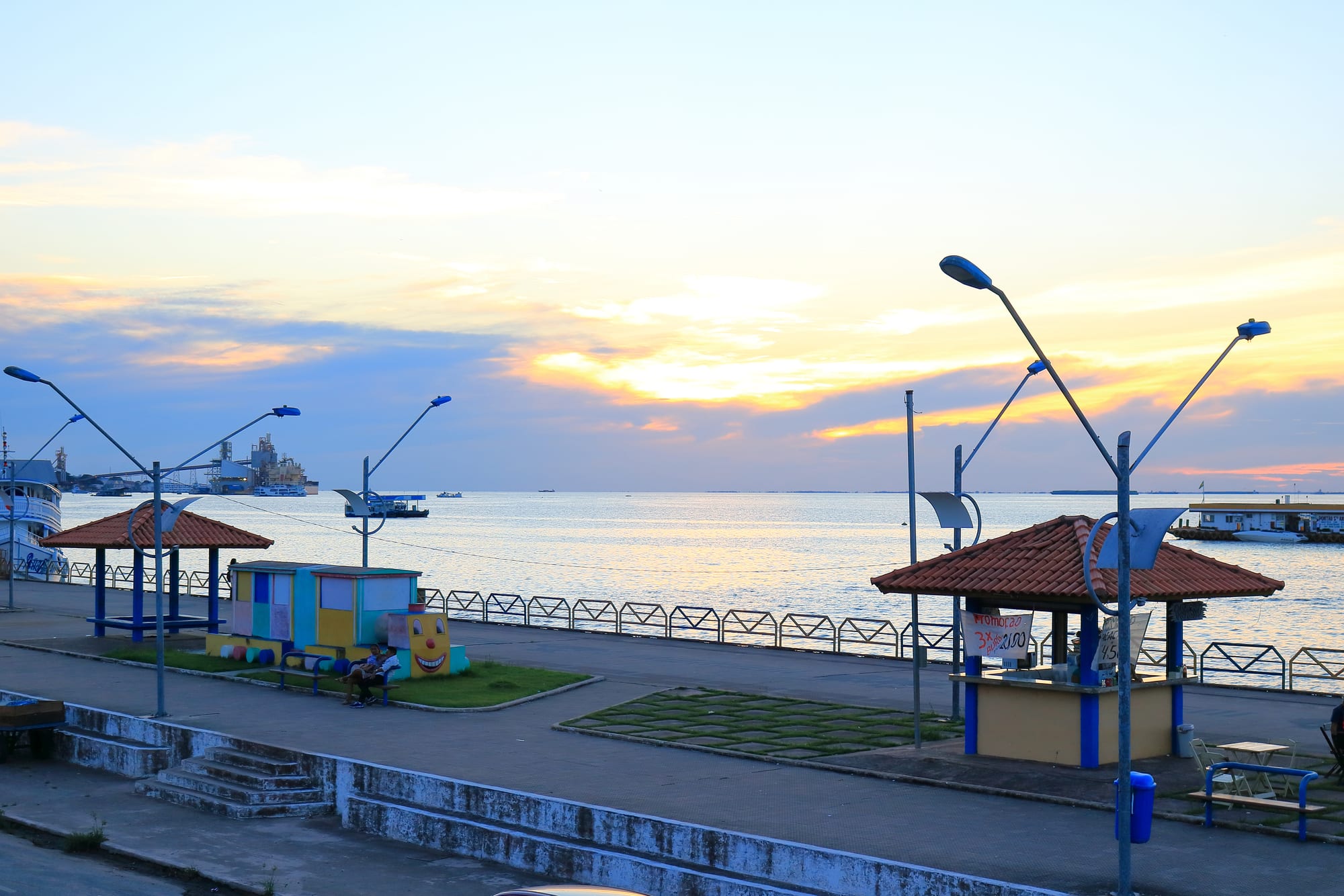
A riverside promenade with tiled kiosks and street lamps beside the wide Tapajós under an orange evening sky

Belém & the Eastern Amazon, Brazil

Santarém

The waterfront promenade of Santarém on the Tapajós River at the end of the day. (Wellington-stm from Brasil / Wikimedia Commons · CC BY 2.0)

A river port in western Pará where the Tapajós meets the Amazon, about midway between Manaus and Belém. Founded as a Jesuit mission village in 1661 on the land of the Tapajó people, it has lived through cycles of rubber, gold and now soya, and is known above all for the meeting of the two rivers and the white beaches of nearby Alter do Chão.

Neighbourhoods

  • Centro and the waterfront
    • First-time visitors
    • Markets
    • River views

    The old commercial centre along the Tapajós, with the cathedral, the markets, the small boat port near Praça Tiradentes and the riverside promenade, the orla, from which the meeting of the two rivers can be watched.

    Open in Maps
  • Prainha and the Mirante
    • Museums
    • Viewpoints

    The riverside district around the João Fona Cultural Centre, the city museum, and the Praça Mirante do Tapajós, a lookout square built in the 2000s above the water.

    Open in Maps
  • Alter do Chão
    • Beaches
    • Festivals
    • Slower pace

    A district of the municipality about 37 km from the centre by road, on the right bank of the Tapajós. White sand beaches appear as the river falls, and the village, once home to the Borari people, hosts the Sairé festival every September.

    Open in Maps

Things to do

The rivers

  • Meeting of the watersviewpoint

    In front of the city the deep-blue, warmer water of the Tapajós runs beside the milky, sediment-laden Amazon before the two mix — the sight locals call the meeting of the waters.

    Open in Maps
  • The orlatrail

    The promenade along the Tapajós in the centre, the city's favourite place for an evening walk with a view of the meeting of the rivers.

    Open in Maps
  • Praça Mirante do Tapajósviewpoint

    A lookout square built in the early 2000s above the river, with a wide view over the Tapajós.

    Open in Maps

Museums and landmarks

  • João Fona Cultural Centremuseum

    The city museum, facing the river in Prainha, open to visitors free of charge.

    Open in Maps
  • Cathedral of Santarémlandmark

    The metropolitan cathedral of the Archdiocese of Santarém, in the old centre near the river.

    Open in Maps

Markets

  • Mercado Modelomarket

    The central market on Travessa Senador Lemos, selling river fish, fruit, manioc flour and regional produce.

    Open in Maps
  • Mercadão 2000market

    Another of the city's big markets, selling everyday food and goods to townspeople and river communities.

    Open in Maps

Short trips from the city

  • Alter do Chãobeach

    The main attraction of the municipality — freshwater beaches on the clear Tapajós, one of which The Guardian named the most beautiful freshwater beach in the world, popularly known as the Brazilian Caribbean, best from about August to January when the river is low.

    Open in Maps
  • Ilha do Amorbeach

    The sandbar opposite Alter do Chão's waterfront, reached by a short canoe crossing or by swimming.

    Open in Maps
  • Belterraattraction

    The rubber plantation town laid out after the failure of Henry Ford's Fordlândia, with some 50 square kilometres of rubber trees planted at its peak in the late 1930s.

    Open in Maps
  • Tapajós National Forestpark

    A large area of Amazon rainforest between the Tapajós and the Santarém–Cuiabá road, protected since 1974 for sustainable use and run by the federal conservation agency ICMBio.

    Open in Maps

Seasonal events

  • SairéSeptember

    Held every September in Alter do Chão, the most traditional popular festival of the Amazon mixes Catholic processions with dances and the legends of the river, ending in a contest between the pink boto and the tucuxi dolphin groups.

Eat and drink

Long-standing places and food districts in Santarém. Hours, ratings and directions come from your maps app, always current.

Santarém classics

  • Mercado Modelomarket

    The central market, the place to see the river fish of the Tapajós — tambaqui, tucunaré, pirarucu and surubim — and the fruits of the region.

    Open in Maps
  • Riverside restaurants on the orlaneighborhood

    Restaurants and kiosks along the waterfront serve river fish grilled, fried or in caldeirada, with views over the Tapajós.

    Open in Maps
  • Alter do Chão's village restaurantsneighborhood

    Beach shacks and small restaurants around the village square, busiest in the dry-season months when the beaches are exposed.

    Open in Maps

Experience Santarém

History

Long before Europeans arrived, the land at the mouth of the Tapajós was home to the Tapajó people, who gave the river its name and left a distinctive archaeological culture, known as the Santarém or Tapajônica culture and noted above all for its pottery. The first written mention of their settlement dates from 1542, when Francisco de Orellana's expedition raided one of their maize fields on its way down the Amazon.

Jesuit missionaries arrived in the following century, and on 22 June 1661 Father João Filipe Bettendorff founded the mission village of Aldeia do Tapajós on the site; the Jesuits also founded other villages nearby, including the one that became Alter do Chão. A fortress, the Fortaleza do Tapajós, became the nucleus of the growing town. In 1758 it was raised to the status of a vila and renamed Santarém after the Portuguese city, and in 1848 it became a city. During the Cabanagem revolt of 1835 the local authorities moved to repress the rebels who had taken Belém.

The town's fortunes have followed a series of economic cycles — rubber, coffee, then a gold rush whose decline from the late 1980s was followed by a fall in the city's population in the late 1990s. Since 2000 it has grown again, and a private port beside the docks now ships soya from the expanding farmland of the region abroad. Proposals to divide Pará have named Santarém as the capital of a new state of Tapajós.

Culture & Customs

Santarém's culture blends Indigenous, Portuguese and caboclo river traditions. The pottery of the ancient Tapajó culture is a point of local pride and part of what the city offers visitors, and the religious calendar is marked above all by the Círio of Our Lady of the Conception, the largest religious festival in western Pará, which drew some 200,000 faithful in 2017.

The great popular festival is the Sairé, held every September in Alter do Chão. It mixes Catholic processions with local music and the dramatised legends of the Amazon, above all the boto, the river dolphin said to seduce young women, and ends with a contest between two groups, the pink boto and the tucuxi, with costumes, floats and songs in the spirit of the Parintins festival. The Sairé itself goes back to the Jesuit missions of the 17th century and is regarded as the most traditional popular festival of the Amazon.

Life is closely tied to the rivers. People from the riverside communities come into the city by boat to sell fish and produce and to use its hospitals and schools, and the composer Wilson Fonseca, born in Santarém, is honoured in the name of the airport. Evenings on the orla, watching the sun set over the Tapajós, are part of the town's routine.

Daily Life

The municipality had an estimated population of about 360,000 in 2025, according to the national statistics institute IBGE, making it the third most populous in Pará. It leads a small metropolitan area with Belterra and Mojuí dos Campos, and its districts include Alter do Chão and many communities reached only by water. Between 1980 and 2000 many people moved in from the countryside, drawn by better infrastructure, health care and schools.

The economy rests on commerce and services for the whole of western Pará, on the river port and on agriculture: the municipality is among the state's main producers of rice, soya and manioc, and the soya terminal on the waterfront is a visible sign of the farm frontier. Tourism, concentrated on Alter do Chão, brings visitors from Brazil and abroad. Studies of the waterfront have recorded a sharp loss of natural shoreline as port terminals have expanded.

The rhythm of the year follows the river. In the rainy months the water rises, flooding low land and covering the beaches; as it falls from about August, the sandbars reappear and the weekends move to the beaches. Boats come and go at all hours from the small port near Praça Tiradentes.

Food

Santarém eats from the river. Its markets sell tambaqui, tucunaré, pirarucu and surubim, and the fish is grilled, fried, cooked in caldeirada, a fish stew, or served as pirarucu in escabeche. Farofa de piracuí — toasted flour made from dried, ground fish — is a local speciality, often eaten with banana.

The dishes of Pará are found here too: tacacá, the hot tucupi and shrimp soup with jambu, pato no tucupi and maniçoba, along with cakes made from macaxeira, the sweet variety of manioc. Açaí is drunk as well, along with juices of fruits such as cupuaçu and graviola.

Amazon fruits turn up in juices and desserts, from cupuaçu cream and cupuaçu bonbons to biscuits made with Brazil nuts. In Alter do Chão, simple restaurants and beach shacks serve grilled river fish and cold beer beside the water when the beaches are exposed. The markets in town are the best place to see the range of fish, flours and fruit that reach Santarém by boat from the communities along the two rivers, and many visitors eat their best fish at the simplest places.

Planning tools

Budget

Santarém is moderately priced, with cheap market meals, simple hotels and inexpensive local boats and buses. Costs rise for guided trips into the forest and for rooms in Alter do Chão, which climb sharply in the dry-season holidays and around the Sairé in September.

Daily Budget Midrange
USD 80–170 (mid-range hotel, restaurant meals, boat trips on the Tapajós)
Daily Budget Shoestring
USD 30–60 (simple hotel or pousada, market meals, buses to Alter do Chão)

Book Alter do Chão well ahead for September and the dry-season holidays; the river beaches and the orla cost nothing.

Best Time to Visit

The beaches of Alter do Chão appear as the Tapajós falls, from about August to January, which is the most popular time to visit. The rains are heaviest from December to May, and September and October are the driest months. September also brings the Sairé festival.

Suggested Number of Days

Two to three days are enough for the city and a first look at the river beaches. Allow four to six days to stay on the Tapajós and visit the forest, and more for anyone arriving or leaving by slow riverboat.

First Visit
2–3 days
With Surroundings
4–6 days

Transportation

The centre is small enough to walk, and app taxis and taxis cover the rest. Buses run along the highway to Alter do Chão, about an hour by road. Many villages along the rivers are reached by boat; local boats leave from the small port near Praça Tiradentes, and larger ones from the Docas.

Confirm where a boat actually docks before buying a ticket — boats sold as going to Macapá, for example, arrive in Santana.

Airport & Station Connections

Santarém–Maestro Wilson Fonseca International Airport is about 15 km from the centre, around 20 minutes by car or bus along the Fernando Guilhon highway, with flights across Brazil. Riverboats link the city with Manaus, about a day and a half upstream, and Belém, around 60 to 70 hours downstream; the BR-163 road runs south towards Cuiabá.

Walkability

The centre, the markets and the orla are close together and pleasant to walk in the cooler hours along the river. Midday heat is intense, and beyond the centre distances are long. Alter do Chão's village is compact, and much of it is walked on sand.

Safety

Brazil has high rates of crime, including violent crime, and it is the main practical concern for visitors — though very unevenly distributed. Santarém and Alter do Chão are quieter than the big cities, but phone theft and petty crime occur, and river travel and remote forest areas call for local knowledge.

Use app taxis at night, travel in remote areas with established local guides, and use repellent against mosquitoes. Check current official travel advice before travelling.

Climate

Equatorial, hot and humid all year, averaging about 26°C, with more than 2,000 mm of rain a year. The rainy season, which locals call winter, runs from December to May; September and October are the driest months. The city lies just south of the equator, so formally summer is December to February, but the meaningful change is between wet and dry.

Summer
the rainy season — hot and very wet, close to the yearly average of about 26°C, with heavy showers
Winter
the drier months — hot and sunnier, close to the yearly average of about 26°C, with the river falling and the beaches emerging

Local Customs

A service charge is usually added to restaurant bills. Portuguese is the language of daily life and English is little spoken. The city is strongly Catholic, and religious festivals such as the Círio of Our Lady of the Conception draw huge crowds. On the beaches, dress is casual; in town and in churches, people dress more modestly.

Respect the rules of protected areas and the communities that guide visitors there, and ask before photographing people in villages.

Common Payment Methods

The currency is the Brazilian real (R$). Cards, phone payment and the instant Pix transfer system are widely accepted in the city; small boats, beach kiosks and village stalls may prefer cash. Withdraw money in Santarém, inside banks or shopping centres by day, as ATMs in Alter do Chão are few and many limit foreign cards.