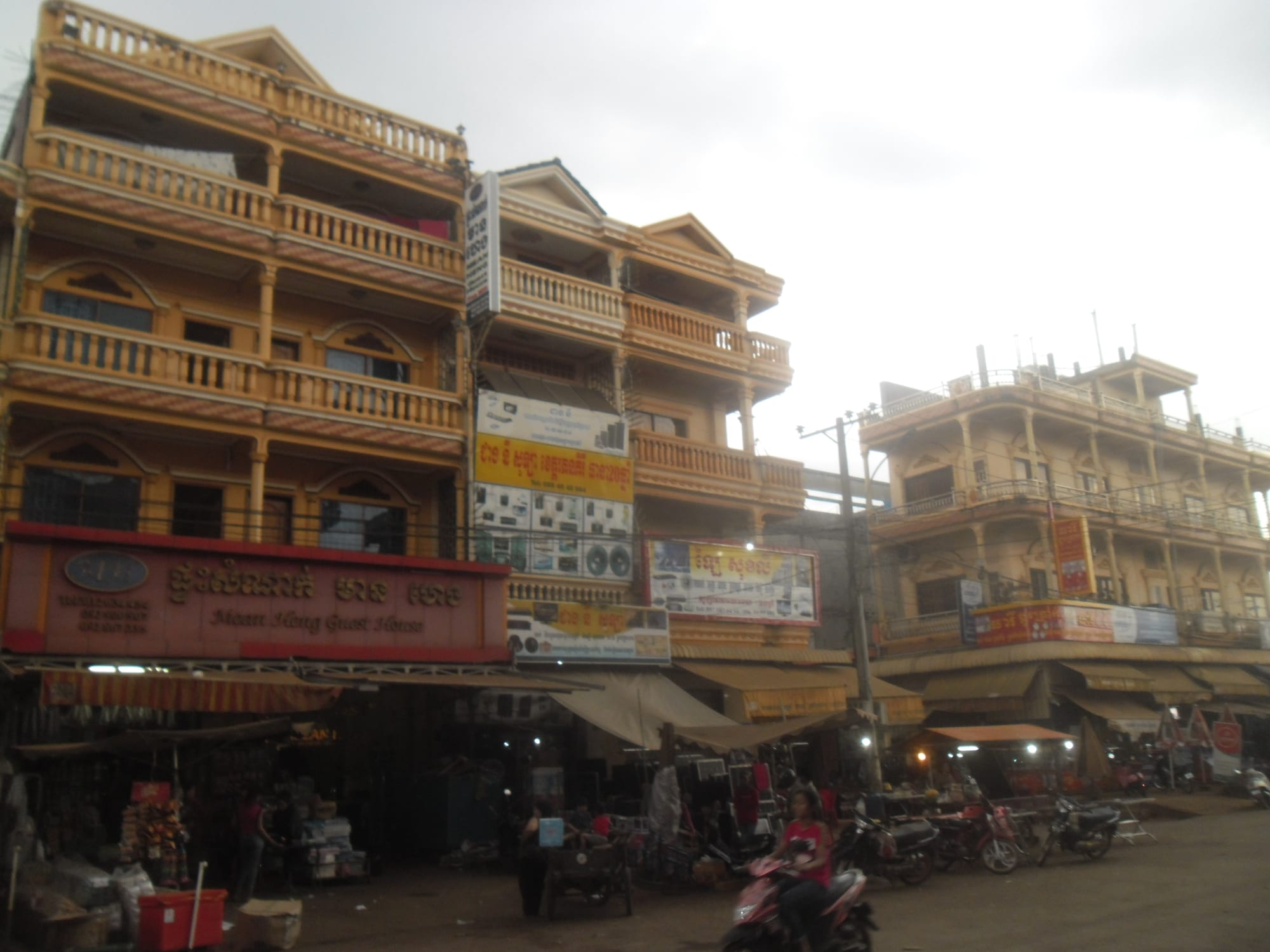
Tall balconied shophouses and a guesthouse above awnings and market stalls in Banlung, with motorbikes parked along the dusty street

Preah Vihear & the Northeast, Cambodia

Banlung

Shophouses and market stalls in the centre of Banlung, the capital of Ratanakiri province. (August Dominus / Wikimedia Commons · CC BY-SA 4.0)

The capital of Ratanakiri province in Cambodia's far north-east, a small town of red laterite roads on a plateau near the Vietnamese and Lao borders. Known as Labansiek until it became the provincial capital in 1979, it serves a region of indigenous highland villages, rubber and cashew plantations, forest and waterfalls, with the crater lake of Yeak Laom at its edge.

Neighbourhoods

  • The market and the centre
    • First-time visitors
    • Markets
    • Best for food

    The crossroads around the central market is where the town does everything — produce and cloth stalls, food carts, minivan offices, banks and shops selling motorbike parts and farm tools. Guesthouses, trekking operators and most restaurants are within a few blocks.

    Open in Maps
  • Boeng Kansaeng
    • Quiet and residential
    • Close to the water

    The small lake at the north of the town, ringed by a road with cafés, guesthouses and a few larger hotels. It is quieter and greener than the market area, and fills with families and food stalls at the end of the day.

    Open in Maps
  • The Yeak Laom road
    • Quiet and residential
    • Nature

    The road running out towards the crater lake, lined with houses, small lodges and rubber and cashew smallholdings that thin out into forest. Several of the town's bungalow-style places to stay are along it.

    Open in Maps
  • The highway edge
    • Close to public transport

    Where National Highway 78 arrives from the west, with fuel stations, workshops, warehouses and newer buildings spreading along the road. It is the practical end of town, used mainly for arrivals, departures and freight.

    Open in Maps

Things to do

The crater lake and waterfalls

  • Lake Yeak Laompark

    A near-circular volcanic crater lake about five kilometres south of the town, 800 metres across and some 50 metres deep, ringed by forest and a three-kilometre path, in a protected area managed by the Tampuan community, for whom it holds spiritual significance.

    Open in Maps
  • Chha Ong waterfallattraction

    A tall waterfall dropping into a shaded gorge in the forest west of the town.

    Open in Maps
  • Ka Tieng and Kachanh waterfallsattraction

    Two smaller falls in the plantations and forest a short ride from the centre, Katieng about three kilometres west of the town, where a conservation programme cares for some of the province's last elephants.

    Open in Maps

In the town

  • The central marketmarket

    The town's trading centre, with vegetables, forest produce, river fish, tobacco and cloth, and highland villagers coming in from the surrounding districts to buy and sell.

    Open in Maps
  • Boeng Kansaengpark

    The small lake at the edge of the town, with a road around it, cafés and food stalls, and a popular walk in the cool of the evening.

    Open in Maps
  • Eisey Patamak hilllandmark

    A low hill on the edge of town with a pagoda and a large reclining Buddha, reached by steps and looking out over the plateau and the forest.

    Open in Maps

Forests, rivers and reserves

  • Virachey National Parkpark

    A national park of some 3,380 square kilometres of forested hills and river valleys along the Lao and Vietnamese borders north of the town, one of only two ASEAN Heritage Parks in Cambodia, entered on guided multi-day treks.

    Open in Maps
  • Veun Sai-Siem Pang National Parkpark

    A national park of forest north-west of Banlung, in Ratanakiri and Stung Treng provinces, established in 2016 and known for its northern buffed-cheeked gibbons.

    Open in Maps
  • The Srepok river at Lumphatattraction

    A river of dry forest and sandbanks south of the town, running through Lomphat Wildlife Sanctuary, a large protected area set aside in 1993 where surveys have confirmed giant and white-shouldered ibises, sarus cranes, storks and vultures.

    Open in Maps

Seasonal events

  • Khmer New Yearmid-April

    Three days of pagoda ceremonies, games and water throwing at the hottest time of year, marked in the town and in lowland villages.

  • Pchum BenSeptember or October

    Offerings of rice are taken to the pagodas before dawn through the fifteen days of the festival of the ancestors.

Eat and drink

Long-standing places and food districts in Banlung. Hours, ratings and directions come from your maps app, always current.

Banlung classics

  • Highland grills and soupsrestaurant

    Town restaurants serve grilled river fish and meat, bamboo shoot and wild-green soups and rice, the everyday cooking of the plateau, alongside standard Khmer dishes.

    Open in Maps
  • Ratanakiri cashews and fruitmarket

    The province's cashews, mangoes, avocados, durian and coffee are sold roasted, fresh or ground at market stalls and shops in the town.

    Open in Maps

Markets and food streets

  • The central marketmarket

    Cooked-food aisles with noodle soups, rice plates and grilled meat, and stalls of forest vegetables, bamboo, river fish, chillies and dried goods brought in from the districts.

    Open in Maps
  • Boeng Kansaeng food stallsneighborhood

    Carts and open-air tables set up by the lake in the late afternoon, selling grilled meat and fish, fruit shakes, sugarcane juice and beer.

    Open in Maps

Experience Banlung

History

Ratanakiri's uplands lay outside the reach of the Khmer kings and their successors for most of their history. The plateau was the country of the Tampuan, Jarai, Kreung, Brao and Kavet, who farmed rotating hill fields and traded forest products, resin, wax and later rubber down the rivers to the Mekong. The province's name, from the Khmer words for gem and mountain, points to the stones dug in its hills. Under the French, large rubber plantations were laid out around Labansiek, the settlement that became Banlung, with indigenous workers used for the building and the harvesting.

Banlung itself is a modern town. Norodom Sihanouk's development and Khmerization campaign in the 1950s and 1960s drove roads, plantations and lowland settlers into the north-east and moved some highland families to the lowlands to be schooled in Khmer. War followed: the Ho Chi Minh Trail and North Vietnamese base areas ran through the forests to the east, American bombing followed in the late 1960s and early 1970s, and the Khmer Rouge built some of its earliest strongholds in these hills, recruiting among highland communities. The provincial capital moved from Veun Sai to Banlung in 1979, after the fall of the Khmer Rouge, to make trade with Vietnam easier; before Veun Sai it had been at Lumphat.

After 1979 the province remained isolated, reached by a road that took days in the wet season. The paving of National Highway 78 in the 2000s ended that, and with it came rubber, cassava and cashew plantations, migration from the lowlands, logging and gem digging, and a rapid transformation of the landscape. Banlung grew into a small market and administrative town, and from the 1990s a modest flow of travellers arrived for the lake, the waterfalls and the forest.

Culture & Customs

The province is one of the most culturally distinct in Cambodia. Indigenous peoples make up a large share of its population, each with their own language, and many communities keep animist beliefs centred on spirits of the forest, the water and the ancestors, alongside Buddhism and, in some villages, Christianity. Sacred groves, spirit forests and elaborately carved wooden grave houses, decorated with figures and personal possessions of the dead, remain part of village life and are private places rather than sights.

Rice wine drunk through long bamboo straws from a shared jar accompanies weddings, funerals, harvests and the welcoming of guests, and gongs and buffalo sacrifice have traditionally marked the largest ceremonies. Weaving, basketry and back-strap looms produce cloth still worn on ceremonial occasions. The Tampuan communities around Yeak Laom manage the crater lake, which is regarded as sacred, and run it as a community site.

Banlung's own life is more mixed: lowland Khmer officials, traders and plantation staff, Chinese and Vietnamese shopkeepers and Lao families near the northern border, with the Buddhist calendar setting the town's festivals. Relations between highland communities and incoming settlers, and disputes over land and forest, are a live subject. Visitors are expected to go to villages with someone who knows them, to ask before photographing, and to treat cemeteries and spirit sites as closed.

Daily Life

About 17,000 people live in the town, in a province of some 184,000 spread thinly across forest and plateau, just over one per cent of Cambodia's population. Mornings begin early and cold in the dry season, with the market busy from before six; offices and schools run through to the early afternoon, and the town is quiet after dark apart from the food stalls by the lake. Red dust covers everything from January to April, and mud replaces it in the rains.

The economy has changed faster here than almost anywhere in Cambodia. Rubber, cashew, cassava and pepper plantations, many established as economic land concessions, have replaced large areas of forest, and agriculture, transport and trade in these crops employ most people. Logging, small-scale gem digging for zircon and other stones, and hydropower on the Sesan river have all left their mark, and land disputes between companies, settlers and indigenous communities over ancestral land and forest are long-running and sometimes bitter. Conservation organisations work in the parks north and west of the town, and tourism supports guesthouses, guides and drivers on a small scale.

Highland households combine upland rice, gardens and forest gathering with plantation work, and many young people leave for Phnom Penh or Vietnam for part of the year. Services are limited: the provincial hospital handles only basic cases, and serious illness means the long road to the capital.

Food

Banlung's restaurants serve the food of lowland Cambodia — rice with grilled freshwater fish or pork, samlor machu, the sour tamarind soup, samlor korko thickened with roasted ground rice, beef lok lak with a lime and pepper dip, and nom banh chok, rice noodles in a green fish gravy, at breakfast. Prahok, the fermented fish paste, and tuk trey, fish sauce, season most of it.

Highland cooking is simpler and built on what the fields and forest give: upland rice, bamboo shoots, wild greens and mushrooms, small river fish, freshwater snails and crabs, chicken and pork at ceremonies, seasoned mostly with chilli, salt and herbs and often cooked in bamboo over an open fire. Krolan, sticky rice roasted with coconut and beans in a bamboo tube, is sold at the roadside, and jar rice wine, home-brewed from rice or cassava, is drunk through bamboo straws at festivals rather than sold in restaurants.

The province supplies a good deal of the country's fruit and nuts. Cashews are the dominant cash crop and are roasted and sold in the town; mangoes, avocados, jackfruit, durian and bananas come from the smallholdings; and Ratanakiri coffee, grown on the plateau, is served strong, iced and sweetened with condensed milk in cafés around the market and the lake.

Planning tools

Budget

Beds and food are cheap, and the cost of a stay is set by what is done outside the town: a motorbike or a driver for the waterfalls and villages, a guide for the lake and the plantations, and multi-day treks in the national parks, which are priced per group and are the single largest expense.

Daily Budget Midrange
USD 45–95 (bungalow or better hotel, restaurant meals, a car and driver or a guided day in the forest)
Daily Budget Shoestring
USD 15–30 (guesthouse room, market meals, a rented motorbike or shared transport)

Agree trek and guide prices, including food and village fees, before setting out, and carry cash, as machines are limited to the town centre.

Best Time to Visit

November to February, when the tracks are dry, the air is clear and nights on the plateau are genuinely cool. March to May is hot and hazy, with smoke from field burning. The rains from June to October turn the red roads to mud and make remote villages and treks hard to reach, though the waterfalls are at their strongest.

Suggested Number of Days

Two days is enough for the town, the crater lake and the nearest waterfalls. Longer stays are for the forest and the outlying districts, where roads are slow and guided treks take several days at a time.

First Visit
2 days
With Surroundings
3–5 days

Transportation

Rented motorbikes are the usual way to get around, along with moto-taxis and tuk-tuks from the market, and cars with drivers for longer trips or the wet season. Minivans and buses connect the town with Phnom Penh, Kratie, Stung Treng and Sen Monorom from offices near the centre. Roads beyond the main highway are laterite and rough.

Check brakes and tyres on a rented motorbike, avoid the red-earth tracks after heavy rain, and hire a local guide for village visits rather than arriving unannounced.

Airport & Station Connections

Banlung lies about 636 kilometres from Phnom Penh by road, roughly nine to eleven hours by bus or minivan, and around four hours from Kratie on National Highway 78. Stung Treng is some three hours to the west and Sen Monorom several hours to the south. The airport on the western edge of the town has taken only charter and private flights since commercial services ended in the 2000s; the nearest airport with scheduled flights is Phnom Penh.

Walkability

The centre is small and can be crossed on foot in twenty minutes, from the market to the lake at Boeng Kansaeng. Roads are wide, dusty in the dry season and muddy in the wet, pavements are intermittent, and street lighting is limited. The crater lake, the waterfalls and the villages are all too far to walk and need two wheels or a car.

Safety

Banlung is a quiet town with little crime against visitors beyond opportunist theft. The risks are rural: motorbike accidents on loose laterite, waterfalls with slippery rocks and strong flows after rain, remote forest where people become lost without a guide, and distance from medical care, which is basic in the province. Malaria and dengue occur in the forested districts, and unexploded ordnance remains in parts of the north-east away from roads and paths.

Trek only with a licensed local guide, stay on paths and cleared ground in forest and border areas, use repellent and avoid road travel after dark. Check current official travel advice before travelling.

Climate

Tropical monsoon, tempered by the height of the plateau, which is noticeably fresher than the Mekong lowlands. The dry season runs from November to April and the wet season from May to October, when rain is heavy and the laterite roads deteriorate.

Summer
hot before the rains — around 33–36°C in March and April; wet and around 28–32°C from May to October
Winter
dry and warm by day, 25–31°C, with cool nights from December to February

Local Customs

Ratanakiri is home to Tampuan, Jarai, Kreung, Brao, Kavet and other indigenous peoples as well as lowland Khmer, and highland villages have their own customs, spirit forests and burial grounds. Permission should be asked before entering a village, a house or a cemetery and before photographing people, and cemeteries and spirit sites should not be entered at all without an invitation. Jar rice wine drunk through bamboo straws is shared at ceremonies and is offered as hospitality.

Visit villages with a local guide who can explain what is welcome, cover shoulders and knees at pagodas and at the crater lake, and buy handicrafts from village weavers rather than bargaining hard; tipping is not expected.

Common Payment Methods

Cash is essential. The riel and the US dollar both circulate, with riel used for small amounts, and cash machines in the town centre take international cards. Beyond Banlung there are almost no machines, and villages, guides, transport and markets are cash only. Clean, untorn dollar notes are expected.