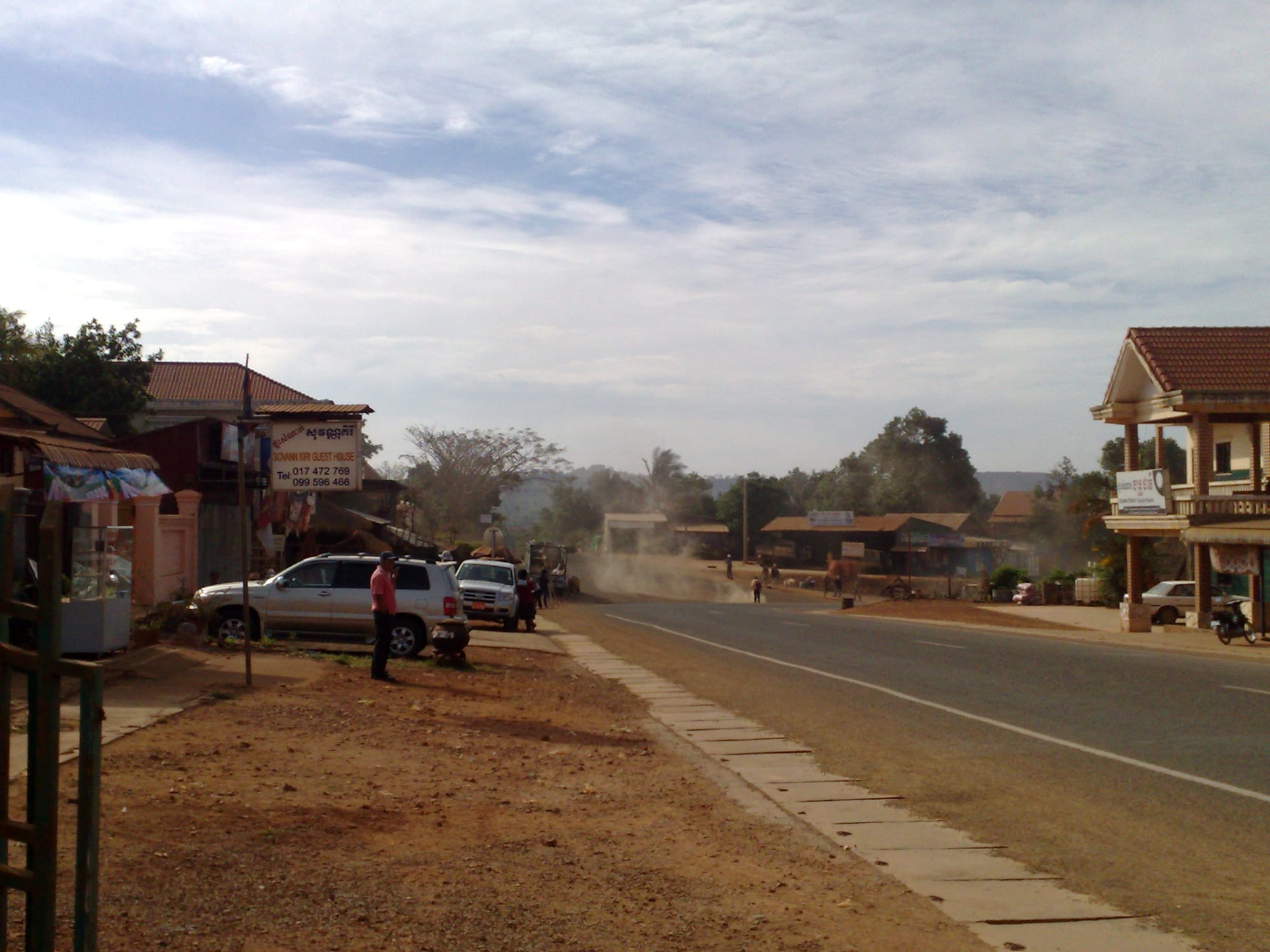
A dusty main road through Sen Monorom lined with shophouses and a guesthouse sign, with wooded hills in the distance

Preah Vihear & the Northeast, Cambodia

Sen Monorom

The main road through Sen Monorom, the capital of Mondulkiri province. (Dtfman / Wikimedia Commons · CC0)

The small capital of Mondulkiri province in Cambodia's eastern highlands, set on red-earth hills well above the lowland plain. Built up from a tiny administrative post, it is a town of guesthouses, a market and government offices, used as the base for elephant sanctuaries, Bunong villages, forest reserves and the Bou Sra waterfall in the country around it.

Neighbourhoods

  • The town centre and market
    • First-time visitors
    • Local life
    • Best for food

    A few blocks of shophouses, offices, phone shops and noodle stalls around the covered market, which sells vegetables, forest produce, dried fish and cheap clothes. Most of the town's guesthouses, minivan offices and tour operators are within a short walk of it.

    Open in Maps
  • The National Highway 76 strip
    • Close to transport
    • Quiet and residential

    The highway from Snuol runs into town past workshops, fuel stations, cashew and rubber traders and newer concrete houses. It is where buses and minivans set down passengers, and the long-distance ticket offices are here.

    Open in Maps
  • The hills and lakes on the edge of town
    • Views
    • Quiet and residential

    Beyond the last streets the ground opens into grassy, lightly wooded hills with small reservoirs, pine-like trees and scattered homesteads. Several lodges and bungalow places sit out here, close enough to walk in and far enough for cool nights and open views.

    Open in Maps
  • The Bunong villages around Sen Monorom
    • Culture
    • Day trips

    The Bunong, Mondulkiri's largest indigenous group, live in villages in the surrounding communes, many working with elephant projects and community tourism. Visits are usually arranged through local operators, and photography and entering houses are matters to ask about first.

    Open in Maps

Things to do

In and around the town

  • Sen Monorom marketmarket

    The town's covered market, the place to see what the plateau produces — bamboo shoots, wild greens, mushrooms, cashews and river fish — alongside breakfast noodle stalls.

    Open in Maps
  • Mondulkiri's elephant sanctuariesattraction

    Several projects in the forest around Sen Monorom care for retired working elephants with Bunong families; visits involve walking with the animals rather than riding them.

    Open in Maps
  • The hills around Sen Monoromviewpoint

    Open grassy ridges within a few kilometres of town, grazed and dotted with trees, giving long views over the plateau and cool evenings.

    Open in Maps

Short trips from the town

  • Bou Sra Waterfallattraction

    A waterfall with a triple-tier drop through forest east of the town, where viewing platforms allow it to be seen from above as well as at ground level.

    Open in Maps
  • Phnom Nam Lyr Wildlife Sanctuarypark

    A small, steep protected forest east of Sen Monorom towards the Vietnamese border, rising well above the surrounding plateau.

    Open in Maps
  • Keo Seima Wildlife Sanctuarypark

    A large protected forest holding black-shanked douc langurs and yellow-cheeked crested gibbons, with community-run visits from Bunong villages on its edge.

    Open in Maps
  • Phnom Prich Wildlife Sanctuarypark

    Dry forest, grassland and river valleys north-west of Sen Monorom, part of the wider Eastern Plains landscape.

    Open in Maps

Seasonal events

  • Khmer New Yearmid-April

    Three days of pagoda visits, games and water-throwing that empty the offices and fill the town with families returning from elsewhere.

  • Pchum BenSeptember or October

    The festival of the ancestors, when food offerings are taken to pagodas over fifteen days, ending in a public holiday.

Eat and drink

Long-standing places and food districts in Sen Monorom. Hours, ratings and directions come from your maps app, always current.

Where people eat

  • Sen Monorom marketmarket

    Morning stalls serving kuy teav noodle soup and rice plates, with fresh produce from the plateau on the surrounding tables.

    Open in Maps
  • The town-centre streetsneighborhood

    Khmer rice-and-stir-fry restaurants, barbecue places and a handful of Western-run cafés and bars serving the guesthouse trade, mostly within a few blocks of the market.

    Open in Maps

Local products

  • Mondulkiri coffee and honeycafe

    Coffee grown on the plateau is roasted and sold in the town, alongside wild honey collected in the forest and cashews from the surrounding plantations.

    Open in Maps

Experience Sen Monorom

History

Mondulkiri was a frontier of the Khmer world rather than part of its heartland: the plateau was the country of the Bunong, who farmed rotating hill fields, kept and worked elephants and traded forest products down to the lowlands, largely outside the control of the kings at Angkor and later at Phnom Penh. The French administration brought the highlands into the colonial state in the early 20th century, mapping the plateau, encouraging rubber planting and establishing small posts.

Sen Monorom itself is a recent town. The province was created in 1961 out of the eastern part of Kratié by order of King Norodom Sihanouk, and Sen Monorom was set up as its capital in 1962. The Vietnam War reached the plateau: in the late 1960s Mondulkiri held bases of the National Liberation Front of South Vietnam, and bombing by American forces followed. The Khmer Rouge built their early bases in the Ratanakiri hills to the north, and Mondulkiri was heavily affected in the years that came after — like others in the province, the Bunong were displaced in the 1970s and were only allowed back to their homeland in the 1980s.

The town was rebuilt slowly after 1979, and for decades it was reached only by a rough track that took a day or more from the Mekong. The paving of National Highway 76 changed that, cutting the journey from Phnom Penh to a matter of hours and bringing traders, plantation companies and visitors. Since the 2000s the province has been transformed by rubber, cashew and cassava concessions, logging and land sales, while conservation projects and community tourism have grown alongside them. Sen Monorom has become the meeting point of both.

Culture & Customs

The town's character comes from the meeting of two worlds. Lowland Khmer officials, traders and soldiers make up much of the settled population and set its Buddhist calendar, with a pagoda, monks on the morning alms round and the national festivals marked as they are everywhere else in Cambodia. Around it lies Bunong country. The Bunong, also called Phnong, speak an Austroasiatic language of the Bahnaric branch, distantly related to Khmer, and their traditions centre on spirits of forest, river and rice field, on large communal ceremonies and on the long relationship between families and their elephants.

Rice wine drunk through bamboo straws from a shared jar marks weddings, harvests and welcomes, and the largest ceremonies involve offerings of jar wine and sacrificed animals to the spirits. Gongs, woven cloth and baskets are part of household life rather than performance, although weaving groups now sell to visitors in town. Elephants, once working animals in logging and transport, are now at the centre of the province's tourism, and the shift from riding to sanctuary-style care has been one of the notable local changes of recent years.

Manners in town are Cambodian: greetings with palms together, modest dress, quiet voices and care not to embarrass anyone in public. In the villages, visitors are guests on someone else's land, and the plain rule is to ask before entering, photographing or walking into forest that may be considered sacred.

Daily Life

Sen Monorom is small — something over 10,000 people, and even so the largest town in a province that is Cambodia's biggest by area and its most sparsely populated. It is nonetheless the place where everything in Mondulkiri happens: the provincial offices, the hospital, the secondary schools, the banks and the market are all here, and people come in from the communes by motorbike to use them.

The economy runs on agriculture and what has replaced the forest. Cashew, rubber, cassava, pepper, coffee, avocado and fruit are grown on the plateau; traders in town buy and truck the harvests down to Phnom Penh and Vietnam. Plantation concessions, logging and land speculation have reshaped the province and produced long-running disputes with Bunong communities over land they have farmed for generations. Tourism, mostly around elephants, trekking and waterfalls, supports guesthouses, drivers and guides, and it collapses in the wet season.

Days start early and cold by Cambodian standards, with mist on the hills and the market busiest before eight. Offices close through the hottest part of the afternoon, and the evening is short — restaurants fill soon after dark and the town is quiet by ten. Electricity and mobile coverage have improved greatly, but road access, water supply and health care remain the everyday concerns, and many young people leave for work in Phnom Penh or across the border.

Food

Eating in Sen Monorom is Khmer cooking adapted to what the plateau grows. The staples are the same as everywhere in Cambodia: rice with a soup and a fried dish, kuy teav noodle soup for breakfast, bai sach chrouk — grilled pork with rice and pickles — from stalls in the morning, and lok lak, diced beef in a peppery sauce, on almost every menu. Prahok, the fermented fish paste, is the background flavour of much of it, and samlor korko, a thick mixed-vegetable soup, suits the local produce well.

The upland difference is in the ingredients. Bamboo shoots, wild greens, mushrooms and forest herbs appear in the market and in village cooking, with freshwater fish, chicken and pork rather than sea fish, and food seasoned simply with chilli, salt and lemongrass. Krolan, sticky rice with coconut and beans roasted in a bamboo tube, is sold along the roads into town. Rice wine, often home-made and drunk from a communal jar, belongs to ceremonies rather than restaurants.

Mondulkiri also produces things the rest of the country buys: cashews, wild honey, avocados, strawberries in a few plots and coffee grown on the hills, which the town's cafés roast and sell. Western-run cafés and bars serving the guesthouse trade sit alongside the Khmer restaurants, and iced coffee with sweetened condensed milk is the standard drink of the afternoon.

Planning tools

Budget

Sen Monorom is inexpensive to stay and eat in, but the things people come for are spread across rough roads, so transport is the real cost: a motorbike with a driver, a shared car, or a guided trek. Elephant sanctuary visits and community tours are priced per person and are the largest single item for most visitors.

Daily Budget Midrange
USD 50–110 (eco-lodge or better hotel, a car and driver, guided treks and sanctuary visits)
Daily Budget Shoestring
USD 20–35 (guesthouse room, market food, a rented scooter or shared transport)

Bring enough cash, since cash machines are few and card payment is rare outside a couple of hotels; dollars and riel are both used.

Best Time to Visit

November to February is the most comfortable stretch: dry tracks, clear air and genuinely cool nights on the plateau. March and April are hot and dusty, with red earth blowing through the town. The rains from May to October leave the hills green and the waterfalls full, but turn dirt roads to mud and make some sanctuaries and villages hard to reach.

Suggested Number of Days

Two days is enough for the town and one trip into the surrounding hills. Three or four allows the more distant forests and waterfalls, a village stay or a longer trek. Wet-season road conditions are the usual reason to allow more time.

First Visit
2 days
With Surroundings
3–4 days

Transportation

Everything in the centre is walkable; everything else is not. Visitors hire a scooter, a motorbike with a driver or a car with a driver, and guesthouses arrange most trips. Roads to the main sights are partly unpaved, steep in places and slippery after rain, and there is no public transport within the province worth the name.

Inexperienced riders should take a driver rather than a scooter on the red-dirt tracks, and helmets and long sleeves are sensible on dusty roads.

Airport & Station Connections

There is no airport. Buses and minivans run from Phnom Penh, about 390 km away by National Highway 76 through Snuol, and there are services from Kratie and from Banlung in Ratanakiri. Some travellers arrive by private car with a driver, which makes stops on the way possible.

Walkability

The built-up part of the town is small enough to cross on foot in fifteen or twenty minutes, and the market, guesthouses and restaurants are close together. Pavements are patchy, the roads are dusty in the dry months and muddy in the wet, and there is little street lighting away from the centre. Walks into the surrounding hills start almost at the edge of town.

Safety

The town is quiet and petty crime is uncommon, though the usual care with bags and valuables applies. The real risks are on the road: unpaved surfaces, scooter accidents and driving after dark. Medical facilities are basic, and serious cases go to Phnom Penh. Unexploded ordnance remains in parts of eastern Cambodia, so staying on established paths matters in forest areas.

Ride carefully or take a driver, carry water and a torch on forest trips, and choose elephant and trekking operators with care. Check current official travel advice before travelling.

Climate

The plateau is several degrees cooler than the Cambodian lowlands, with a dry season from November to April and heavy rain from May to October. Mornings are often misty, and cloud can sit on the hills for days in the wet months.

Summer
warm and very wet from May to October, typically 22–30°C, with long downpours and mud on the dirt roads
Winter
dry and pleasant, about 20–30°C by day, with nights cool enough to feel cold indoors

Local Customs

Khmer manners apply in town: a slight bow with palms together in greeting, shoes off indoors and in pagodas, shoulders and knees covered at religious sites, and no touching of anyone's head. In Bunong villages the customs are their own — spirit forests, burial grounds and some houses are not open to visitors, and permission should be asked before entering or photographing.

Tipping is not expected but is appreciated by guides and drivers; ask before photographing people, and treat rice wine offered from a shared jar as a courtesy to accept or decline politely.

Common Payment Methods

The riel and the US dollar circulate together, with dollars used for larger sums and riel given as change. Cash is the rule: a couple of banks and cash machines serve the town, card payment is limited to some hotels and tour operators, and villages are cash-only.