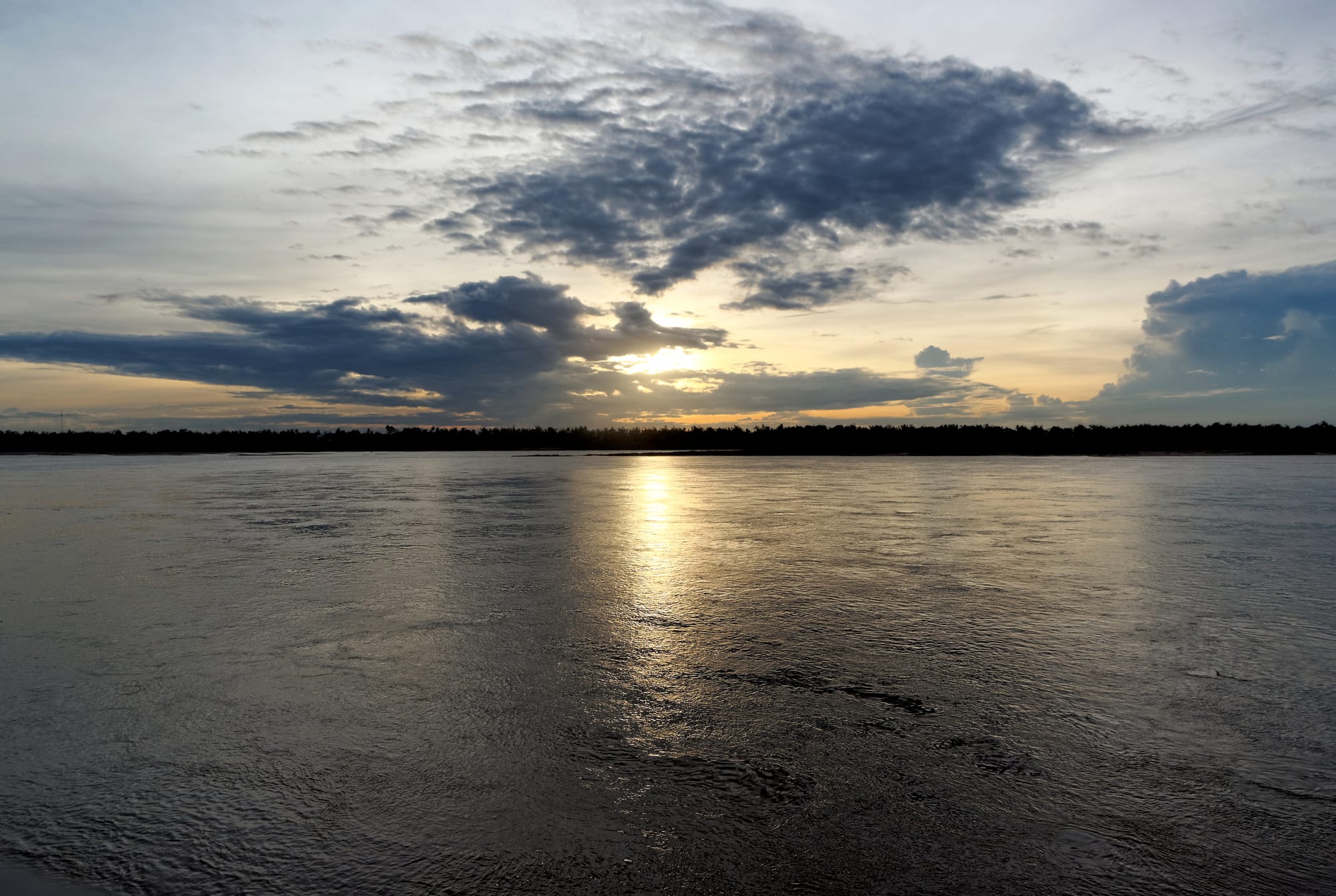
The broad Mekong at dusk, silver water under layered cloud with a low dark line of trees along the far bank

Preah Vihear & the Northeast, Cambodia

Kratie

Sunset over the Mekong at Kratie in north-eastern Cambodia. (Jakub Hałun / Wikimedia Commons · CC BY-SA 4.0)

A small provincial capital on the east bank of the Mekong in north-eastern Cambodia, with a riverfront of French colonial shophouses and a large sandy island facing it. Travellers stop here for the stretch of river upstream, where about a hundred Irrawaddy dolphins survive in the deep pools, and for slow days along the water.

Neighbourhoods

  • The riverfront
    • First-time visitors
    • Historic district
    • Best for food

    A few streets of two-storey shophouses with shuttered balconies face the Mekong along the town's promenade. Most guesthouses, cafés and restaurants are here, and the whole town comes out to sit by the water at the end of the afternoon.

    Open in Maps
  • Around the market
    • Markets
    • Local life

    The covered market block a street back from the river is the centre of daily trade, ringed by food stalls, phone and motorbike shops and moto-taxi drivers. Busiest before eight in the morning and quiet by the evening.

    Open in Maps
  • Koh Trong
    • Quiet and residential
    • Cycling

    The long island in the river opposite the town, reached by ferry, with sandy lanes, pomelo orchards, stilt houses and a floating Vietnamese village at its edge. A handful of homestays and small lodges make it the quiet alternative to the riverfront.

    Open in Maps
  • The road north to Kampi
    • Quiet and residential
    • Local life

    Villages, pagodas and rubber and fruit smallholdings line the river road upstream, past the hill of Phnom Sombok. It is farming country rather than a place to base a stay, but it holds the landing for the dolphin boats.

    Open in Maps

Things to do

The river

  • Kampi dolphin poolattraction

    A deep stretch of the Mekong upstream of the town, where small wooden boats go out at dawn and dusk to watch Irrawaddy dolphins surface; about 105 were counted in the Cambodian stretch of the river in 2024.

    Open in Maps
  • Koh Trongattraction

    The island opposite the town, crossed by sandy tracks between pomelo orchards and stilt houses and circled on foot or by bicycle, with a floating village of ethnic Vietnamese families at its northern end.

    Open in Maps
  • The riverfront promenadeattraction

    The paved walk along the Mekong in front of the colonial shophouses, lined with benches, drink carts and food stalls and busiest at sunset.

    Open in Maps

Temples and the town

  • Phnom Somboklandmark

    A small hill north of the town with pagodas at two levels, reached by steps and giving a wide view over the Mekong and the surrounding plain.

    Open in Maps
  • The central marketmarket

    The town's covered market, selling river fish, fruit, meat and vegetables from early morning, with cooked-food aisles at its edges.

    Open in Maps

Short trips

  • Samborlandmark

    A village upriver linked with a royal capital of the pre-Angkorian Chenla period, and the site of Wat Sasar Moi Roi, a large pagoda of a hundred columns.

    Open in Maps
  • Chhloungattraction

    A riverside district town downstream from Kratie with a cluster of French colonial and Chinese merchant buildings along the Mekong.

    Open in Maps

Seasonal events

  • Khmer New Yearmid-April

    Three days of pagoda ceremonies, games and water throwing at the hottest, lowest point of the river year.

  • Pchum BenSeptember or October

    Families carry offerings of rice to the pagodas before dawn during the fifteen-day festival of the ancestors.

  • Water Festivallate October or November

    Three days of boat races and river celebrations marking the end of the rains and the change in the waters, centred on Phnom Penh and kept in river towns as well.

Eat and drink

Long-standing places and food districts in Kratie. Hours, ratings and directions come from your maps app, always current.

Kratie classics

  • Mekong fish grillsrestaurant

    River fish grilled whole over charcoal and eaten with rice, raw herbs and a sour dip is the town's standard meal, served in the riverfront restaurants.

    Open in Maps
  • Krolanmarket

    Sticky rice with coconut milk and beans roasted in a bamboo tube, sold along the roads out of town and a speciality of this part of the Mekong.

    Open in Maps
  • Koh Trong pomelosmarket

    Pomelos grow in the island's orchards and are sold at the ferry landing and at stalls in the town in season.

    Open in Maps

Markets and food streets

  • The central marketmarket

    Noodle soups, rice plates and grilled meat in the cooked-food aisles, with dried and fermented fish, palm sugar and fruit on the stalls around them.

    Open in Maps
  • The riverfront restaurantsneighborhood

    The row of shophouses facing the Mekong holds most of the town's restaurants and cafés, mixing Khmer kitchens with simple traveller menus.

    Open in Maps

Experience Kratie

History

The stretch of the Mekong around Kratie has been settled far longer than the town itself. Upriver at Sambor the area is linked with a royal capital of the pre-Angkorian Chenla period, whose rulers held the middle Mekong before the rise of Angkor, and the rapids and deep pools above the town marked the limit of easy navigation from the delta.

Modern Kratie grew under the French protectorate in the late 19th and early 20th centuries as a river port and administrative seat. Steamers working upstream from Phnom Penh towards Stung Treng and Laos called here, Chinese and Vietnamese merchants settled along the bank, and the rows of shuttered shophouses on the riverfront date from that period. Rubber, timber and river trade supported the town, and the province was one of the more isolated parts of the country, reached mainly by water until roads improved.

The eastern provinces were heavily bombed during the Indochina wars, when the Vietnamese-controlled supply routes ran through the forests nearby, and the region came under Khmer Rouge control early in the war; the town was emptied like the rest of the country after 1975. It escaped serious destruction, however, which is why the colonial centre survives largely intact. Since the 1990s a paved highway has replaced the river as the main link to Phnom Penh, plantations have spread across the province, and the town has taken on a modest trade in visitors drawn by the dolphins and the quiet of the riverfront.

Culture & Customs

Kratie is a lowland Khmer town, Buddhist and conventional, and life runs through the pagodas, the market and the river. Monks walk for alms at first light, the wats hold the ceremonies that punctuate the year — Khmer New Year in April, Pchum Ben in the autumn, ordinations and funerals — and the hill shrines at Phnom Sombok and the pagoda at Sambor draw people from the surrounding villages.

The town has long been mixed. Chinese and Vietnamese traders settled along the riverfront in the colonial period and their descendants still run shops and restaurants; a floating Vietnamese fishing community lives off the north end of Koh Trong; and Cham Muslim villages with their own mosques stand along the Mekong nearby. In the districts east of the river, Khmer settlement gives way to upland peoples whose villages lie towards Mondulkiri.

The dolphins have shaped local identity in the past two decades. They are regarded with affection and a degree of reverence, the stretch of river from eastern Kratie province to the Lao border was declared a limited fishing zone in 2012, with gill nets and fishing cages barred, and boatmen, guides and stallholders now depend in part on the animals, whose Mekong population is listed as critically endangered. Evenings are social and unhurried: families gather on the promenade at sunset, children swim from the sandbanks in the dry season, and the town is quiet well before late. Visitors are expected to dress modestly away from the water and to keep noise down near shrines and on the boats.

Daily Life

Kratie is the capital of a thinly settled province where about seven in ten people live in the countryside, and almost everything happens between six in the morning and the middle of the afternoon. The market opens in the dark, schools and offices run through the morning, the hottest hours empty the streets, and the riverfront fills again at dusk with walkers, food carts and exercise groups.

The economy is farming, fishing and trade. Rice is grown on the flood plain, and the riverbanks and islands produce vegetables, maize, sesame and fruit, with pomelo orchards on Koh Trong. Rubber and cassava plantations, many of them established on former forest land, have spread across the province and are a source of both jobs and long-running land disputes with rural and indigenous communities. Fishing on the Mekong remains important, but catches have fallen with dams upstream, illegal gear and pressure on the river, which also threatens the dolphins.

Most people live in wooden stilt houses on the plots behind the centre and in the villages along the river road, where newer concrete houses are appearing as money returns from relatives working in Phnom Penh, Thailand and South Korea. Tourism provides a small, seasonal income to guesthouses, boatmen and drivers. The province's persistent concerns are river health, land, debt and the distance to decent healthcare.

Food

Kratie eats from the Mekong. River fish is grilled over charcoal, fried, stewed in sour soups or dried and fermented into prahok, the pungent paste that flavours much of Khmer cooking; small fish are salted and dried on racks in the villages, and fish sauce and prahok sit on most tables. Meals are rice with two or three shared dishes and a plate of raw herbs, cucumber and banana flower.

The dishes are those of lowland Cambodia: nom banh chok, rice noodles under a green fish gravy of lemongrass and turmeric, eaten at breakfast; kuy teav, a clear pork and rice-noodle soup; samlor machu, a sour tamarind soup with fish; samlor korko, thick with vegetables and roasted ground rice; and, in restaurants, beef lok lak with a lime and black pepper dip and fish amok steamed in banana leaf.

Kratie's own speciality is krolan, sticky rice with coconut milk, black beans and sometimes sesame, packed into a bamboo tube and roasted over a fire until the tube chars; it is sold in bundles along the roads out of town and taken home by travellers as a gift. The island opposite supplies pomelos, and mangoes, bananas and sugar palms grow along the river. Drinks are iced coffee with condensed milk, sugarcane juice, palm juice in season and beer over ice at the riverfront tables.

Planning tools

Budget

Kratie is cheap. Guesthouses on the riverfront and homestays on Koh Trong cost little, meals are inexpensive, and the main extras are the boat out to the dolphin pool, hired by the boat rather than the seat, and transport up and down the river road.

Daily Budget Midrange
USD 40–90 (riverfront hotel or island lodge, restaurant meals, a tuk-tuk for the day and a dolphin boat)
Daily Budget Shoestring
USD 15–30 (guesthouse or homestay, market meals, shared minivan and moto-taxis)

Share a dolphin boat with other passengers to spread the cost, and bring cash, as machines are few once out of the town centre.

Best Time to Visit

December to April, the dry season, when the Mekong is low, the dolphins gather in the deep pools and the sandbars and island tracks are exposed. March and April are very hot. The rains from June to October bring a swollen, fast river, green countryside and fewer visitors, and the island's paths turn to mud.

Suggested Number of Days

A night or two covers the town and the river for most travellers, which is how long the majority of people break their journey here. Longer stays are usually about a slower pace on the island or trips along the river road.

First Visit
1–2 days
With Surroundings
2–3 days

Transportation

The town is small and flat, and moto-taxis and tuk-tuks wait by the market and the riverfront; drivers also work by the half-day for the river road and the dolphin landing. Bicycles and motorbikes are rented by guesthouses, and a passenger ferry and small boats cross to Koh Trong. Buses and minivans use offices near the market.

Agree the tuk-tuk fare and waiting time for the trip upstream before setting out, and check the last ferry back from the island.

Airport & Station Connections

Kratie lies on the Mekong about 250 kilometres north-east of Phnom Penh, roughly five to six hours by bus or minivan on paved roads, and is a common stop on the way to Stung Treng, the Lao border, Banlung or Sen Monorom, each several hours further. There is no airport; Phnom Penh is the nearest.

Walkability

The centre is easy on foot: the riverfront, the market and the guesthouses sit within a few hundred metres of each other, and the promenade is the natural place to walk in the early morning and evening. Pavements are patchy and shade is limited in the middle of the day. Koh Trong is walked or cycled on sandy lanes, and the dolphin pool is too far to reach on foot.

Safety

The town is quiet and crime against visitors is rare, with petty theft the usual risk. The Mekong is the real hazard: the current is strong and the water deep, boats are small and often carry no life jackets, and swimming from sandbars is dangerous when the river is high. Medical care is basic and the nearest hospitals of any size are in Phnom Penh, and roads in the region are dangerous after dark.

Wear a life jacket on river boats and choose one that is not overloaded, avoid road travel at night, and carry mosquito repellent, as dengue and malaria occur in the region. Check current official travel advice before travelling.

Climate

Tropical monsoon in the Mekong lowlands. The dry season runs from November to April and the wet season from May to October, when heavy rain raises the river by several metres and floods the low banks and islands.

Summer
hot before the rains — often 33–38°C in March to May; wet, humid and around 30–33°C from May to October
Winter
dry and warm — 25–32°C from November to February, with cooler mornings

Local Customs

Cambodian manners apply: the sampeah, palms together with a slight bow, is the greeting, shoulders and knees are covered at pagodas, and shoes are removed before entering a temple building or a home. Monks are not touched, and women do not hand things to them directly. On the dolphin boats, quiet is expected, and boats are supposed to keep their distance and cut engines near the animals.

Ask before photographing people, particularly in the floating village and the fishing hamlets; tipping is not expected but is appreciated by boatmen, drivers and guides.

Common Payment Methods

The riel and the US dollar both circulate, with dollars used for larger amounts and riel as change. Cash machines in the centre dispense both, but they are the last reliable ones for some distance upriver. Cards are accepted by a few hotels only; boats, homestays, markets and moto-taxis are cash, and torn notes may be refused.