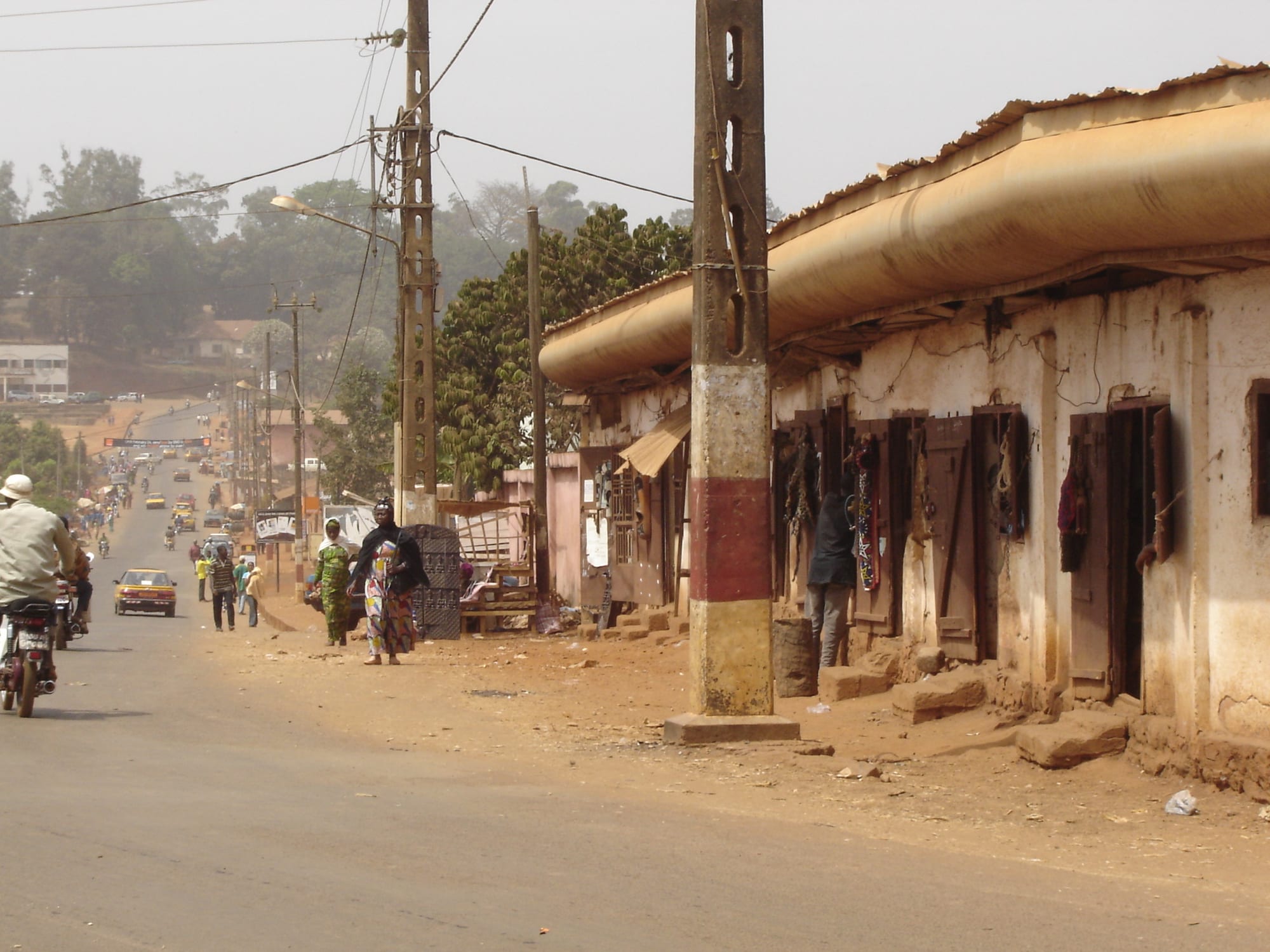
A dusty main street of low shopfronts with curved tin awnings, motorcycles and pedestrians under a hazy sky

Bamenda, Bafoussam & the Western Highlands, Cameroon

Foumban

The main street of Foumban on a hazy dry-season day. (Elin / Wikimedia Commons · CC BY 2.0)

The seat of the Bamum kingdom in the French-speaking West Region, north-east of Bafoussam on the grassy uplands beyond the Noun river. Its royal palace, built in 1917 and still the residence of the Bamum ruler, holds a museum of the dynasty, and the town's workshops of bronze casters, carvers, weavers and embroiderers have made it one of Cameroon's main centres of traditional art.

Neighbourhoods

  • The palace quarter
    • First-time visitors
    • Historic district

    The centre of the town is the royal compound and the open ground in front of it, where ceremonies are held. Administrative offices, the main mosque and older courtyard houses stand within a short walk, and the streets here are the busiest in Foumban on market days.

    Open in Maps
  • The artisans' street
    • Crafts and shopping
    • Best for walking

    The Rue des Artisans, running from the palace to the Musée des Arts et des Traditions Bamoun, is lined with the workshops of bronze casters, wood carvers, embroiderers and weavers, many of them family businesses working in the styles of the Bamum court. Work is made and sold in the same room.

    Open in Maps
  • The market quarter
    • Markets
    • Local life

    The commercial heart, around the main market, where traders sell produce from the surrounding farms, cloth, enamelware and household goods. Small eating houses, transport agencies and motorcycle-taxi ranks cluster around the market entrances.

    Open in Maps
  • The outer quarters
    • Quiet and residential
    • Local life

    Beyond the centre the town thins into residential quarters of compounds and small farms on gently rolling land, with schools, churches and neighbourhood mosques. The Bamum countryside of maize, coffee and cattle begins almost immediately.

    Open in Maps

Things to do

The royal town

  • Foumban Royal Palacelandmark

    The seat of the Bamum ruler, built in 1917 under King Njoya and often likened to a medieval chateau, with a museum tracing the dynasty from 1394 and holding royal gowns, arms, masks and bead-covered thrones.

    Open in Maps

Markets and crafts

  • Rue des Artisansattraction

    The street between the palace and the Bamum arts museum, lined with workshops where bronze is cast by the lost-wax method, wood is carved into stools and doorposts, and cloth is woven and embroidered in Bamum patterns.

    Open in Maps
  • Musée des Arts et des Traditions Bamounmuseum

    A museum a few hundred metres south of the palace, with a large collection of Bamum history and art — cooking implements, musical instruments, pipes, statues, masks, gongs and a carved xylophone.

    Open in Maps
  • Foumban marketmarket

    The town's main market, selling produce from the Noun plain, palm oil, cloth and household goods, and busiest on the days when traders come in from the surrounding villages.

    Open in Maps

Short trips from the town

  • Bafoussamattraction

    The capital of the West Region and the main Bamiléké city, about 60 kilometres west across the Noun river, with two large markets and the chief's palace.

    Open in Maps

Seasonal events

  • Nguonevery two years, in the dry season

    The Bamum kingdom's assembly and festival, held every two years, in which the ruler gives an account of his reign before the notables and the people, with masked dances, drumming and processions at the palace; it is inscribed on UNESCO's list of the intangible cultural heritage of humanity.

  • Muslim festivals at the palaceafter Ramadan and at Eid al-Adha

    The Bamum are largely Muslim, and the two Eids bring prayers on the open ground, formal greetings at the palace and horsemen in embroidered robes.

Eat and drink

Long-standing places and food districts in Foumban. Hours, ratings and directions come from your maps app, always current.

Bamum and highland dishes

  • Koki and taro with yellow saucerestaurant

    Steamed black-eyed-pea pudding wrapped in banana leaves, and pounded taro served with a palm-oil sauce, are the everyday dishes of the western highlands and are cooked in small eating houses across the town.

    Open in Maps
  • Kondrerestaurant

    A stew of unripe plantain simmered with meat and spices, a Bamiléké and Bamum favourite for family meals and celebrations.

    Open in Maps

Markets and street food

  • Foumban market food stallsmarket

    Beans and fried plantain, rice with sauce, beignets and grilled meat are sold at the market edges, alongside groundnuts, honey and the coffee grown around the town.

    Open in Maps
  • Evening grillsneighborhood

    Soya, thin beef skewers dusted with spiced groundnut, and roast plantain and maize appear on charcoal grills along the main streets after dark.

    Open in Maps

Experience Foumban

History

Bamum tradition dates the kingdom to about 1394, when Nshare Yen led a group east across the Noun river and established a capital on the site of Foumban, subduing the small chiefdoms around it. His successors built a centralised state with a court, a standing army, titled notables and a network of tributary villages; by the 19th century the Bamum were among the strongest of the grassfields kingdoms, and the town was their political and ritual centre.

The reign that made Foumban famous was that of Njoya, who came to the throne in the 1880s and ruled until 1933. He devised a script for the Bamum language from 1896, revising it repeatedly into a semi-syllabary, had a history of his kingdom and a book of medicine written in it, opened schools and a printing works, and had the palace that stands today built in 1917, a tall building often compared to a European chateau. Njoya negotiated in turn with the German administration and then with the French, who deposed him and exiled him to Yaoundé, where he died.

The kingdom survived the colonial period and independence as a traditional institution within the Cameroonian state, and Foumban became the administrative centre of the Noun department. The town also holds a political place in the country's history: the constitutional conference of July 1961 that shaped the federation of French-speaking and English-speaking Cameroon was held here, though the constitution itself was agreed in Yaoundé the following month. Craft production, taught at the palace and later at the town's art school, remains its best-known industry.

Culture & Customs

Foumban is a royal town, and the palace sets its rhythm. The ruler, addressed as sultan or king, presides with the notables over ceremonies in the open ground before the palace, and the Nguon, the kingdom's old assembly at which the ruler answers for his reign, is the great event of the Bamum calendar, with masked dancers, drums and processions.

The Bamum are largely Muslim, unusually for the southern highlands, following Njoya's conversion in the early 20th century, though Christian and traditional practice also persist and the three coexist within families. Friday prayers, the two Eids and the palace's own festivals structure the year.

Craft is the town's other identity. Bamum work is recognisable across Cameroon: bronze and brass cast by the lost-wax method into figures, pipes and vessels; carved stools and doorposts with human and animal motifs; beaded masks and thrones; and embroidered cloth, including the indigo ndop textile used in royal ceremony. The skills are handed down within families of casters and carvers whose workshops line the street from the palace, and the institute of fine arts the University of Dschang opened here in 2009 trains new generations. Njoya's script survives as a symbol of Bamum identity and is taught again after decades of decline, appearing on signs and on the manuscripts kept in the palace museum.

Daily Life

The town had about 84,000 residents at the 2005 census and has grown since, though it remains much smaller than Bafoussam, the regional capital an hour and a half away. Most families combine trade or craft work with farming on the plain around the town, growing maize, cassava, groundnuts, coffee and vegetables, and keeping cattle on the grasslands north of the Noun.

Public employment, schools and the departmental administration provide salaried work, and craft production supports a large number of households, selling to traders and to visitors from Douala and Yaoundé as well as abroad. The tourist trade that once brought steady visitors has been thinner since the conflict in the neighbouring English-speaking regions began, and many young people leave for the coastal cities or for France.

Days begin early and cool. Markets fill in the morning, motorcycle taxis buzz along the main roads, and the afternoons are quieter. Weekends belong to weddings, funerals and the meetings of savings groups, the tontines, which are as important in the West Region's social life as in its economy. The palace, the mosques and the churches anchor a town where the old institutions are visibly part of the present.

Food

Foumban eats the food of the western highlands, adapted to a Muslim town where pork is largely absent and beef and chicken are the meats of choice. Pounded taro or cocoyam with a yellow palm-oil sauce is the celebratory dish; kondre, a stew of unripe plantain with meat, onions and spices, appears at family meals; and koki, a steamed pudding of ground black-eyed peas and palm oil wrapped in banana leaves, is sold by the slice.

Maize is the everyday staple, eaten as corn fufu with stewed huckleberry greens or as a thick porridge, and rice with a groundnut or tomato sauce is standard restaurant fare. The plain supplies beans, groundnuts, plantain, avocados, honey and, from the volcanic slopes nearby, arabica coffee. Beef from the northern herds is grilled as soya, thin skewers dusted with spiced peanut, on street corners after dark, and safou, the purple bush plum, is roasted over the same coals in season.

Drinks lean away from alcohol in many households: foléré, a cold infusion of hibiscus flowers, ginger juice, and sweet tea are common, while palm wine and bottled beer are sold in the bars of the market quarter. Groundnut sweets and beignets fried in the morning are the usual street snacks.

Planning tools

Budget

Foumban is inexpensive. Simple hotels, market food and shared transport cost little, and the main discretionary spending is on crafts, where bargaining is expected, and on a guide and an introduction if a visit to the palace or a workshop is arranged formally.

Daily Budget Midrange
USD 70–140 (mid-range hotel, restaurant meals, a hired car with driver)
Daily Budget Shoestring
USD 25–50 (basic hotel, local food, shared taxis and buses)

Bring cash in Central African CFA francs; cash machines are few and cards are rarely accepted outside the larger hotels.

Best Time to Visit

The dry season from about November to February is the most comfortable time, with clear skies, easier roads and the season of palace ceremonies and weddings. From about June to September the rains are heavy and unsurfaced roads around the town turn to mud.

Suggested Number of Days

The palace, its museum and the craft workshops fill a full day, and a second allows a slower look at the market and the town. Adding the Bamiléké chiefdoms and the towns of the West Region stretches a visit to three or four days.

First Visit
1–2 days
With Surroundings
3–4 days

Transportation

Minibuses and shared taxis connect Foumban with Bafoussam and with Foumbot, and coach agencies run to Douala and Yaoundé. Within the town, motorcycle taxis are the usual way to move, and the centre is small enough that most visitors walk between the palace, the market and the workshops.

Agree the fare before getting on a motorcycle taxi, and expect police and gendarmerie checkpoints on the roads between towns.

Airport & Station Connections

Foumban is reached by road. Bafoussam, about 60 kilometres west, is the regional hub and roughly one and a half to two hours away; coaches from Douala and Yaoundé take most of a day. Foumban Nkounja Airport lies south-west of the town at Koutaba and has no scheduled passenger service, so nearly everyone arrives by bus or shared taxi.

Walkability

The centre is compact and flat enough to walk: the palace, the main mosque, the market and the beginning of the artisans' street lie within a few hundred metres of one another. Pavements are irregular and the streets are dusty in the dry season and muddy in the rains, and the outer quarters are spread out enough that most people ride.

Safety

Foumban is in the French-speaking West Region, which has been calmer than the neighbouring English-speaking regions, though areas near the Northwest boundary have seen violence connected with the separatist conflict. Petty theft in crowds and on transport is the main everyday concern, and persistent selling around the craft workshops can be wearing.

Most governments advise against all travel to the Far North and to the Northwest and Southwest regions. Avoid political gatherings, and do not photograph soldiers, police, checkpoints or government buildings. Check current official travel advice before travelling.

Climate

Foumban stands high on the western highlands, so it is much cooler than the lowlands, with mild days, cool nights and a long rainy season. Harmattan haze from the Sahara can dull the light between December and February.

Summer
the wettest months, cloudy and often rainy, with daytime temperatures usually around 22–27°C
Winter
the dry season from about November to February, sunnier and dustier, around 25–30°C by day and cool after dark

Local Customs

The Bamum are largely Muslim, a legacy of King Njoya's conversion, and the kingdom's institutions are respected: the ruler, the notables and the palace calendar still order public life. Greetings are formal and unhurried, and modest dress is expected, particularly near the palace and the mosque. French is the language of business, with Shü Pamom spoken at home.

Ask permission before photographing people, ceremonies or palace interiors; bargaining in the craft workshops is normal and good-humoured; alcohol is served but is less openly consumed than in the Christian towns nearby.

Common Payment Methods

The currency is the Central African CFA franc, written FCFA and pegged to the euro. Almost everything is paid for in cash, including crafts. Cash machines are limited and unreliable for foreign cards, so money is usually changed or withdrawn in Bafoussam, Douala or Yaoundé beforehand.