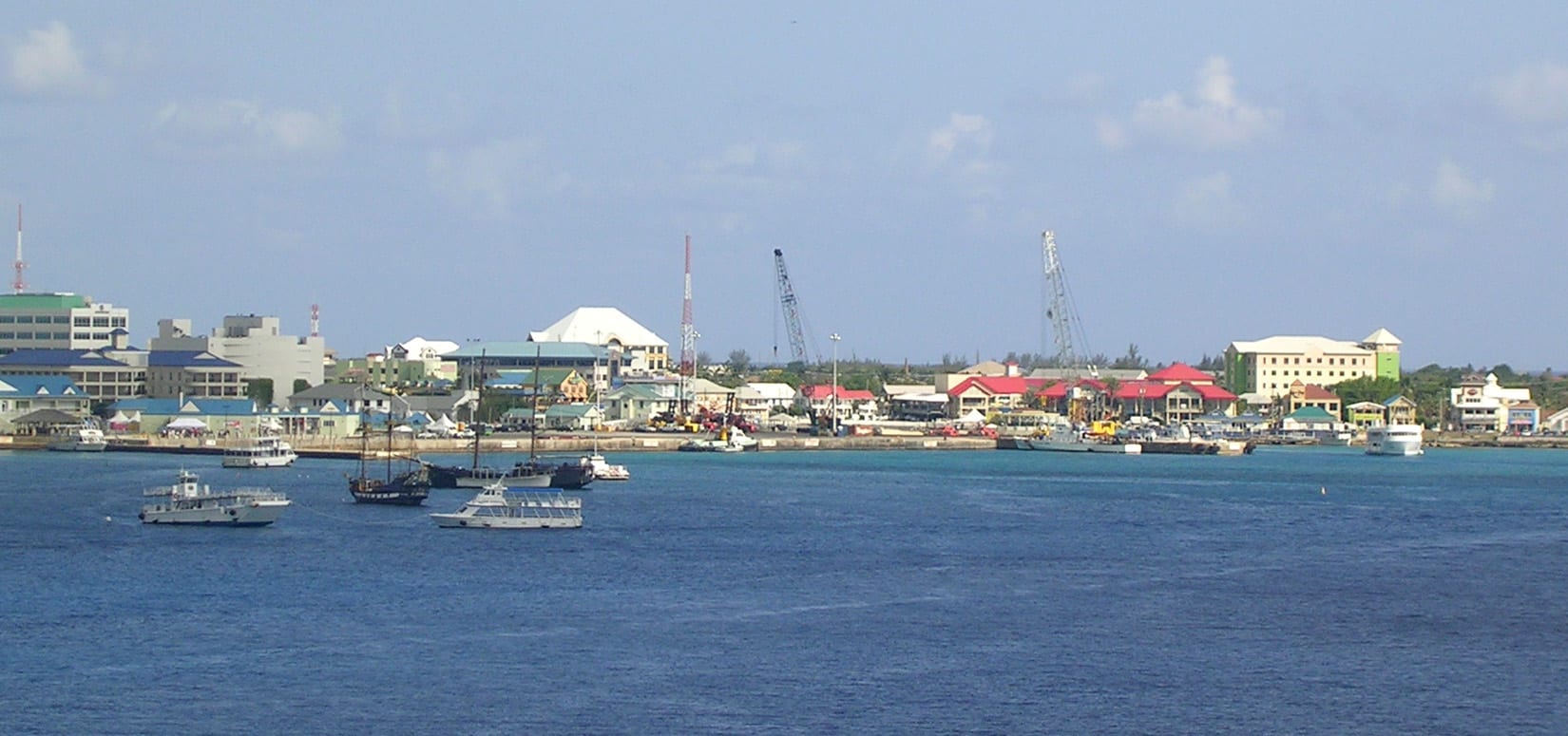
George Town's low waterfront of pastel buildings and red roofs across deep blue harbour water, with boats at anchor and cranes behind

Cayman Islands

George Town

The harbour front of George Town, Grand Cayman, seen from the sea. (Roger Wollstadt from Sarasota, Florida / Wikimedia Commons · CC BY-SA 2.0)

The capital and largest city of the Cayman Islands, on the west coast of Grand Cayman, named after King George III. A small harbour town of turtlers and seafarers grew into an offshore financial centre and cruise port; today its downtown of banks, courts and duty-free shops sits beside Seven Mile Beach, the Camana Bay development and the boats bound for Stingray City.

Neighbourhoods

  • Downtown and the harbour
    • First-time visitors
    • Historic district
    • Shopping

    The old centre on Hog Sty Bay, where cruise passengers come ashore by tender. Harbour Drive runs past the National Museum, the remains of Fort George and a small walkable area of shops, while the streets behind hold the banks, the Parliament and the main courthouse of the financial centre.

    Open in Maps
  • Seven Mile Beach
    • Beaches
    • Nightlife
    • Best for food

    The long crescent of coral sand north of downtown, shared between George Town and West Bay and the centre of the islands' tourism. West Bay Road behind it is lined with hotels, condos, bars, clubs and shopping centres; the beach itself is public and can be walked end to end.

    Open in Maps
  • Camana Bay
    • Best for food
    • Walkable
    • Families

    A planned waterfront community of 685 acres between Seven Mile Beach and the North Sound, with shops, restaurants, cafés, a cinema, courtyards, apartments and a marina. An overhead pedestrian path links it to the beach, and a 75-foot observation tower looks out over the island.

    Open in Maps

Things to do

History and museums

  • Cayman Islands National Museummuseum

    The museum of Caymanian heritage, opened in 1990 in the Old Courts Building on Harbour Drive, which dates from the 1830s and is the oldest building on the island; its core is a collection begun by Ira Thompson in the 1930s.

    Open in Maps
  • Fort Georgelandmark

    The remains of a fort built in 1790 to guard the harbour, at the corner of Harbour Drive and Fort Street, owned by the National Trust and restored in 2013–14.

    Open in Maps
  • National Gallery of the Cayman Islandsmuseum

    The territory's art museum in George Town, founded in 1996, with a collection of Caymanian art.

    Open in Maps

Beaches and the sea

  • Seven Mile Beachbeach

    A public crescent of coral sand a little over six miles long, the island's best-known beach, though erosion has worsened in places since Hurricane Helene in 2024.

    Open in Maps
  • Cemetery Beachbeach

    A stretch of Seven Mile Beach named after the small island cemetery beside it.

    Open in Maps
  • Stingray Cityattraction

    Shallow sandbars in the North Sound where southern stingrays gather in large numbers; boat trips stop on the shallow bar for wading and the deeper one for diving.

    Open in Maps
  • Camana Bay Observation Towerviewpoint

    A 75-foot tower with views across Seven Mile Beach, George Town and the North Sound.

    Open in Maps

Around Grand Cayman

  • Pedro St. Jameslandmark

    Known locally as Pedro's Castle, the oldest surviving stone building and great house in the islands, on the south coast near Savannah.

    Open in Maps
  • Hellattraction

    A patch of jagged black limestone in West Bay, about half the size of a football field, seen from viewing platforms beside a gift shop that trades on the name.

    Open in Maps
  • Cayman Turtle Centreattraction

    A turtle farm in West Bay founded in 1968 to breed green sea turtles, now a research and conservation centre and the islands' largest land-based attraction.

    Open in Maps
  • Queen Elizabeth II Botanic Parkpark

    Gardens and native woodland in North Side, with a woodland trail, a heritage garden, an orchid boardwalk and a habitat for the endemic blue iguana.

    Open in Maps
  • Mastic Reservetrail

    A National Trust forest reserve in the island's interior, crossed by the Mastic Trail and named after its yellow and black mastic trees.

    Open in Maps

Seasonal events

  • Batabanofirst week of May

    The Cayman Islands carnival, held in George Town with music, dance and costumes, bringing together residents of more than 100 nationalities.

  • Pirates WeekNovember

    An eleven-day festival begun in 1977 to bring visitors in the quiet season, centred on George Town with events across the islands.

Eat and drink

Long-standing places and food districts in George Town. Hours, ratings and directions come from your maps app, always current.

Food districts and markets

  • Farmer's Market Cooperativemarket

    A farmers' market cooperative on Thomas Russell Way.

    Open in Maps
  • Harbour Driveneighborhood

    The waterfront street downtown, at the centre of the shopping district where cruise passengers come ashore, with restaurants among the shops.

    Open in Maps
  • Camana Bayneighborhood

    Restaurants and cafés around courtyards and the harbour of the planned town beside Seven Mile Beach.

    Open in Maps
  • Seven Mile Beachneighborhood

    Bars, pubs, clubs and restaurants along West Bay Road and the beach, the centre of the island's tourism.

    Open in Maps

Experience George Town

History

George Town takes its name from King George III. It grew around Hog Sty Bay on Grand Cayman's west coast. As early as 1662 the governor of Jamaica was instructed to fortify the islands, but Fort George, a small stone battery guarding the harbour, was built only in 1790; an inspector from Jamaica in 1802 found it "by no means well equipped", with three guns instead of the eight planned. By the early 20th century it was disused, and its survival became a planning dispute in 1972 before the remains passed to the National Trust in 1987.

The town's oldest building, the Old Courts Building on Harbour Drive, dates from the 1830s, one of a handful of 19th-century structures that remain. For most of its history George Town was a modest port of seafarers and turtlers. That changed after work began on an airport in 1952: in the 1950s tourism took off with the new airfield, a bank, hotels, scheduled flights and cruise calls, and from the 1960s the absence of direct taxes drew banks, trusts and registered companies until financial services dominated the economy.

On 11 September 2004 Hurricane Ivan, the worst storm to hit the islands in 86 years, swept over low-lying Grand Cayman. The town rebuilt, Fort George was restored in 2013–14, and the airport terminal was enlarged in 2019. In 2022 George Town entered the contest for city status held for the Platinum Jubilee, losing out to Stanley in the Falklands; in 2024 Hurricane Helene worsened the erosion of Seven Mile Beach.

Culture & Customs

The town's traditions come from the sea. Caymanians long made their living from turtling and the sea, and the National Museum, built on a collection that Ira Thompson began gathering as a hobby in the 1930s, tells that story in the old courthouse. The National Gallery holds a collection of Caymanian art.

Two festivals fill the streets. Pirates Week, an eleven-day festival each November, was started in 1977 by the tourism minister Jim Bodden to bring visitors in the quiet season. Batabano, the Cayman carnival, takes over George Town in the first week of May with music, dance and costumes, and celebrates a community drawn from more than 100 nationalities.

Christianity is the main religion, mostly Protestant with a sizable Roman Catholic population, and churches shape the week; nearly all supermarkets and many shops close on Sundays. George Town also has a synagogue and an active Jewish community, and places of worship for Jehovah's Witnesses and the Baháʼí faith. The Truman Bodden Sports Complex is a multi-use sports complex in the city.

Daily Life

About 47,000 people lived in George Town in 2025, making it the largest city in any British Overseas Territory and home to nearly half the population of the Cayman Islands. Most residents are immigrants, chiefly from Jamaica, the Philippines, the United Kingdom, the United States, Canada, Honduras and India, with a growing South African community.

Finance is the backbone. In 2007 financial services produced 55 per cent of the territory's economy and over a third of all jobs, and downtown holds the banks and law firms alongside the Parliament and the main courthouse. Tourism is the other pillar: cruise ships anchor off the harbour on several days a week, usually from early morning until mid-afternoon, and their passengers fill the shops of the waterfront before the streets empty again.

Residents live in districts such as Whitehall Estates, north of downtown near Seven Mile Beach, Tropical Gardens, south of the airport off Crewe Road, and Grand Harbour on the main road in from the east, while Camana Bay works almost as a town of its own. Life is car-based. The cost of housing is high, and the balance between residents, workers on permits and visitors is a constant subject of debate.

Food

Caymanian cooking is closely tied to Jamaican cuisine and keeps British influences. Fish and seafood are the main ingredients, most commonly tuna, turtle, snapper, mackerel and mahi-mahi, and conch is served marinated, in salads, in chowders or in stews; gourmet sea salt is also produced on the island. Stewed turtle is the national dish, supplied by the turtle farm in West Bay, which raises green sea turtles so that the meat can be eaten without depleting wild stocks — a practice that still draws criticism.

Everyday staples include coconut, plantain, cassava, yams, breadfruit, and rice and peas. Jamaican cooking brought jerk, curry and other seasonings, and jerk chicken and pork, oxtail, patties and fried snapper are all frequently served.

Downtown, restaurants along the Harbour Drive waterfront cater to cruise passengers, and the Farmer's Market Cooperative is on Thomas Russell Way. Camana Bay and West Bay Road behind Seven Mile Beach have many restaurants and bars. Nearly all food and drink is imported, and nearly all supermarkets close on Sundays.

Planning tools

Budget

George Town is one of the most expensive places in the Caribbean to stay. Almost everything is imported, rooms on Seven Mile Beach are dear, and boat trips and diving add quickly to the bill. Condos away from the beach, supermarket cooking and casual local food keep costs down.

Daily Budget Midrange
USD 350–750 (beach-area hotel or condo, restaurants, a Stingray City trip or a dive, car hire)
Daily Budget Shoestring
USD 150–250 (guesthouse or condo away from the beach, self-catering, minibuses or a shared hire car)

Buy groceries before Sunday, when most supermarkets close, and pick one or two boat trips rather than daily excursions.

Best Time to Visit

December to April is the dry season, with the calmest seas and the highest prices. May and November are good-value shoulder months. August to October is the low season, when hurricanes are a risk. Cruise days, Tuesday to Friday, make downtown far busier than days without ships.

Suggested Number of Days

A cruise call allows a few hours ashore. A first stay usually runs to three or four days; most visitors take five to seven to include the rest of Grand Cayman, more for anyone diving every day.

First Visit
3–4 days
With Surroundings
5–7 days

Transportation

Grand Cayman is built around the car. Public transport is run by minibuses, identified by blue licence plates, from a depot on Edward Street next to the library; taxis wait at the cruise docks and the resorts. Most visitors hire a car or scooter. Driving is on the left, and the main routes into the city are the Linford Pierson Highway from the east and the Esterly Tibbetts Highway from the north and West Bay.

Taxis charge fixed rates to each part of the island; at the airport rank, staff direct passengers to a taxi and give the cost.

Airport & Station Connections

Owen Roberts International Airport, the main international airport of the Cayman Islands and the base of Cayman Airways, lies within the city limits, with flights to North American hubs and London. Taxis leave from a rank outside the terminal; hotels are not allowed to run airport shuttles. Cruise ships anchor offshore and tender passengers to terminals in the harbour.

Walkability

Downtown around the harbour is small and easy on foot, with the museum, the fort and the shops close together. Seven Mile Beach is not within walking distance of the cruise docks, and roads elsewhere are made for cars. Camana Bay is built for walking and has a footbridge to the beach, and the beach itself can be walked along its length.

Safety

Generally very safe for visitors. Petty theft from cars and beaches occurs, most often in downtown George Town and parts of West Bay, though serious crime is rare. Drug laws are strict and even small amounts are prosecuted. At sea, currents on the walls are the main diving hazard.

Leave nothing in cars or on the sand, carry no drugs, and watch the forecast in hurricane season. Check current official travel advice before travelling.

Climate

Tropical marine, warm and humid all year. The drier, slightly cooler season runs from November to April; May to October is hotter and wetter and falls within the Atlantic hurricane season, which runs from June to November.

Summer
hot and humid, with rain showers — across the islands temperatures run at around 81–90°F
Winter
drier and slightly cooler, with the calmest seas, though across the islands temperatures still run at around 81–90°F

Local Customs

Society is Christian and conservative, and Sunday is kept: nearly all supermarkets and many shops close. Residents come from more than 100 countries, and English is the language of daily life.

Plan shopping around Sunday closures, and respect the strict drug laws.

Common Payment Methods

The currency is the Cayman Islands dollar, pegged to the US dollar. US dollars are accepted everywhere, with change often given in Cayman dollars, and cards are standard; US credit cards are usually charged in US dollars.