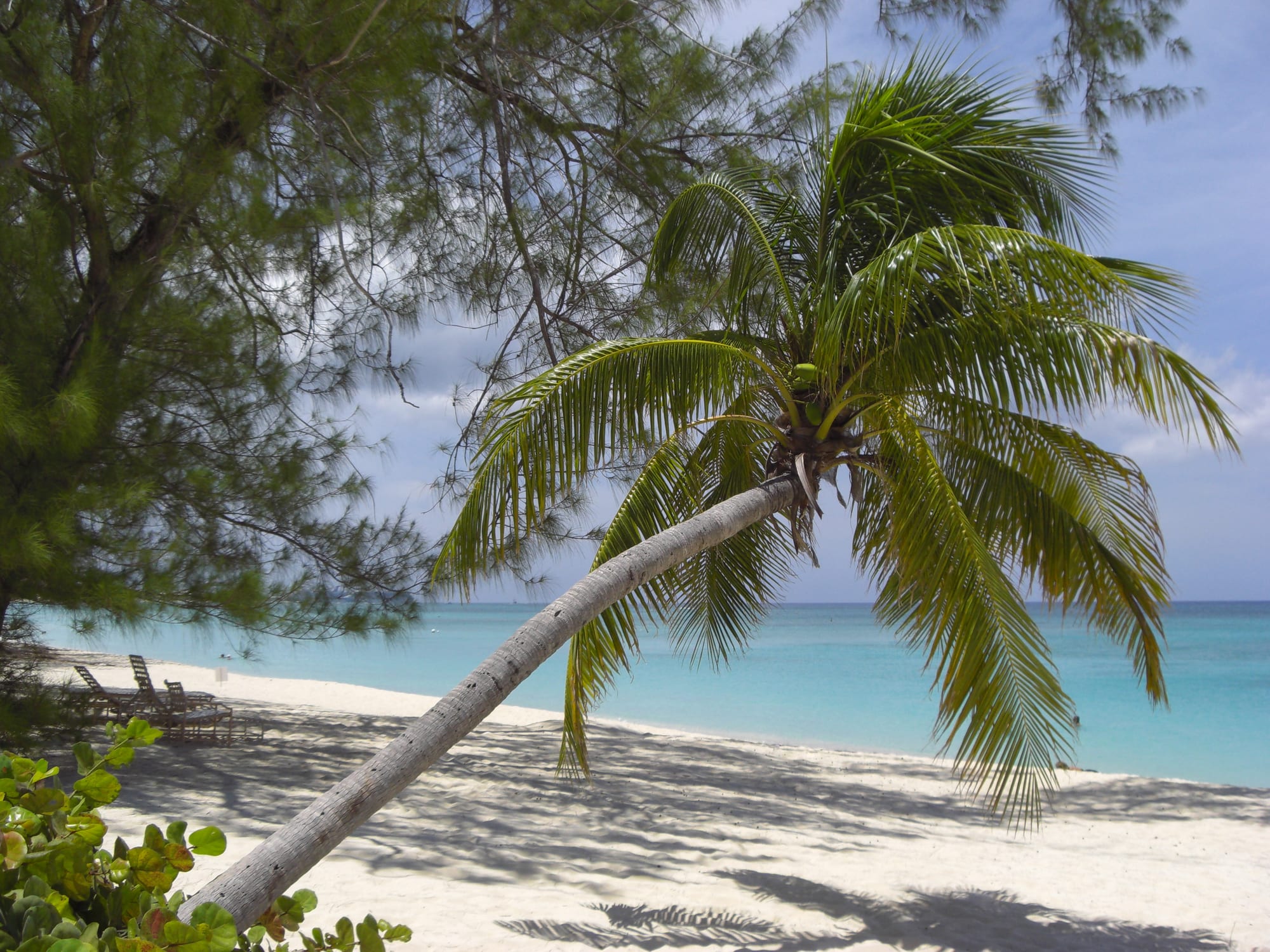
A coconut palm leaning low across a white-sand beach toward calm turquoise sea, with casuarina branches overhead and a few sun loungers in the shade

Cayman Islands

A coconut palm leans out over white sand and turquoise water on a beach on Grand Cayman. (Diego Delso / Wikimedia Commons · CC BY-SA 3.0)

Three low-lying islands south of Cuba, a British Overseas Territory — a major offshore financial centre and one of the world's wealthiest jurisdictions per head, known for Seven Mile Beach, world-class wall diving, and the absence of direct taxation.

Explore Cayman Islands

History

Columbus sighted the islands in 1503 and called them Las Tortugas for the sea turtles; the name that stuck, "Caimanas", came from a word for the crocodilians once found here. No people lived here before the Europeans, and for two centuries the islands drew only turtle hunters, buccaneers, deserters from Cromwell's army in Jamaica, and the survivors of shipwrecks on the reefs. A permanent English-speaking population dates from the 1730s, and the first royal land grant by the governor of Jamaica in 1734 brought settlement and enslaved Africans; the islands were administered as a dependency of Jamaica.

Local legend holds that George III granted the Caymans freedom from taxation after islanders rescued the crews of a wrecked convoy, the "Wreck of the Ten Sail", on 8 February 1794 — the reward is legend rather than record, though the absence of direct taxes is very real. When Jamaica became independent in 1962 the Cayman Islands chose to remain a British territory.

From the 1960s the islands built themselves into a tax-neutral offshore financial centre, and about 100,000 companies are now registered here, more than the resident population, alongside a large tourism industry of cruise calls and stopover visitors. Hurricane Ivan submerged nearly all of Grand Cayman in September 2004; a major rebuilding programme had the island's infrastructure almost back to its pre-hurricane condition within two years, and the territory remains the wealthiest in the Caribbean by income per head.

  • Cayman Islands: From Turtles to Trusts — Uninhabited islands that pirates and turtle-hunters found, a quiet British backwater of sailors for two centuries, and one of the world's largest offshore financial centres

Culture & Customs

Caymanian identity is English-speaking, Christian, and rooted in the sea: Caymanians long made their living from turtling and the sea, and seafaring, thrift, and church still shape the culture. Traditional crafts include rope made from the silver thatch palm, the national tree, and the old wooden catboat and island cooking are points of pride, with festivals such as Pirates Week and Batabano celebrating local culture.

More than half the workforce is now foreign nationals — Jamaican, Filipino, Honduran, British, American, Canadian — on work permits tied to their employer, and the friction between the islands' welcoming image and real tensions over immigration, housing, and cost of living is a constant theme. Society is socially conservative and law-and-order minded, though same-sex civil partnerships were introduced in 2020 after a court battle, and the Privy Council upheld the law in 2025.

  • Cayman Islands: Sand Yards and Silver Thatch — A seafaring people with a strong Christian tradition, greetings that begin with "good morning" and a courteous Miss or Mr, and customs woven from the islands' own palm and white sand

Daily Life

About 90,000 people live across the three islands, the great majority on Grand Cayman, where George Town is the capital and financial hub. There is no income, capital-gains, or corporation tax; government revenue comes from import duties, company and work-permit fees, and tourism.

The cost of living is very high, housing and rent especially so, and daily life is car-dependent, air-conditioned, and closely tied to the finance and tourism calendars. Cayman Brac, with its limestone bluff, and tiny Little Cayman, with a couple of hundred residents and world-famous diving, are far quieter and more rural than Grand Cayman.

  • Cayman Islands: Outnumbered at Home — A financial capital where expatriate workers now outnumber Caymanians in the workforce, no income tax anywhere on the islands, and a Sunday still largely kept for church

Food

Caymanian cooking centres on the sea: conch (stewed, or as fritters), fresh mahi-mahi, wahoo, and snapper, fish and seafood cooked in coconut milk, and turtle stew, still eaten and now supplied by a farm on Grand Cayman, a practice that draws criticism abroad. Sides run to rice and peas, cassava and breadfruit, and sweet, dense "heavy cake".

Jamaican jerk and patties are everywhere given the size of the Jamaican community, and the invasive lionfish now appears on menus as a conservation measure. Local rum and beer from the Cayman Islands Brewery, opened in 2007, are the usual drinks, and Stingray City — wading with wild southern stingrays on a sandbar in the North Sound — is as much a food story as a wildlife one, the rays long fed by fishermen cleaning their catch there.

  • Cayman Islands: Food and the National Dish — A turtle stew tradition now supplied by a turtle farm that is the only facility of its kind in the world, a dense cassava cake that is the official national dessert, and a Jamaican-influenced Caribbean table

Attractions & Natural Wonders

Seven Mile Beach on Grand Cayman is the headline — a long, calm, west-facing strip of coral sand lined with resorts. Offshore, the diving is exceptional: the sheer drop-offs and coral of the walls, the USS Kittiwake, sunk off Seven Mile Beach as an artificial reef in 2011, and, off Little Cayman, the celebrated Bloody Bay Wall, which falls away from six metres to the abyss.

Stingray City and its shallow sandbars draw boat trips into the North Sound; Rum Point on the quieter north coast has calm swimming and a bioluminescent bay; and the Mastic Trail crosses old forest through the middle of the island. The Queen Elizabeth II Botanic Park protects native dry forest and runs the recovery programme for the endemic blue iguana, brought back from the edge of extinction.

Novelty stops include "Hell", a field of jagged black limestone with its own post office, and the Cayman Turtle Centre. Cayman Brac offers bluff-top trails and caves, and Little Cayman has the Booby Pond nature reserve and long, almost empty beaches.

Planning basics

Budget

The Cayman Islands are among the Caribbean's most expensive destinations — a resort economy where nearly everything is imported and rooms and restaurants are dear. Condos and guesthouses away from Seven Mile Beach, supermarket cooking, and the roadside fish shacks bring costs down.

Daily Budget Midrange
USD 350–750 (beach-area hotel or condo, restaurants, diving or a Stingray City trip, car hire)
Daily Budget Shoestring
USD 150–250 (off-beach guesthouse or condo, self-catering, hired car shared)

Stay off the beach strip, self-cater from the supermarkets, and prioritise one or two diving or snorkelling trips rather than daily activities.

Visa Requirements

Citizens of the UK, EU, US, Canada, Australia, and many other countries enter visa-free for tourism, usually for a stay of up to six months. A passport valid for the stay, an onward or return ticket, and proof of funds and accommodation are expected. Cruise passengers need nothing extra.

Typical Stay
Up to six months visa-free for tourism for most Western passports

Carry proof of onward travel and where you are staying; overstaying is taken seriously.

Safety

Generally very safe for visitors. Petty theft from cars and beaches occurs, most often in downtown George Town and parts of West Bay, though serious crime is rare and the islands are among the safest in the Caribbean. Drug laws are strict and even small amounts are prosecuted. Diving hazards include strong currents on the walls, and hurricanes are a summer-autumn risk.

Health
Tap water is treated and safe; the sun and heat are intense; medical care is good but expensive

Don't leave valuables in cars or on the sand, carry no drugs, dive within your limits on the walls, and watch the forecast in hurricane season.

Climate

Tropical marine, warm and humid all year at around 81–90°F. The drier, slightly cooler season runs November to April; May to October is hotter and wetter, and falls within the Atlantic hurricane season — Hurricane Ivan devastated Grand Cayman in 2004.

Dry Season
November–April
Wet Season
May–October (the Atlantic hurricane season runs June–November)

Transportation

Owen Roberts International Airport on Grand Cayman is the main gateway, with Charles Kirkconnell Airport on Cayman Brac; Cayman Airways links the three islands. There is little public transport beyond minibuses on Grand Cayman's main routes, so most visitors hire a car or scooter. Driving is on the left. Cruise ships tender passengers into George Town.

Hire a car on Grand Cayman; for Little Cayman, arrange transfers through your dive lodge.

Best Time to Visit

December to April is the dry season, with the calmest seas and best diving visibility — and the highest prices. May and November are good-value shoulder months. August to October is the hurricane-risk low season.

Events
Cayman Carnival Batabano, held in George Town in the first week of May; Pirates Week, an eleven-day festival in November

Currency

The Cayman Islands dollar is pegged to the US dollar at about 1 KYD to 1.20 USD, making it one of the world's strongest currencies — factor that into prices. US dollars are accepted everywhere, with change often given in Cayman dollars. Cards are standard.

Symbol
CI$
Currency Code
KYD — Cayman Islands dollar (US dollars accepted, change in KYD)

Language

English is the official language, spoken with a distinctive Caymanian lilt. Jamaican Patois, Spanish, and Tagalog are widely heard among the large work-permit population from Jamaica, Central America, and the Philippines.

Official Language
English