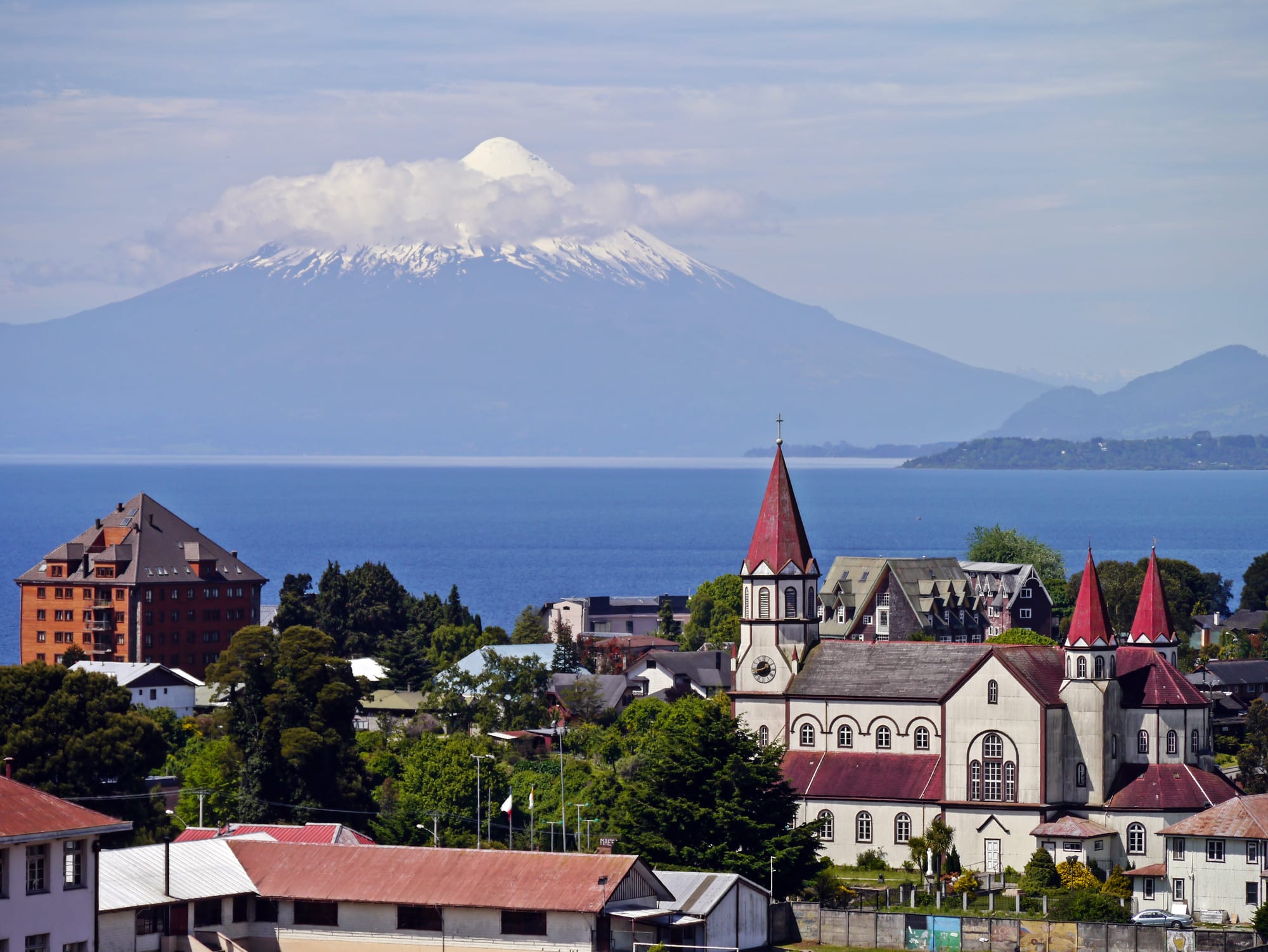
A cream church with red spires among town rooftops, with a blue lake and the snow-capped Osorno volcano behind

The Lake District & Araucanía, Chile

Puerto Varas

The Sacred Heart church in Puerto Varas, with Lake Llanquihue and the Osorno volcano beyond. (M M from Switzerland / Wikimedia Commons · CC BY-SA 2.0)

A lakeside town on the south-western shore of Lake Llanquihue in Chile's Los Lagos Region, 20 km from Puerto Montt, with the cone of the Osorno volcano across the water. Founded by German settlers in 1853, it keeps their shingled wooden houses, cakes and clubs, and is now one of the busiest tourist bases in southern Chile.

Neighbourhoods

  • Centre and lakefront
    • First-time visitors
    • Best for food
    • Lake views

    The streets between the main square and the lake, with most of the town's restaurants, cafés, shops, tour agencies and its casino. The lakefront promenade looks straight across Lake Llanquihue to the Osorno and Calbuco volcanoes, and the town's beach is here.

    Open in Maps
  • The historic western sector
    • Historic district
    • Architecture

    A protected heritage zone of about 13 hectares, designated in 1992, with steep-roofed wooden houses of the German settlers, several listed family houses from the early 20th century and the Sacred Heart church on its hill. It is quiet and residential, a short walk uphill from the centre.

    Open in Maps
  • Nueva Braunau
    • Rural life
    • Museums

    A farming village west of the town founded in 1875 by Sudeten German settlers from Braunau in Bohemia, and named after their home. It has the Antonio Felmer Museum of settler life.

    Open in Maps

Things to do

In the town

  • Sacred Heart of Jesus Churchlandmark

    The wooden church on one of the highest points of the town, built between 1915 and 1918 and declared a national monument in 1992, one of the town's best-known landmarks.

    Open in Maps
  • Lake Llanquihuepark

    Chile's second-largest lake, shaped by glaciers, whose shoreline promenade gives the town its views of the Osorno and Calbuco volcanoes; kayaking and boating are popular in summer.

    Open in Maps
  • Molino Machmar Art Centremuseum

    An arts centre in an old mill in the heritage zone that worked through the 20th century and belonged to a descendant of Hessian settlers; it hosts exhibitions, including the collective show of the El Color del Sur painting meeting.

    Open in Maps

Short trips from the town

  • Frutillarattraction

    A German-settled town further up the western shore of the lake, part of UNESCO's Creative Cities network for music since 2017, with a museum of the early colonists.

    Open in Maps
  • Teatro del Lagoattraction

    The theatre and concert hall on the lakeshore at Frutillar, the main stage of the summer Frutillar Musical Weeks.

    Open in Maps
  • Osorno volcanolandmark

    A 2,652-metre conical volcano on the south-eastern shore of the lake, the symbol of the local landscape; a road climbs to a chairlift used for skiing in winter and sightseeing in summer.

    Open in Maps
  • Petrohué Waterfallsattraction

    Chutes of water over volcanic rock on the Petrohué River, just below its source in Lake Todos los Santos, inside Vicente Pérez Rosales National Park.

    Open in Maps
  • Todos los Santos Lakepark

    A deep green lake whose catchment is largely covered with old-growth Valdivian temperate rainforest, crossed by the boats of the bus-and-boat route over the Andes to Bariloche in Argentina.

    Open in Maps

Seasonal events

  • Semana PuertovarinaFebruary

    The town's main summer festival, with open-air concerts by well-known Chilean artists, local arts and crafts and family activities.

  • Kuchen Tagonce a year (date varies)

    Kuchen Day, a celebration of the settlers' baking, with hundreds of exhibitors showing their recipes in the covered street beside the main square.

  • Festival de la LluviaJune

    The Rain Festival, a community celebration of winter with an umbrella parade, a bed race, a waiters' race and live folk music.

  • Winter Gastronomic Festivallate July to early August

    A food festival in the town square with music, cooking demonstrations by Chilean chefs and tastings from local restaurants and cafés.

  • Carnaval del Surearly December

    Theatre and dance shows in public spaces around the town, celebrating local identity.

Eat and drink

Long-standing places and food districts in Puerto Varas. Hours, ratings and directions come from your maps app, always current.

Puerto Varas classics

  • Cafés and German pastry shopscafe

    The town's cafés and shops sell the baking brought by the German settlers — kuchen, cakes, biscuits, chocolates, marzipan and home-made jams.

    Open in Maps
  • Restaurants of the centreneighborhood

    Restaurants around the square and along the lakefront mix traditional southern cooking — lamb, beef, venison, wild boar and salmon — with contemporary menus, and the town has a name as a food destination.

    Open in Maps
  • Craft beer and pubsneighborhood

    Local craft beer and liqueurs are part of the town's food culture, served in its pubs and bars.

    Open in Maps

Experience Puerto Varas

History

Puerto Varas dates from 1853 and is named after Antonio Varas, then Minister of the Interior. It grew out of a government colonisation project under President Manuel Montt: the Llanquihue Lake Colonization Territory was created on 27 June 1853, and by the end of that year the first 212 German families had arrived. They came from many parts of Germany, among them Hesse, Silesia, Westphalia, Saxony, Thuringia and Bavaria. The first settlement, known as La Fábrica, stood where the road from Puerto Montt and the coast reached the lake, and settlers were taken by small boat to the plots assigned to them, in what became the Puerto Chico sector.

Navigation on the lake had begun in 1852 with the cutter La Fundadora. A Catholic church opened near the present square in 1872, Sudeten German settlers from Braunau in Bohemia founded the village of Nueva Braunau in 1875, and the Deutscher Verein, or German Club, was founded in 1885. The settlement became an official town in 1897, and the commune in its present form dates from 1925. Houses were built of alerce wood with tools brought from Europe, and the Sacred Heart church followed in 1918.

In the 1950s the mayor Teobaldo Kuschel Kneer had rose bushes planted in the squares, parks, streets and front gardens, and the name City of Roses stuck. In 1992 a 13-hectare area of the western sector was declared a heritage zone. Over the following decades tourism became the town's main business, and in April 2025 passenger trains returned on a local line to Puerto Montt.

Culture & Customs

Puerto Varas is known above all for its German traditions. Many residents descend from the settlers, family names such as Kuschel, Raddatz and Jüpner are attached to the protected houses of the heritage zone, and the German Club dates from the 19th century. The architecture is the most visible legacy: steep roofs, timber walls and neo-Gothic details, with the Sacred Heart church on its hill as the landmark. The roses planted from the 1950s, which bloom in spring and summer, remain part of the town's identity, tended by residents and the municipality.

The calendar is full of festivals. Semana Puertovarina in February brings open-air concerts with well-known Chilean artists; Kuchen Tag, held since the late 1990s, celebrates the settlers' baking; the Rain Festival in June marks winter with an umbrella parade and races; and the Carnaval del Sur in early December fills public spaces with theatre and dance. In nearby Ensenada a festival around April celebrates the murta, a native berry.

The town has a small arts scene, with the Molino Machmar Art Centre, the Pablo Fierro Museum, a gallery and the Antonio Felmer Museum in Nueva Braunau. El Color del Sur, a national meeting of Chilean painters, holds open-air painting days and a collective exhibition here each summer, and a short way up the lake Frutillar holds its Musical Weeks in January and February.

Daily Life

The commune had about 53,000 inhabitants at the 2024 census, and it is large, stretching east beyond the lake to Ensenada, Petrohué and Peulla near the Argentine border. The town itself is the commune's capital and by far its largest settlement; official projections put the commune's growth between 2002 and 2012 at about a quarter.

Tourism drives the economy, with hotels, inns, a casino, restaurants and the agencies that run trips to the volcanoes, the national park and the lake crossing to Argentina. Puerto Montt, 20 km to the south, is the regional capital, and the two towns are closely linked; frequent minibuses and, since 2025, a local train make the link.

Schooling has a long German and Catholic tradition, dating from the settlers' first schools and the Catholic school founded in 1903 by sisters from Paderborn in Germany. Daily life follows the weather: long, wet winters are spent indoors, and in summer the lakefront, the beach and the festivals bring everyone outside, while visitors from Santiago and abroad fill the town.

Food

Baking is the town's culinary signature. The German settlers brought kuchen, fruit tarts and cakes, and today they are sold with biscuits, chocolates, marzipan and home-made jams in the town's shops and cafés. Kuchen Tag, held each year since the late 1990s, draws hundreds of exhibitors with their own versions. Traditional German food — pork, sausages and cheeses — is easy to find in shops and restaurants.

Restaurants mix this heritage with the meats of southern Chile — beef, lamb, venison, wild boar and chicken — and with salmon, and the town has built a reputation as one of the most attractive places to eat in Chile, with traditional dishes served beside contemporary cooking. The Winter Gastronomic Festival in the main square at the end of July and start of August showcases local chefs and products.

Native ingredients have their place too: the murta, a small red native berry, is celebrated each year at a festival in Ensenada and appears in jams and tarts. Craft beer and local liqueurs are part of the food culture, and across the region the Chilean staples — empanadas, cazuela and pastel de choclo — are as common here as anywhere in the country.

Planning tools

Budget

Puerto Varas is one of the more expensive towns of the Lake District, with prices and demand at their highest in January and February. Excursions to the national park, volcano trips, rafting and the lake crossing to Argentina are the main extra costs, and a hire car helps for the sights around the lake.

Daily Budget Midrange
USD 110–220 (lakeside hotel, restaurant dinners, a guided excursion, a hire car)
Daily Budget Shoestring
USD 40–75 (hostel or guesthouse, set-menu lunches, minibuses and local buses)

Book well ahead for January and February and for the Andean lake crossing, which is usually arranged through an agency.

Best Time to Visit

December to March brings the mildest weather, the longest days and the summer festivals, with roses in bloom across the town; January and February are the busiest months. Spring and autumn are quieter. Winter is rainy and chilly in town, with skiing on the Osorno volcano and the town's own festivals of rain and winter food.

Suggested Number of Days

Two or three days suit a first visit to the town and its lakeshore. Four to six allow time for the national park, the volcano and the other lake towns. Rain and cloud often hide the volcanoes, so an extra day improves the chance of clear views.

First Visit
2–3 days
With Surroundings
4–6 days

Transportation

Frequent minibuses link the town with Puerto Montt, and buses run to the other lake towns and towards Ensenada and Petrohué. Since April 2025 a local train line has connected Puerto Varas with Puerto Montt, Alerce and Llanquihue. Agencies run tours to the national park and the volcano, and a hire car gives the most freedom around the lake.

Buses towards Ensenada continue in season into the national park, which makes the falls reachable without a car.

Airport & Station Connections

The nearest airport is El Tepual International Airport, serving Puerto Montt, with many daily non-stop flights from Santiago and flights from other Chilean cities. Overnight buses run from Santiago, a road journey of about 1,030 km and some 12 hours on the Pan-American Highway. From Argentina, the bus-and-boat lake crossing arrives from Bariloche.

Walkability

The centre, the lakefront and the historic western sector are all within easy walking distance, though the streets climb steeply away from the lake towards the church. The lakefront promenade is the town's main walk. The volcano, the national park and the other lake towns need a bus, tour or car.

Safety

Chile is one of the safer countries in South America, but petty and opportunistic crime has risen, especially in Santiago and Valparaíso — pickpocketing, bag-snatching, phone theft, and distraction scams in tourist areas, markets, and on transport. Puerto Varas is a calm town. The natural risks are the volcanoes around the lake, cold water, and fast-changing weather on the mountains; the 2015 eruption of the Calbuco volcano affected Ensenada and the east of the commune.

Keep an eye on bags in busy places, follow guides and park rules on the volcanoes and rivers, and respect any volcanic alerts. Check current official travel advice before travelling.

Climate

An oceanic climate with about 1,760 mm of rain a year. Summers are mild, winters rainy and somewhat chilly, and rain can fall in any month. Snow stays on the high volcanoes for much of the year.

Summer
December–February is mild — January averages about 18°C, highs rarely pass 30°C and nights fall to around 8–12°C
Winter
June–August is rainy and chilly — daytime highs are usually 6–9°C, July averages close to 5°C and nights usually range from about 5°C to −5°C

Local Customs

Spanish is spoken with a Chilean accent, and German family names, the German club and German-style baking reflect the settlers' heritage. English is common in tourism. Residents and the municipality take pride in the roses that give the town its nickname. Many households take once, a light evening tea with bread and cake, rather than a late dinner.

Dress modestly and keep quiet inside the churches during services, and keep to marked trails in the national park.

Common Payment Methods

The currency is the Chilean peso (CLP). Cards are widely accepted in hotels, restaurants and agencies, and there are ATMs in the centre, though they charge fees and cap withdrawals. Cash is useful for minibuses, rural buses and small places outside town.