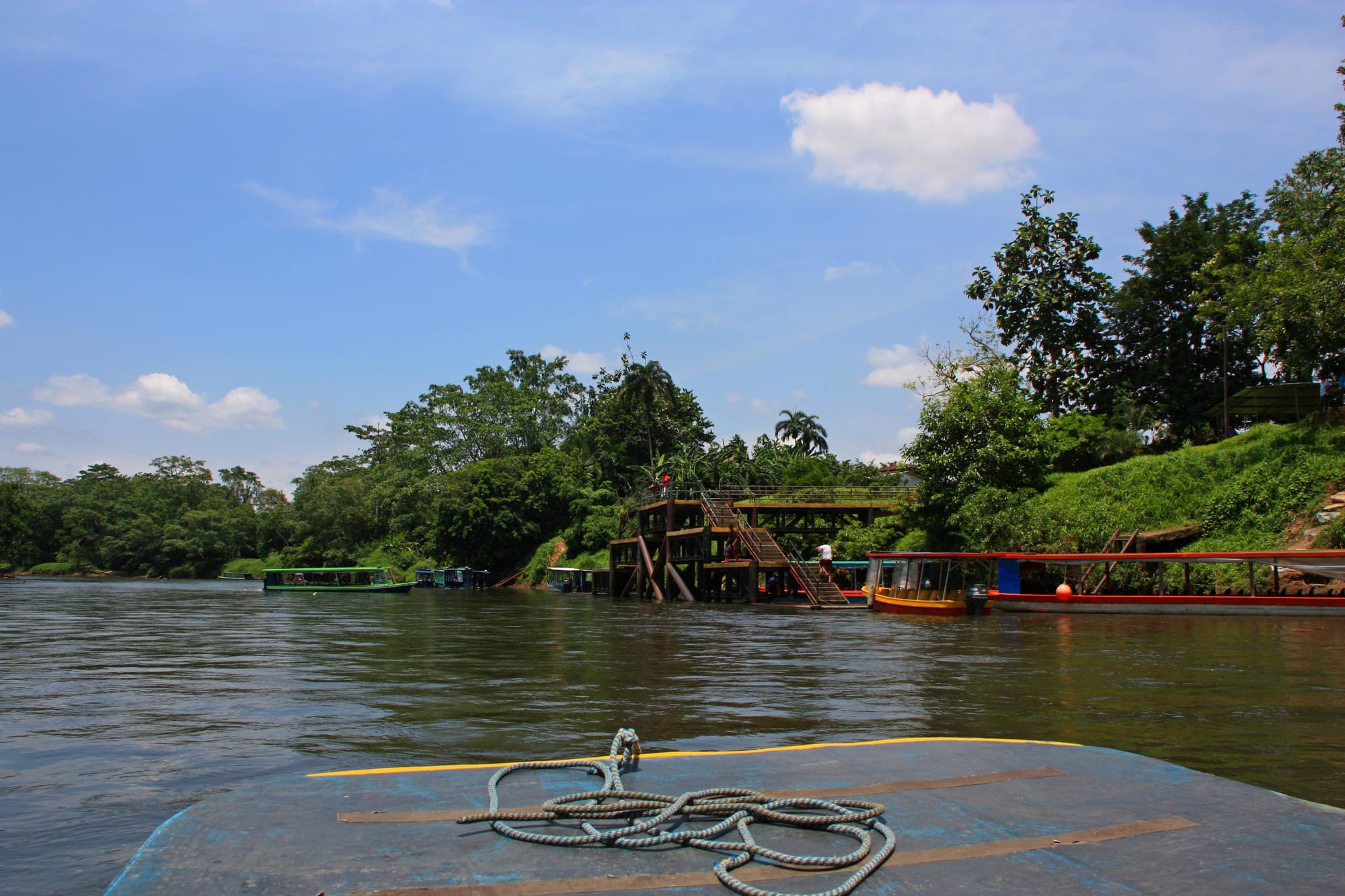
Long wooden river boats moored at a timber jetty on a wide brown river lined with tropical trees

San José, the Central Valley & Arenal, Costa Rica

Puerto Viejo de Sarapiquí

Arriving by boat at the river dock of Puerto Viejo de Sarapiquí. (diego_cue / Wikimedia Commons · CC BY-SA 3.0)

A lowland river town in Costa Rica's north-east, on the Sarapiquí river near the Nicaraguan border. Its river was long a route from the Central Valley towards the San Juan, and the town became a canton capital in 1970. Today it lives on bananas, pineapples, cattle and tourism, with the La Selva research station and Braulio Carrillo's rainforest close by.

Neighbourhoods

  • The town centre and the river dock
    • First-time visitors
    • River trips
    • Close to public transport

    The small commercial centre of the canton, with its church, shops, sodas and bus stop, running down to the dock on the Sarapiquí where river boats tie up and outfitters offer trips on the water.

    Open in Maps
  • The road south towards La Selva
    • Nature lovers
    • Birdwatching

    The highway towards Horquetas, on which the La Selva research station lies just outside town, with forest lodges and farms along the way.

    Open in Maps
  • Chilamate and the riverside villages
    • Quiet and rural
    • Rainforest stays

    Villages along the Sarapiquí upstream of town, where lodges with their own forest reserves and trails stand among farms and patches of rainforest.

    Open in Maps

Things to do

Rainforest and research

  • La Selva Biological Stationpark

    A protected area of about 1,500 hectares of lowland rainforest at the meeting of the Sarapiquí and Puerto Viejo rivers, founded in 1953 and run by the Organization for Tropical Studies, one of the world's most productive tropical research stations; guided walks for visitors are arranged in advance.

    Open in Maps

On the river

  • Sarapiquí Riverattraction

    A navigable tributary of the San Juan, still used to carry people and farm produce, and a national monument for its part in the 1856 war against the filibusters; boat trips from town follow it through the lowland forest.

    Open in Maps
  • The river docktransit hub

    The small river port of Puerto Viejo, used by shallow-draft boats for local transport and by outfitters for river trips.

    Open in Maps

Short trips from the town

  • Braulio Carrillo National Parkpark

    A large national park created in 1978 across the mountains between the Central Valley and the Caribbean lowlands, protecting cloud forest and rainforest, part of the Sarapiquí watershed and some of the highest biodiversity in the country.

    Open in Maps
  • Barva Volcanopark

    A forested volcano in the Barva sector of Braulio Carrillo, with three crater lakes, reached from the Central Valley side of the park.

    Open in Maps

Eat and drink

Long-standing places and food districts in Puerto Viejo de Sarapiquí. Hours, ratings and directions come from your maps app, always current.

Puerto Viejo classics

  • Sodas in the town centrerestaurant

    Small family-run diners serving casados — rice, beans, salad, plantain and a piece of chicken, fish or meat — and gallo pinto at breakfast.

    Open in Maps
  • Lodge restaurants along the riverneighborhood

    Restaurants at the forest lodges up and down the river, serving Costa Rican dishes with plantain, pineapple and other produce of the lowland farms.

    Open in Maps

Experience Puerto Viejo de Sarapiquí

History

Before the Spanish conquest the plains of the Sarapiquí were home to the Botos, an Indigenous people of the northern lowlands. In the colonial period the river was a possible route to the Caribbean by way of the San Juan, and in 1820 Joaquín Mora Fernández, brother of the first head of state, explored it down to its meeting with the San Juan. After independence the government offered rewards for routes to the coast through the north, and with great effort the Sarapiquí trail was opened from Heredia to a landing on the river known as El Muelle.

The river's most famous moment came in the war against William Walker. On 10 April 1856 the filibusters entered Costa Rica by way of the Sarapiquí, and a battle was fought at Sardinal; the river is now considered a national monument for its role in moving arms, goods and soldiers during that war.

For most of the following century Puerto Viejo was a small riverside settlement within the canton of Heredia; its first school opened only in 1952. On 18 November 1970 Sarapiquí became the tenth canton of the province of Heredia, and Puerto Viejo, as its head town, received the title of city. In 1953 the American botanist Leslie Holdridge founded La Selva nearby, which the Organization for Tropical Studies bought in 1968 and turned into one of the world's leading rainforest research stations. More recently the river has been dammed for hydroelectric power, and the 2009 Cinchona earthquake in the mountains upstream badly affected it.

Culture & Customs

Puerto Viejo's culture is that of the northern plains: a farming and river town whose people work on the banana and pineapple plantations, on cattle farms and, increasingly, in tourism. The river has always been central to its life, used to carry people and farm produce, and boats still tie up at the town dock.

The canton has a large foreign-born population: at the 2011 census 17.8 per cent of the canton's residents had been born abroad, and the Nicaraguan border lies to the north. Catholic life centres on the town church; when the canton was created in 1970 its church community was dedicated to Saint Augustine. Local pride runs deep in the history of the river, which carried soldiers and arms in the 1856 war against William Walker and is now a national monument.

Science and conservation give the town an unusual international side. La Selva hosts around 300 scientists and 100 university courses every year, and it also serves as a centre of environmental education for the local community. Wildlife watching, above all birdwatching, and boat trips on the river have made the area one of the country's best-known places for lowland rainforest, and nature tourism is now part of the town's identity alongside its farms.

Daily Life

The district of Puerto Viejo had an estimated 23,246 people in 2022, spread over about 428 square kilometres, and most of its people live in the countryside rather than in the town. It is the head town of the canton of Sarapiquí, the largest canton in the province of Heredia, and the place where the surrounding villages come for shops, banks, schools and government offices.

The economy rests on agriculture — bananas, pineapples, plantains, sugar cane and cattle — and on tourism based on the rainforest, the protected areas and the river. The rivers are still working routes, used to move farm produce and people, and lodges and guides keep to the hours of the forest, when birdwatching starts early in the morning.

The climate shapes everything: it is hot and humid all year, rain can fall at any time, and the rivers are prone to flooding. The roads to San José and Heredia cross the mountains, and buses connect the town with the capital. The building of hydroelectric dams on the river since the privatisation of electricity production has been a source of controversy, including a corruption scandal in 2012.

Food

Food in Puerto Viejo is everyday Costa Rican cooking with the produce of the lowlands. Breakfast is gallo pinto, rice and black beans fried together with onion, sweet pepper and cilantro, served with eggs and tortillas; lunch is a casado of rice, beans, salad, fried plantain and a piece of chicken, fish or beef, eaten at the sodas, the small family-run diners in the town centre.

The farms around the town grow bananas, plantains, pineapples and sugar cane, and they turn up at many meals: fried plantain beside the rice and beans, and pineapple eaten fresh or blended into frescos, the fruit drinks made with water or milk that are served across the country. Beef from the surrounding cattle farms is part of everyday cooking too.

Lodges outside town serve these dishes to visitors along with international cooking. Olla de carne, a stew of beef, cassava, potatoes and other vegetables, is a traditional dish, and coffee is drunk throughout the day, often brewed through a cloth chorreador, the traditional Costa Rican filter.

Planning tools

Budget

Puerto Viejo itself is an ordinary working town with simple places to stay and cheap sodas. The main costs are the forest lodges outside town, guided walks at the research station and in private reserves, and boat trips on the river.

Daily Budget Midrange
USD 110–200 (forest lodge, meals, a guided rainforest walk and a river trip)
Daily Budget Shoestring
USD 40–65 (simple room in town, soda meals, buses)

Arrange a guided walk at La Selva ahead of a visit, and compare river-trip outfitters at the dock.

Best Time to Visit

The town is hot, humid and green all year, with no distinct seasons, and most rain falls from June to August and from November to January. Birdwatching, forest walks and river trips go on through the year, and the months outside the wettest spells are usually the most comfortable.

Suggested Number of Days

One or two days allow a river trip and a guided rainforest walk. Three or four suit birdwatchers and anyone combining the lowlands with Braulio Carrillo's forests on the way to or from San José. Heavy rain is what most often changes plans.

First Visit
1–2 days
With Surroundings
3–4 days

Transportation

The town centre is small, and buses link it with San José and the nearby villages. Lodges and the research station lie along roads outside town, so visitors without a car rely on taxis, lodge transfers or tours. Boats leave from the dock for trips on the river.

The road from the Central Valley is demanding, with aggressive drivers; visitors not used to driving in Costa Rica may prefer to hire a driver.

Airport & Station Connections

Puerto Viejo is about two hours by road from San José, through the mountains, and about 82 km north of the city of Heredia. Buses run from San José, and some lodges arrange transfers from Juan Santamaría International Airport near Alajuela, the main gateway for international flights.

Walkability

The centre and the river dock are easy to cover on foot. The lodges, the research station and the national park lie outside town and need transport.

Safety

Costa Rica still compares well with its Central American neighbours, and crime that reaches visitors is usually petty theft or the occasional armed robbery — break-ins to parked rental cars, bag-snatching on beaches, and pickpocketing in San José. Across the region, homicides have risen in recent years, mostly linked to drug gangs in poorer districts away from tourist areas, and car break-ins happen at trailheads. The Sarapiquí is prone to flooding, and trails in Braulio Carrillo are narrow and not regularly patrolled by rangers.

Leave nothing visible in a parked car, walk the remoter forest trails with a guide, and ask locally about river levels after heavy rain. Check current official travel advice before travelling.

Climate

The town lies at only about 37 metres above sea level on the Caribbean-facing plains, and its climate is hot and humid all year, with no distinct seasons. Rain is heaviest from June to August and from November to January. At the La Selva station nearby, temperatures vary little through the year and about 4 metres of rain falls annually.

Summer
between the wettest spells: hot and humid, with daily temperatures at the nearby La Selva station ranging from about 19°C to 31°C
Winter
June–August and November–January: the heaviest rain, with temperatures at La Selva still about 19–31°C

Local Customs

Puerto Viejo is a farming town as much as a tourist one. A greeting before any request is expected, usted is widely used, and pura vida serves as hello, thanks and goodbye.

Ask before photographing people at work on farms or at the dock, and follow guides' instructions on forest trails.

Common Payment Methods

The currency is the Costa Rican colón (₡). Lodges and tour operators accept cards and US dollars, but buses, sodas and small shops need colones, and cash is useful in the villages.