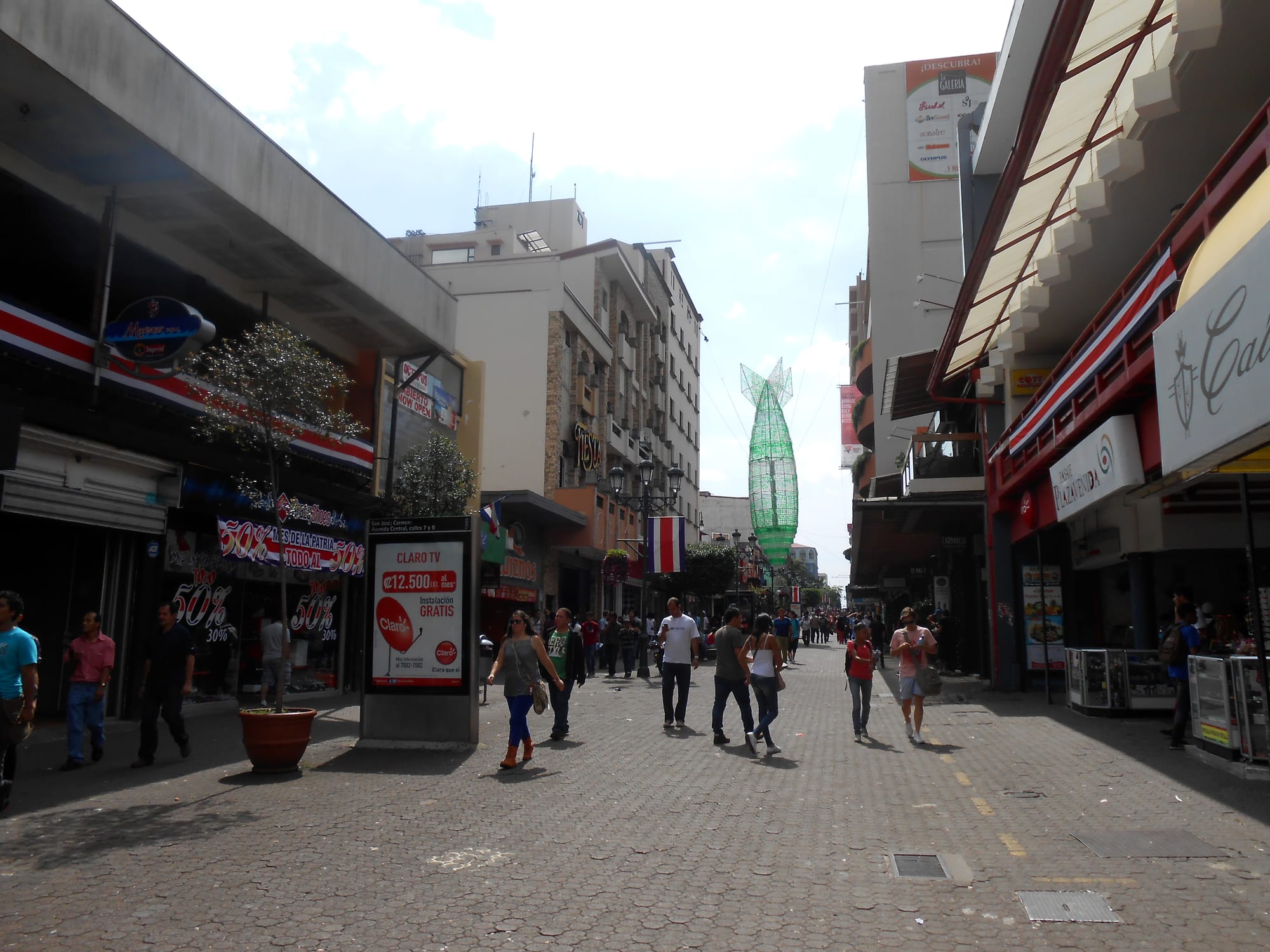
A pedestrian street of shops and low office buildings with shoppers walking under a pale sky

San José, the Central Valley & Arenal, Costa Rica

San José

The pedestrianised Avenida Central in downtown San José. (Haakon S. Krohn / Wikimedia Commons · CC BY-SA 3.0)

Costa Rica's capital, in the Central Valley at the heart of a metropolitan area of more than two million people. Founded in 1736 and capital since 1823, it grew rich on tobacco and then coffee, which paid for the National Theatre. Today it is the country's seat of government and transport hub, with gold, jade and national museums close together downtown.

Neighbourhoods

  • Downtown (the casco central)
    • First-time visitors
    • Museums
    • Close to public transport

    The old grid of the Carmen, Merced, Hospital and Catedral districts, where the National Theatre, the gold museum, the cathedral and the Central Market lie a few blocks apart along the pedestrian stretch of Avenida Central. Busy and noisy by day, much quieter after dark.

    Open in Maps
  • Barrio Amón
    • Historic district
    • Architecture

    One of San José's first elegant neighbourhoods, built in the late 19th century on the north-east edge of downtown and named after the French coffee entrepreneur who developed it. Its houses of that era make it one of the city's historic quarters.

    Open in Maps
  • Barrio Escalante
    • Best for food
    • Cafés
    • Quiet and residential

    A residential district north-east of the centre, close to the train line, that has become the city's best-known area for restaurants and coffee shops.

    Open in Maps
  • La Sabana and Paseo Colón
    • Parks
    • Sport
    • Business travellers

    The western side of the city, where Paseo Colón runs out to La Sabana, the largest park in San José, with the National Stadium and the Costa Rican Museum of Art in the former airport terminal.

    Open in Maps
  • San Pedro
    • Students and nightlife
    • Local life

    The eastern suburb in the Montes de Oca canton that is home to the main campus of the University of Costa Rica. It is one of the city's safer commercial districts and its student quarter.

    Open in Maps
  • Escazú
    • Quiet and residential
    • Shopping

    A suburban canton on the west side of the capital, reaching south to the Escazú hills, whose whole territory now lies within the Greater Metropolitan Area.

    Open in Maps

Things to do

Famous landmarks

  • National Theatre of Costa Ricalandmark

    The capital's finest historic building, opened on 21 October 1897 with a performance of Faust and paid for in the years of coffee wealth, with a lavishly furnished interior and seats for about 1,100 people.

    Open in Maps
  • Melico Salazar Theatrelandmark

    A theatre of 1928 a block west of the National Theatre, built for Spanish operettas and named after the Costa Rican tenor Melico Salazar, with a full programme of concerts and plays.

    Open in Maps
  • Metropolitan Cathedrallandmark

    The city's cathedral on Calle Central, rebuilt after the original church of 1802 was destroyed by an earthquake.

    Open in Maps
  • Plaza de la Democracialandmark

    The square in front of the Legislative Assembly, officially dedicated to democracy and the abolition of the army, flanked by the National Museum and the jade museum.

    Open in Maps

Museums

  • Pre-Columbian Gold Museummuseum

    An underground museum below the Plaza de la Cultura, run by the Central Bank, with more than 1,500 gold objects made between a few centuries BC and the Spanish conquest.

    Open in Maps
  • Museo del Jademuseum

    An archaeological museum founded in 1977 and since 2014 in a modern building facing the Plaza de la Democracia, holding the world's largest collection of American jade.

    Open in Maps
  • National Museum of Costa Ricamuseum

    The national museum, housed since 1950 in the Bellavista barracks of 1917, where José Figueres symbolically abolished the army on 1 December 1948.

    Open in Maps
  • Costa Rican Museum of Artmuseum

    The national art collection of more than 6,000 works, opened in 1978 in the old airport terminal in La Sabana.

    Open in Maps

Parks, sport and the university

  • La Sabana Metropolitan Parkpark

    The country's largest urban park, called the lungs of San José, on the site of the city's former airport, with the National Stadium at its edge.

    Open in Maps
  • Costa Rica National Stadiumattraction

    The 2011 stadium in La Sabana, home of the national football team, with about 42,000 seats.

    Open in Maps
  • University of Costa Ricaattraction

    The country's oldest and largest university, founded in 1843 as the Universidad de Santo Tomás, whose main campus in San Pedro has about 45,000 students.

    Open in Maps

Markets

  • San José Central Marketmarket

    A market of 1880 filling a whole block on Avenida Central, with more than 200 stalls in narrow alleys selling coffee, herbs, leather, crafts and cheap meals at small sodas.

    Open in Maps

Short trips from the city

  • Irazú Volcanopark

    The country's highest active volcano, above Cartago, with a grey summit of craters reached by road.

    Open in Maps
  • Poás Volcanopark

    An active volcano north of Alajuela, where a viewing platform looks into a wide steaming crater.

    Open in Maps

Seasonal events

  • Semana Universitarialast week of April

    A week of open-air shows, sport and concerts on the University of Costa Rica's main campus in San Pedro.

  • Festival de la Luzsecond Saturday of December

    A night parade of floats, masked dancers, live music and fireworks that marks the start of Christmas in the capital.

  • Tope Nacional26 December

    A parade of thousands of horses and riders along Paseo Colón.

  • Fiestas de Zapotelate December

    The year-end fair in the suburb of Zapote, with fairground rides, fireworks and rodeo shows.

Eat and drink

Long-standing places and food districts in San José. Hours, ratings and directions come from your maps app, always current.

Markets and sodas

  • San José Central Marketmarket

    The classic place for a casado or a bowl of soup at a counter soda, among stalls of coffee, fruit and herbs; it is also known for cinnamon ice cream.

    Open in Maps
  • Mercado Borbónmarket

    A food market two blocks north of the Central Market, with butchers, fishmongers and fruit sellers.

    Open in Maps

Food districts

  • Barrio Escalanteneighborhood

    The city's restaurant district, with Costa Rican, Latin American and international kitchens and many coffee shops in old houses with gardens.

    Open in Maps
  • La Californianeighborhood

    Known as La Cali, the area just east of downtown where much of the city's bar life is concentrated.

    Open in Maps

Experience San José

History

San José was founded in 1736 by order of the cabildo of León to gather the scattered inhabitants of the Aserrí valley. Unlike nearby Cartago, the colonial capital, it was not founded by formal decree and had no town council of its own. Growth came with better water supply and above all the state Tobacco Factory, set up in 1782, whose profits let the town overtake its neighbours. Its town council and city title were restored in 1820, and after independence it became the capital in 1823, which makes it one of the younger capital cities of Latin America.

Coffee transformed it in the 19th century. Export wealth paid for the National Theatre, which opened in 1897 with a performance of Faust. The French entrepreneur Amon Fasileau-Duplantier developed Barrio Amón, the city's first elegant suburb, and the two remain symbols of the coffee golden age. In 1948 the city was at the centre of the civil war; on 1 December that year José Figueres symbolically abolished the army at the Bellavista barracks, which since 1950 have housed the National Museum.

In the 20th century San José spread across the valley floor and merged with Alajuela, Heredia, Cartago and the suburbs between them into a single metropolitan area. La Sabana, once the site of the city's airport, is now its largest park, and a new National Stadium opened there in 2011. The city joined UNESCO's network of learning cities in 2016 and is also recognised by UNESCO as a city of design.

Culture & Customs

San José is the country's cultural capital. The National Theatre and the Melico Salazar Theatre stage concerts, dance and drama through the year, the Teatro Variedades of 1892 is the city's oldest theatre, and the national museums of history, gold, jade and art all lie within a short distance of one another. The University of Costa Rica in San Pedro gives the eastern districts a student life of bars, bookshops and cheap restaurants, and its Semana Universitaria in late April fills the campus with concerts and shows.

Football is the city's great passion. Deportivo Saprissa, the capital's biggest club with a record number of league titles, plays in the northern suburb of Tibás, the club Universidad plays at the Estadio Ecológico, and the national team plays at the stadium in La Sabana, the park that josefinos — the people of San José — call the lungs of their city.

December is the city's festival month. The Festival de la Luz opens the Christmas season with a night parade of floats, masked dancers and fireworks; the Tope Nacional on 26 December brings thousands of horses and riders along Paseo Colón; and the fair at Zapote runs through the end of the year with fairground rides and rodeo shows. Courtesy matters: people greet one another before getting to business, use the formal usted widely, and answer most things with pura vida.

Daily Life

The canton of San José had an estimated 352,381 people in 2022, and the Greater Metropolitan Area that joins it to Alajuela, Heredia and Cartago had more than two million in 2017. Only about a fifth of the canton's residents live in the four central districts; most live in the outer districts such as Pavas, Hatillo and San Sebastián, or in suburbs beyond the city limits. More than a million people pass through the city every day, many of them commuting into the centre by bus.

As the seat of government, the capital holds the ministries, the Legislative Assembly, the courts, the banks and most embassies, alongside the universities and hospitals. Many josefinos work in offices and services.

The day starts early, with coffee and gallo pinto before work, and traffic builds quickly in the morning and evening rush. Downtown is busy with shoppers and office workers by day and empties after dark, when nightlife moves to Escalante, La California and San Pedro. Traffic, the cost of housing and rising crime in some districts are the everyday complaints; the homicide rate has risen in recent years, mostly linked to drug gangs in poorer areas away from the tourist centre.

Food

Josefino eating is the national cooking at its most everyday. Breakfast is gallo pinto — rice and black beans — with tortillas and natilla, a thin sour cream, and lunch is a casado: rice, beans, salad, fried plantain and meat, eaten at sodas, the small family-run diners found on every block. Olla de carne, a beef soup with root vegetables, and chifrijo, beans with fried pork (chicharrón), are bar and family favourites.

The Central Market, open since 1880, is the best place to eat like a local, with counter sodas serving casados and soups among stalls of coffee, herbs and fruit; it is also known for helado de sorbetera, a cinnamon-flavoured ice cream. Two blocks north, the Mercado Borbón is the food market, with butchers, fishmongers and fruit sellers. Ceviche, small pieces of raw fish cured in lime juice, is sold at market counters and bars across the city.

For eating out, Barrio Escalante has the city's best-known cluster of restaurants and cafés, and San Pedro's student streets have cheap places to eat. Coffee is the city's pride, often brewed through a cloth chorreador, and tropical fruit is blended with water or milk into frescos.

Planning tools

Budget

San José is one of the cheaper places to be based in Costa Rica. Hostels, business hotels and guesthouses cover every budget, a casado at a soda costs far less than a tourist restaurant meal, and city buses are very cheap. Museum tickets for foreigners and taxis are the main extra costs.

Daily Budget Midrange
USD 100–180 (mid-range hotel, restaurants in Escalante, museums, taxis or ride-hailing)
Daily Budget Shoestring
USD 40–70 (hostel bed, soda meals, city buses)

Carry small change for buses, eat lunch at market sodas, and group the downtown museums together, as they are a short walk apart.

Best Time to Visit

December to April is the dry season, with sunny days, clear views of the surrounding volcanoes and the year-end festivals, parades and fair. From May to November rain usually falls in the afternoon, so mornings stay good for walking; museums and theatres make the city an easy base in any season.

Suggested Number of Days

One or two days cover the city itself. Three to five days allow time for the volcanoes, coffee country and the other valley towns, all of which can be reached as returns from the capital. Rush-hour traffic is the main thing that stretches a visit.

First Visit
1–2 days
With Surroundings
3–5 days

Transportation

Buses link every part of the city with the suburbs, and routes, schedules and fares are on the Moovit app. Commuter trains run from the Atlántico station near the Parque Nacional to Heredia and Cartago, with some extended to Alajuela, and from the Pacífico station westwards; services are limited and mostly at commuter hours. Taxis should use a meter; ride-hailing is widely used and generally cheaper. Traffic is heavy at rush hour.

Give a taxi driver the name of a landmark or business rather than a street address, which is often of little use.

Airport & Station Connections

Juan Santamaría International Airport, the country's busiest, is about 20 km north-west of downtown, near Alajuela. Licensed orange airport taxis wait outside arrivals, and a public bus that runs in its own lane for much of the way leaves from a stop a few minutes' walk away. Long-distance buses from across the country and from Nicaragua and Panama arrive at several separate terminals.

Walkability

The historic centre is compact and laid out on a grid, and the pedestrian stretches of Avenida Central link the market, the Plaza de la Cultura and the museums on foot. Traffic is fast and drivers rarely stop for pedestrians, so crossings need care. Beyond the centre, distances and busy roads make buses or taxis the practical choice, especially after dark.

Safety

Costa Rica still compares well with its Central American neighbours, and crime that reaches visitors is usually petty theft or the occasional armed robbery — break-ins to parked rental cars, bag-snatching on beaches, and pickpocketing in San José. San José has the country's highest concentration of street crime: pickpocketing and bag-snatching around the bus terminals, the Central Market and Avenida Central, and robberies after dark. Homicides have risen in recent years, mostly linked to drug gangs in poorer districts away from tourist areas. A safe block and an unsafe one can sit side by side, and the area around the Coca-Cola bus terminal has a poor reputation.

Keep phones and cash out of sight in the street, use registered taxis or ride-hailing at night, and leave nothing visible in a parked car. Check current official travel advice before travelling.

Climate

San José's altitude keeps it mild all year: monthly average temperatures stay between about 22°C and 24°C, with April the warmest month and October the coolest. Days are usually in the low to high 20s °C and nights can feel cool. The year divides into a dry season and a rainy one rather than summer and winter.

Summer
dry season (December–April): sunny, around 22–27°C by day, cooler at night
Winter
rainy season (May–November): still mild, about 22°C on average, with often clear mornings and heavy afternoon showers

Local Customs

Costa Ricans are courteous and fairly formal, using usted widely, and a greeting before any question is expected. Dress in the capital is more formal than in the beach towns. Pura vida works as hello, thanks and goodbye.

Ask before photographing people in markets and dress modestly in churches.

Common Payment Methods

The currency is the Costa Rican colón (₡). Cards are accepted in most hotels, restaurants and shops, and US dollars are widely taken for larger purchases, with change given in colones. Cash in colones is needed for buses, market stalls and small sodas. ATMs are common, including at the airport.