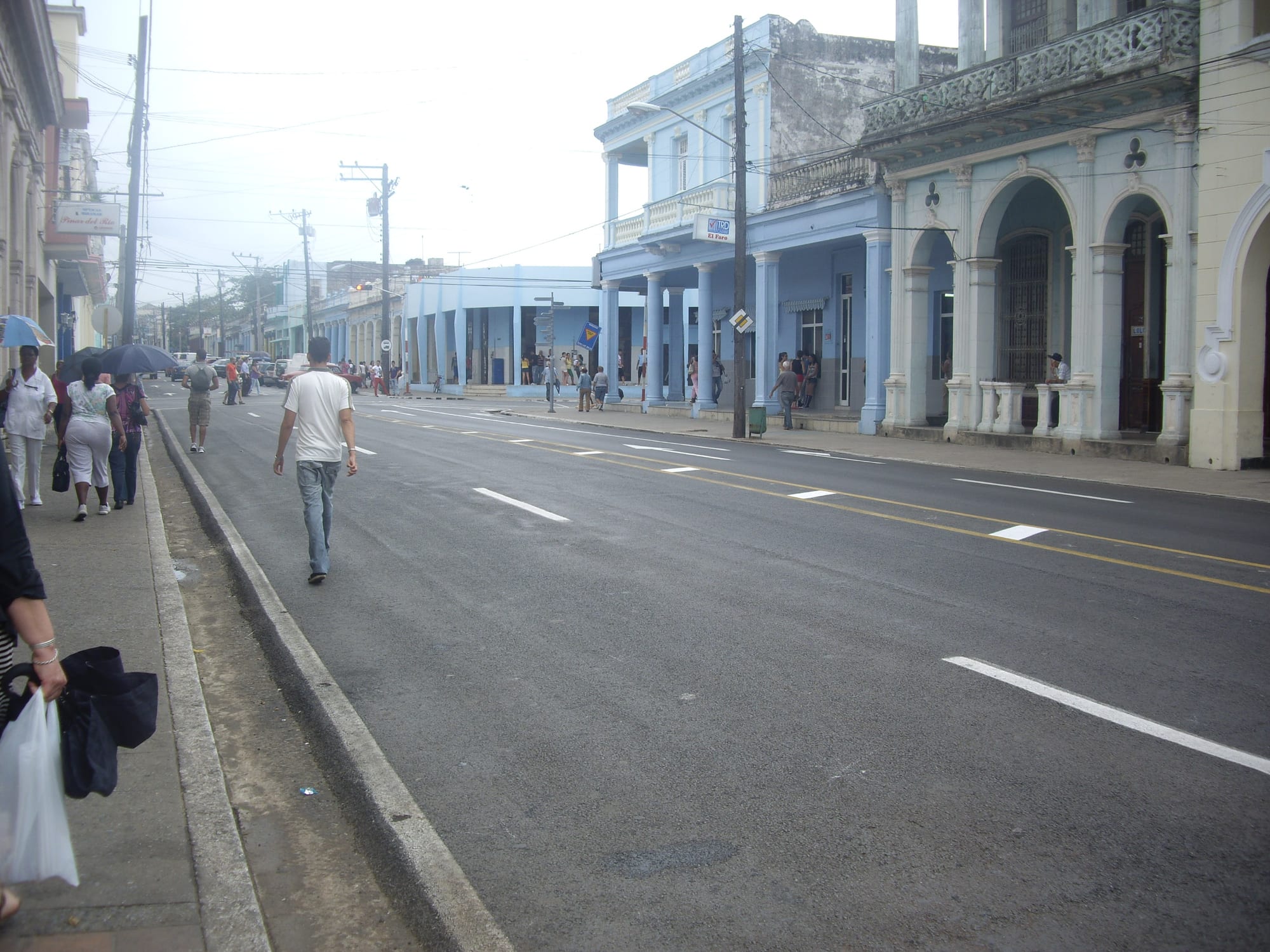
A wide street in Pinar del Río lined with pale blue colonnaded buildings and pedestrians on the pavements

Havana, Viñales & the West, Cuba

Pinar del Río

Calle José Martí, the main street of Pinar del Río. (Mmoyaq / Wikimedia Commons · CC BY-SA 3.0)

The capital of Cuba's westernmost province, a working city of colonnaded streets in the heart of the Vuelta Abajo tobacco country, about 26 kilometres south of Viñales. Canary Island farmers made the region famous for its cigar leaf, and the city remains a centre of the cigar industry, far less visited than the valley to its north.

Neighbourhoods

  • The city centre
    • First-time visitors
    • Historic district
    • Close to buses

    The streets around Calle José Martí, the main street, lined with columned porticoes and pastel buildings, hold most of the city's shops, banks and services.

    Open in Maps
  • The outer districts
    • Local life
    • Quiet and residential

    Residential neighbourhoods of low houses and apartment blocks spread out from the centre, with the baseball stadium and the university, before giving way to tobacco fields and grazing land.

    Open in Maps
  • The surrounding villages
    • Rural life
    • Tobacco country

    The municipality takes in villages such as Briones Montoto, Cayo Conuco, La Coloma, La Conchita and Las Ovas, among tobacco plantations, cattle ranches and open grazing land.

    Open in Maps

Things to do

Landmarks of the centre

  • Cathedral of San Rosendolandmark

    The Cathedral of Pinar del Río, seat of the bishop of the Diocese of Pinar del Río.

    Open in Maps
  • Palacio Guaschlandmark

    A palace listed among the places of interest of the city.

    Open in Maps
  • Teatro José Jacinto Milanéslandmark

    The most important theatre in the city, built in 1838 and counted among the great theatres of colonial Cuba.

    Open in Maps

Baseball

  • Estadio Capitán San Luisattraction

    The stadium of the Vegueros, the province's baseball team, one of the most successful in the Cuban National Series and Caribbean Series champions in 2015.

    Open in Maps

Short trips from the city

  • Viñales Valleypark

    A karst valley of tobacco farms and limestone mogotes north of Viñales, inscribed as a UNESCO World Heritage Site in 1999 for its landscape and traditional tobacco farming.

    Open in Maps
  • Viñalesattraction

    A small town of one-storey wooden houses with porches at the edge of the Viñales Valley, the base for walks, rides and cave visits.

    Open in Maps

Eat and drink

Long-standing places and food districts in Pinar del Río. Hours, ratings and directions come from your maps app, always current.

Pinar del Río classics

  • Restaurants in the city centreneighborhood

    State and private restaurants around Calle José Martí serving the Cuban staples of pork, chicken, rice and beans to a mostly local clientele.

    Open in Maps
  • Guayabita del Pinarrestaurant

    The province's own drink, made since 1892 with a small guava grown in the mountains of Pinar del Río.

    Open in Maps

Experience Pinar del Río

History

Long before the Spanish came, the far west of Cuba was home to the Guanahatabey, nomadic people who lived in caves and drew most of their living from the sea, and to Taíno communities further east. After the conquest the Spanish left the rugged west largely alone, and it developed slowly once Canary Islanders began arriving in the late 1500s. These settlers became the tobacco farmers of the region, and the area, at first called Nueva Filipina, was renamed Pinar del Río in 1778, supposedly for the pine forests along the Río Guama.

Tobacco plantations and cattle ranches spread across the rich soil, and by the middle of the 19th century, when Europe had taken to the cigar, the region flourished. The Vuelta Abajo district around the city became famous for the finest cigar leaf, the town was founded on its present site on 10 September 1867, and in 1893 the railway was extended to carry the crop to market. Pinar del Río came to be known as the Mecca of tobacco.

In 1878, when Cuba was divided into six provinces, the town became the capital of the westernmost, and it has remained a provincial capital ever since. In 1962 Soviet missile sites in Pinar del Río Province were at the centre of the missile crisis. Hurricane Ian caused severe damage across the province in 2022, and the city has since shared in the national crisis of fuel shortages and blackouts.

Culture & Customs

The countryside around Pinar del Río is guajiro land, and the word for the rural farmer — said to mean 'one of us' — is worn with pride. Farming families of the Vuelta Abajo pass down the craft of growing, curing and sorting tobacco leaf, and many descend from Canary Island settlers. The punto guajiro, sung improvised verses in ten-line décimas, belongs to this rural culture, and cockfighting and rodeos are part of country life.

Baseball is the passion of the city. The provincial team, nicknamed the Vegueros — the tobacco growers — was founded in 1969 and is one of the most successful in the Cuban National Series, with ten championships; in 2015 it won the Caribbean Series, the first Cuban team to do so since 1960. The Hall of Famer Tony Oliva, who starred for the Minnesota Twins, came from the province.

The city has a university, founded in 1972, a historic theatre and a cathedral, and its centre of colonnaded streets has a provincial, unhurried feel. Unlike Viñales to the north, Pinar del Río is not a tourist town, and visitors share its streets with locals going about their business.

Daily Life

The municipality of Pinar del Río had about 191,000 people in 2022, making it one of the larger cities in Cuba, with most of them living in the city itself and the rest in the surrounding countryside and villages. The municipality borders Viñales, San Luis, San Juan y Martínez and Consolación del Sur.

The city lies in a major tobacco-growing area and is a centre of the cigar industry. Provincial government, the university, health services and commerce employ many others, and farming dominates the countryside around, where the carabao, the water buffalo, is the main working animal.

Daily life follows the national pattern: long blackouts, queues for bread and fuel, erratic water supply and high prices at private shops, with remittances from relatives abroad keeping many households going. Emigration has left many families divided. The Carretera Central highway, the A4 motorway and the railway to Havana link the city with the capital, and the farms of the province send their produce along them.

Food

Food in Pinar del Río is the Cuban staple repertoire of the countryside: roast pork for celebrations, rice and black beans cooked together as moros y cristianos or congrí, root vegetables such as yuca with mojo, a garlic-citrus dressing, and fried plantain, both savoury tostones and sweet maduros. Fruit and vegetables come from the farms around the city, though supplies depend on what the shortages allow.

The province's own drink is guayabita del Pinar, a drink made since 1892 with a small guava grown in the mountains of Pinar del Río. Rum from Cuba's sugar cane fills the glasses at celebrations, and strong, sweet coffee, cafecito, punctuates the day.

Tobacco, though not a food, is the city's most famous product: leaf from the Vuelta Abajo goes into many of Cuba's best-known cigars, and the city is a centre of the cigar industry. State cafeterias sell cheap sandwiches and pizza, and a growing number of small private restaurants serve local diners and the occasional visitor.

Planning tools

Budget

Pinar del Río is cheaper than Havana and Viñales, and amenities are more modest, because the city sees few tourists. Casas particulares are the usual place to stay. Fuel and food shortages have made prices harder to predict since early 2026, and almost everything is paid in cash.

Daily Budget Midrange
USD 80–150 (a good casa with meals, restaurant dinners, a private taxi to Viñales)
Daily Budget Shoestring
USD 35–60 (casa particular, state cafeterias and set meals, buses and colectivos)

Carry enough euros or dollars in cash for the whole stay and change small amounts at a time.

Best Time to Visit

December to April is the driest and most comfortable time. Tobacco is planted in the autumn and harvested in the first months of the year, when the drying barns of the surrounding farms are full. May to October is hotter and wetter, and September and October carry the highest hurricane risk.

Suggested Number of Days

A day is enough for the city centre at an easy pace, and many visitors treat the city as a stop on the way west. Allow three or four days to take in the tobacco country around it as well.

First Visit
1 day
With Surroundings
3–4 days

Transportation

The centre is compact and walkable. Víazul buses between Havana and Viñales stop at the city's bus terminal, and shared taxis (colectivos) run to Viñales and Havana. Fuel shortages disrupt buses and taxis.

Confirm transport the day before travelling and keep a spare day in the plan.

Airport & Station Connections

The city lies on the Carretera Central highway and the A4 motorway west of Havana, around three to four hours away by Víazul bus, and has a railway station on the line to Havana. Its own airport is abandoned, so visitors fly into José Martí International Airport in Havana and continue by road.

Walkability

The centre is easy on foot, with shaded colonnades along the main streets giving shelter from sun and rain. The stadium and outer districts are a longer walk, and the tobacco country beyond needs a taxi.

Safety

Cuba has low levels of violent crime and is generally very safe for visitors. The west is safe by regional standards, and Pinar del Río sees far less hustling than Havana, but power cuts, water shortages and hurricanes affect the whole region; Hurricane Ian caused severe damage in the province in 2022.

Agree taxi fares in advance, keep a torch for blackouts and carry basic medicines. Check current official travel advice before travelling.

Climate

Tropical; the west has the most marked seasons in Cuba. Winter cold fronts reach the province from the north, bringing wind and cool nights, while summers are hot, humid and wet, and the west lies in the path of many Atlantic hurricanes.

Summer
hot and humid in western Cuba, around 30–33°C by day, with heavy afternoon storms
Winter
warm days in western Cuba around 24–27°C, with cooler nights during cold fronts

Local Customs

People here are called Pinareños, and the province is proud of its guajiros, the rural farmers whose name is said to mean 'one of us', and of its tobacco and its baseball team. English is spoken far less than in Havana or Viñales, so some Spanish helps.

Ask before photographing people, dress modestly in the cathedral, and be patient with queues and shortages.

Common Payment Methods

The currency is the Cuban peso (CUP), and services for visitors are often priced in US dollars or euros. Cash is essential: ATMs are unreliable and US-issued cards do not work at all.