A white neoclassical building with tall columns behind a paved square, with red-flowering trees and people on benches

Trinidad, Cienfuegos & the Centre, Cuba

Santa Clara

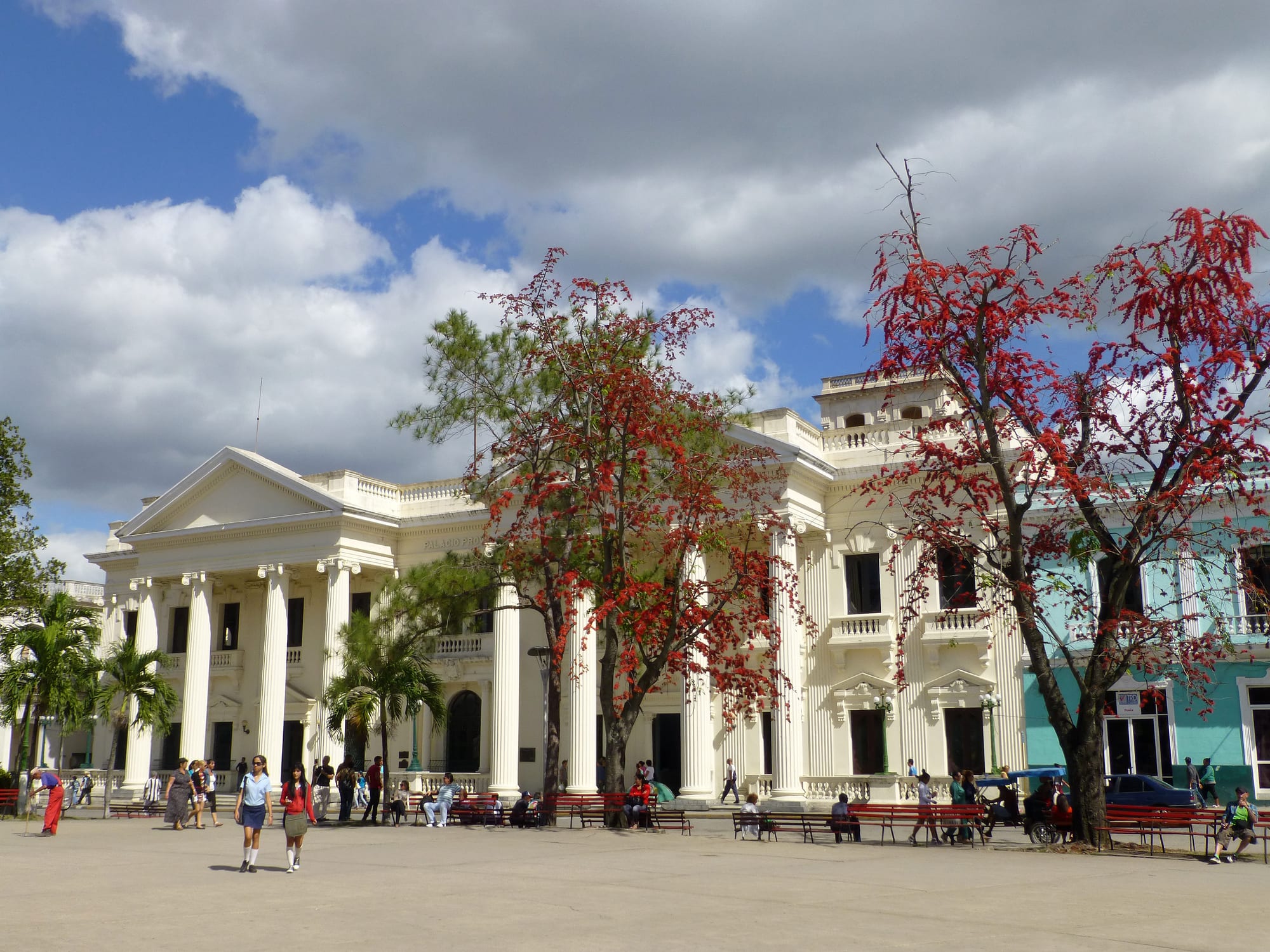
Neoclassical buildings and flowering trees on the Parque Vidal, the central square of Santa Clara. (Ji-Elle / Wikimedia Commons · CC BY-SA 4.0)

The capital of Villa Clara province, almost at the geographical centre of Cuba — a university city and transport hub founded in 1689 by families from Remedios. Its place in modern history was fixed in December 1958, when rebel columns under Che Guevara took the city and derailed an armoured train, and today his mausoleum draws visitors from across the world.

Neighbourhoods

  • Centro and the Parque Vidal
    • First-time visitors
    • Historic district
    • Nightlife

    The old grid laid out in the 17th century around the former Plaza Mayor, now the Parque Vidal. The Teatro La Caridad, the former city hall and hotels face the square, the cathedral and El Mejunje are a short walk away, and most casas particulares and cafés are in the streets around it.

    Open in Maps
  • Loma del Carmen
    • Historic district
    • Quiet and residential

    The small hill where, by tradition, the city's founders heard mass under a tamarind tree in 1689. A church, a monument ringed by a descendant of the tamarind and the Parque del Carmen mark the spot, near the railway station.

    Open in Maps
  • Plaza Che Guevara
    • Revolutionary history
    • Open spaces

    The large square on the western side of the city, overlooked by a bronze statue of Guevara and the memorial complex that holds his remains, the museum and the eternal flame. Outside ceremonies it is open and quiet.

    Open in Maps
  • The east side and the railway
    • Revolutionary history
    • Close to public transport

    Avenida Liberación leads from the centre past the railway depot to the Tren Blindado memorial, built where the armoured train was derailed in 1958, between the main line and the Cubanicay river. The Loma del Capiro rises above the eastern edge of the city.

    Open in Maps

Things to do

Revolution memorials

  • Che Guevara Mausoleumlandmark

    A memorial complex inaugurated in 1988, where Guevara and fellow combatants killed in Bolivia in 1967 were laid to rest in 1997, with a large bronze statue, an eternal flame and a museum of his life.

    Open in Maps
  • Tren Blindadomuseum

    A memorial park and museum on the site where Guevara's men derailed an armoured government train on 29 December 1958, with the bulldozer monument and exhibits inside the derailed cars.

    Open in Maps
  • Loma del Capiroviewpoint

    A group of three small peaks used by Guevara as a command post during the battle, with a monument on the summit and a lookout over the city and the palm-dotted savanna.

    Open in Maps

The old centre

  • Parque Vidalpark

    The central square, covering a whole block, declared a National Monument in 1998 for its mix of colonial and neoclassical buildings and its monuments, including a statue of Marta Abreu.

    Open in Maps
  • Teatro La Caridadlandmark

    A theatre on the Parque Vidal paid for entirely by the philanthropist Marta Abreu, one of the few colonial theatres left in Cuba and a National Monument.

    Open in Maps
  • Catedral de Santa Clara de Asíslandmark

    The city's Roman Catholic cathedral, on Calle Marta Abreu two blocks from the Parque Vidal.

    Open in Maps
  • El Mejunjeattraction

    An LGBT cultural centre set up in 1985 by Ramón Silverio in the ruins of an old hotel beside the cathedral, open to everyone, with a theatre, a café, an art gallery and concerts from rock to Cuban folk music.

    Open in Maps

Short trips from the city

  • Remediosattraction

    The oldest Spanish settlement in the old Las Villas province, near the north coast, with two churches on its main square, known as the cradle of the Christmas parrandas.

    Open in Maps
  • Caibariénattraction

    A small port known as the White Town, a few kilometres from Remedios, which shares in the parrandas and is the mainland end of the causeway to the cays.

    Open in Maps
  • Cayo Santa Maríabeach

    An island off the north coast, linked to Caibarién by a long causeway, known for white sand beaches and all-inclusive resorts, with some public beaches and snorkelling spots.

    Open in Maps
  • Hanabanilla reservoirpark

    A reservoir behind an embankment dam on the Hanabanilla River, near the village of El Salto del Hanabanilla in Villa Clara Province.

    Open in Maps

Eat and drink

Long-standing places and food districts in Santa Clara. Hours, ratings and directions come from your maps app, always current.

Food districts

  • The boulevardneighborhood

    The main street of the centre, where cafés and cantinas serve strong espresso, Cristal beer and rum, often with live music.

    Open in Maps
  • Around the Parque Vidalneighborhood

    The streets around the central square hold most of the city's paladares and cafés, serving pork, chicken, rice and beans and other Cuban staples.

    Open in Maps

Experience Santa Clara

History

Santa Clara was founded on 15 July 1689 by 175 people. Most belonged to two large families who already owned land at the site; the rest were families from San Juan de los Remedios, near the coast, who had chosen to move inland rather than live under constant pirate attack. By tradition the founders heard mass under a tamarind tree on the hill now called Loma del Carmen. The settlement went through several names — Cayo Nuevo, Villa Nueva de Santa Clara, Villa Clara — before settling on Santa Clara, and it was laid out on a regular Spanish grid around a Plaza Mayor, today's Parque Vidal.

Lying almost at the centre of the island, the town became a stop for travellers between Havana and the east and a transport hub, and by the 19th century it had outgrown Remedios and become capital of Las Villas province. Its great benefactor was Marta Abreu, who with her husband supported the rebels in the war of independence and paid for the Teatro La Caridad, schools for poor children, a fire station and the railway station. In 1923 the old parish church in the main square was demolished to enlarge the plaza, a decision still criticised.

In late December 1958 rebel columns under Che Guevara and Camilo Cienfuegos attacked the city. On 29 December Guevara's men derailed an armoured train sent from Havana, and the city was captured; Batista fled Cuba within hours. In 1977 Santa Clara became capital of the new Villa Clara province, and in 1997 Guevara's remains, found in Bolivia, were buried in the memorial on the city's western side.

Culture & Customs

Santa Clara is best known for the battle of 1958, which is remembered in its memorials, from the armoured train to the mausoleum. Yet its everyday character is that of a provincial university town. The Universidad Central "Marta Abreu" de Las Villas, founded in 1952, and a medical university founded in 1966 bring in students from across central Cuba.

The best-known cultural venue is El Mejunje, which Ramón Silverio began in 1985 as a gathering of bohemians and intellectuals in the ruins of an old hotel beside the cathedral. It grew into an LGBT cultural centre open to everyone, with a theatre, a café, an art gallery, concerts from rock to Cuban folk music and a Saturday-night disco, and it has run campaigns on HIV prevention and against homophobia. The Teatro La Caridad is one of the colonial theatres that still stands on the island.

The Parque Vidal has long been the centre of social life. An older custom, now rarely practised, had young women walking around the inner path of the square while young men walked the outer one. The city has produced the pianist Rubén González, the drummer Dafnis Prieto and several major-league baseball players, and baseball is followed closely. In December the towns to the north-east, Remedios and Caibarién, hold the parrandas, rival neighbourhood festivals with floats, lanterns and fireworks.

Daily Life

The municipality of Santa Clara had about 246,000 people in 2022, making it the fifth-largest city in Cuba. It is the capital of Villa Clara province and its administrative, university and medical centre, and it lies where the central highway, the motorway and the main railway meet, so much of the island's road and rail traffic passes through.

The city is divided into wards, from the old centre around the Parque Vidal and residential districts such as Condado and Vigía to semi-rural areas on the edge, where farmland begins. Pedicabs and horse carriages share the streets with old cars and buses. The Parque Vidal, a block-sized square of benches and monuments, is where people meet in the afternoons.

Daily life follows the national pattern of low state wages, rationing, queues and long power cuts. Island-wide blackouts have recurred through 2026, and since the United States began blocking fuel shipments to Cuba early in the year, shortages of fuel, food and medicine have deepened. Like the rest of the centre, Santa Clara has lost many young people to emigration in recent years, and many families depend on money sent from relatives abroad.

Food

Santa Clara eats the national staples: rice and black beans, cooked together as moros y cristianos or congrí, roast or fried pork, chicken, yuca with mojo, a garlic and citrus dressing, and plantain served as crisp tostones or sweet maduros. In the countryside of central Cuba, pork roasted slowly over an open fire or in a pit is the dish for celebrations.

Most visitors eat at their casa particular, where breakfast and dinner are often cooked by the family, or in paladares, the private restaurants around the Parque Vidal. Peso-priced state cafeterias serve simpler plates of pork, chicken and salad. Ingredients depend on what is available, and the menu can be short when shortages bite.

The boulevard, the main street of the centre, is the place for a drink: cafés and cantinas there serve Cristal beer, rum and small cups of strong, sweet espresso, the cafecito that punctuates the Cuban day. On the plains outside the city, sugar cane gives guarapo, fresh cane juice, and tobacco is processed in the province.

Planning tools

Budget

Santa Clara is cheaper and less touristy than Trinidad. Casas particulares and paladares are the usual choices, and most of the sights are memorials and squares that cost little. Prices shift fast because of the multiple exchange rates and the shortages, and visitors pay almost everything in cash.

Daily Budget Midrange
USD 90–180 (a good casa, paladar dinners, private taxis, a day trip to Remedios or the cays)
Daily Budget Shoestring
USD 35–60 (casa particular with breakfast, state cafeterias, pedicabs and Víazul buses)

Bring all the cash needed in euros or US dollars; ATMs are unreliable and US-issued cards do not work.
Best Time to Visit

December to April is dry and the most comfortable time for walking the city. The parrandas of nearby Remedios are held each year between 16 and 26 December. Summer is hot and wet but quieter, and September and October carry the highest hurricane risk.

Suggested Number of Days

The city's own sights fit into a day or two. Allow three or four days to add the old towns of the north coast, the causeway cays or the mountains to the south. Fuel shortages can slow every journey, so a spare day helps.

First Visit
1–2 days
With Surroundings
3–4 days

Transportation

The centre is compact, and pedicabs and horse carriages work the streets around the Parque Vidal and run out to the memorials. Taxis are easy to find; agree the fare before setting off. Shared taxis and Víazul buses link the city with Havana, Sancti Spíritus and other cities.

Fuel shortages regularly disrupt buses and taxis, so confirm that services are running and keep plans flexible.

Airport & Station Connections

Abel Santamaría Airport, about 11 km north of the city, receives international flights, mainly for the resorts of Cayo Santa María. Santa Clara lies on the central highway, the motorway and the main Havana–Santiago railway, 267 km east of Havana by road, and Víazul buses connect it with Havana, Sancti Spíritus, Camagüey and Santiago de Cuba. Fuel shortages have disrupted flights since 2026, and several foreign airlines suspended routes.

Walkability

The old centre is a grid of short blocks around the Parque Vidal and easy on foot, with the cathedral, El Mejunje and the theatre all close together. The Tren Blindado is a short walk north-east of the centre. The mausoleum, on the western side, and the Loma del Capiro, to the east, are each about 1.5 km from the centre, and many visitors take a pedicab, a horse carriage or a taxi.

Safety

Cuba has low levels of violent crime and is generally very safe for visitors. Santa Clara, like the other smaller cities of the centre, sees few problems beyond occasional petty theft and overcharging. Power cuts and water shortages affect the whole region, and island-wide blackouts have recurred through 2026.

Keep valuables secure, agree taxi fares in advance, carry a torch and basic medicines, and be patient with shortages. Check current official travel advice before travelling.

Climate

Tropical and hot, on a plain in the middle of the island. The drier, slightly cooler season runs from November to April; May to October is hotter, more humid and wetter, with heavy afternoon storms, and overlaps the hurricane season.

Summer
hot and humid, around 31–34°C on the region's plains and coast, with afternoon storms
Winter
warm and mostly dry, around 26–28°C by day on the region's coast

Local Customs

The memorials are treated with respect: photography inside the mausoleum is not allowed, and there are no souvenir sellers at the site. The Parque Vidal is the city's meeting place in the late afternoon and evening. Spanish is the language of daily life, and English is less widely spoken than in Havana. Tips matter to the many people who rely on tourism for their income.

Follow the no-photography rule inside the mausoleum, and ask before photographing people.

Common Payment Methods

The currency is the Cuban peso (CUP), but many tourist services are priced in US dollars or euros. Bring cash in euros or US dollars and change small amounts at a time; there are several official rates and a far weaker informal one. ATMs are unreliable and US-issued cards do not work.