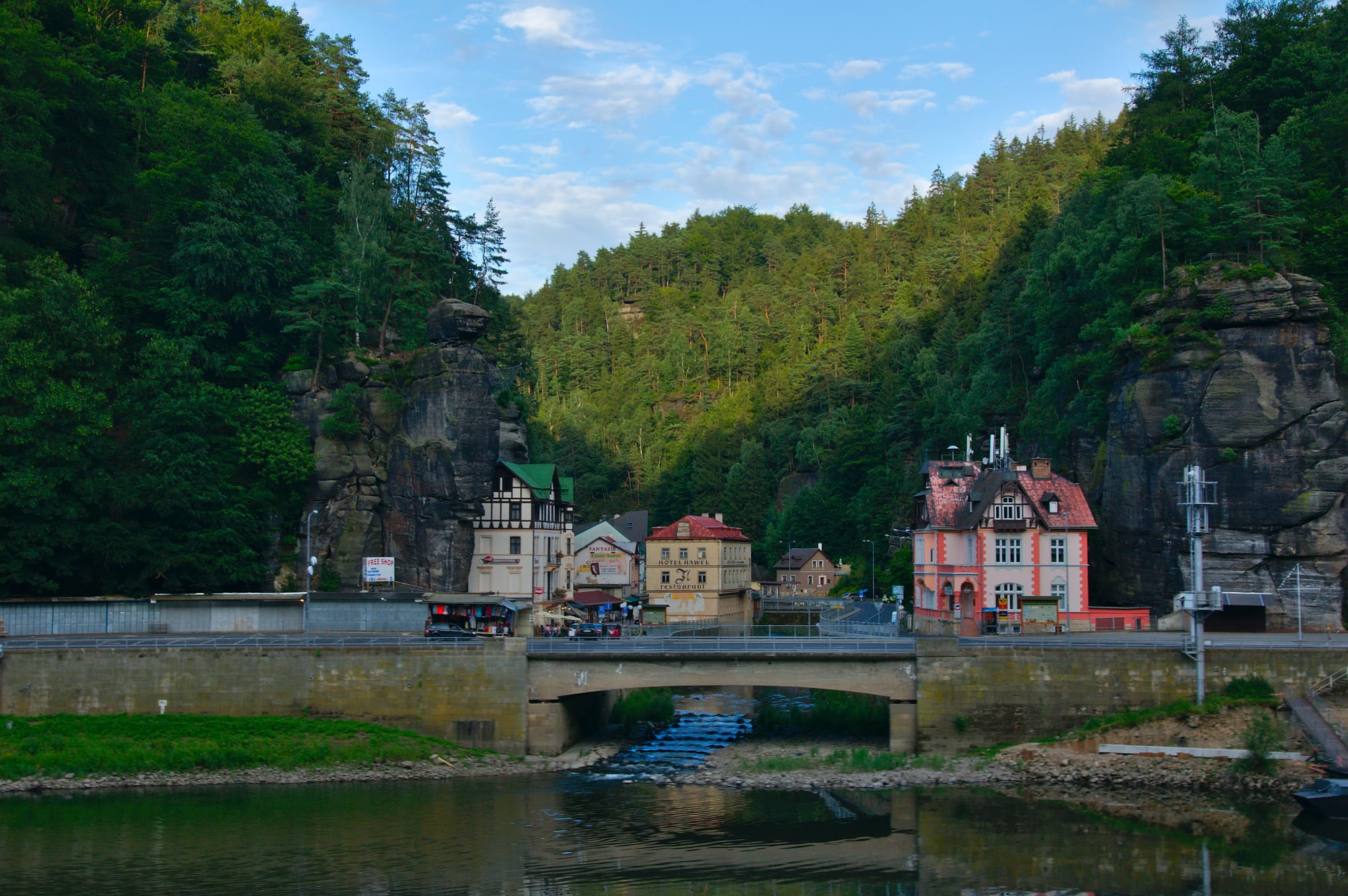
Houses of Hřensko between wooded sandstone cliffs, seen across a river and a low stone road bridge

North & East Bohemia, Czechia

Hřensko

Hřensko at the mouth of the Kamenice, with the road bridge over the river and sandstone rocks on either side. (Jiří Komárek / Wikimedia Commons · CC BY-SA 4.0)

A small village wedged between sandstone cliffs where the Kamenice meets the Elbe on the German border — the lowest municipality in Czechia. Founded as a trading settlement on the river, it grew into a resort when the Clary-Aldringen family opened the Kamenice gorges to boats in the late 19th century, and it is now the main gateway to Bohemian Switzerland National Park and the Pravčická brána.

Neighbourhoods

  • The village on the Elbe
    • First-time visitors
    • Close to public transport
    • Best for food

    A single strip of houses, restaurants and shops squeezed between the river and the cliffs along the main road to the German border, with the ferry landing for Schöna and the bus stops. Most of the village's places to eat and the national park information office are here.

    Open in Maps
  • The Kamenice valley
    • Hiking
    • Nature
    • Quiet

    The narrow side valley running inland from the bridge at the river mouth, where houses give way to forest, rock walls and the path towards the gorges. It is the starting point for walks to the Pravčická brána and for the boat sections of the Kamenice Gorge.

    Open in Maps

Things to do

Rocks and gorges

  • Pravčická bránalandmark

    The largest natural sandstone arch in Europe, about 3 km north-east of the village, with a span of 26.5 metres; a footpath climbs to it from Hřensko, and the arch itself may no longer be walked on.

    Open in Maps
  • Kamenice Gorgetrail

    The rocky ravine of the Kamenice, opened to visitors from the 1880s, where ferrymen steer boats with a tiller through the Edmund Gorge and the Wild Gorge, linked by a riverside path cut partly through the sandstone.

    Open in Maps
  • Bohemian Switzerland National Parkpark

    The national park of forest and sandstone towers on the right bank of the Elbe, created in 2000 and adjoining Saxon Switzerland in Germany; most of Hřensko's territory lies inside it.

    Open in Maps

In the village

  • Church of Saint John of Nepomuklandmark

    The village's main cultural landmark, a small late Baroque church built in 1786–1787.

    Open in Maps
  • The Elbe at the borderviewpoint

    The riverbank where the Elbe leaves the country, at about 115 metres above sea level the lowest point in Czechia.

    Open in Maps

Short trips from the village

  • Děčínneighborhood

    The riverside town about 11 km to the south, with Děčín Castle, reached by the long walled approach road called the Long Ride, a 16th-century stone bridge and a zoo.

    Open in Maps
  • Jetřichoviceneighborhood

    A village in the national park, with a second park information office and the rock viewpoints of Mariina skála, Vilemínina stěna and Rudolfův kámen nearby.

    Open in Maps
  • Děčínský Sněžníkviewpoint

    A mountain west of the Elbe, at about 724 metres the highest peak of the Elbe Sandstone Mountains.

    Open in Maps
  • Bad Schandauneighborhood

    The neighbouring German spa town in Saxon Switzerland, reached by road or by the ferry and the Dresden S-Bahn.

    Open in Maps

Eat and drink

Long-standing places and food districts in Hřensko. Hours, ratings and directions come from your maps app, always current.

Hřensko and around

  • Restaurants along the main roadneighborhood

    Pubs and restaurants lining the road between the river and the cliffs, serving Czech dishes to hikers and day visitors arriving from both sides of the border.

    Open in Maps
  • Děčín's town centreneighborhood

    A wider choice of pubs and restaurants in the nearest town, about 11 km upriver.

    Open in Maps

Experience Hřensko

History

Hřensko began as a riverside tavern serving the raftsmen who floated timber on the rivers; it is first mentioned in writing in 1488, and its name comes from that inn below the Hornichen hill, Horniss Kraczmer in the old German, distorted over time into Hřen- with a Czech place-name ending. Other settlers arrived from the 16th century, and it grew as a trading post at the point where the Kamenice reaches the Elbe. The late Baroque church of Saint John of Nepomuk was built in 1786–1787.

The village's modern character came from tourism under the Clary-Aldringen family. An inn was built beside the Pravčická brána in 1826, and Prince Edmund Clary-Aldringen added a new building there in 1881. In 1877 five adventurers bet that they could ride a wooden raft through the Kamenice Gorge; from the 1880s the prince paid for Italian experts and two hundred workers to cut paths and tunnels into the sandstone, and boat sections opened in 1881, 1890 and 1898. By the early 20th century about 160,000 people a year visited the gorge, and one of the first mountain clubs in the Czech lands was founded in Hřensko.

Before the Second World War the village was almost entirely German: of 579 inhabitants in 1921, 540 were Germans. After 1945 the German population was expelled, as elsewhere in the borderlands. The area was protected as a landscape area from 1972 and became part of the Bohemian Switzerland National Park in 2000. In July 2022 a large fire burned about 1,000 hectares of the park around the village, and a smaller fire followed in April 2026.

Culture & Customs

Hřensko's culture is that of a border resort. For more than a century visitors have arrived by river, road and rail to walk the sandstone hills, and the village still faces both ways: two border crossings, by road to Schmilka and by river to Schöna, link it with Saxon Switzerland, the German half of the same landscape.

The sandstone itself shapes local life and identity. The gorges are worked by ferrymen who steer the boats with a tiller and tell stories as they go, a tradition dating from the late 19th century, and the long-distance mountain path from Eisenach to Budapest passes the Pravčická brána. The arch reached a wider public when it appeared in the film The Chronicles of Narnia: The Lion, the Witch and the Wardrobe; because climbing on it is no longer allowed, the scenes of the actors running across it were filmed in a studio.

Respect for the national park's rules is part of the local etiquette, and after the 2022 fire bans on open flames and closures of paths in dry weather are taken seriously.

Daily Life

About 250 people live in the municipality, which consists of Hřensko itself and the small settlement of Mezná. At 130 metres above sea level it is the lowest municipality in Czechia, and the lowest point in the country — 115 metres — is on the Elbe where it crosses into Germany within its territory.

Almost everything here depends on visitors. The village has a national park information office, restaurants, shops and guesthouses along the I/62 road, which carries cross-border traffic between Ústí nad Labem and Saxony. Life follows the seasons: in summer coaches, buses, hikers and cyclists fill the narrow valley, and the gorge boats run all day; in winter the village grows very quiet.

Most residents rely on Děčín, about 11 km to the south, for schools, healthcare and larger shops. The fires of 2022 and 2026 and recurring summer closures have become a pressing concern, both for the forest and for a village whose income depends on the paths staying open.

Food

Meals in Hřensko are the hearty Czech cooking found across Bohemia: roast pork with bread dumplings and sauerkraut, known as vepřo-knedlo-zelo; svíčková, marinated beef in a thick sauce of carrot, parsley root and celeriac, served with dumplings, cranberries and a slice of lemon; guláš, a stew of beef, pork or game with onions and spices; and roast duck with dumplings and braised red cabbage. Smažený sýr, a slice of Edam-type cheese breaded and fried, is a standard choice for walkers, and bramboráky, fried pancakes of grated raw potato, make a quick snack.

Lager is the usual drink. Northern Bohemia has its own breweries, among them Svijany near Liberec, and the Saaz hops grown around Žatec are used in Czech lagers. Fruit dumplings filled with plums, apricots or strawberries and koláče, yeast pastries with fruit, poppy seed or sweet curd cheese, are common sweet choices, and Litoměřice, upriver on the Elbe, is the centre of a wine subregion.

Planning tools

Budget

Hřensko itself is small and geared to day visitors, and prices at the village restaurants reflect the crowds. Walking in the national park is free; the Kamenice boat trips and the Pravčická brána charge entry. Děčín, the nearest town, has a wider and cheaper choice of rooms and meals.

Daily Budget Midrange
USD 110–190 (guesthouse near the park, restaurant dinners, gorge boats and arch entry)
Daily Budget Shoestring
USD 45–80 (pension or hostel in Děčín, pub meals, buses and trains)

Start early in summer: the paths to the gorges and the arch are busiest from late morning.

Best Time to Visit

May to October, when the footpaths are usually at their driest; June and September are quieter than the summer holidays. In dry summers parts of the park can be closed because of the fire risk. Outside summer the gorge boats run shorter hours, and winter is quiet.

Suggested Number of Days

One long day or two shorter ones cover the classic walks from the village. Three or four days allow time for the wider national park and the German side of the sandstone hills; bad weather or fire closures can change the number.

First Visit
1–2 days
With Surroundings
3–4 days

Transportation

The village is walkable from end to end in minutes, and the national park is explored on foot along marked trails. Local buses run from Děčín through Hřensko into the park, and a tourist bus runs through the village to the hamlet of Mezní Louka. A small ferry crosses the Elbe to Schöna in Germany. Parking in the village fills quickly on summer weekends.

Use the buses rather than driving in high season, and combine a one-way walk with a bus back.

Airport & Station Connections

Trains between Prague and Dresden stop at Děčín, about 11 km to the south, and at Bad Schandau in Germany; from Děčín local buses continue to Hřensko. From Saxony, the Dresden S-Bahn ends at Schöna, directly across the river, where a ferry crosses to the village. The nearest international airports are at Prague and Dresden. The I/62 road runs through the village to the border crossing at Schmilka.

Walkability

The village is a narrow strip along one road, easy to walk but with heavy traffic towards the border. Paths into the national park start in the village; the walk to the Pravčická brána climbs about 4 km through forest, and the gorge paths are narrow, damp and stepped in places.

Safety

Czechia is a safe country with low levels of violent crime. In Hřensko the risks are outdoor ones: slippery sandstone paths and steps, sudden changes in the weather, and forest fires in dry summers — a fire in July 2022 burned about 1,000 hectares of the national park, and another followed in April 2026.

Keep to marked trails, follow fire closures and bans on open flames, and keep valuables out of sight in parked cars. Check current official travel advice before travelling.

Climate

Hřensko sits deep in the Elbe valley, which makes it sheltered and relatively dry, with about 570 millimetres of precipitation a year. The surrounding sandstone plateaus are cooler and the shaded gorges stay cool even in summer.

Summer
warm — July averages about 19°C in nearby Děčín, cooler in the gorges
Winter
cold — January averages about 0°C in nearby Děčín

Local Customs

The national park has strict rules: walkers keep to marked trails, and open fires are banned, above all in dry summers. In restaurants, a tip of around 10 per cent is normal where tourists eat, and it is handed to the waiter when paying rather than left on the table.

Take litter home from the park, and treat the arch and the gorge walls as protected rock, not climbing frames.

Common Payment Methods

The currency is the Czech koruna (CZK, written Kč). Cards are accepted almost everywhere, but a little cash in koruna is useful for small kiosks, buses and the gorge boats. When paying by card or using an ATM, choose to be charged in koruna to avoid a high conversion fee.