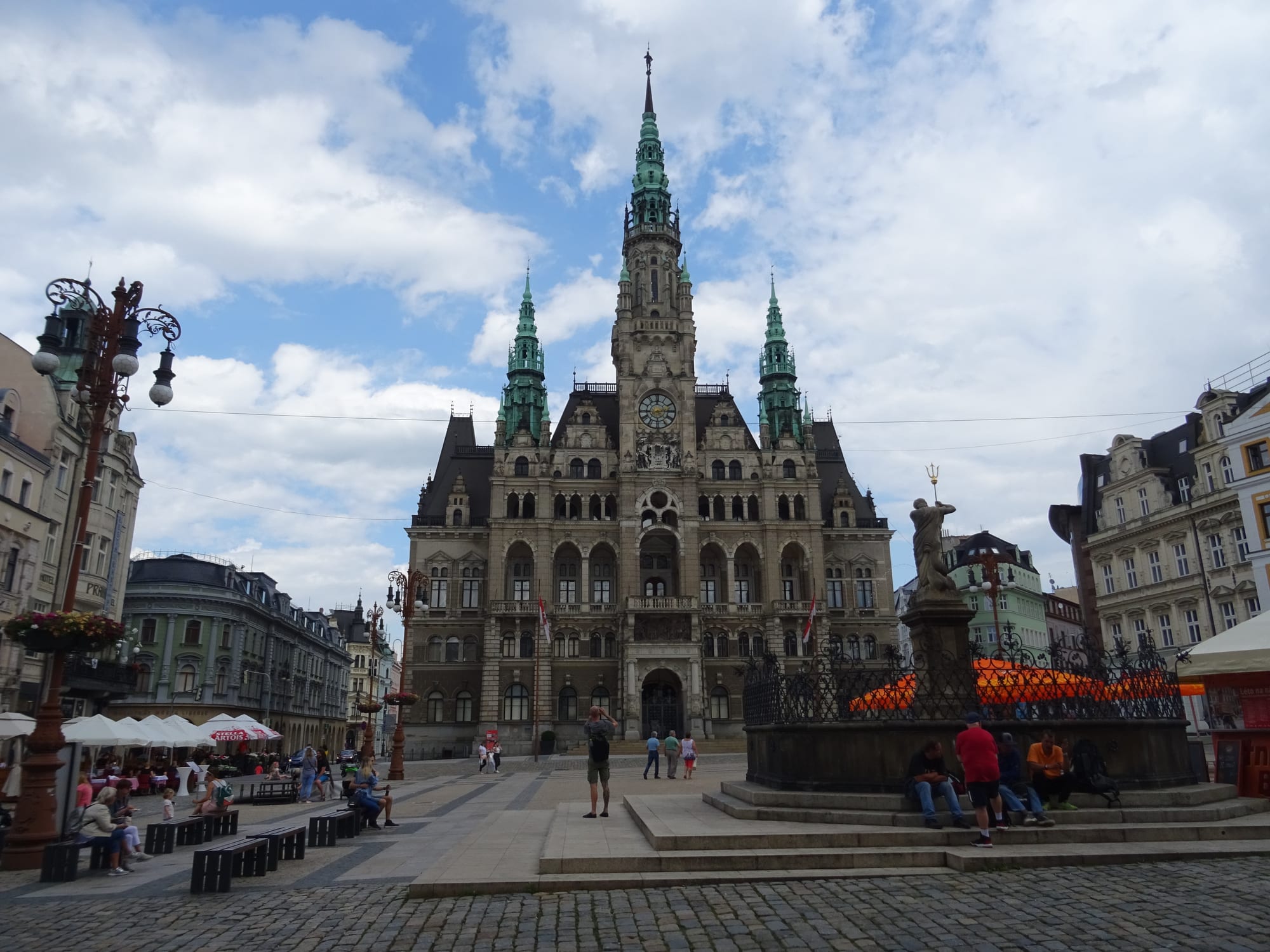
The ornate neo-Renaissance Liberec town hall with three green spires above a paved square with benches and a fountain

North & East Bohemia, Czechia

Liberec

Liberec City Hall on Náměstí Dr. E. Beneše, the main square of the city. (NeoMeesje / Wikimedia Commons · CC BY-SA 4.0)

The fifth-largest city in Czechia, in a basin on the Lusatian Neisse between the Jizera Mountains and the summit of Ještěd. Textiles made it the 'Manchester of Bohemia' and left a neo-Renaissance town hall, theatre and museum; today it is a university and sports city crowned by the hyperboloid Ještěd Tower, with ski slopes and forest trails at its edge.

Neighbourhoods

  • City centre
    • First-time visitors
    • Close to public transport
    • Best for food

    The old core around Náměstí Dr. E. Beneše, dominated by the City Hall, with the Šalda Theatre behind it, the facade remains of 16th-century houses on a narrow street and the Fügnerova tram and bus hub a short walk away. Cafés and restaurants spread out from the square.

    Open in Maps
  • Masarykova and the villa quarter
    • Museums
    • Parks
    • Families

    The avenue leading out of the centre past the North Bohemian Museum, the Regional Gallery, late 19th-century villas and, further along, the zoo and botanical garden on the edge of the forest. Trams run its length.

    Open in Maps
  • Horní Hanychov and the foot of Ještěd
    • Hiking
    • Skiing
    • Outdoors

    The south-western end of the city, where the tram line ends below Ještěd. Footpaths, a road and the ski area climb from here towards the summit tower.

    Open in Maps
  • Vratislavice nad Nisou
    • Local life
    • Beer

    A self-governing borough of about 8,900 people on the Neisse, south-east of the centre, with its 1701 parish church, a brewery founded in 1872 and a carpet factory. The car designer Ferdinand Porsche was born here.

    Open in Maps

Things to do

Landmarks of the centre

  • Liberec City Halllandmark

    The neo-Renaissance town hall of 1888–1893, with three towers, the highest 61 metres; in summer its interiors and one tower are open to visitors, and it has been a national cultural monument since 2024.

    Open in Maps
  • F. X. Šalda Theatrelandmark

    The neo-Renaissance theatre of 1881–1883 behind the City Hall, whose stage curtain, Triumph of Love, was painted by Gustav and Ernst Klimt with Franz von Matsch.

    Open in Maps
  • Feast of Giantsattraction

    A working bus stop turned sculpture by David Černý — a table set with beer mugs, a knocked-over menorah and the head of Konrad Henlein on a plate, all allusions to the city's history.

    Open in Maps
  • Liberecká výšinaviewpoint

    A restaurant of 1900–1901 in the eastern part of the city, built to look like a medieval castle, with a 25-metre lookout tower modelled on a watchtower of Nuremberg Castle.

    Open in Maps

Museums and science

  • North Bohemian Museummuseum

    Founded in 1873 as the first arts and crafts museum in the Czech lands, in a building of 1898 whose tower copies the City Hall's.

    Open in Maps
  • Regional Gallerymuseum

    The city's art gallery on Masarykova, beside the North Bohemian Museum.

    Open in Maps
  • iQ Landiamuseum

    A science centre aimed mainly at older children, one of the most visited attractions in the city.

    Open in Maps
  • New Synagogue and research librarylandmark

    A building completed in 2000 on the site of the Old Synagogue, burned by the Nazis in November 1938, that houses both the regional research library and a new synagogue.

    Open in Maps

Parks, animals and the mountain

  • Ještěd Towerlandmark

    Karel Hubáček's 94-metre hyperboloid transmitter and mountain hotel of 1966–1973 on the 1,012-metre summit of Ještěd, winner of the Perret Prize and voted the most important Czech building of the 20th century, with views into Germany and Poland.

    Open in Maps
  • Liberec Zoopark

    Founded in 1904 and the oldest zoo in the former Czechoslovakia, covering almost 14 hectares with more than 160 species; its white tigers are its symbol.

    Open in Maps
  • Botanical Garden Liberecpark

    Established in 1876 and the oldest botanical garden in the Czech Republic, rebuilt in 1996–2000 with nine glasshouses holding more than 8,000 exotic plants.

    Open in Maps
  • Harcov Reservoirpark

    A reservoir inside the city, built for flood protection and industrial water and now used for recreation by local people.

    Open in Maps

Sport and nights out

  • Home Credit Arenaattraction

    The 9,000-seat arena opened in 2005, home of the Bílí Tygři Liberec ice hockey team in the Czech Extraliga.

    Open in Maps
  • Stadion u Nisyattraction

    The football stadium of Slovan Liberec, one of the most successful Czech clubs, beside the Neisse; it occasionally hosts the national team.

    Open in Maps
  • Centrum Babylonattraction

    An entertainment complex in a former textile factory, with a large water park, an amusement park and other attractions.

    Open in Maps

Short trips from the city

  • Jablonec nad Nisouneighborhood

    The neighbouring city of about 46,000, linked by tram, known since the 18th century for glass and costume jewellery.

    Open in Maps
  • Jizera Mountainspark

    The forested range on the Polish border north-east of the city, with long cross-country ski trails in winter and walking and cycling routes in summer.

    Open in Maps
  • Frýdlantneighborhood

    A small town north of the city known for its castle complex, an early Gothic castle joined to a Renaissance château and protected as a national cultural monument.

    Open in Maps
  • Bohemian Paradisepark

    A protected landscape of sandstone rock towns and castles south of Liberec, also the only UNESCO Global Geopark in the Czech Republic.

    Open in Maps

Seasonal events

  • Ski Jumping World CupJanuary

    A round of the World Cup on the jumps below Ještěd, which comes to Liberec every January; the city also hosted the 2009 Nordic World Ski Championships.

  • Anifilmearly May

    An international festival of animated film, held in Liberec since 2020 after moving from Třeboň.

  • MateřinkaJune, every other year

    A puppet theatre festival for preschool children, held every two years.

Eat and drink

Long-standing places and food districts in Liberec. Hours, ratings and directions come from your maps app, always current.

Liberec classics

  • Kavárna Poštacafe

    A Viennese-style café on the main square, the Náměstí Dr. E. Beneše.

    Open in Maps
  • Konrád brewery, Vratislavicerestaurant

    The brewery founded in 1872 in the borough of Vratislavice, closed in 1998 and revived in 2004 under the Konrád name, with a classic car museum in its grounds.

    Open in Maps

Food districts

  • Restaurants around the main squareneighborhood

    Pubs, cafés and restaurants in the streets around the City Hall, serving Czech dishes alongside pizza, Indian and Nepalese cooking.

    Open in Maps

Experience Liberec

History

Liberec grew from two settlements on the trade route from Bohemia into Lusatia: Habersdorf, founded in the 11th or 12th century by Czech settlers and German colonists, and Reichenberg, established nearby in the 13th century. They merged, and Reichenberg is first named in writing in 1352. The town was burned in 1469 during a battle with the army of King George of Poděbrady, and after 1558 the Redern family developed it and laid the foundations of its textile industry. Emperor Rudolf II made it a town in 1577. After 1620 it passed to Albrecht von Wallenstein and then to the Gallas and Clam-Gallas families.

The 18th century brought prosperity: the population tripled and the cloth trade boomed. In the 19th century Reichenberg became the centre of the textile industry for all of Austria-Hungary, the "Manchester of Bohemia", where Johann Liebieg built a textile empire, and in the 1850s it was the second-largest city in Bohemia. In the late 19th century it built its neo-Renaissance City Hall, theatre and museum, a villa district, a zoo and a botanical garden.

It was the most populous German-speaking town in the Bohemian lands. In 1918 it was briefly declared the capital of the German-Austrian province of German Bohemia before Czechoslovak troops entered on 16 December. The Great Depression fed support for Konrad Henlein's Sudeten German Party; the Munich Agreement gave the city to Nazi Germany in 1938, it became capital of the Reichsgau Sudetenland in 1939, most Czech and Jewish residents fled or were expelled, and the synagogue was burned. After 1945 nearly all the German population was expelled and the city was resettled by Czechs. The communist era added a technical university in 1953 and the Ještěd Tower in 1966–1973.

Culture & Customs

The Ještěd Tower is the city's emblem. Karel Hubáček's hyperboloid of reinforced concrete, designed to extend the silhouette of the mountain and resist its weather, won the Perret Prize of the International Union of Architects in 1969 and later a poll for the most important Czech building of the 20th century; in February 2026 the Liberec Region Council approved buying the hotel and transmitter from their operator. Liberec has been more careless with other modern buildings: Hubáček's honeycomb-shaped Ještěd department store was demolished in 2009 despite protests from architects.

The neo-Renaissance core keeps the confidence of the textile era, from the City Hall to the F. X. Šalda Theatre, whose curtain was painted by Gustav and Ernst Klimt and Franz von Matsch. The city hosts Anifilm, an international festival of animated film, and Mateřinka, a puppet festival for small children. David Černý's Feast of Giants bus stop serves up the city's difficult past — German and Czech beer mugs, a fallen menorah and Henlein's head on a plate — and a new synagogue has stood since 2000 on the site of the one burned in 1938.

Sport runs deep. Slovan Liberec has won three national football titles, Bílí Tygři play top-flight ice hockey, the Ski Jumping World Cup visits every January, and the city hosted the Nordic World Ski Championships in 2009.

Daily Life

About 108,000 people live in Liberec, the fifth-largest city in Czechia, and about 227,000 in the wider Liberec–Jablonec agglomeration, which has grown together since the late 19th century and is linked by an interurban tram line. The city is divided into 33 municipal parts, among them the self-governing borough of Vratislavice nad Nisou.

The textile mills that built the city have largely gone; Centrum Babylon, an entertainment complex, occupies one former factory. The economy now rests on manufacturing, on glass and jewellery in nearby Jablonec, and on the Technical University of Liberec, which has about 9,000 students and is known especially for textile engineering research; it also has an institute for nanomaterials. In Vratislavice the brewery and the carpet factory remain the most important industries.

Life has a mountain rhythm. The trams carry walkers and skiers to Horní Hanychov, and the Jizera Mountains, with their cross-country ski trails, are a short ride away. The Ještěd cable car, opened in 1933, has been closed indefinitely since a fatal accident in 2021.

Food

Liberec eats the Czech staples. Roast pork with bread dumplings and sauerkraut, known as vepřo-knedlo-zelo, is often considered the most typical Czech dish; svíčková is marinated beef in a thick sauce of carrot, parsley root, celeriac and sometimes cream, served with dumplings, cranberry compote and a slice of lemon; and guláš is a stew of beef, pork or game with onions and spices. Pubs serve snacks such as utopenci, spicy pickled sausages in a sweet-sour vinegar marinade, and nakládaný hermelín, a soft cheese similar to Camembert.

Beer is local. The brewery in Vratislavice nad Nisou, founded in 1872 and famous for its beer, closed in 1998 and was revived in 2004 under the Konrád name, and Svijany, one of the oldest Czech breweries, established in 1564, brews unpasteurised lagers in a village near Liberec. Neighbouring Jablonec and the wider region share the Czech love of koláče, yeast pastries filled with fruit, poppy seed or sweet curd cheese.

Kavárna Pošta on the main square is a Viennese-style café, and the streets around the City Hall also have pizza, Indian and Nepalese restaurants and a Scandinavian-style café with its own bakery.

Planning tools

Budget

Liberec costs noticeably less than Prague for rooms, meals and beer, and public transport is cheap. Prices rise around big sporting events such as the January ski jumping and in the winter season on Ještěd and in the Jizera Mountains.

Daily Budget Midrange
USD 100–180 (mid-range hotel, restaurant dinners, museum and zoo tickets, ski passes)
Daily Budget Shoestring
USD 45–80 (hostel or pension, pub meals, tram day passes)

A day ticket on the city trams and buses covers the centre, the zoo and the foot of Ještěd.

Best Time to Visit

May to September for walking on Ještěd and in the Jizera Mountains, the zoo and the city's parks; summers are mild rather than hot. From December to March the mountains are snowy, with downhill skiing on Ještěd and cross-country trails nearby, and January brings the ski jumping.

Suggested Number of Days

One or two days are enough for the city itself. Allow three to five to include the mountains and the rock landscapes around it; winter sports and the weather on the summit change the number most.

First Visit
1–2 days
With Surroundings
3–5 days

Transportation

Liberec has a compact tram network, running since 1897, with lines from the Fügnerova hub to Horní Hanychov below Ještěd and to Lidové sady plus a tram line to neighbouring Jablonec nad Nisou. Buses cover the rest of the city. The Ještěd cable car has been closed indefinitely since an accident in 2021, so the summit is reached on foot or by road.

The tram to Horní Hanychov is the easiest way to the foot of Ještěd.

Airport & Station Connections

Liberec lies about 80 km north-east of Prague, whose Václav Havel Airport is the main international gateway. Frequent buses from Prague's Černý Most take about an hour; trains are slower, around two and a half hours with a change at Turnov. Direct trains also run from Dresden in about two hours. The station is about 1 km south-west of the centre, with the bus station beside it.

Walkability

The centre around the City Hall is compact and easy on foot, and the museum, gallery and zoo are a walk or short tram ride up Masarykova. The city sits in a hilly basin, so streets climb steeply in places, and the outer districts and the mountain are best reached by tram.

Safety

Czechia is a safe country with low levels of violent crime. Liberec is a calm regional city where the main concerns are the ordinary ones of petty theft in busy places and fast-changing weather on Ještěd and in the Jizera Mountains.

Carry warm layers on the mountain, where the summit can be in cloud and wind when the city is mild, and keep to marked trails in winter. Check current official travel advice before travelling.

Climate

A humid continental climate, cooler and wetter than much of Bohemia because of the surrounding mountains, with about 845 mm of precipitation a year; July is the wettest month and April the driest. Ještěd and the Jizera Mountains are colder and snowier than the city.

Summer
mild — July averages about 18°C, with warmer spells and frequent showers
Winter
cold — January averages about -1°C, with regular snow in the hills

Local Customs

Liberec shares the habits of the rest of Czechia, including a strong following for ice hockey and football. In restaurants, a tip of around 10 per cent is normal where tourists eat, and it is handed to the waiter when paying rather than left on the table.

On hockey and football nights the trams and pubs near the arena and stadium fill quickly; plan around match times.

Common Payment Methods

The currency is the Czech koruna (CZK, written Kč). Cards are accepted almost everywhere; carry a little cash for small pubs and kiosks. When using an ATM or card terminal, choose to be charged in koruna to avoid a high conversion fee, and use a withdrawal rather than a balance check, which can carry a charge.