History
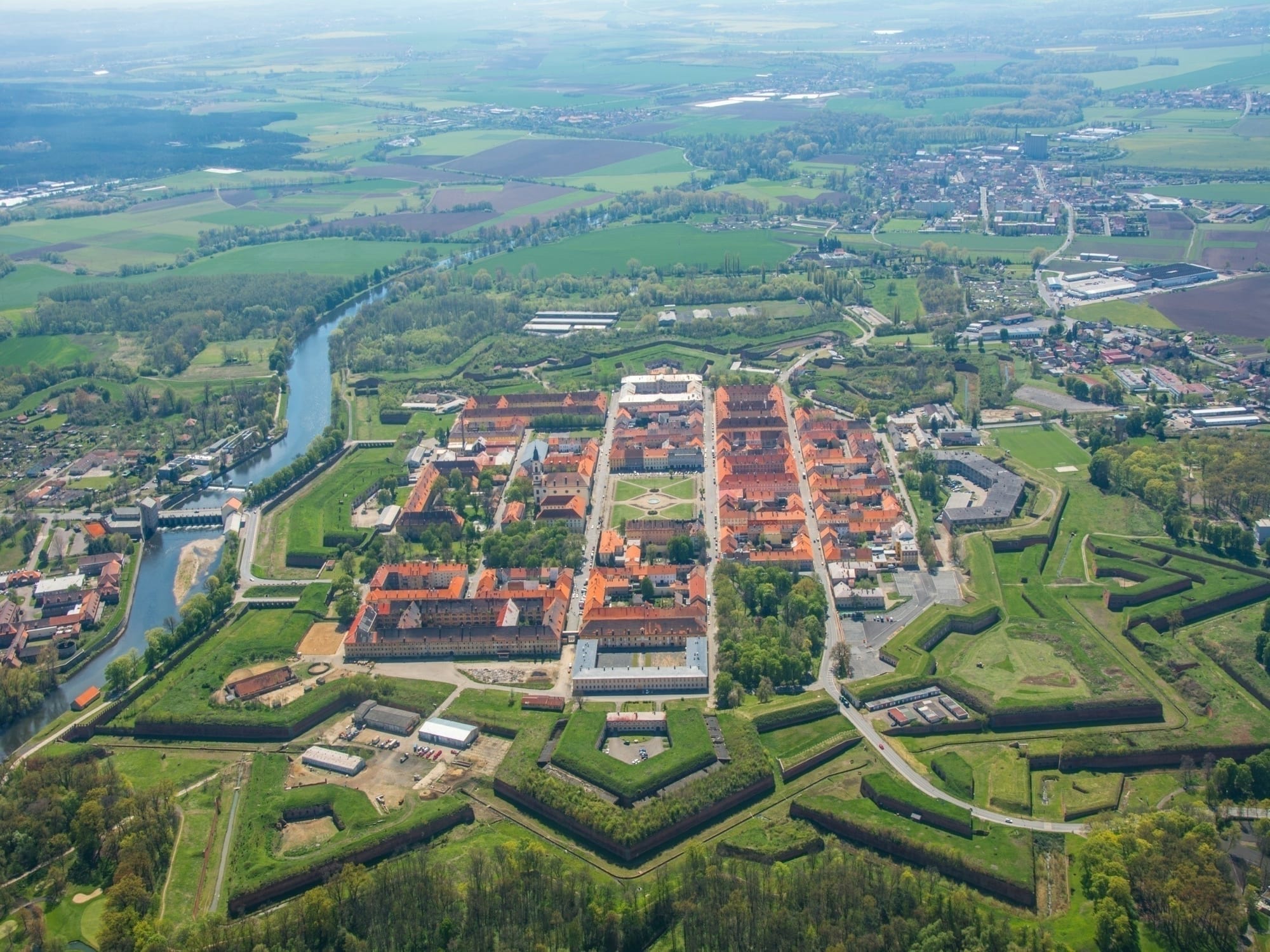
On 10 January 1780 Emperor Joseph II ordered a fortress to be built where the Ohře meets the Elbe, to guard the river crossings against Prussian armies coming from Saxony, and named it Theresienstadt after his mother, Maria Theresa. Construction began that October and took ten years. The result was a citadel, the Small Fortress, on the east bank, and a walled garrison town, the Main Fortress, on the west, covering almost four square kilometres; it could house about 5,600 soldiers in peacetime and twice as many in war, and its trenches could be flooded. Terezín became a free royal town in 1782, but the fortress was never besieged. In the 19th century the Small Fortress served as a prison, and in the First World War it held political prisoners, among them Gavrilo Princip, the assassin of Franz Ferdinand, who died there in 1918.
After the German occupation of 1939 the Gestapo set up a prison in the Small Fortress in 1940, through which tens of thousands of people passed and about 2,600 died. In November 1941 the SS turned the Main Fortress into the Theresienstadt Ghetto. More than 150,000 Jews, including 15,000 children, were sent there, from Czechoslovakia, Germany and Austria, and later the Netherlands and Denmark. About 33,000 died in the ghetto from hunger, disease and overcrowding, and about 88,000 were deported to Auschwitz and other extermination camps. The camp and prison were liberated by the Soviet Army on 9 May 1945.
After the war the Small Fortress became an internment camp for ethnic Germans until 1948, and the army kept a garrison in the town until 1996. The floods of 2002 damaged the crematorium; the fortress, then in a deteriorated condition, was listed on the 2002 World Monuments Watch, and a long-term conservation plan followed.