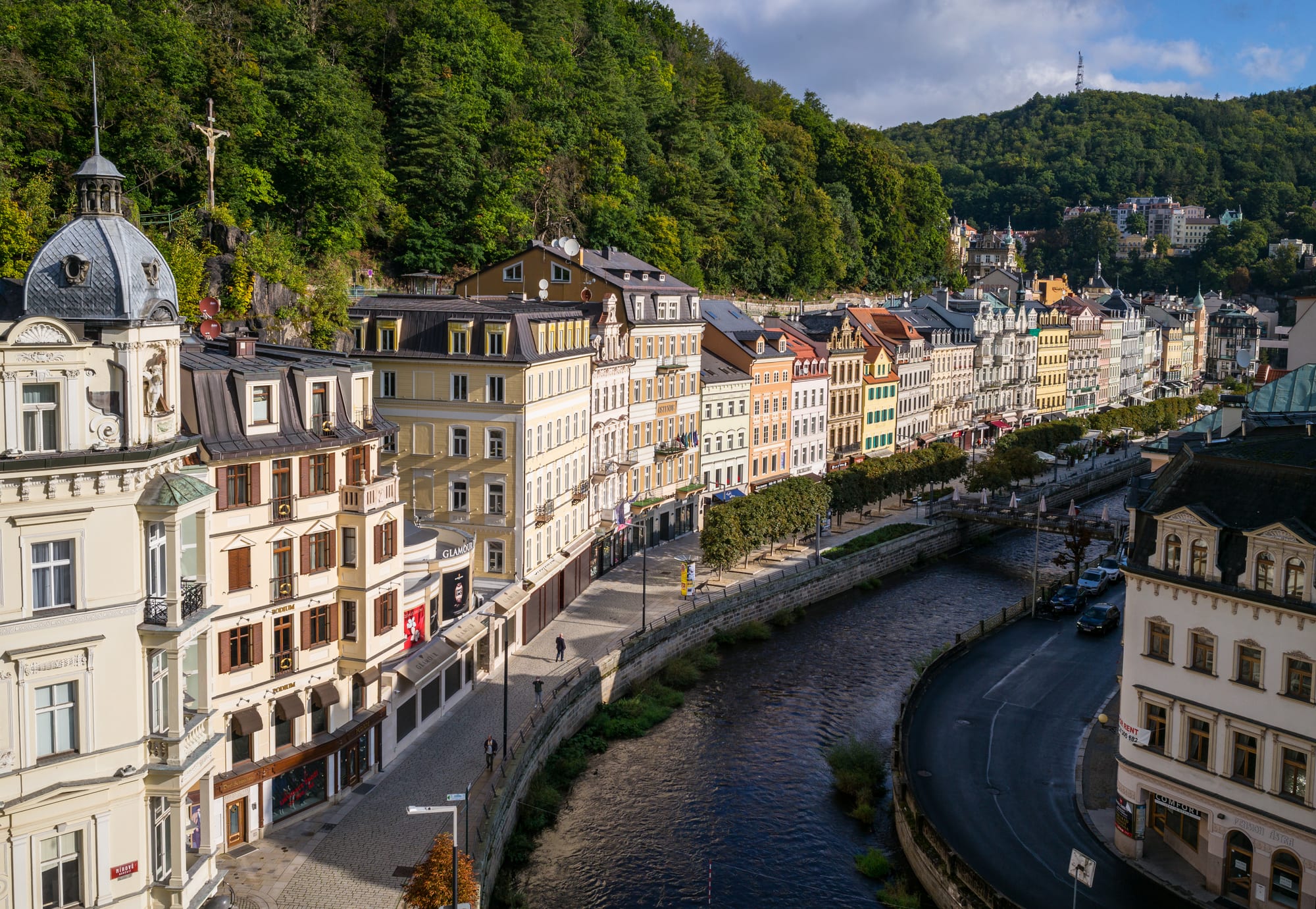
Pastel spa houses lining a riverside promenade along the narrow Teplá river, with steep forested hills behind

West Bohemia & the Spa Towns, Czechia

Karlovy Vary

Stará louka and the Teplá river in the spa quarter of Karlovy Vary. (rboed* / Wikimedia Commons · CC BY 2.0)

The most visited Czech spa town, about 106 km west of Prague where the Teplá meets the Ohře. Founded around hot springs in the 14th century and named after Charles IV, it became a resort of Europe's aristocracy in the 19th century. Colonnades, spa houses and an international film festival fill its narrow, wooded valley.

Neighbourhoods

  • The spa quarter along the Teplá
    • First-time visitors
    • Historic district
    • Spas

    The long, narrow valley of the Teplá, protected since 2018 as an urban monument reservation, where the colonnades, drinking springs, spa houses and churches stand on both banks. Stará louka, the riverside promenade, is lined with shops, cafés and pastel facades under wooded hills.

    Open in Maps
  • The town centre on the Ohře
    • Close to public transport
    • Shopping
    • Local life

    The flatter, newer town at the mouth of the Teplá, by the lower railway station and the intercity bus station, with the main shopping streets and the Jan Becher Museum.

    Open in Maps
  • The wooded hills above the valley
    • Walks
    • Views

    The slopes of the Slavkov Forest that rise steeply on either side of the spa quarter, reached by footpaths and funiculars, with lookout towers and the Russian Orthodox church on the hillside.

    Open in Maps

Things to do

Colonnades and springs

  • Mill Colonnadelandmark

    The largest colonnade, a pseudo-Renaissance structure of 1871–1881 sheltering five mineral springs, one of the town's traditional symbols.

    Open in Maps
  • Hot Spring Colonnade and Vřídlolandmark

    The modernist hall of 1975 built over Vřídlo, the hottest spring in the country, which reaches about 73°C and shoots up to 12 metres high.

    Open in Maps
  • Market Colonnadelandmark

    A carved wooden colonnade in Swiss style by Fellner and Helmer, built in 1882–1883, over the Market spring and the spring of Charles IV.

    Open in Maps
  • Park Colonnadelandmark

    A cast-iron colonnade by Fellner and Helmer of 1880–1881, with the Snake and Park springs.

    Open in Maps

Landmarks and museums

  • Imperial Spa (Císařské lázně)landmark

    The most important spa building in town, built in French Neo-Renaissance style in 1893–1895 to designs by Fellner and Helmer, and a national cultural monument.

    Open in Maps
  • Church of St Mary Magdalenelandmark

    Kilian Ignaz Dientzenhofer's Baroque church of 1732–1736, one of the most important buildings of the Czech Baroque and a national cultural monument.

    Open in Maps
  • Church of St Peter and Paullandmark

    The Russian Orthodox church of 1893–1897 in Byzantine style, the largest and most important Orthodox church in the country.

    Open in Maps
  • Diana Lookout Towerviewpoint

    A lookout tower on the forested hill above the spa quarter, reached by the Diana funicular, with a café, a restaurant and a small zoo.

    Open in Maps
  • Jan Becher Museummuseum

    A museum on Masaryka street devoted to Becherovka, the herbal liqueur made in the town since 1807, and its inventor.

    Open in Maps

Short trips from the town

  • Loket Castlelandmark

    One of the oldest stone castles in the country, on a massive rock almost encircled by the Ohře, once called the impregnable castle of Bohemia and now a museum.

    Open in Maps
  • Bečov nad Teplouattraction

    A small town up the Teplá valley whose castle and château hold the Reliquary of St Maurus.

    Open in Maps
  • Slavkov Forestpark

    The wooded highland and protected landscape area that rises south of the town, with paths into the hills from the spa quarter.

    Open in Maps

Seasonal events

  • Karlovy Vary International Film FestivalJuly

    One of the oldest film festivals in the world, holding international competitions since 1948, and the leading film event in Central and Eastern Europe.

Eat and drink

Long-standing places and food districts in Karlovy Vary. Hours, ratings and directions come from your maps app, always current.

Karlovy Vary classics

  • Spa wafers (Karlovarské oplatky)market

    Wafers that originated in the town, sold at street stands in the spa quarter and in grocery stores across the country.

    Open in Maps
  • Becherovkamarket

    The herbal bitters made from a secret recipe of more than twenty herbs and spices, produced in the town since 1807 and usually served chilled as a digestif.

    Open in Maps

Cafés and food streets

  • Stará loukaneighborhood

    The riverside promenade of the spa quarter, lined with cafés and restaurants; places a short way off the main street are often cheaper.

    Open in Maps
  • The town centreneighborhood

    The streets of the newer town on the Ohře, with everyday Czech pubs and restaurants used by residents.

    Open in Maps

Experience Karlovy Vary

History

People lived near the springs long before the town: a Bronze Age fortified settlement has been found in Drahovice, and German settlers came to the region as craftsmen and miners from the late 12th century, so the town grew up German-speaking. A small spa settlement was founded most likely around 1349. Legend says that Charles IV, staying at Loket, found a hot spring while hunting in the surrounding forests and healed his injured leg in its water; he founded a spa on the site, later named Karlsbad — "Charles' Baths" — after him, and granted the town privileges on 14 August 1370.

In 1819 a conference here produced the Carlsbad Decrees, Metternich's anti-liberal censorship for the German Confederation. Writings by physicians such as David Becher and Josef von Löschner made the town a leading spa, and the railway from Prague to Cheb in 1870 brought still more guests: from 134 families in the 1756 season to 26,000 guests a year by the end of the 19th century and a record of 70,956 in 1911. Peter the Great, Goethe, Beethoven, Chopin and his parents, and Turgenev were among them.

The First World War ended the boom. In 1918 the German-speaking town became part of Czechoslovakia, and in March 1919 six demonstrators were killed by Czech troops. In 1930 most of its 23,901 inhabitants were Germans. Annexed by Nazi Germany in 1938, the town had a Gestapo prison during the war, and after 1945 most German-speaking residents were expelled. After 1989 the spa buildings were restored, Russian guests and investors arrived, and in 2021 the town joined the Great Spa Towns of Europe World Heritage Site.

Culture & Customs

The spa ritual shapes the town. Over 80 springs rise here, 16 of them for drinking, all from the same source in the tectonically active Eger Graben and sharing the same dissolved minerals. Guests walk from colonnade to colonnade drinking from the springs, many following a course of drinking cures, and the colonnades themselves — the hot-spring hall of 1975, the cast-iron Park Colonnade, the carved wooden Market Colonnade, the great Mill Colonnade — are the town's public living rooms.

Film is the other great tradition. The Karlovy Vary International Film Festival, one of the oldest in the world, takes over the town every July; in 2022 it hosted parts of the Odesa festival, and in 2026 it marked its 80th anniversary with a drone show of 1,300 drones in place of the usual fireworks. The town has also been a film location, standing in for Montenegro in Casino Royale in 2006.

The roll of famous guests is long — Peter the Great in 1711, Goethe, who wrote on local geology, Beethoven, who gave a concert here in 1812, and Atatürk in 1918 — and English visitors paid for the Methodist church of St Luke. The Orthodox church of St Peter and St Paul, the largest in the country, reflects the town's long ties with Russian guests. Ice hockey and volleyball clubs play in the top tiers.

Daily Life

About 49,000 people live in Karlovy Vary, with about 138,000 in the wider area linked by commuting, and the population is older than average: a quarter are over 65. In the 2021 census 11.6 per cent held foreign citizenship, the largest groups Ukrainian, Russian and Vietnamese, and in 2017 the Karlovy Vary region had the highest share of foreign residents in the country after Prague.

The economy is built on services, spa care and tourism, with small and medium-sized industry. Food and drink lead manufacturing: Mattoni 1873, which bottles mineral water, is the largest industrial employer, Becherovka has been made here since 1807, and the spa wafers originated here too. Glass and porcelain also matter, above all Moser, the luxury glassmaker founded in 1857.

The town is the regional capital, and its life divides between the spa valley, where visitors and spa guests walk the colonnades, and the newer town on the Ohře and the residential districts on the flatter land of the Sokolov Basin to the north. The Rolava reservoir in the middle of the city is used for recreation. Local buses and funiculars connect the hills with the centre, and the D6 motorway and railways run towards Prague, Cheb and Germany.

Food

Karlovy Vary is known for three products. Spa wafers, Karlovarské oplatky, which originated here, are sold at street stands in town and in grocery stores across the country. Becherovka, formerly Karlsbader Becherbitter, is a herbal bitters made since 1807 from a secret recipe of more than twenty herbs and spices, often described as tasting of ginger or cinnamon, 38 per cent alcohol and usually served chilled as a digestif. The town also gave its name to Carlsbad plums, candied stuffed prunes.

Then there is the water. The springs themselves are drunk warm from the colonnades as part of the cure, and bottled mineral water from Mattoni is one of the town's biggest industries. Restaurants serve Czech cooking: bread dumplings, knedlíky, steamed and sliced like bread, with most main dishes; roast duck with dumplings and braised red cabbage; and guláš, a stew of beef, pork or game with onions and spices.

Cafés and restaurants line Stará louka and the river through the spa quarter, some with outdoor seating, and some places on the river charge twice the price of those a short way off it. The lookout restaurant at Diana serves Czech dishes, and the newer town on the Ohře has ordinary pubs and restaurants used by residents.

Planning tools

Budget

Karlovy Vary is cheaper than Prague except in the spa quarter, where grand spa hotels, riverside cafés and film-festival week push prices up. Some places on the river charge twice the price of those a short way off it.

Daily Budget Midrange
USD 120–210 (spa hotel or mid-range hotel, restaurant dinners, a museum or a treatment)
Daily Budget Shoestring
USD 50–85 (pension or hostel, pub meals, buses)

Shop around for cafés and bars: places a short way off the riverside promenade are often much cheaper.

Best Time to Visit

May to September, when the parks and colonnades are at their best; the film festival in July fills the town and its hotels. The spas stay open all winter, when prices drop and the valley is quiet, though days are short and cold.

Suggested Number of Days

One or two days covers the colonnades, churches and lookouts of the spa quarter. Allow three or four to include the castles and forests nearby, or longer for a spa stay.

First Visit
1–2 days
With Surroundings
3–4 days

Transportation

Local buses and two funiculars serve most of the town. The Imperial funicular is the oldest tunnel funicular in Europe, and the Diana funicular climbs to the lookout tower. Most visitors walk the spa quarter and use buses for the stations and the hills.

A local bus week ticket also covers a ride on the Diana funicular.

Airport & Station Connections

Karlovy Vary lies about 106 km west of Prague. Buses from Prague's Florenc and Dejvická stations run about hourly and take about two hours, quicker than the train, which takes over three hours. The D6 motorway links it with Prague, and trains also run to Cheb and Germany. Karlovy Vary Airport lies at Olšová Vrata, south-east of the centre, but most visitors fly into Prague.

Walkability

The spa quarter is a long, narrow valley best explored on foot, with the colonnades, springs and churches strung along the Teplá. Off the river the streets climb steeply, and the funiculars save the walk up to the lookouts. The lower station and bus station are on the western edge of the centre.

Safety

Czechia is a safe country with low levels of violent crime. The busy colonnades call for ordinary care with belongings, and the hot springs are too hot to touch at source.

Keep an eye on belongings in the colonnade crowds and remember that the springs are mineral water taken as a cure, not ordinary drinking water. Check current official travel advice before travelling.

Climate

A humid continental climate, with the town set in a wooded valley. June is the wettest month and February the driest.

Summer
mild to warm — July averages about 17°C over day and night, with hotter spells that have reached 35.8°C
Winter
cold — January averages about −2°C over day and night

Local Customs

Taking the waters is a ritual: guests stroll the colonnades drinking the spring water, often as part of a course of drinking cures. Tipping is a sign of appreciation rather than a fixed share of the bill; around 10 per cent is usual in places used to visitors. A greeting on entering a shop or café is polite.

Keep voices low in the colonnades and spa houses, where many guests are taking treatment.

Common Payment Methods

The currency is the Czech koruna (CZK, written Kč). Cards are accepted almost everywhere, and ATMs are common in the centre and spa quarter. Carry a little cash for buses, wafer stands and small cafés.