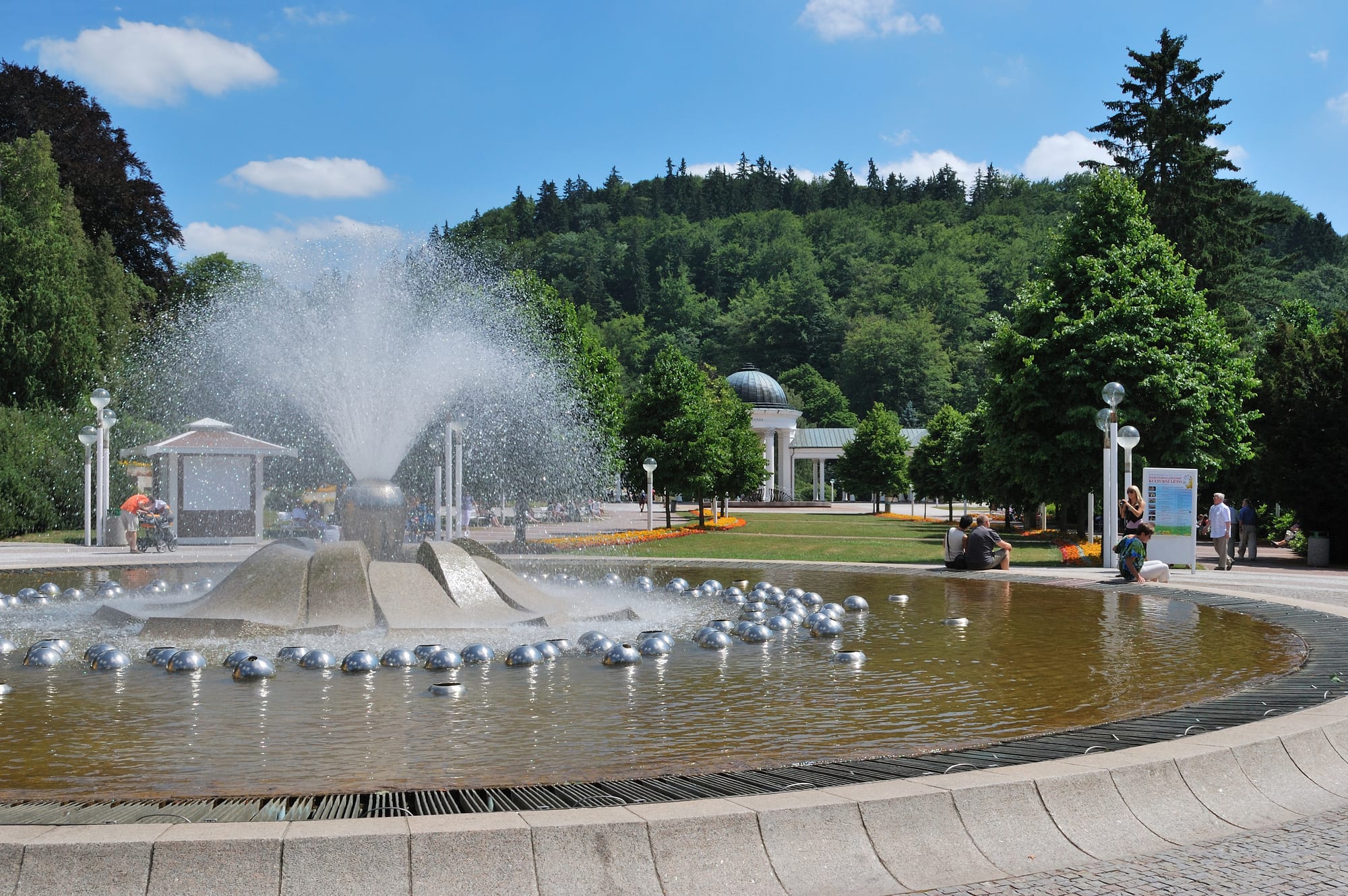
A fountain spraying water over a round pool of steel spheres, with lawns, a domed pavilion and a forested hill behind

West Bohemia & the Spa Towns, Czechia

Mariánské Lázně

The Singing Fountain in Mariánské Lázně, with the colonnade of Caroline's Spring in the background. (Harke / Wikimedia Commons · CC BY-SA 3.0)

A spa town in the wooded hills of western Bohemia, about 25 km south-east of Cheb, built in the 19th century around about a hundred carbon-dioxide springs. Known in German as Marienbad, it drew rulers and celebrities in its Golden Era and is now part of the Great Spa Towns of Europe World Heritage Site, a quiet resort of colonnades, parks and forest walks.

Neighbourhoods

  • The spa quarter
    • First-time visitors
    • Historic district
    • Parks

    The heart of the town, laid out by the abbots of Teplá as a landscaped park around the springs. The main colonnade, the Singing Fountain, the spring pavilions, Goethe Square and the grand spa houses of the Golden Era stand among lawns and woodland paths.

    Open in Maps
  • Hlavní třída and the lower town
    • Close to public transport
    • Shops

    The main street runs down from the spa quarter towards the railway station, 20 to 30 minutes' walk from the colonnade. The streets around it hold shops, cafés and the everyday town.

    Open in Maps
  • Krakonoš hill
    • Views
    • Families

    A wooded hill at about 750 metres, around a kilometre from the centre, reached by a cable car from Koliba. The Boheminium park of miniature Czech monuments is up here, among the forest paths.

    Open in Maps

Things to do

Springs and colonnades

  • Main Colonnadelandmark

    The cast-iron spa colonnade of 1888–1889, one of the town's most important buildings, where guests walk and drink the waters and concerts are held during the season.

    Open in Maps
  • Singing Fountainattraction

    A fountain on the spa promenade, created in 1986, that plays a well-known piece of music every odd hour, with light effects in the evening.

    Open in Maps
  • Cross Spring pavilionlandmark

    A domed pavilion with 72 Ionic columns and a patriarchal cross over the Cross Spring, built in 1818–1826 and rebuilt in concrete in 1911–1912.

    Open in Maps
  • Ferdinand's Spring Colonnadelandmark

    The colonnade over a strongly mineralised spring whose water is bottled under the Excelsior label.

    Open in Maps

Churches and museums

  • Church of the Assumptionlandmark

    The Roman Catholic church in the middle of Goethe Square, one of the town's most valued monuments.

    Open in Maps
  • Orthodox Church of St Vladimirlandmark

    An Orthodox church designed by Gustav Wiedermann and built chiefly for spa guests from Russia.

    Open in Maps
  • Former Anglican churchlandmark

    A church of 1879 by the Victorian architect William Burges, founded by Lady Anna Scott in memory of her husband and now used as a concert hall.

    Open in Maps
  • Town Museummuseum

    The museum in the house where Goethe stayed, with a large geological park showing the rocks of the Slavkov Forest.

    Open in Maps
  • Park Boheminiumattraction

    A park of models of Czech monuments at 1:25 scale on Krakonoš hill.

    Open in Maps

Outdoors and short trips

  • Royal Golf Club Mariánské Lázněattraction

    One of the oldest golf courses in Europe, about 3 km from the centre, opened in 1905 by King Edward VII and given its royal title in 2003.

    Open in Maps
  • Slavkov Forestpark

    The protected landscape area of wooded hills that surrounds the town, where the Teplá river rises.

    Open in Maps
  • Kynžvart Castlelandmark

    The Neoclassical château of the Metternich family near Lázně Kynžvart, reopened in 2000 with guided tours of 25 rooms.

    Open in Maps
  • Teplá Abbeylandmark

    The Premonstratensian abbey founded in 1193 that owned the springs and whose abbots founded the spa.

    Open in Maps

Eat and drink

Long-standing places and food districts in Mariánské Lázně. Hours, ratings and directions come from your maps app, always current.

Mariánské Lázně classics

  • Spa waferscafe

    Lázeňské oplatky, sweet baked wafers made in the Czech spa towns; those made in Mariánské Lázně are very well known.

    Open in Maps
  • Cafés of the spa quarterneighborhood

    Cafés and restaurants around Goethe Square and the colonnade, where spa guests stop between drinking rounds.

    Open in Maps

Experience Mariánské Lázně

History

German settlers were brought into this area by the Přemyslid rulers in the 12th century, and a village called Úšovice is recorded in 1273. The springs first appear in a document of 1341, when they belonged to the Premonstratensian abbey at Teplá. They were not used for treatment until Josef Nehr, the abbey's physician, spent the years from 1779 until his death in 1820 proving their healing properties. The abbots, above all Karl Kaspar Reitenberger, then turned a marshy valley into a park of colonnades, Neoclassical spa houses and pavilions, buying the surrounding forests to protect them. The place became Marienbad, Mary's spa, after an image of the Virgin hung by a spring; it was declared a spa in 1818 and became a town in the 1860s.

The Golden Era ran from about 1870 to 1914. A railway reached the town from Cheb in 1872, new hotels and colonnades went up, and around 20,000 visitors a year came, among them rulers, celebrities and European rabbis with their Hasidic followers. Goethe stayed three times from 1820, Chopin visited, and King Edward VII opened the golf course in 1905. By the early 20th century about a million bottles of mineral water were exported each year.

After the Second World War the German-speaking majority was expelled and the town was resettled with Czechs. Under communism it was sealed off from most foreign visitors. After 1989 much of the spa quarter was restored, and in 2021 Mariánské Lázně became part of the Great Spa Towns of Europe World Heritage Site.

Culture & Customs

The spa sets the tone. Guests walk the promenades between the springs, concerts are held regularly at the colonnade during the season, and the Singing Fountain plays well-known pieces of music every odd hour. The town has its own West Bohemian Symphony Orchestra, a town theatre and an art school named after Chopin, and it holds an annual Chopin music festival.

Literature and film run through its story. Goethe spent his late love affair with the young Ulrike von Levetzow here in 1823 and named his Marienbad Elegy after the town; the house where he stayed is now the town museum. In 1946 the town hosted Czechoslovakia's first international film festival, whose later editions moved to Karlovy Vary because Mariánské Lázně could not hold the crowds. Since 2016 it has had the Marienbad Film Festival, and since 2020 a summer festival of small publishers and booksellers. Films shot here range from Music from Mars in 1955 to Army of Thieves in 2021, although Last Year at Marienbad was not filmed here.

The many nationalities of the old spa guests left churches of several denominations, including an Orthodox church built for Russian visitors and a former Anglican church. Golf and winter sports have a long tradition, and a long-track speedway circuit has hosted world championship finals.

Daily Life

About 14,000 people live in Mariánské Lázně. Spa care and tourism are the backbone of the economy, alongside agriculture, forestry and food production, including the spa wafers made in the town. Most of the territory lies within the Slavkov Forest protected landscape area, and the town is a railway junction on the lines from Prague to Cheb and from Plzeň to Karlovy Vary.

Life follows the rhythm of the spa season: guests fill the colonnade and parks, and local people work in the hotels, sanatoriums and services that support them. Away from the spa quarter the town is quiet and residential, with housing along the valley and the villages joined to it.

Public transport is an unusual feature for so small a town. Trams ran here from 1902 and were replaced by trolleybuses in the 1950s; eight new trolleybuses with battery power arrived in 2020, although proposals to replace them with buses keep returning in the town council.

Food

The springs themselves are the town's signature drink. About a hundred springs rise in and around Mariánské Lázně, rich in carbon dioxide and often in iron, at around 7–10°C. The Cross Spring is strongly mineralised and laxative and was once evaporated to make a salt sold as a remedy; Rudolph's Spring is rich in calcium, Caroline's Spring in magnesium, and the waters of Ferdinand's Spring are bottled under the Excelsior label.

The sweet speciality is lázeňské oplatky, spa wafers: sweet baked wafers made in the Czech spa towns, and those made in Mariánské Lázně are very well known.

Restaurant menus follow Czech cooking: svíčková, marinated beef in a thick sauce of carrot, parsley root and celeriac with bread dumplings and cranberries; roast pork with dumplings and cabbage; smažený sýr, breaded fried cheese; and goulash soup, with local beer from the region's breweries. Fruit dumplings filled with plums, apricots or strawberries are eaten as a sweet. In the spa's heyday the town also had kosher restaurants for its many Jewish guests.

Planning tools

Budget

Mariánské Lázně is quieter and generally cheaper than Karlovy Vary. Most accommodation is in spa hotels and guesthouses, and many hotels offer relaxation packages. Day-to-day costs in the town are at ordinary Czech levels.

Daily Budget Midrange
USD 120–210 (spa hotel or mid-range hotel, restaurant dinners, a spa treatment)
Daily Budget Shoestring
USD 50–85 (pension or guesthouse, pub meals, trolleybus and trains)

Walking the spa parks and the marked forest paths costs nothing.

Best Time to Visit

May to September is the main season, when the parks are green, concerts are held at the colonnade and the forest paths are at their best. The spas stay open in winter, when the town is quieter.

Suggested Number of Days

A day is enough to see the spa quarter at an easy pace; two allow time for longer walks in the forest. Add a day or two to visit the castles and the other spa towns nearby. A course of treatments usually lasts longer.

First Visit
1–2 days
With Surroundings
3–4 days

Transportation

The town is walkable, though the station is some way below the spa quarter. Four trolleybus lines and four bus lines serve the town and the neighbouring villages, and a cable car climbs to Krakonoš hill.

Trains run west to Cheb and Františkovy Lázně and north to Karlovy Vary, so the spa towns are easy to combine by rail.

Airport & Station Connections

Direct trains from Prague run via Plzeň every two hours during the day and take about three hours. The town lies on three railway lines and is about 25 km from Cheb and 55 km from Karlovy Vary. An airport lies on the southern border of the town, but most visitors arrive by train, coach or car.

Walkability

The spa quarter is a park and best seen on foot, with paved promenades linking the springs and colonnade. The town climbs a valley side, so some streets are steep, and the walk from the railway station takes 20 to 30 minutes. Marked paths lead straight from the parks into the forest.

Safety

Czechia is a safe country with low levels of violent crime. Mariánské Lázně is a calm resort; the practical risks are uneven forest paths and icy pavements in winter.

Take care on steep paths in wet or icy weather and check for ticks after forest walks. Check current official travel advice before travelling.

Climate

The town's higher altitude and position far to the west, closer to an oceanic climate, shape its weather; about 702 mm of rain falls a year, at the upper end of the national average.

Summer
mild — July, the warmest month, averages about 16°C over day and night
Winter
cold — January, the coldest month, averages about −3.1°C

Local Customs

The spa keeps a formal, slightly old-fashioned air. A cure combines drinking the waters with treatments. Tipping is a sign of appreciation: rounding up the bill by a few crowns is common.

The waters are drunk in small amounts and some are strongly laxative, so ask at the spa before drinking a lot. Drivers must have no alcohol in their blood.

Common Payment Methods

The currency is the Czech koruna (CZK), often written Kč. Cards are accepted almost everywhere; carry a little cash for small cafés and wafer stalls.