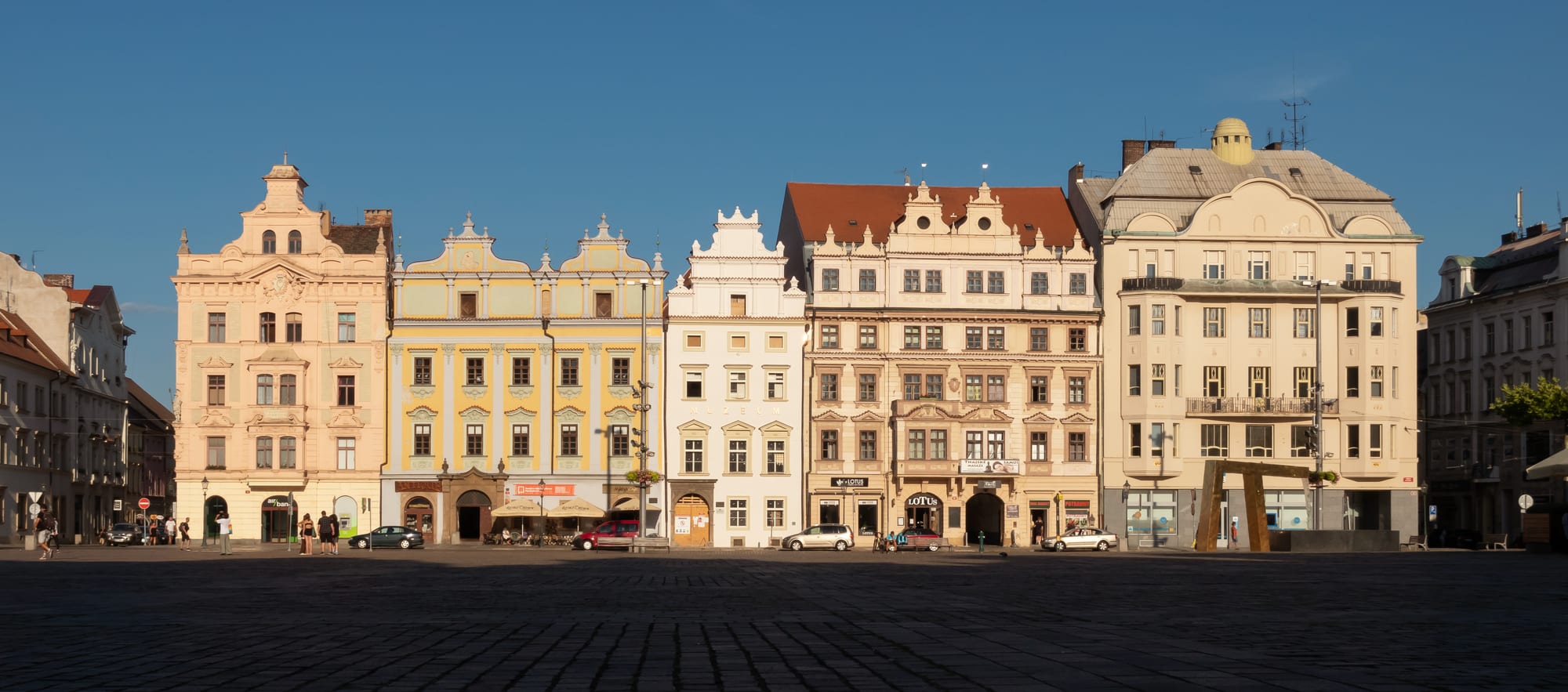
A row of pastel Renaissance and Baroque house fronts in evening sun across a wide cobbled square under a clear blue sky

West Bohemia & the Spa Towns, Czechia

Plzeň

Historic houses on Náměstí Republiky, the main square of Plzeň. (Michielverbeek / Wikimedia Commons · CC BY-SA 4.0)

The capital of West Bohemia, where four rivers meet to form the Berounka about 78 km west of Prague. Founded as a royal town in 1295, it gave the world pale pilsner lager in 1842 and grew into an engineering city around the Škoda Works. Today it is a prosperous university city with a large Gothic cathedral on one of the biggest medieval squares in the Czech lands.

Neighbourhoods

  • Historic centre
    • First-time visitors
    • Historic district
    • Best for food

    A grid of streets laid out at the end of the 13th century around Náměstí Republiky, protected as an urban monument reservation since 1989. The cathedral, the Renaissance town hall, the museums and many pubs are here, with a ring of parks along the line of the old walls.

    Open in Maps
  • Slovany
    • Close to public transport
    • Quiet and residential

    The district around the main railway station, near the city centre. It was the site of the city's first large post-war housing estate, and trams and trolleybuses stop just outside the station.

    Open in Maps
  • Bory
    • Quiet and residential

    A southern district of housing estates built from the late 1960s, with one of the sites of the university hospital and the city's prison.

    Open in Maps
  • Lochotín and Bolevec
    • Quiet and residential
    • Parks and nature

    The northern districts, built up with large housing estates in the 1970s and 1980s. The university hospital has its other site in Lochotín, a chain of fishponds lies on the northern fringe of the city, and an old farmstead in Bolevec is now an open-air museum.

    Open in Maps

Things to do

Famous landmarks

  • Cathedral of St. Bartholomewlandmark

    The Gothic church on the main square, begun in the late 13th century and a cathedral since 1993; its 102.6-metre tower is the tallest church tower in the country, and inside stands the Plzeň Madonna.

    Open in Maps
  • Náměstí Republikylandmark

    One of the largest medieval squares in the Czech lands, lined with Gothic and Renaissance houses, with the town hall of 1554–1559 and a plague column of 1681.

    Open in Maps
  • Great Synagoguelandmark

    A synagogue completed in 1893 in a mix of Romantic Revival and Renaissance Revival styles with Oriental decoration, the second largest in Europe, restored and reopened in 1998 and used for concerts and exhibitions.

    Open in Maps
  • Franciscan Monasterylandmark

    One of the oldest buildings in the city, founded at the end of the 13th century, with the Church of the Assumption, the Chapel of St Barbara and a museum of church art.

    Open in Maps
  • Plzeň Historical Undergroundattraction

    Part of a 20-kilometre labyrinth of cellars and passages dug beneath the old town from the 13th century; almost 800 metres are open to visitors, entered from the Brewing Museum.

    Open in Maps

Beer and museums

  • Pilsner Urquell Breweryattraction

    The brewery where pale lager was first brewed in 1842; tours take in the historic cellars and the water tower of 1905–1907, and it was the most visited sight in the Plzeň Region in 2024.

    Open in Maps
  • Techmania Science Centermuseum

    A science centre that is among the most visited attractions in the city.

    Open in Maps
  • Patton Memorial Pilsenmuseum

    A museum of the American army's liberation of Plzeň and south-west Bohemia in 1945, opened for the 60th anniversary of the event.

    Open in Maps
  • Puppet Museummuseum

    A museum on the main square about Plzeň's puppet tradition, with exhibitions, workshops and interactive activities.

    Open in Maps

Parks and sport

  • Plzeň Zoo and Botanical Gardenpark

    The city zoo and botanical garden, one of the most visited attractions in Plzeň.

    Open in Maps
  • Doosan Arenaattraction

    The home ground of FC Viktoria Plzeň, one of the most successful Czech football clubs, in Štrunc Park near the meeting of the Mže and Radbuza.

    Open in Maps

Short trips from the city

  • Radyně Castlelandmark

    A 14th-century castle on a hill above the town of Starý Plzenec, south-east of the city.

    Open in Maps
  • Starý Plzenecattraction

    The original Plzeň, a small town known for sparkling wine, with a late 10th-century Romanesque church and the remains of a Slavic gord on Hůrka hill.

    Open in Maps
  • Kozel Castlelandmark

    An 18th-century hunting château at Šťáhlavy, near the city.

    Open in Maps
  • Plasyattraction

    A small town on the Střela river north of the city, known for its former monastery, a national cultural monument.

    Open in Maps

Seasonal events

  • Liberation Festivalearly May

    The celebration of the city's liberation by the American army on 6 May 1945, with a convoy of historic military vehicles and visits by American and Belgian veterans.

  • Pilsner Festearly October

    A large beer festival held when the Pilsner Urquell brewery celebrates its birthday.

Eat and drink

Long-standing places and food districts in Plzeň. Hours, ratings and directions come from your maps app, always current.

Plzeň classics

  • U Salzmannůrestaurant

    The oldest beer restaurant in the city, serving traditional Czech food.

    Open in Maps
  • Na Parkáněrestaurant

    A pub in the old town known for unfiltered Pilsner Urquell.

    Open in Maps

Food districts

  • Pubs around Náměstí Republikyneighborhood

    The streets around the main square hold many pubs and restaurants serving pilsner with Czech pub food.

    Open in Maps

Experience Plzeň

History

A castle stood at what is now Starý Plzenec by 976, but the city itself was founded nearby in 1295 by King Wenceslaus II as New Plzeň, and the older settlement took the name Starý Plzenec. The new town lay on the trade routes from Bohemia to Nuremberg and Regensburg; brewing is first recorded in 1307, and by the 14th century Plzeň was the third-largest town in Bohemia after Prague and Kutná Hora. It stayed Catholic during the Hussite Wars, when Prokop the Great besieged it three times without success, and in 1476 the first printing press in Bohemia produced its first book here.

Emperor Rudolf II made the city his seat in 1599–1600. In the Thirty Years' War Mansfeld's troops took it in 1618, and Wallenstein wintered here in 1633 before fleeing to Cheb, where he was killed. The great change came in the 19th century. In 1842 the new burghers' brewery, under the Bavarian brewer Josef Groll, produced the first pale lager, and in 1869 Emil Škoda founded the engineering works that became a leading arms supplier to the Austro-Hungarian army and employed more than 30,000 people by 1917.

During the German occupation the Škoda Works made weapons for the Wehrmacht, and in January 1942 more than 2,000 of the city's Jews were deported to Terezín. Allied bombing in April 1945 caused heavy damage, and on 6 May 1945 General Patton's Third Army liberated the city. The German minority was expelled after the war. In June 1953 more than 20,000 people, mostly Škoda workers, protested against a currency reform in the Plzeň uprising. After 1989 the Škoda group was broken up, and in 2015 Plzeň was a European Capital of Culture.

Culture & Customs

Plzeň's identity rests on beer and on its liberation. The pilsner style, much copied, carries the city's name to beers brewed around the world, and the brewery is the most visited attraction in the region. Each May the Liberation Festival remembers the American arrival of 1945 with a convoy of wartime vehicles and visits from American and Belgian veterans.

The city has a strong puppet tradition: the puppeteers Josef Skupa and Gustav Nosek and the animator Jiří Trnka all worked here, and a puppet museum stands on the main square. The J. K. Tyl Theatre has opera, drama, musical, ballet and orchestral companies, with a Neo-Renaissance main house of 1899–1902 and the New Theatre opened in 2014. Apartment interiors by the architect Adolf Loos are among the city's well-known sights, and Plzeň was a European Capital of Culture in 2015.

Sport draws big crowds. FC Viktoria Plzeň, one of the most successful Czech football clubs, has played in the Champions League, and HC Škoda Plzeň plays in the top ice hockey league; there is also a speedway track. The surrounding region is staunchly Catholic by history, and St Bartholomew's has been a cathedral since the diocese was created in 1993.

Daily Life

Plzeň is the fourth-largest city in the country, and more than 300,000 people live in the wider agglomeration. The city produces about two-thirds of the Plzeň Region's output with less than a third of its people, and it is one of the most prosperous places in the Czech Republic; it came top among Czech cities in one international quality-of-life ranking in 2025, though only 61st of 206 in a national index the same year.

Engineering still matters. The successor companies of the Škoda Works, above all Škoda Transportation and Doosan Škoda Power, remain important, as do the Pilsner Urquell brewery and the liqueur maker Stock in Božkov; since the late 1990s foreign investment has grown fast. The University of West Bohemia, founded in 1991, has about 12,000 students, and Charles University has a medical faculty here.

Many people live in the housing estates built after the war, from Slovany and Doubravka to Bory, Lochotín and Bolevec, while former villages such as Božkov, Černice and Koterov keep their old farmhouses. Trams and trolleybuses carry commuters between the estates and the centre, and the D5 motorway puts Prague and Bavaria within easy reach. Summers are getting hotter: in August 2026 the city recorded 41.5°C, its highest temperature on record.

Food

Plzeň drinks its own beer first. Pilsner Urquell was the world's first pale lager, brewed from pale malt, the city's very soft water, Saaz hops from nearby Žatec and Bavarian lagering, with triple decoction mashing. Unpasteurised tank beer is increasingly available, and a few pubs and the brewery serve it unfiltered. Gambrinus, from a company founded in 1869 and now brewed at the same brewery, is one of the most popular beers in the country.

The food that goes with it is Czech pub cooking. Pivní sýr, beer cheese, is a soft cheese mixed with raw onion and mustard and spread on toasted bread; utopenci, drowned men, are spicy sausages pickled in sweet-sour vinegar with onion and chilli; and nakládaný hermelín is a pickled soft cheese similar to Brie and Camembert. Main courses include goulash soup, svíčková, marinated beef with a thick vegetable sauce and bread dumplings, and vepřo-knedlo-zelo, roast pork with dumplings and cabbage, often called the most typical Czech dish.

Two other drinks come from the city's edges. Fernet Stock, made in Božkov, has long been the best-selling herbal liqueur in the Czech Republic, and the small town of Starý Plzenec just to the south-east is known for its sparkling wine.

Planning tools

Budget

Plzeň is priced at ordinary Czech levels, well below Prague, and the local beer is inexpensive. Rooms cost more during big football matches and festivals, but most of the year a comfortable stay is easy to find near the centre.

Daily Budget Midrange
USD 110–190 (mid-range hotel, restaurant dinners, the brewery tour and the underground)
Daily Budget Shoestring
USD 50–85 (hostel or pension, pub meals, trams and buses)

The cathedral square, the synagogue's exterior, the riverside parks and the ring of gardens around the old town cost nothing to enjoy.

Best Time to Visit

May to September is the warmest and liveliest time, and early May brings the Liberation Festival. The city works year-round, since the brewery, the underground and the museums are indoors, but winters are cold and grey.

Suggested Number of Days

One full day covers the centre and the brewery; two allow time for the museums and a football or hockey match. Add a day or two to visit the castles and small towns nearby or to combine Plzeň with the spa towns.

First Visit
1–2 days
With Surroundings
3–4 days

Transportation

The centre is compact and best seen on foot. Trams, trolleybuses and buses run by the city company PMDP cover the rest of Plzeň, with one ticket valid on all of them; tickets come from machines and small shops, and a contactless card can be used on board.

The D5 motorway between Prague and Nuremberg passes the city, and trains run west to Cheb, south-west to Domažlice, south to Klatovy and south-east to České Budějovice.

Airport & Station Connections

Most visitors arrive from Prague, just over an hour away by train on the line to Cheb, or by the D5 motorway. Václav Havel Airport Prague is about 89 km away, roughly an hour's drive. The main railway station is in Slovany, within walking distance of the centre, and the central bus station handles international coaches.

Walkability

Very good in the centre: the main square, the brewery, the synagogue and the railway and bus stations are all within walking distance of each other, and a ring of parks follows the line of the old walls. The housing estates and the zoo are a tram ride away.

Safety

Czechia is a safe country with low levels of violent crime. In Plzeň the main risks are ordinary ones in crowds on match days and festival nights.

Keep an eye on belongings in crowds and on public transport. Check current official travel advice before travelling.

Climate

A cool, temperate climate with an annual average of about 8.4°C and fairly low rainfall, around 525 mm a year. Heat waves now reach the city: a record 41.5°C was measured on 4 August 2026.

Summer
warm across Czechia, with rain and storms; the city's record high is 41.5°C
Winter
cold, cloudy and snowy across Czechia; the city's record low is −28.0°C

Local Customs

Beer is part of daily life, and pubs are the main place to meet. Tipping is a sign of appreciation rather than a percentage: rounding the bill up by a few crowns is common. Plzeň is proud of its American liberation, which is commemorated openly every May, and of its football club.

Drivers must have no alcohol at all in their blood. Churches are visited as monuments, but quiet behaviour is expected during services.

Common Payment Methods

The currency is the Czech koruna (CZK), often written Kč. Cards are accepted almost everywhere, including on public transport; carry a little cash for small pubs and market stalls.