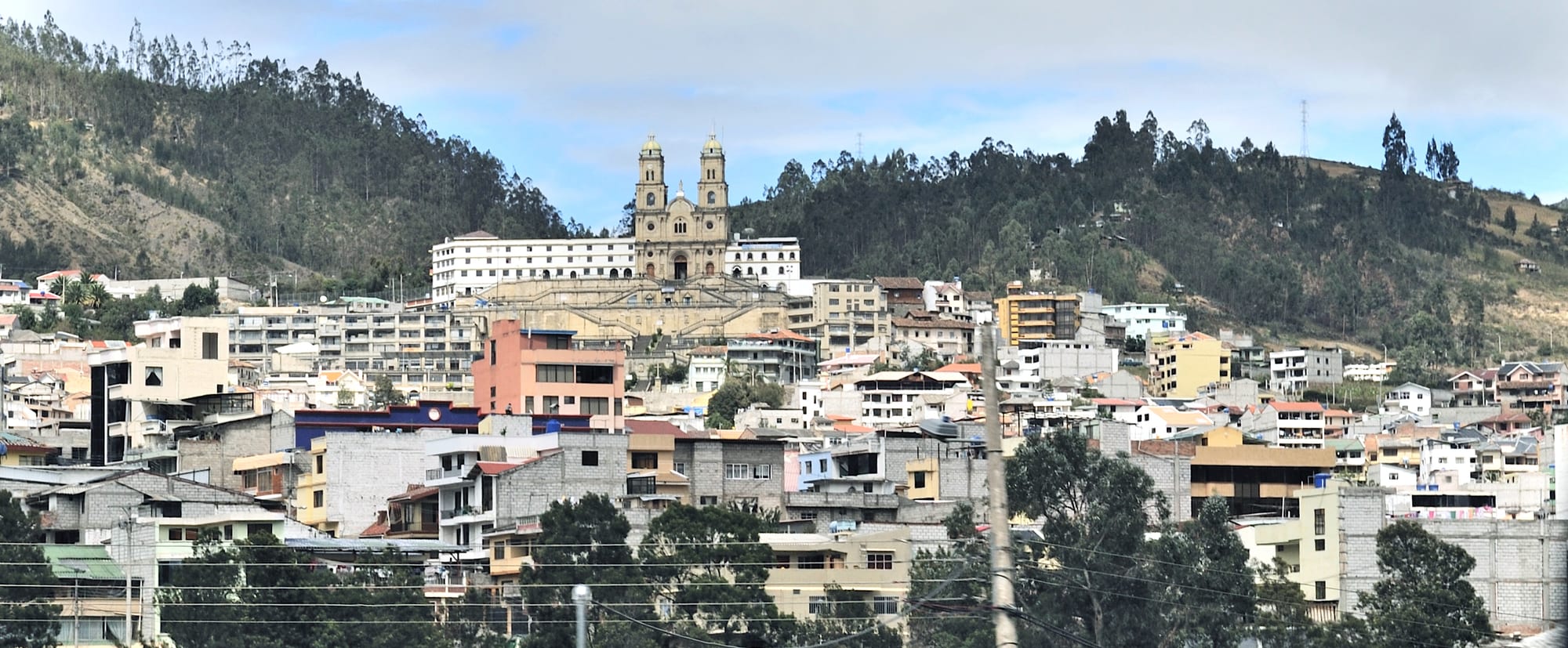
Houses and apartment blocks climbing a wooded hillside, topped by a twin-towered stone church

Cuenca & the Southern Andes, Ecuador

Azogues

Azogues climbing towards the twin-towered church of San Francisco above the city. (Cayambe / Wikimedia Commons · CC BY-SA 3.0)

The capital of Cañar province, at about 2,520 metres on the Burgay river north-east of Cuenca, founded in 1562 and named after the mercury mines found nearby. A small hillside city known for toquilla-straw hats and the Franciscan sanctuary of the Virgin of the Cloud above its centre, it is closely tied to Cuenca and lies about 20 km from the Inca ruins of Ingapirca.

Neighbourhoods

  • The city centre
    • First-time visitors
    • Historic district
    • Close to public transport

    The streets around the cathedral and the central park on the slopes above the Burgay river, with government offices, shops, hat sellers and most places to eat. Buses for the villages around the city leave from the city's terminals.

    Open in Maps
  • The sanctuary hillside
    • Views
    • Religious sites

    The eastern side of the centre, where flights of stone steps climb to the Franciscan sanctuary of the Virgin of the Cloud above the city.

    Open in Maps
  • The surrounding parishes
    • Crafts
    • Quiet and residential

    Rural parishes a short bus ride away, such as Javier Loyola on the road to Cuenca, Bayas at the foot of Cerro Abuga and San Miguel de Porotos, where pottery, ironwork, stone carving and hat weaving continue in family workshops.

    Open in Maps

Things to do

Churches and viewpoints

  • Franciscan Sanctuary of the Virgin of the Cloudlandmark

    A Republican-era church of carved stone from Cerro Abuga on the hill above the centre, reached by symmetrical flights of 407 steps, with an altar holding the wooden statue of the Virgen de la Nube, carved by workers from Azogues.

    Open in Maps
  • Azogues Cathedrallandmark

    The church in the centre of the city, begun in the late 19th century with a front of yellow stone from Cerro Abuga, where the image of the Señor de Burgos is venerated.

    Open in Maps
  • Monument to the Virgin of the Cloudviewpoint

    A 30-metre statue inaugurated in 2009 on the summit of Cerro Abuga at about 3,100 metres, overlooking the city and the valley.

    Open in Maps
  • Church of the Señor de las Floreslandmark

    A historic church in the parish of Bayas, at the foot of Cerro Abuga about 1 km from the city, reached by local bus.

    Open in Maps

Crafts

  • Toquilla-straw hat sellersmarket

    Shops in and around the centre selling the hats woven in the communities of Azogues canton, where most of the province's weavers live.

    Open in Maps
  • Jatumpamba pottery villageattraction

    A potters' village in the parish of San Miguel de Porotos, 11 km south-east of the city, where traditional pottery is still made.

    Open in Maps

Short trips from the city

  • Cojitambo archaeological complexlandmark

    Ruins spread over the flat summit and northern and western slopes of Cerro Cojitambo, 11 km west of the city, occupied since long before the Inca.

    Open in Maps
  • Ingapircalandmark

    The largest known Inca ruins in Ecuador, whose elliptical Temple of the Sun was raised around a large rock on an older Cañari site.

    Open in Maps
  • Cuencaattraction

    The capital of neighbouring Azuay, whose historic centre is a UNESCO World Heritage Site, linked to Azogues by a fast road.

    Open in Maps

Seasonal events

  • Fiesta of the Virgen de la Nube1 January and 31 May

    Thousands of pilgrims gather at the Franciscan sanctuary on the feast days of the Virgin of the Cloud, the city's guardian, whose canonical coronation took place on 1 January 1967.

  • Founding of Azoguesearly October

    The anniversary of the founding on 4 October 1562, the feast of Saint Francis, whose name the city bears.

Eat and drink

Long-standing places and food districts in Azogues. Hours, ratings and directions come from your maps app, always current.

Azogues classics

  • Market stalls of the centremarket

    Stalls serving the pork and maize dishes of the southern highlands, such as hornado roast pork with mote, boiled hominy.

    Open in Maps
  • Restaurants around the central parkneighborhood

    Simple restaurants and cafés in the blocks around the cathedral, many serving the almuerzo set lunch at midday.

    Open in Maps

Experience Azogues

History

The valley of the Burgay river was home to the Peleusí, one of the peoples counted as part of the Cañari nation, and the area belonged to the Cañari world that the Inca later conquered. On 4 October 1562, the feast of Saint Francis, Gil Ramírez Dávalos founded a settlement here, named San Francisco de Peleusí de Azogues: Peleusí after the yellow flowers that grew in the fields and Azogues after the mercury, azogue in Spanish, found in nearby mines.

For two centuries it belonged to the jurisdiction of Cuenca; it became a parish in 1775 and took part in the independence movement of 1820 together with Cuenca. In April 1825 the government of Gran Colombia made it the head of a canton, and it later became the capital of Cañar province.

In the 20th century the town grew, with the weaving of toquilla-straw hats among its main industries, and by the 1930s a road on the line of today's Pan-American Highway linked it with Cuenca. The Virgen de la Nube received her canonical coronation in 1967, and in 1968 Azogues became the seat of its own Roman Catholic diocese. In 2009 a 30-metre monument to the Virgin was inaugurated on the summit of Cerro Abuga. Today the city is part of the Cuenca metropolitan area, and thousands of its residents travel to Cuenca every day for work.

Culture & Customs

Religion is at the centre of local identity. The Virgen de la Nube, the Virgin of the Cloud, is considered the guardian of Azogues, and on 1 January and 31 May thousands of pilgrims from Ecuador and abroad gather at her sanctuary on the hill. Many of the city's churches are built of yellow stone from the old quarry on Cerro Abuga, with round arches.

Crafts are the other pillar. Toquilla-straw hats are woven across Cañar province, with most weavers living in the communities of Azogues canton, and the city is known for a Panama-hat industry that produces mainly for export. Around the city, families keep other trades alive: potters at Jatumpamba, ironworkers in the parish of Javier Loyola, and the stone carvers of Rumiurco, who carve grey andesite from Cerro Cojitambo and display their work beside the Pan-American Highway.

In the community of Jatumpamba, in San Miguel de Porotos, older ways of life persist in pottery, hat weaving, legends and traditional farming practices. Azogueños share much of the culture of neighbouring Cuenca.

Daily Life

The 2022 census counted 35,763 people in the city of Azogues and 74,515 in Azogues canton, making it the second-largest city in Cañar province. Its main activities are commerce, farming, livestock and education, and as the provincial capital it is home to government offices and the seat of a diocese.

Azogues works closely with Cuenca, its much larger neighbour, and many residents travel there daily on the fast road between the two cities, so that Azogues is often described as a commuter town of the Cuenca metropolitan area. The crafts — hats, pottery, ironwork and stone carving — still provide income for many families in the parishes around the city.

The city spreads along the Burgay valley and up the surrounding hillsides. Emigration, above all to the United States, has been heavy from Cañar and Azuay, peaking in Ecuador during the banking crisis of 1998–99, and migration from Cañar remains strong. The rise in crime nationwide has reached even these calmer southern cities.

Food

Azogues shares the cooking of the southern highlands, which centres on pork and maize. Hornado, roast pork carved at market stalls, comes with mote, the large boiled hominy eaten with many meals in the region, and mote pillo is a typical dish of nearby Cuenca. Cuy, guinea pig, is popular in the highlands, often served with maize or potatoes.

The almuerzo, the set lunch of soup and a main course, is the everyday meal in the centre. Bakeries sell sweet breads, and in the week before All Souls' Day colada morada, a drink of black corn flour sweetened with panela and flavoured with fruit and spices, is served with guagua de pan, bread shaped like a child. Canelazo is a hot drink of sugarcane spirit, sugar or panela and cinnamon water, often with fruit juice such as naranjilla.

Planning tools

Budget

Azogues is inexpensive and sees few foreign tourists, so prices are set for local people. Many visitors come for the day from Cuenca, which has a far wider choice of places to stay; local buses to the crafts villages and archaeological sites cost little.

Daily Budget Midrange
USD 50–100 (best local hotel or a Cuenca base, restaurant meals, a taxi or tour to Ingapirca)
Daily Budget Shoestring
USD 25–40 (simple hotel, almuerzo set lunches, local buses)

Carry cash and small notes for buses, markets and small restaurants.

Best Time to Visit

The climate is mild all year. June to September is drier in the southern highlands and best for clear views and for Ingapirca and Cojitambo. The pilgrimages of the Virgen de la Nube on 1 January and 31 May fill the sanctuary and the streets.

Suggested Number of Days

Most visitors spend a single day. Two or three days allow time for the crafts villages, the archaeological sites and the Inca ruins to the north.

First Visit
1 day
With Surroundings
2–3 days

Transportation

The centre is walkable, though steep. Urban buses run to the surrounding parishes from stops in the city, and intercantonal buses from the bus terminal reach the villages and Cojitambo. Taxis are easy to find for trips into the hills.

For Ingapirca, a tour or taxi from Azogues or Cuenca is simpler than changing buses.

Airport & Station Connections

Azogues has no airport of its own and uses Mariscal Lamar Airport in Cuenca. A fast road links the two cities, with frequent buses, and the Pan-American Highway continues north towards Quito and west towards Guayaquil.

Walkability

The centre is compact but built on a slope; streets and the long stairway to the sanctuary are steep, and at about 2,520 metres the climb is tiring. The crafts villages and archaeological sites need a bus or taxi.

Safety

Ecuador's security has deteriorated sharply since about 2019, with a surge in organised crime, gang violence, and prison unrest, especially in Guayaquil, Esmeraldas, Manta, and the northern border with Colombia. The southern highlands are among the calmer parts of the country, though petty theft and occasional robberies occur and crime has risen here as it has nationwide. Landslides affect mountain roads in the rainy season.

Keep valuables out of sight in markets and crowds at festivals, use registered taxis at night and travel by day on mountain roads. Check current official travel advice before travelling.

Climate

A mild Andean climate with an average temperature of about 17°C, with spring-like days and cool nights all year and showers possible in any month.

Summer
June–September, the drier season: average temperatures around 17°C, with cold nights
Winter
October–May, the wetter season: average temperatures still around 17°C, with more frequent rain

Local Customs

Azogues is a devout Catholic city whose identity centres on the Virgen de la Nube. Its people are linked closely to Cuenca by work and family, and emigration abroad has touched many families in Cañar.

Dress modestly in the sanctuary and the cathedral, keep quiet during services, and ask before photographing people, especially at religious events.

Common Payment Methods

The currency is the US dollar. Cash is used for most everyday purchases; cards are accepted in a few larger shops and hotels. There are ATMs in the centre; carry small notes.