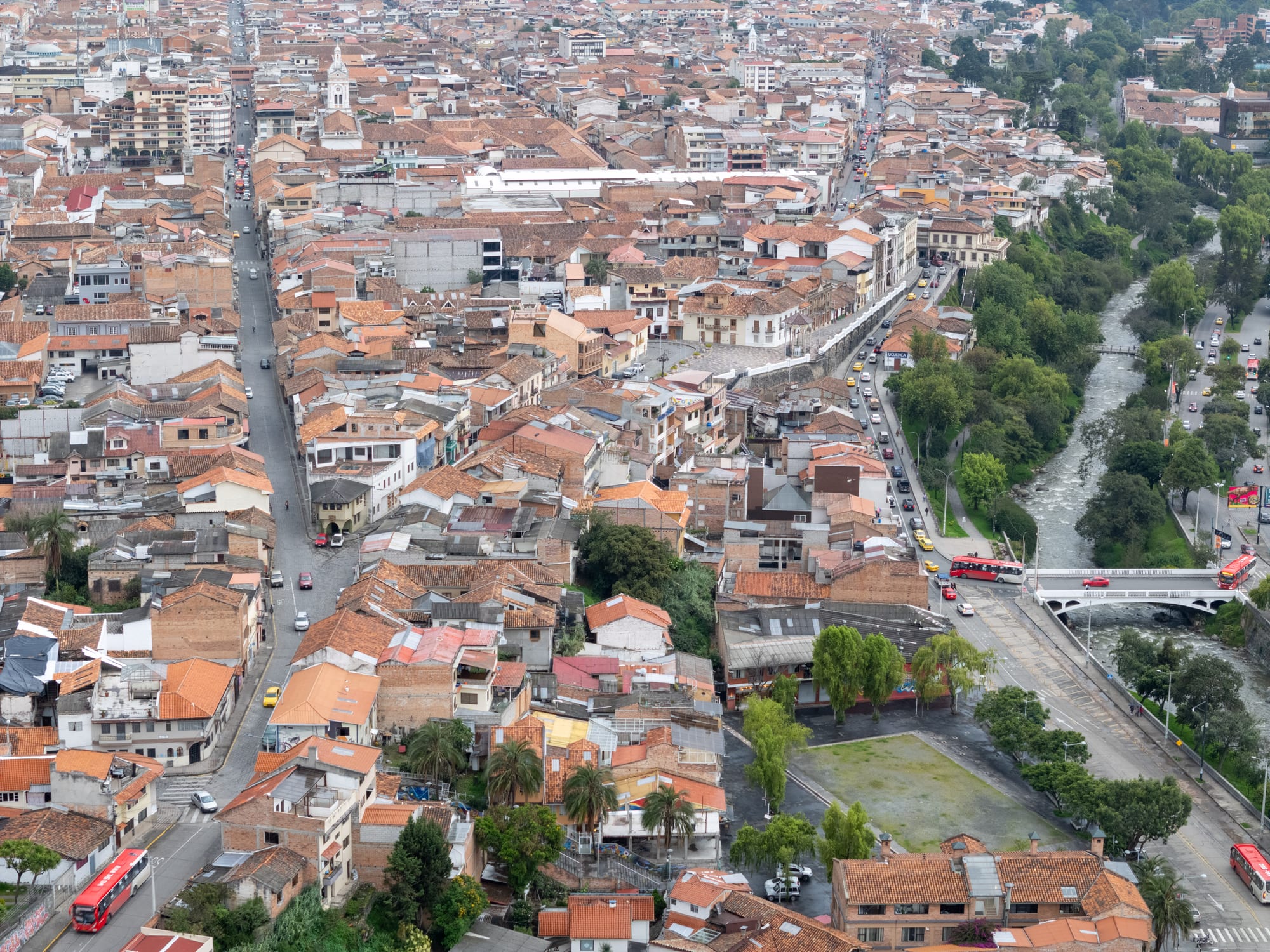
Aerial view of tiled roofs and narrow streets above the tree-lined Tomebamba river, with red buses crossing a bridge

Cuenca & the Southern Andes, Ecuador

Cuenca

The El Vado neighbourhood and the Tomebamba river on the edge of Cuenca's historic centre. (Pablo Zuñiga / Wikimedia Commons · CC BY 4.0)

The capital of Azuay province, at about 2,540 metres in the southern Andes, founded by the Spanish in 1557 on the ruins of the Inca city of Tomebamba. Its colonial centre of churches, blue domes and river walks has been a UNESCO World Heritage Site since 1999, and the city is known for Panama hats and a sizeable foreign community.

Neighbourhoods

  • El Centro (historic centre)
    • First-time visitors
    • Historic district
    • Close to public transport

    The UNESCO-listed grid between the Tomebamba river and Gran Colombia street, centred on Parque Calderón with the old and new cathedrals facing each other. Churches, colonial courtyards, museums, the flower market and many guesthouses are all within a few blocks, and the tram runs through it.

    Open in Maps
  • Calle Larga and El Barranco
    • Nightlife
    • Best for food
    • River views

    The street along the top of the river bluff on the southern edge of the centre, lined with restaurants, bars and museums. Steps lead down from it to the Tomebamba and the paths along its banks.

    Open in Maps
  • El Vado
    • Historic district
    • Crafts

    An old quarter beside the Tomebamba, along one of the river's most scenic stretches, with traditional buildings and views across the water.

    Open in Maps
  • South of the Tomebamba
    • Quiet and residential
    • Parks

    Across the river from the centre, wider avenues of newer houses and flats, shopping centres and the riverside parks of the Yanuncay.

    Open in Maps
  • Turi
    • Views
    • Crafts

    A hill parish south of the city whose church and public park look over the whole of Cuenca. Artisan shops beside the church sell hats and boots, and souvenir stalls line the road up.

    Open in Maps

Things to do

Famous landmarks

  • New Cathedrallandmark

    The Cathedral of the Immaculate Conception, begun in 1885 and built over almost a century, whose three domes of blue and white tile are the symbol of the city; its towers were left short because of a calculation error.

    Open in Maps
  • Old Cathedral (El Sagrario)museum

    The main church of colonial Cuenca, begun in the mid-16th century across Parque Calderón from the new cathedral, now a museum of religious art.

    Open in Maps
  • Parque Calderónpark

    The main square of the old town, framed by the two cathedrals, where the tourist office stands.

    Open in Maps
  • Carmen de la Asunciónlandmark

    A monastery church founded in 1682, whose atrium holds the city's flower market.

    Open in Maps

Museums

  • Pumapungo Museummuseum

    An ethnographic and art museum founded in 1979, with costumes and objects from peoples across Ecuador, Shuar tzantzas, and an archaeological park on the remains of Inca Pumapungo.

    Open in Maps
  • Museum of Aboriginal Culturesmuseum

    A museum of the region's Aboriginal cultures on Calle Larga.

    Open in Maps
  • Museum of La Concepciónmuseum

    A monastery museum with 17th-century tombs and a large collection of religious art.

    Open in Maps
  • Remigio Crespo Toral Municipal Museummuseum

    The city's municipal museum.

    Open in Maps

Walks and viewpoints

  • Tomebamba river walktrail

    Paths along the banks of the Tomebamba below the old town, the river that gives the city much of its character.

    Open in Maps
  • Mirador de Turiviewpoint

    The hilltop church and lookout south of the city, perhaps the only place on the ground from which the whole of Cuenca can be seen.

    Open in Maps

Markets and crafts

  • Flower marketmarket

    Stalls of cut flowers in the atrium of the Carmen de la Asunción church, on Calle Sucre across from the new cathedral.

    Open in Maps
  • Panama hat workshopsattraction

    Workshops where toquilla-straw hats woven in the surrounding villages are finished, blocked and sold, some offering short tours of the process.

    Open in Maps

Short trips from the city

  • El Cajas National Parkpark

    A national park of páramo, rivers and glacial lakes between 3,100 and 4,450 metres, where the Tomebamba and Yanuncay rivers rise; it is part of a UNESCO biosphere reserve.

    Open in Maps
  • Ingapircalandmark

    The largest known Inca ruins in Ecuador, whose Temple of the Sun is an elliptical building raised around a large rock.

    Open in Maps
  • Gualaceoattraction

    A valley town 35 km east of Cuenca nicknamed the Garden of Azuay, known for its landscapes and crafts.

    Open in Maps
  • Chordelegattraction

    A small town of Cañari origin known for its gold and silver filigree jewellery.

    Open in Maps

Seasonal events

  • CarnivalFebruary or March

    Celebrated with water balloons and sprays of foam in the streets, and with family gatherings.

  • Cuenca Independence Dayearly November

    The anniversary of the city's independence on 3 November 1820, marked with processions, cultural events, dances and a large craft fair.

  • Pase del Niño Viajero24 December

    The city's great Christmas procession, with people of all ages dressed as biblical characters, decorated trucks and horses and thousands of musicians.

Eat and drink

Long-standing places and food districts in Cuenca. Hours, ratings and directions come from your maps app, always current.

Cuenca classics

  • Hornado and mote at the marketsmarket

    Market stalls carving whole roast pork, served with mote, boiled hominy, and mote pillo, one of Cuenca's most typical dishes.

    Open in Maps
  • Bakeries of the centrecafe

    Bakeries in the centre, which around the Day of the Dead sell guaguas de pan, doll-shaped breads eaten with colada morada.

    Open in Maps

Food districts

  • Calle Larganeighborhood

    The riverside street of restaurants, cafés and bars on the southern edge of the old town, busy in the evening.

    Open in Maps
  • Cafés around Parque Calderónneighborhood

    Coffee houses and lunch places in the blocks around the main square, many serving the almuerzo set lunch at midday.

    Open in Maps

Experience Cuenca

History

Long before the Spanish came, the valley where four rivers meet was home to the Cañari, whose settlement here was called Guapondelig. In the late 15th century, after a bitter struggle, the Inca conquered them, and Tupac Inca Yupanqui ordered a grand city built on the site. Tomebamba, with its palace and temples at Pumapungo, was said by chroniclers to rival Cusco, but by the time the Spanish reached it the city had been destroyed and abandoned during the Inca civil war, and stories of its lost gold made it one of the candidates for El Dorado.

On 12 April 1557 Gil Ramírez Dávalos, acting for the viceroy of Peru, founded Santa Ana de los Ríos de Cuenca on the ruins, naming it after the Spanish city of Cuenca and the rivers that cross it. The colonial town grew slowly on a regular grid of churches and convents. Cuenca declared its independence on 3 November 1820 and became the capital of one of the three provinces of the new republic.

In the 19th and 20th centuries the city lived on crafts and trade, above all the toquilla-straw hats exported through Panama. Work on the New Cathedral began in 1885 and took almost a century. The historic centre was declared a UNESCO World Heritage Site in 1999, and Cuenca has since become a magnet for tourists and for foreign retirees. A tram line opened in May 2020. The severe drought of 2024, worst in the south of the country, led to national power cuts, and in September 2025 Azuay was placed under a state of emergency during the fuel-subsidy protests.

Culture & Customs

Cuenca has long called itself the Athens of Ecuador, for its contribution to the country's arts, sciences and literature and for the writers and public figures born here. The city has a strong Catholic tradition that shows in the many churches of the old town and in its religious processions.

Crafts are the city's best-known export. The weaving of the toquilla-straw hat, sold abroad for more than a century as the Panama hat, was added to UNESCO's intangible cultural heritage lists in 2012; the hats are plaited from palm-like toquilla fibre in villages of Azuay and Cañar and finished, blocked and sold in Cuenca's workshops. Ceramics, ironwork, embroidery and the filigree jewellery of nearby Chordeleg are also part of the city's craft tradition.

The great public celebrations are the Pase del Niño Viajero on 24 December, when thousands of musicians and people of all ages dressed as biblical characters pass through the historic centre with decorated trucks and horses, the independence festivities of early November, and Carnival, when the city splashes itself with water balloons and foam.

Daily Life

The 2022 census figure of about 596,000 people for Cuenca is in line with the population of the whole canton, which an official 2015 estimate put at 580,000, about 400,000 of them in the city proper; Cuenca is the third-largest city in Ecuador after Guayaquil and Quito. Local publications estimate that between 4,000 and 6,000 foreign residents live here, many of them retirees from the United States and Europe drawn by the climate and the cost of living. Long emigration from Azuay to the United States and Spain has also shaped the city, and remittances are an important source of income.

The economy rests on commerce and industry — textiles, furniture, hats and shoes, as well as ceramics and appliances — alongside tourism, the universities and the administration of the province. Cuenca once exported cut flowers widely and now specialises in orchids.

Life is calmer than in Quito or Guayaquil. Most people live in the newer districts beyond the rivers, while the old town fills by day with offices, shops and visitors. Markets are busiest in the morning, lunch is the largest meal of the day, and the riverside paths are used for walking, running and cycling. Recent concerns include the drought and power cuts of 2024 and mining in the páramo, such as the Loma Larga project in the Quimsacocha water reserve, whose approval helped fuel the 2025 protests.

Food

Cuenca's cooking centres on pork and maize. Hornado, a whole roast pig, and chancho al horno are carved at market stalls and served with mote, the large boiled hominy that is a staple here; mote pillo, one of the most typical dishes of Cuenca, scrambles it with egg, and mote pata is another popular mote dish. Llapingachos, cheesy potato cakes, and morocho, made from maize, are everyday favourites.

Cuy, roast guinea pig, is a popular traditional dish, and trout from the lakes and streams of Cajas is a common main course. Lunch is the largest meal of the day, typically served in two courses: soup, then stewed or grilled meat with rice.

Around the Day of the Dead on 2 November, families drink colada morada, a thick purple drink made with fruits, spices and maize flour, with guaguas de pan, filled breads shaped like dolls. Canelazo, sugarcane spirit with hot cinnamon water, often with naranjilla juice, is drunk on cold evenings.

Planning tools

Budget

Cuenca is good value by the standards of Andean cities, with hostels, restored colonial guesthouses and boutique hotels in the old town. The almuerzo set lunch keeps eating cheap. Tours to Cajas and Ingapirca are the main extra cost.

Daily Budget Midrange
USD 60–120 (colonial boutique hotel, restaurant dinners, a guided day trip to Cajas or Ingapirca)
Daily Budget Shoestring
USD 25–40 (hostel bed, almuerzo set lunches, the tram and city buses)

Eat the main meal at midday, when set lunches cost a fraction of evening restaurant prices; the centre is easy to cover on foot or by tram.

Best Time to Visit

Cuenca can be visited at any time of year. June to September is drier and gives the best chance of clear days in Cajas and at Ingapirca. Early November brings the independence festivities and craft fair, and Christmas Eve the Pase del Niño procession; hotels fill around both.

Suggested Number of Days

Two or three days cover the old town, its museums and the river. Allow four to six to add day trips into the national park, to the Inca ruins to the north and to the craft towns to the east. Bad weather in the páramo can cost a day.

First Visit
2–3 days
With Surroundings
4–6 days

Transportation

The centre is compact and most visitors walk. A single tram line, opened in May 2020, crosses the city and links the old town with the airport, a short walk from the bus terminal; city buses cover the rest, and taxis are plentiful and cheap. Day trips to Cajas, Ingapirca and the craft towns go by bus from the Terminal Terrestre or with a tour.

Take a daytime bus for the road over Cajas to Guayaquil, which climbs through the park's páramo and lakes.

Airport & Station Connections

Mariscal Lamar International Airport lies inside the city, just east of the bus terminal, with domestic flights to Quito and Guayaquil; a taxi or the tram reaches the centre in minutes. Most travellers arrive by bus: Guayaquil is 243 km away, nearly four hours over the Cajas road, Loja four and a half hours or more to the south and Quito around ten hours to the north.

Walkability

The historic centre is a flat, regular grid that is easy and pleasant to walk, with the cathedrals, museums, markets and the river all within about fifteen minutes of each other. Steps lead down from Calle Larga to the Tomebamba, and paths follow the river for long distances. At about 2,540 metres the altitude can make hills and stairs tiring soon after arrival.

Safety

Ecuador's security has deteriorated sharply since about 2019, with a surge in organised crime, gang violence, and prison unrest, especially in Guayaquil, Esmeraldas, Manta, and the northern border with Colombia. Cuenca is generally regarded as one of the safer cities in the country, though petty theft and bag-snatching occur. Azuay was among the provinces put under a state of emergency during the fuel-subsidy protests of September 2025.

Keep bags and phones close in markets and crowds, use registered taxis at night, and carry warm, waterproof layers and register at the ranger post before walking in Cajas. Check current official travel advice before travelling.

Climate

A temperate Andean climate averaging about 16°C, with spring-like days and cool nights all year; a sweater or jacket is needed in the evening. Showers are possible in any month. Cajas, much higher, is cold, wet and often foggy.

Summer
June–December, the drier season: mild days and cool nights, with the year averaging about 16°C
Winter
January–May, the rainy season: bright mornings and afternoon showers, heaviest from March to May, with similar temperatures around the yearly average of about 16°C

Local Customs

Cuenca has a strong Catholic tradition, visible in its many churches. Greetings are polite and unhurried. Lunch is the largest meal of the day.

Dress modestly and keep quiet in churches during services, ask before photographing people, especially women in traditional dress at markets, and check the bill for a service charge before adding a tip in sit-down restaurants.

Common Payment Methods

Ecuador uses the US dollar, alongside its own coins. Cards are accepted in hotels, larger restaurants and shops, and ATMs are common in the centre, but markets, buses and small cafés take cash. Carry small notes, as change for a USD 20 can be hard to find and damaged bills are refused.