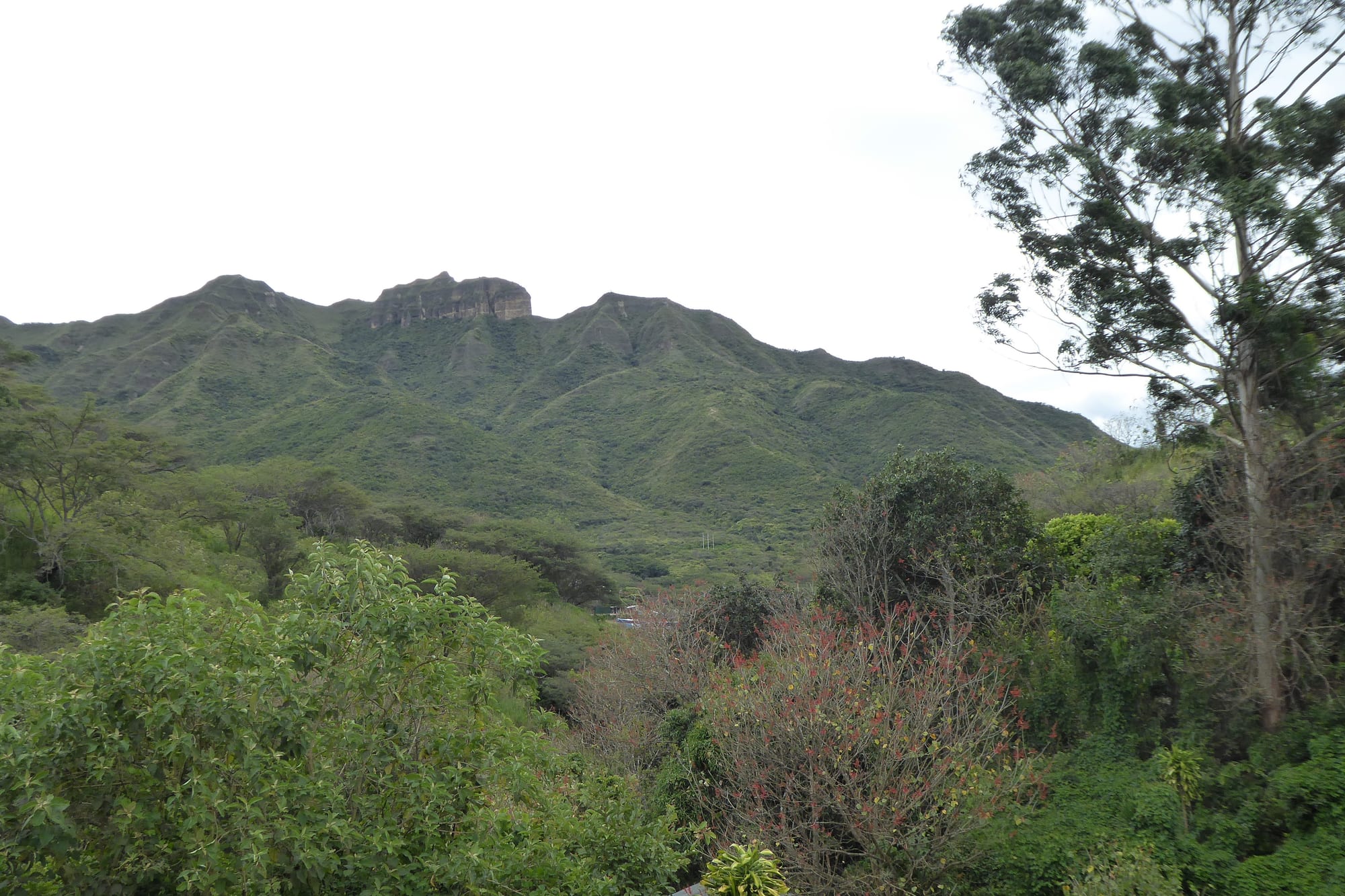
A green mountain ridge with a rocky crest rising above trees and flowering shrubs under a pale sky

Cuenca & the Southern Andes, Ecuador

Vilcabamba

The ridge of Mandango above the Vilcabamba valley in Loja province. (Arabsalam / Wikimedia Commons · CC BY-SA 4.0)

A village in a warm valley of Loja province, about 45 km south of the city of Loja, beneath the ridge of Mandango. Its fame rests on stories of extremely long-lived residents, which researchers in the 1970s found to be exaggerated, and today it draws walkers, riders and foreign settlers to its mild climate and trails.

Neighbourhoods

  • The village centre
    • First-time visitors
    • Best for food
    • Close to public transport

    A few streets of low houses around the central park and church, little changed in appearance. The park is the meeting place for residents and visitors, with restaurants serving Andean dishes alongside food from many countries, and the buses and shared taxis from Loja stop nearby.

    Open in Maps
  • The surrounding valley
    • Quiet and residential
    • Walking and riding
    • Nature

    Lanes and footpaths leading out along the rivers into farmland and hillsides, where guesthouses with gardens, small nature reserves and the homes of many foreign residents are scattered across the valley. Most trailheads are within walking distance or a short taxi ride of the plaza.

    Open in Maps

Things to do

In and around the village

  • Central parkpark

    The village square, ringed by old houses and restaurants, the place where locals and visitors gather.

    Open in Maps
  • Mandangotrail

    The ridge above the valley, called the Sleeping Inca and said in local legend to protect the area from earthquakes and other disasters; it can be climbed on foot or on horseback.

    Open in Maps
  • Rumi Wilco Nature Reservepark

    A nature reserve whose entrance is about 15 minutes' walk from the village square, with forest paths near the river.

    Open in Maps
  • Yamburara Recreational Parkpark

    A recreation park with green areas, swimming pools, a plant nursery and a small zoo, used by local families for picnics.

    Open in Maps
  • Horse riding in the hillsattraction

    Rides of two hours to three days into the surrounding hills, arranged in the village.

    Open in Maps

Short trips from the village

  • Podocarpus National Parkpark

    A national park created in 1982 that runs from lower montane rainforest at about 1,000 metres to elfin forest and páramo lakes above 3,000 metres, with a high level of endemic species.

    Open in Maps
  • Lojaattraction

    The provincial capital, known as the music and cultural capital of Ecuador, with colonial churches, a city gate and the oldest botanical garden in the country.

    Open in Maps

Eat and drink

Long-standing places and food districts in Vilcabamba. Hours, ratings and directions come from your maps app, always current.

Vilcabamba classics

  • Restaurants around the central parkneighborhood

    Places on and around the square serving Andean dishes and, because of the village's international population, food from many other countries.

    Open in Maps
  • Village shops and caféscafe

    Small shops and cafés selling locally grown, shade-grown coffee, granola, jams and other produce of the valley.

    Open in Maps

Experience Vilcabamba

History

The name Vilcabamba is thought to come from the Kichwa huilco pamba, the plain of the huilco, a tree sacred in the region, and the valley has been called the Playground of the Inca for its supposed use as a retreat for Inca royalty. Above it rises Mandango, the Sleeping Inca, which local legend says shields the valley from earthquakes and other disasters.

For most of its history Vilcabamba was a quiet farming parish of Loja. That changed in the 1960s and 1970s, when an Ecuadorian scientific mission and then foreign researchers came to study residents who claimed extraordinary ages. In 1973 Alexander Leaf of Harvard Medical School introduced them to the world in National Geographic, and the village became known as the Valley of Longevity.

Leaf himself grew doubtful when the same man gave his age as 122 in 1971 and as 134 three years later. Researchers who checked baptismal records concluded in 1978 that there was not a single centenarian in the village; the oldest person was 96, and those claiming to be over 100 averaged 86. Ages had been exaggerated for prestige, identical family names had confused the records, and the high share of elderly people came from young people leaving and older people arriving. The researchers did note that hard work and a low-fat diet seemed to keep older villagers healthy. The fame remained, and it brought tourists and a steady stream of foreign settlers.

Culture & Customs

The longevity story is part of local identity. Many residents still credit the climate, the clean air and the mineral-rich water of the valley's rivers, and the legend of the Sleeping Inca on Mandango is told to visitors. The village belongs to Loja province, whose capital is known as the music and cultural capital of Ecuador.

The arrival of foreign residents has given the village an unusual mix for a parish of its size. Restaurants on the plaza serve dishes from several continents beside Andean ones, and village shops sell organic shade-grown coffee, granola, natural soaps and locally made crafts aimed at residents and visitors alike. Retirees from around the world, especially the United States and Canada, have settled permanently in the valley, with both positive and negative effects on what was once a quiet place.

Life is lived outdoors and on foot or horseback. Walking and riding in the hills are what draw most visitors, and the rhythm is slow.

Daily Life

The parish had a population of more than 7,000 in 2020. The proportion of older people is higher than usual, which researchers attributed to young people moving away to the cities while older people moved in. Farming, services and tourism provide work, and the guesthouses, restaurants and shops that serve visitors and foreign residents are an important part of the village economy.

The houses around the plaza have changed little, in part because their owners have had limited money to alter them, while newer homes and guesthouses are scattered along the rivers and up the hillsides. Many visitors come for a few days and stay on to consider settling, and the foreign community is a visible part of daily life, from the plaza cafés to the shops selling local coffee and produce.

For hospitals, universities and larger shops, residents travel to Loja, about an hour away by bus. The rise in crime affecting the whole country has reached the calmer southern highlands as well.

Food

Vilcabamba eats the food of Loja province. Repe, a creamy soup of green bananas and fresh cheese, is the region's best-known dish, alongside tamales and humitas, steamed parcels of ground maize, and the mote, boiled hominy, of the southern highlands.

The plaza's restaurants also reflect the international population, with dishes from many countries next to the almuerzo set lunch of soup, rice, meat and juice. Coffee, an emblematic product of Loja province, is grown in the area and sold, shade-grown and organic, with granola, jams and other produce in village shops. Cecina, pork seasoned with salt, garlic and pepper, dried in the sun and then grilled, is another Loja speciality.

Fresh fruit juices are everywhere, and horchata, an infusion of medicinal herbs and flowers sweetened and finished with a few drops of lemon, is the region's traditional drink.

Planning tools

Budget

Vilcabamba is one of the cheaper stops in the southern highlands, with hostels and guesthouses spread through the valley. Guided walks into Podocarpus and horse-riding trips are the main extra costs; the trails around the village can be walked without a guide.

Daily Budget Midrange
USD 60–110 (guesthouse with a garden, restaurant meals, a guided ride or park trip)
Daily Budget Shoestring
USD 25–40 (hostel bed, set lunches in the village, buses or shared taxis from Loja)

Carry enough cash from Loja, and ask guesthouses for their trail maps before setting out.

Best Time to Visit

The valley is mild all year. June to September, the drier months in the southern highlands, is best for longer walks and for the high parts of Podocarpus; October to May brings more rain, greener hills and muddier trails.

Suggested Number of Days

Two or three days give time for the village and the shorter walks. Allow four to six to add longer hikes, a riding trip or a visit to the national park; many visitors stay much longer, as the village is built for slow travel.

First Visit
2–3 days
With Surroundings
4–6 days

Transportation

The village itself is walked. Buses run roughly hourly to Loja, taking about an hour to an hour and a half, and shared taxis leave from the main bus stop when they fill up. Taxis reach trailheads and outlying guesthouses, and there are international buses south to Piura in Peru.

Agree the fare before taking a taxi out to the trailheads.

Airport & Station Connections

Most travellers arrive from Loja, about 45 km north, by bus or shared taxi. The nearest airport is Ciudad de Catamayo Airport, which serves Loja from Catamayo, 18 km west of that city. Long-distance buses link Loja with Cuenca and Guayaquil, and a bus runs from Vilcabamba to Piura in Peru.

Walkability

The centre is small and flat enough to cross in a few minutes, and lanes lead straight from it into farmland and footpaths. Trails into the hills are steep and exposed to the sun, and some guesthouses are a few kilometres out along unlit roads.

Safety

Ecuador's security has deteriorated sharply since about 2019, with a surge in organised crime, gang violence, and prison unrest, especially in Guayaquil, Esmeraldas, Manta, and the northern border with Colombia. The southern highlands are among the calmer parts of the country, though crime has risen there too. Armed robberies of walkers on Mandango were reported over the years, including a machete robbery of a group of tourists in July 2011.

Leave valuables behind when walking, especially on Mandango, walk in company where possible, and carry water and sun protection on exposed trails. Check current official travel advice before travelling.

Climate

A mild valley climate at about 1,500 metres, warmer than Loja or Cuenca, with an average temperature of about 19°C, clear nights and green hillsides. Rain is heavier from about October to May.

Summer
June–September, the drier season: temperatures mostly between 18 and 22°C
Winter
October–May, the wetter season: temperatures still mostly between 18 and 22°C, with more showers

Local Customs

A small farming village with a large community of foreign residents, where the plaza is the social centre. Greet shopkeepers and neighbours, and treat the church and its services with respect. The reputation for long life remains part of the village's identity.

Ask before photographing residents, and dress modestly away from the trails.

Common Payment Methods

The currency is the US dollar. Cash is needed for most purchases, buses and taxis; a few guesthouses and restaurants take cards. Bring enough cash and small notes from Loja.