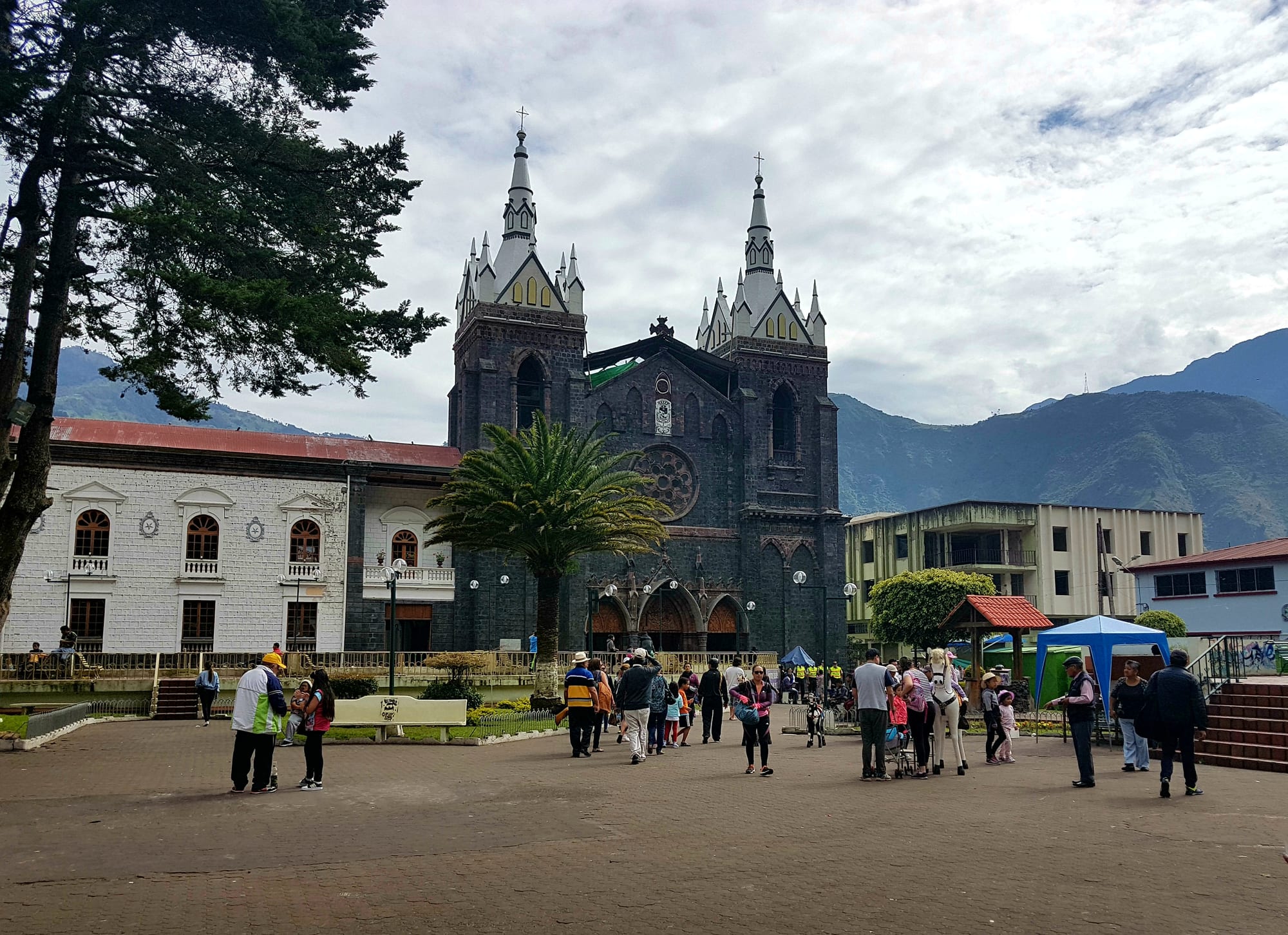
A dark stone neo-Gothic church with two white-tipped spires behind a paved square with strolling people, green mountains beyond

Quito & the Northern Andes, Ecuador

Baños de Agua Santa

The basilica of the Virgin of the Holy Water on the main square of Baños de Agua Santa. (Medios Públicos EP / Wikimedia Commons · CC BY-SA 2.0)

A small spa town at about 1,820 metres on the northern foothills of the Tungurahua volcano, where the Pastaza river leaves the Andes for the Amazon. Named for hot springs long credited with healing powers and devoted to the Virgin of the Holy Water, it is now one of Ecuador's busiest tourist towns, known for waterfalls, thermal pools, adventure sports and sugar-cane taffy.

Neighbourhoods

  • Town centre
    • First-time visitors
    • Best for food
    • Close to the bus station

    A compact grid around the central park and the basilica, with most of the town's guesthouses, restaurants, tour agencies and the stalls selling melcocha and crafts in front of the church. The small bus terminal is on the northern edge, within walking distance.

    Open in Maps
  • The Virgin's waterfall and the baths
    • Thermal pools
    • Quiet mornings

    The southern edge of town, where the Cabellera de la Virgen waterfall drops down the Bellavista hill and the municipal pools sit at its foot. Trails and viewpoints climb the slopes above.

    Open in Maps
  • Ruta de las Cascadas and Río Verde
    • Waterfalls
    • Cycling
    • Nature

    The road east down the Pastaza gorge towards Puyo, passing a string of waterfalls and suspension bridges to the village of Río Verde and the Pailón del Diablo. It is a popular cycling route, mostly downhill.

    Open in Maps

Things to do

In town

  • Basilica of the Virgin of the Holy Waterlandmark

    The neo-Gothic basilica built with volcanic rock between 1904 and 1944, a place of pilgrimage whose walls are hung with paintings of the Virgin's miracles, including saving the church from volcanic eruptions.

    Open in Maps
  • Piscinas de la Virgenattraction

    Municipal thermal pools of sulphurous water at the foot of the Cabellera de la Virgen waterfall, the source of the town's name and its reputation for healing waters.

    Open in Maps
  • Termas El Saladoattraction

    A set of thermal pools on the edge of town, remodelled in 2012, with several hot and cold pools for bathing.

    Open in Maps

Waterfalls of the Pastaza gorge

  • Agoyán waterfallattraction

    A waterfall on the Pastaza just outside town, one of the three main falls near Baños, below a hydroelectric plant built upstream in 1987 so as to preserve it.

    Open in Maps
  • Manto de la Noviaattraction

    The 'bride's veil', a waterfall about 10 km east of town that drops into the Pastaza, seen from a long suspension bridge over the river.

    Open in Maps
  • Pailón del Diabloattraction

    The 'Devil's Cauldron' near Río Verde, about 15 km east, one of Ecuador's most famous waterfalls, where the Río Verde drops about 80 metres before joining the Pastaza; trails and suspension bridges lead to viewpoints.

    Open in Maps

Walks and viewpoints

  • Casa del Árbolviewpoint

    A tree house on the hills above town with swings out over the slope towards the mountains, reached by bus.

    Open in Maps
  • Tungurahuaviewpoint

    The active volcano that rises directly south of the town; its eruptive phase from 1999 to 2017 forced repeated evacuations, and its slopes can be seen from viewpoints around Baños.

    Open in Maps

Seasonal events

  • Fiestas of the Virgin of the Holy WaterOctober

    A month of pilgrimages, processions and dancing in honour of the town's patron, the Virgin of the Holy Water.

Eat and drink

Long-standing places and food districts in Baños de Agua Santa. Hours, ratings and directions come from your maps app, always current.

Baños classics

  • Melcocha stallsmarket

    Shops and stalls around the town that make melcocha, sugar-cane taffy made from boiled raw cane syrup; most of Ecuador's melcocha is made here.

    Open in Maps
  • Sugar-cane juice and sweetsmarket

    Stalls selling jugo de caña, freshly squeezed sugar-cane juice, sticks of cane to chew and brightly coloured cane sweets.

    Open in Maps
  • The town marketmarket

    The town's market, where cuy, roast guinea pig, and other Andean dishes are served at simple stalls.

    Open in Maps

Experience Baños de Agua Santa

History

According to the Spanish-language histories of the town, Baños had no formal founding. The often-quoted date of 1553 is the year Dominican friars were assigned to evangelise the Amazon lowlands beyond it, and the cult of the Virgin here is thought to have begun in those years. A chronicle of 1604 describes a tiny settlement called the Asiento de los Baños, with hot springs at the foot of a waterfall and a small adobe chapel with a thatched roof, the Ermita de la Virgen. The Virgin's wooden image was said to have survived a fire in that chapel and, later, lava from Tungurahua that reached its doors, and these stories made the town a place of pilgrimage.

The present basilica was built between 1904 and 1944. In 1928 a road was opened from Ambato, making Baños the main route from the highlands to the Amazon, and in December 1944 the canton of Baños was formally created. The Ambato earthquake of 5 August 1949 reduced almost all of the town's buildings to rubble.

The volcano has shaped recent history above all. Tungurahua came back to life in 1999 after a long quiet period, and in October that year all of the town's more than 17,000 residents were evacuated for weeks. The eruptive phase that followed lasted until 2017, with its most violent eruption in August 2006 and further eruptions in 2010, 2012, 2013, 2014 and 2016, some of them forcing evacuations. The town recovered and built its economy on tourism.

Culture & Customs

Baños takes its full name, Baths of Holy Water, from the hot springs, whose minerals were long believed to have healing powers, and from the Virgin of the Holy Water, whose image stands in the basilica. Pilgrims come to give thanks and ask for blessings, and the walls of the church are lined with paintings of her miracles, among them saving the church from volcanic eruptions. Through October the town celebrates her fiestas with pilgrimages, processions and dancing.

The other side of the town is its adventure culture. Visitors raft and kayak on the Pastaza, go canyoning in the side streams, jump from the bridge over the gorge, and hike, cycle and ride horses in the hills, and the streets are lined with agencies selling these trips and tours into the Amazon. Balsa-wood parrots, sold in small shops, are a local craft.

In recent years the town has also taken up a modern figure, the duende or goblin, spread through art and tourism in the 21st century; Spanish-language studies note that it is often presented to visitors as an ancient tradition when it is in fact recent.

Daily Life

The 2022 census counted about 14,100 people in the town, making it the second-largest town in Tungurahua province after the capital, Ambato, to which it is closely tied: many residents commute there by road. Tourism is the most important business, from hostels, restaurants and tour agencies to the municipal pools, and the town's position as the last highland town before the Amazon basin keeps traffic flowing through it to Puyo and the lowlands.

The town's economy depends on visitors from abroad and, at weekends and holidays, from Ecuador's cities, and sugar-cane growing in the warm valley supplies its sweet-makers. Life centres on the park next to the basilica, the market and the main streets around them.

Living under an active volcano is part of everyday life, and residents remember the 1999 evacuation and the eruptions of the years that followed. More than 60 waterfalls in the surrounding area are the backbone of the tourist trade.

Food

Baños is best known for melcocha, a sugar-cane taffy made from boiled raw cane syrup and described as Ecuador's hallmark candy. The abundance of sugar cane around the town made it a local speciality, and most of the country's melcocha comes from here.

Sugar cane is used in other ways too. Stalls press it into jugo de caña, a sweet, fresh juice, and sell short sticks of peeled cane to chew, along with colourful cane sweets. Melcocha and cane sweets are the snacks most visitors take home, and the stalls in front of the basilica sell them alongside crafts.

For meals, the town shares the cooking of the central highlands. Cuy, roast guinea pig, is a speciality of Andean cooking and is served in the market, while the almuerzo set lunch is the everyday meal. Hornado, whole roast pork, and llapingachos, fried potato-and-cheese patties, are common across the region, and the town's many restaurants also cater to international visitors.

Planning tools

Budget

Baños is one of the cheapest bases in the highlands, with a large number of hostels and family guesthouses competing for backpackers. Food is cheap; the main extra costs are adventure activities — rafting, canyoning, bridge jumping and guided tours — and entry fees for the pools and waterfall trails.

Daily Budget Midrange
USD 60–120 (guesthouse or small hotel, sit-down dinners, a guided rafting or canyoning trip)
Daily Budget Shoestring
USD 25–45 (hostel bed, almuerzo set lunches, local buses, bike hire)

Choose adventure operators with care and compare several agencies before booking rafting or canyoning.

Best Time to Visit

Temperatures barely change through the year. The drier months, roughly October to February, get about half the rain of the wettest, June, and October brings the fiestas of the Virgin. Weekends and Ecuadorian holidays fill the town with domestic visitors.

Suggested Number of Days

Two or three days cover the town, the baths and the waterfall road. Allow longer for adventure sports, longer hikes or a trip on towards the Amazon, and leave spare time in the wetter months, when rain can cut outdoor plans short.

First Visit
2–3 days
With Surroundings
3–5 days

Transportation

The town centre is small enough to walk. For the waterfall road, visitors hire bicycles and ride the largely downhill route east, take local buses, or join the open-sided chiva buses that tour the falls; buses run back from Río Verde and Puyo. Taxis are available for the hills around town.

Bicycles can be put on the roof of buses back up the gorge from Río Verde or Puyo.

Airport & Station Connections

Baños lies about 40 km east of Ambato, roughly an hour by bus, with frequent services. Buses from Quito take about three to four hours. Quito's international airport is the usual arrival point for overseas visitors; the town is also the road gateway from the highlands down to Puyo and the Amazon.

Walkability

The centre is flat, compact and easy on foot, with the basilica, the market, the baths and the bus terminal all close together. Trails to viewpoints above town are steep, and the waterfall road is better covered by bicycle or bus.

Safety

Ecuador's security has deteriorated sharply since about 2019, with a surge in organised crime, gang violence, and prison unrest, especially in Guayaquil, Esmeraldas, Manta, and the northern border with Colombia. Baños is on the highland tourist route, which remains much calmer than the coastal cities. The main risks here are natural and physical: Tungurahua is an active volcano that forced the evacuation of the whole town in 1999, and the safety standards of adventure-sport operators vary.

Follow any ash or eruption alerts, choose rafting and canyoning operators carefully, and watch bags on buses. Check current official travel advice before travelling.

Climate

A subtropical highland climate; the town sits lower than Quito, at about 1,820 metres, and its nights are a little milder. Temperatures are much the same all year.

Summer
the drier months, roughly October to February: days a little over 20°C, nights around 12–13°C
Winter
the wetter months, peaking in June: similar temperatures, a little over 20°C by day, with more rain

Local Customs

Baños is a pilgrimage town as well as an adventure resort, and the basilica is an active place of worship: modest dress and quiet are expected inside, above all during services and the October fiestas. Greetings are 'buenos días', 'buenas tardes' or 'buenas noches', and older people and strangers are addressed as 'usted'.

Many restaurants add a 10 per cent service charge, so a further tip is optional. Swimwear belongs at the pools, not in the town's streets and churches.

Common Payment Methods

The currency is the US dollar. Hotels, agencies and larger restaurants take cards, but cash is needed for buses, pools, stalls and many small businesses. Small notes are easier to use than USD 20 bills.