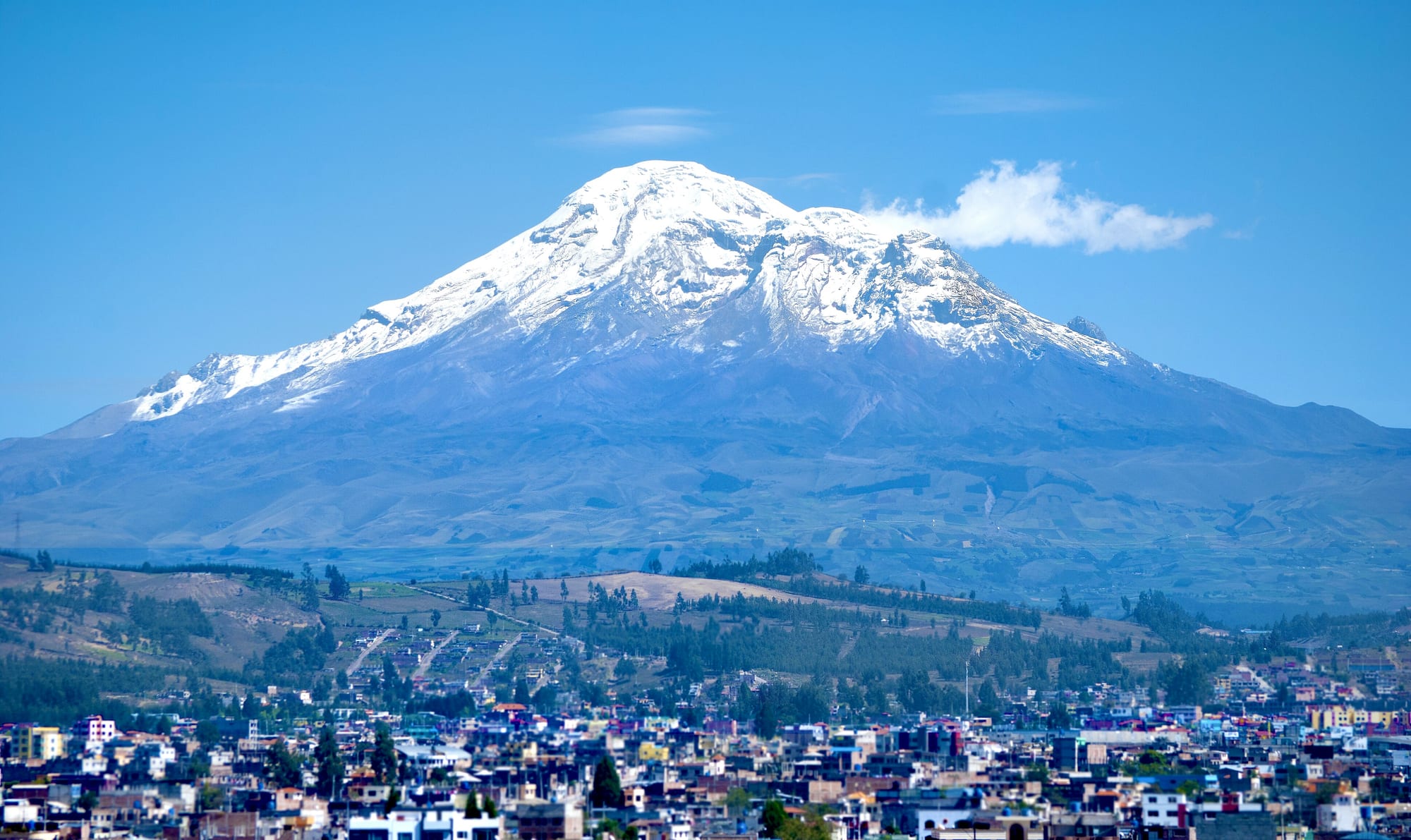
A broad snow-capped volcano under a clear blue sky, rising above wooded hills and the low, colourful houses of a city

Quito & the Northern Andes, Ecuador

Riobamba

Chimborazo rising behind the houses of Riobamba. (Dabit100 / David Torres Costales Riobamba / Wikimedia Commons · CC BY-SA 4.0)

The capital of Chimborazo province, at about 2,750 metres in the Chambo valley, 200 km south of Quito. First founded in 1534 and rebuilt on a new site after the earthquake of 1797, it is a planned highland city of parks, churches and daily markets, a transport hub on the Pan-American Highway and the base for climbing Chimborazo, Ecuador's highest mountain.

Neighbourhoods

  • Historic centre
    • First-time visitors
    • Historic district
    • Markets

    The planned grid of the rebuilt city, laid out around Parque Maldonado with the cathedral on one side and Parque Sucre nearby. Several of the city's daily markets, including La Merced and San Francisco, and its well-preserved churches and museums are within a few streets.

    Open in Maps
  • Around the railway station and Parque 21 de Abril
    • Views
    • Nightlife
    • Budget stays

    The area around the old railway station and the hill of Parque 21 de Abril, which has the best views over the city towards the volcanoes. Guesthouses cluster near the station, and the evening bar scene runs along the avenue from here towards the Parque Infantil.

    Open in Maps
  • Avenida Daniel León Borja
    • Best for food
    • Local life

    The broad avenue running north-west from the station past Parque Guayaquil towards the bus terminal, lined with restaurants, fried-chicken places, shops and hotels.

    Open in Maps

Things to do

In the city

  • Riobamba Cathedrallandmark

    The Cathedral of Saint Peter on Parque Maldonado, rebuilt in 1810–35 from the remains of the church destroyed in the 1797 earthquake, in a style mixing Spanish and Indigenous elements.

    Open in Maps
  • Parque 21 de Abrilviewpoint

    A small hill park near the railway station with the best views over the city and, on clear days, the surrounding volcanoes.

    Open in Maps
  • Museo de Arte Religioso de la Concepciónmuseum

    A museum of 18th-century religious art whose most famous piece, a gem-set gold monstrance, was stolen in 2007; part of it was recovered in 2008 and is on display again.

    Open in Maps
  • Estadio Olímpico de Riobambaattraction

    The city stadium, home ground of the football club Olmedo.

    Open in Maps

Markets

  • La Merced, San Francisco and San Alfonso marketsmarket

    Three of the city's seven daily markets, in the centre, selling vegetables, fruit, meat and dairy, with cooked food at the stalls.

    Open in Maps
  • Saturday market at Plaza Rojamarket

    The weekly market held on Saturdays, with a small artisan market of local crafts the same day.

    Open in Maps

Short trips from the city

  • Chimborazoviewpoint

    Ecuador's highest mountain, a glaciated stratovolcano of 6,263 metres that last erupted around AD 550; Riobamba, about 30 km away, is one of the nearest cities and the usual base for walks and climbs on its slopes.

    Open in Maps
  • Guanoattraction

    A small town just north of Riobamba, known for its handmade leather goods and ornate rugs, overlooked by the El Altar volcano.

    Open in Maps
  • La Balbaneralandmark

    A small stone church near Lake Colta, built in 1534 and considered the oldest church in Ecuador, with its original colonial portal.

    Open in Maps
  • Alausí and the Devil's Noseattraction

    A railway town known for the Nariz del Diablo, where the line zigzags down a steep mountain by switchbacks; the Alausí–Sibambe excursion train was listed as running in 2026.

    Open in Maps

Seasonal events

  • Independence Day of RiobambaApril

    The city's civic holiday on 21 April, marked with parades and celebrations.

  • Fiesta del Niño Rey de ReyesDecember to early January

    Riobamba's main celebration, honouring the Christ Child as King of Kings, beginning in December and ending at Epiphany on 6 January.

Eat and drink

Long-standing places and food districts in Riobamba. Hours, ratings and directions come from your maps app, always current.

Riobamba classics

  • Hornado in the marketsmarket

    Whole roast pork, a speciality of Riobamba, carved at market stalls and served with mote hominy and llapingachos.

    Open in Maps
  • Avenida Daniel León Borjaneighborhood

    A long avenue of restaurants and cafés, with some of the city's many fried-chicken places, including near Parque Guayaquil.

    Open in Maps

Experience Riobamba

History

The land around Riobamba belonged to the Puruhá nation, who fiercely resisted the Inca advance in the late 15th century. The Inca Huayna Capac made peace through an alliance, marrying the princess Paccha; by tradition their son was Atahualpa, the last Inca ruler. After the Spanish conquest, Diego de Almagro founded the city on 15 August 1534 on the plains of San Miguel, near Lake Colta, and it is considered the first city established in what is now Ecuador. Almagro also founded the small church of La Balbanera nearby, said to be the oldest in the country.

The colonial city became part of the Audiencia of Quito in 1563. In 1797 an earthquake destroyed it completely. The survivors moved to the plain of Tapi, 14 km away, and built a new planned city, which still keeps much of its colonial-era architecture; the cathedral was rebuilt from the remains of the old one between 1810 and 1835.

Riobamba first declared independence on 11 November 1820, but was retaken by royalist forces, and became part of Gran Colombia in 1822. In the first half of the 20th century the city grew again to become, for a time, the third city of the country. In November 2002 explosions at an army munitions depot killed seven people and wounded hundreds.

Culture & Customs

Riobamba's culture mixes a proud colonial city with the Indigenous Puruhá heritage of its countryside, where Kichwa-speaking communities keep their own dress and markets. The city has produced scholars and artists since the 18th century, among them the scientist and geographer Pedro Vicente Maldonado and the Jesuit historian Juan de Velasco. Parque Maldonado, facing the cathedral, is the main square.

The main celebration is the Fiesta del Niño Rey de Reyes, honouring the Christ Child as King of Kings, which begins in December and ends on 6 January, the Epiphany. Riobamba's Independence Day on 21 April is the main civic holiday. Cockfights are held during festivities and at weekends at the Gallera San Francisco, and the Monumental Raúl Dávalos bullring, opened in 1952 with room for 13,000 people, has hosted corridas since; the 2011 national referendum banned killing the bull.

The city calls itself the trekking and mountaineering capital of Ecuador. It is the base for climbs of Chimborazo, Carihuairazo, Sangay and El Altar, and mountain biking is popular. Football follows Centro Deportivo Olmedo at the Estadio Olímpico.

Daily Life

According to the 2022 census, the city had about 177,000 people, and more than 370,000 live in the wider urban area. It is one of the largest cities in the central highlands and the main commercial centre of Chimborazo province.

The economy rests on agriculture in the surrounding countryside and on cattle ranching, for which Riobamba is an important trading centre. Its markets are busy every day — the city has seven, three of them in the centre — and Indigenous artisans sell handwoven textiles, crafts and leather goods. Several universities, among them the Universidad Nacional de Chimborazo and the Escuela Superior Politécnica de Chimborazo, bring a large student population.

Life follows a highland rhythm: markets early, lunch as the main meal, cool evenings. Parks such as Maldonado, Sucre and 21 de Abril are the city's meeting places, and in the evening young people head for the bars between the Parque Infantil and the old railway station. Regular passenger trains no longer run to the city: all of Ecuador's railway services were suspended in 2020, and as of 2026 only two tourist routes were listed as operating, among them the Devil's Nose line between Alausí and Sibambe.

Food

Riobamba's speciality is hornado, whole roast pork. It is carved at market stalls in La Merced and the city's other markets and served with mote hominy and llapingachos, fried potato-and-cheese patties. Fritada, pork simmered and then fried in its own fat, is close behind.

The province shares the wider highland diet of potatoes, maize and beans. Locro de papa, a thick potato soup with cheese, is everyday food, and cuy, guinea pig, appears in local dishes such as ají de cuy. The almuerzo set lunch is the everyday meal for workers and students, and the daily markets, with their stalls of vegetables, fruit, meat and dairy from the surrounding farms, are where most households shop.

The city also has a fondness for fried chicken, with many places serving it, some of them on Avenida Daniel León Borja near Parque Guayaquil. On cold evenings, canelazo — sugarcane spirit with hot cinnamon water, often with naranjilla juice — is the warming drink of the highlands.

Planning tools

Budget

Riobamba is cheaper than Quito, with plenty of simple hotels and guesthouses, cheap market meals and set lunches. The main extra costs are guided trips: a licensed guide and equipment for Chimborazo, or transport to Alausí for the train.

Daily Budget Midrange
USD 60–120 (mid-range hotel, sit-down dinners, a guided day trip to Chimborazo)
Daily Budget Shoestring
USD 25–40 (guesthouse room, market meals and almuerzos, local buses)

Book Chimborazo climbs only through licensed agencies and allow time to acclimatise first.

Best Time to Visit

The highlands' drier season, from June to September, gives the best chance of clear views of Chimborazo and the other volcanoes. The wetter months bring afternoon rain but are still fine for the city. The Niño Rey de Reyes fiesta fills the city from December to early January.

Suggested Number of Days

One or two days are enough for the city itself. Allow three or four to include the surrounding mountains and towns, and longer for a high-altitude climb, which needs time to acclimatise.

First Visit
1–2 days
With Surroundings
3–4 days

Transportation

The centre is easy on foot, and city buses and cheap taxis cover the rest. Buses and taxis serve Guano, Colta and the lower slopes of Chimborazo; Alausí is about two hours away by bus.

Use registered taxis and agree on transport back from Chimborazo before setting out.

Airport & Station Connections

Riobamba is about 200 km south of Quito on the Pan-American Highway, roughly three hours by bus. Quito's international airport is the usual entry point for overseas visitors. Regular passenger trains no longer serve the city.

Walkability

The historic centre is a compact, flat grid, and the parks, markets, cathedral and museums are close together. The station area and Avenida Daniel León Borja are a short walk away; the bus terminal is further out.

Safety

Ecuador's security has deteriorated sharply since about 2019, with a surge in organised crime, gang violence, and prison unrest, especially in Guayaquil, Esmeraldas, Manta, and the northern border with Colombia. Riobamba lies on the highland route, which is calmer than the coastal cities, but petty theft occurs in markets and on buses. Altitude sickness is a real risk on Chimborazo.

Watch bags in the markets, acclimatise before going high, and climb Chimborazo only with licensed guides. Check current official travel advice before travelling.

Climate

Its altitude and closeness to Chimborazo give the city a cool climate all year, with near-constant temperatures averaging between about 14°C and 23°C, and a wet and a dry season.

Summer
the drier months, June to September: sunny days up to about 23°C, cold nights and wind
Winter
the wetter months, October to May: similar temperatures, around 14–23°C, with afternoon rain

Local Customs

Riobamba is a conservative, largely Catholic city with a large Indigenous population in the surrounding countryside, and markets are busiest in the morning. Greetings are 'buenos días', 'buenas tardes' or 'buenas noches', and older people are addressed as 'usted'.

Ask before photographing people at the markets. Many restaurants add a service charge, so a further tip is optional.

Common Payment Methods

The currency is the US dollar. Markets, buses and small restaurants want cash in small notes; hotels and larger shops take cards. Damaged notes are refused. ATMs are found in the centre; those inside banks are safer than street machines.