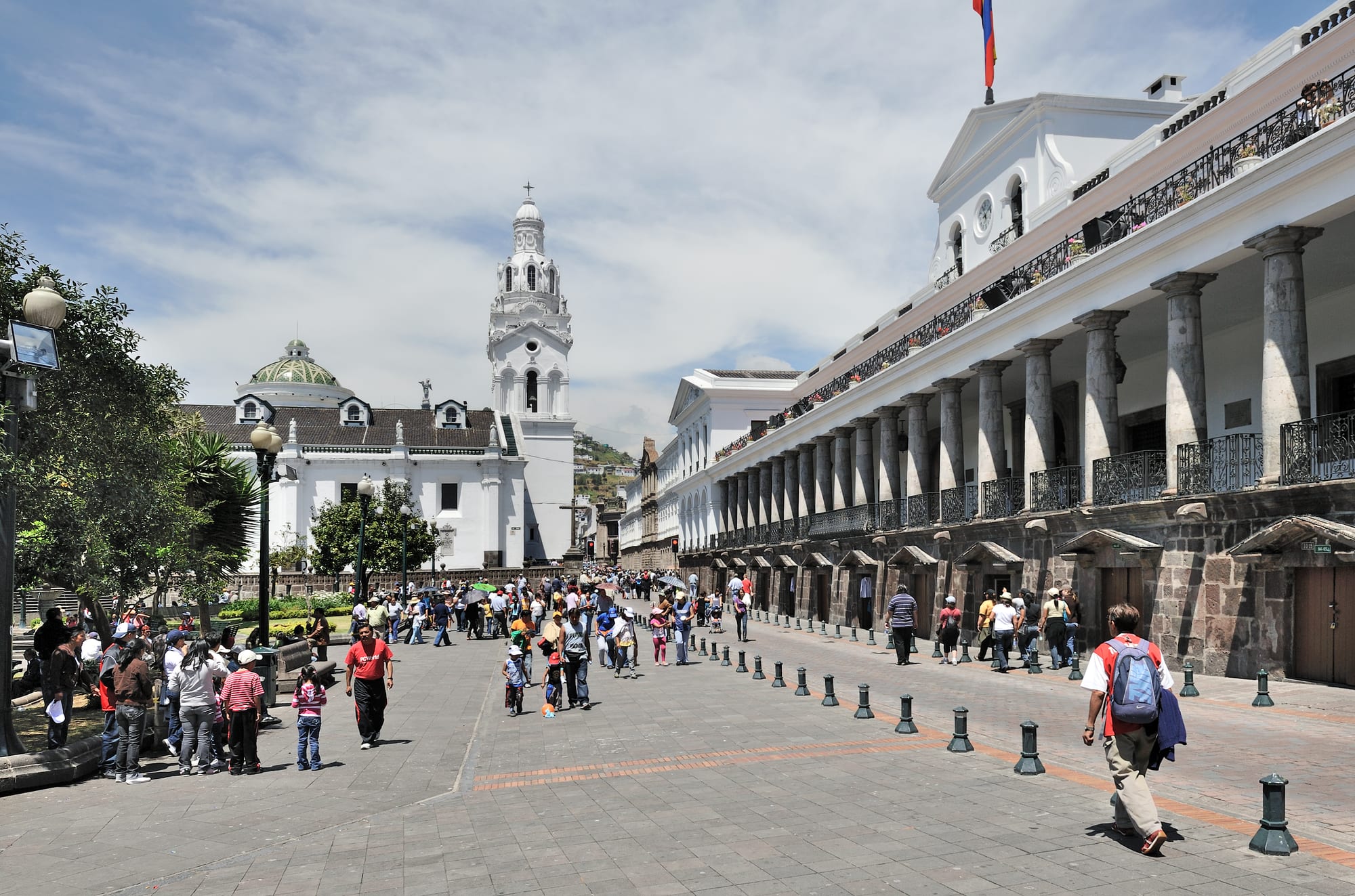
A paved colonial square with strolling people, the white colonnaded Carondelet Palace on the right and the cathedral's bell tower behind

Quito & the Northern Andes, Ecuador

Quito

The Plaza de la Independencia in Quito's historic centre, with the Carondelet Palace and the cathedral. (Cayambe / Wikimedia Commons · CC BY-SA 3.0)

Ecuador's capital, strung along a high Andean valley on the eastern slopes of the Pichincha volcano at about 2,850 metres. Refounded by the Spanish in 1534 on an Inca town, it kept one of the largest and best-preserved colonial centres in the Americas, inscribed by UNESCO in 1978, and is now the country's political centre, with a modern business district, a new metro and the equator just to the north.

Neighbourhoods

  • Historic Centre
    • First-time visitors
    • Historic district
    • Close to public transport

    The colonial core in the south-centre of the city, a grid of steep streets, plazas and about twenty colonial churches and convents around the Plaza de la Independencia, where the presidential palace, the cathedral and the archbishop's palace stand. Calle La Ronda, a street of pre-Columbian origin, runs through it, and El Panecillo hill rises beside it.

    Open in Maps
  • La Mariscal
    • Nightlife
    • Best for food
    • Budget stays

    The modern district north of the old town and the city's entertainment hub, with many of its hotels, hostels, craft shops, bars and clubs. Plaza Foch is the centre of its evening life, and a parade passes through during the December founding fiestas.

    Open in Maps
  • La Floresta
    • Arts and culture
    • Best for food
    • Quiet and residential

    A neighbourhood laid out in 1917 as a garden city, with more than a hundred houses listed as national heritage. Murals, cafés and restaurants fill its streets just uphill from La Mariscal.

    Open in Maps
  • Guápulo
    • Artists and cafés
    • Viewpoints

    A neighbourhood running down the slope from Avenida González Suárez along the winding Camino de Orellana, looking east over the valley. Often called Quito's bohemian quarter, it is home to artists and a few cafés and bars, and holds its own fiesta in September.

    Open in Maps
  • La Carolina and the business district
    • Business travellers
    • Parks
    • Close to public transport

    The modern north around La Carolina Park, with office towers, shopping centres and hotels along the avenues that border the park. The metro runs through it towards the old airport site, now Parque Bicentenario.

    Open in Maps

Things to do

The colonial centre

  • Church of La Compañíalandmark

    The Jesuit church whose interior is completely covered in gold sheets, one of the main sights of the old town.

    Open in Maps
  • Basilica and Convent of San Franciscolandmark

    The first of the city's colonial convents, begun in 1535 beside the broad Plaza San Francisco, and the starting point of the Good Friday procession.

    Open in Maps
  • Quito Metropolitan Cathedrallandmark

    The cathedral on the south-west side of the Plaza de la Independencia, a cathedral since the bishopric of Quito was created in 1545.

    Open in Maps
  • Palacio de Carondeletlandmark

    The seat of Ecuador's government, facing the Plaza de la Independencia, the old town's main square.

    Open in Maps
  • Basílica del Voto Nacionallandmark

    A neo-Gothic basilica in the historic centre, whose towers reach 83 metres.

    Open in Maps
  • El Panecilloviewpoint

    A hill at about 3,000 metres in the middle of the city, crowned by an aluminium Virgin inaugurated in 1975, modelled on a sculpture by Bernardo de Legarda.

    Open in Maps

Museums

  • Casa del Alabadomuseum

    A museum of pre-Columbian art in a 17th-century colonial house in the old town.

    Open in Maps
  • National Museum of Ecuadormuseum

    The national museum of archaeology and art in the House of Ecuadorian Culture, with galleries running from prehistory to modern Ecuador.

    Open in Maps
  • La Capilla del Hombremuseum

    A museum devoted to the work of the Ecuadorian painter Oswaldo Guayasamín, in Bellavista, overlooking the city.

    Open in Maps

Parks and viewpoints

  • TelefériQoviewpoint

    A gondola lift from the edge of the city up the flank of Pichincha to the Cruz Loma lookout at about 3,950 metres, a ride of about twenty minutes, with walking trails at the top.

    Open in Maps
  • Itchimbíapark

    A hilltop park and cultural centre east of the old town, with views across the colonial centre and the stage for the free Quito Fest music festival.

    Open in Maps
  • La Carolina Parkpark

    A large park in the middle of the business district, created from an expropriated farm in 1939, with the Pope's Cross marking the site of John Paul II's 1985 mass.

    Open in Maps
  • Parque El Ejidopark

    The park that divides the old city from the modern one, where artists show and sell work at weekends.

    Open in Maps

Short trips from the city

  • Ciudad Mitad del Mundolandmark

    About 26 km north of the centre, the grounds of the 30-metre Monument to the Equator, built in 1979–82 to commemorate the 18th-century French geodesic mission.

    Open in Maps
  • Pululahua Geobotanical Reservepark

    A reserve around the Pululahua volcano north of the city, whose crater is one of only two in the world inhabited by people, and the only one that is farmed.

    Open in Maps
  • Cotopaxi National Parkpark

    The national park around Cotopaxi's glacier-capped cone south of the city, with a climbers' refuge high on the volcano.

    Open in Maps

Seasonal events

  • Holy WeekMarch or April

    A series of ceremonies beginning on Palm Sunday; at noon on Good Friday the March of the Penitents leaves the Church of San Francisco.

  • Fiestas de GuápuloSeptember

    Guápulo's own celebration, with costumes, a parade, food, music, dancing and fireworks.

  • Fiestas de Quitolate November to early December

    A week of celebrations of the city's founding ending on 6 December, with parades, the new Reina de Quito, opera and theatre.

Eat and drink

Long-standing places and food districts in Quito. Hours, ratings and directions come from your maps app, always current.

Food districts and markets

  • La Floresta evening marketneighborhood

    The neighbourhood's traffic circle turns into an evening food market, best known for tripa mishqui, grilled beef or pork intestines; the surrounding streets are full of restaurants and cafés.

    Open in Maps
  • Plaza Fochneighborhood

    The square at the heart of La Mariscal, ringed by restaurants and bars serving both Ecuadorian and international food.

    Open in Maps
  • Guápulo's cafésneighborhood

    A handful of relaxed cafés and bars on the steep lanes of the city's bohemian quarter, with views over the valley.

    Open in Maps

Experience Quito

History

People lived in the valley long before the city: obsidian tools at El Inga on the slopes of Ilaló date to about 8000 BC, a farming village grew at Cotocollao around 1500 BC, and deep shaft tombs from about AD 800 have been found in the La Florida neighbourhood. In the late fifteenth century the Inca ruler Huayna Capac defeated the Quitu, the valley's people, and Quito became the capital of the empire's northern region. When the Spanish arrived, the general Rumiñahui resisted; the town was refounded at its present site on 6 December 1534 by 204 settlers under Sebastián de Benalcázar, and Rumiñahui was executed early in 1535.

The San Francisco convent was begun in January 1535, the first of about twenty churches and convents built in colonial times, largely with Indigenous labour. Quito became the seat of a Real Audiencia in 1563, but stayed a small city: about 10,000 people in 1743. It briefly declared itself independent of Spain in the Quito Revolt of 1765–66, and on 10 August 1809 a junta declared self-government; colonial troops crushed it in 1810, and independence came with Sucre's victory at the Battle of Pichincha on 24 May 1822.

The republic's century was violent. President García Moreno was assassinated here in 1875, Eloy Alfaro was lynched by a mob in 1912, and in 1949 a radio adaptation of The War of the Worlds caused a panic in which more than twenty people died. In 1978 the historic centre and Kraków were the first places inscribed as UNESCO World Heritage Sites. The city has renewed its centre since 2002, moved its airport out to Tababela in 2013 and opened a metro in 2023; in 2025 a landslide broke a main water pipe and caused the worst water crisis in 25 years.

Culture & Customs

Quito is the political and cultural capital of Ecuador, home to its main government, cultural and administrative institutions. Its colonial churches hold the work of the Quito School, the painters and sculptors, among them Bernardo de Legarda and Caspicara, who worked across the old Audiencia of Quito, from Pasto and Popayán to Piura and Cajamarca; Legarda's winged Virgin is copied in the huge statue on El Panecillo. The twentieth-century painter Oswaldo Guayasamín built his own monument in the Capilla del Hombre.

Catholic ritual still shapes the year. Holy Week begins on Palm Sunday, and at noon on Good Friday the March of the Penitents sets out from San Francisco. The founding of the city is celebrated for a week that ends on 6 December, with parades, a queen, opera and theatre, and La Mariscal holds a large parade during it. Neighbourhoods keep their own fiestas — Guápulo's in September — and Itchimbía hosts the free Quito Fest music festival.

Football matters a great deal. LDU Quito is the country's most successful club and the only Ecuadorian winner of the Copa Libertadores, in 2008; Independiente del Valle, El Nacional, Aucas and Deportivo Quito are also based here, and the altitude of the city's stadiums, over 2,800 metres, is held to give home sides an advantage.

Daily Life

Ecuador's statistics institute counts about 1.76 million people in the city and about 2.68 million in the wider metropolitan district. It fills a long plateau on the eastern flank of Pichincha at about 2,850 metres, with the old town in the south-centre and the modern business and nightlife districts to the north; the valleys of Los Chillos and Tumbaco lie below to the east.

As the seat of government, Quito holds the country's main governmental and administrative institutions, and it contributes more to national output than any other city, with the highest income per head. Petroecuador, the state oil company, and the regional offices of many international firms and banks are based here, alongside textile and metal industries and agriculture.

Daily life runs north to south along the valley, and traffic and water supply are under pressure. The metro now runs from one end of the line to the other in about half an hour. The 2025 water crisis, which left about 400,000 residents without supply, showed the strain on the city's infrastructure, and crime has become a real concern: homicides rose sharply in the first months of 2025 compared with the year before, though the capital remains calmer than the coastal cities. Evenings are cold enough for a jacket all year.

Food

Quito eats like the rest of the highlands, with potatoes, maize and pork at the centre. Hornado, roast pig, is a popular street food of the mountain regions, and it appears with fritada and yahuarlocro among the typical dishes served in the city and the valleys around it. Llapingachos, pan-seared potato balls, are eaten across Ecuador.

Street food comes into its own in the evening. The traffic circle in La Floresta becomes a food market at night, where the favourite is tripa mishqui, grilled beef or pork intestines, and the area around it has many of the city's restaurants. La Mariscal, around Plaza Foch, has a wide mix of local and international cooking. Restaurants serve the almuerzo, a cheap set lunch of soup, a main course and juice, and lunch is the main meal of the day.

Some foods belong to particular days. In the week before All Souls' Day in November, colada morada, a drink of black corn flour sweetened with panela and flavoured with fruit, herbs and spices, is served with guaguas de pan, bread shaped like children. Cacao is one of the country's export crops, and cafés serve hot chocolate. During the Fiestas de Quito the popular drink is canelazo, made with aguardiente.

Planning tools

Budget

Quito is good value by international standards, though it costs a little more than the smaller highland towns. Set-lunch almuerzos, buses, the metro and hostel beds are cheap; hotels in La Mariscal and the old town, taxis and guided day trips to the equator or Cotopaxi make up most of a midrange budget.

Daily Budget Midrange
USD 70–140 (boutique or mid-sized hotel, sit-down dinners, museum tickets, taxis and a guided day trip)
Daily Budget Shoestring
USD 30–50 (hostel bed, almuerzo set lunches, metro and buses)

Carry small notes for buses, market stalls and taxis; many restaurants add a service charge to the bill.

Best Time to Visit

June to August, the local summer, is the dry season, with the clearest views of the surrounding volcanoes. The wet season from September to May brings more rain, though a rainy forecast rarely means a whole day of rain, and the city is busiest and most festive in Holy Week and during the founding fiestas in late November and early December.

Suggested Number of Days

Two or three days cover the old town and the modern districts. Allow four to six to add trips to the equator and the volcanoes. Most visitors also need a day to adjust to the altitude before doing anything strenuous.

First Visit
2–3 days
With Surroundings
4–6 days

Transportation

Quito is long and narrow, stretched north to south along its valley. The metro, opened on 1 December 2023, runs one line with 15 stations from Quitumbe in the south through the historic centre and La Mariscal to El Labrador in the north. Bus rapid transit lines run the same way: the green Trole trolleybus, the red Ecovía in the north-east and the blue Central Corridor, in the north-west. Taxis are plentiful.

Use registered or app taxis and make sure the meter is running.

Airport & Station Connections

Mariscal Sucre International Airport, opened in 2013, lies on the Oyambaro plain near Tababela, about 18 km east of Quito; the drive to the centre takes roughly 45 minutes to an hour, by taxi or airport bus. Long-distance buses use the Quitumbe terminal in the south for routes south and Carcelén in the north for Otavalo and the Colombian border.

Walkability

The historic centre is compact and best seen on foot, but its streets are steep and the altitude makes climbs tiring at first. La Mariscal and La Floresta are also walkable. Distances between the old town and the north are long, so most people use the metro, the bus lines or taxis between districts.

Safety

Ecuador's security has deteriorated sharply since about 2019, with a surge in organised crime, gang violence, and prison unrest, especially in Guayaquil, Esmeraldas, Manta, and the northern border with Colombia. Quito is calmer than the coast but has real street crime: pickpocketing and bag-snatching in the old town, on buses and at the bus terminals, and robberies in some areas after dark. Homicides in the city rose in the first months of 2025 compared with 2024.

Use registered or app taxis, keep phones and valuables out of sight in the old town and on buses, and avoid street ATMs. Check current official travel advice before travelling.

Climate

A subtropical highland climate with little change through the year: average afternoon highs around 21°C and night-time lows around 10°C. The city has two seasons, dry and wet, and the sun at this altitude is very strong.

Summer
the dry season, June to August, called summer locally: afternoon highs around 21°C and night-time lows around 10°C
Winter
the wet season, September to May, called winter locally: similar temperatures, around 21°C by day, with more rain

Local Customs

Quito is a strongly Catholic city, and church interiors and processions call for quiet and modest dress. Greetings are 'buenos días', 'buenas tardes' or 'buenas noches', with a handshake between men and a kiss on the cheek between women or between a man and a woman; older people and strangers are addressed as 'usted'.

Many restaurants and hotels add a 10 per cent service charge, so a further tip is optional. Ask before photographing people, particularly in Indigenous dress.

Common Payment Methods

Ecuador uses the US dollar, with its own coins alongside US ones. Cards are accepted in hotels, larger restaurants and shops; cash is needed for buses, markets and small cafés. Small notes are easier to use than USD 20 bills. ATMs are widespread; those inside banks or shopping centres are safer than street machines.