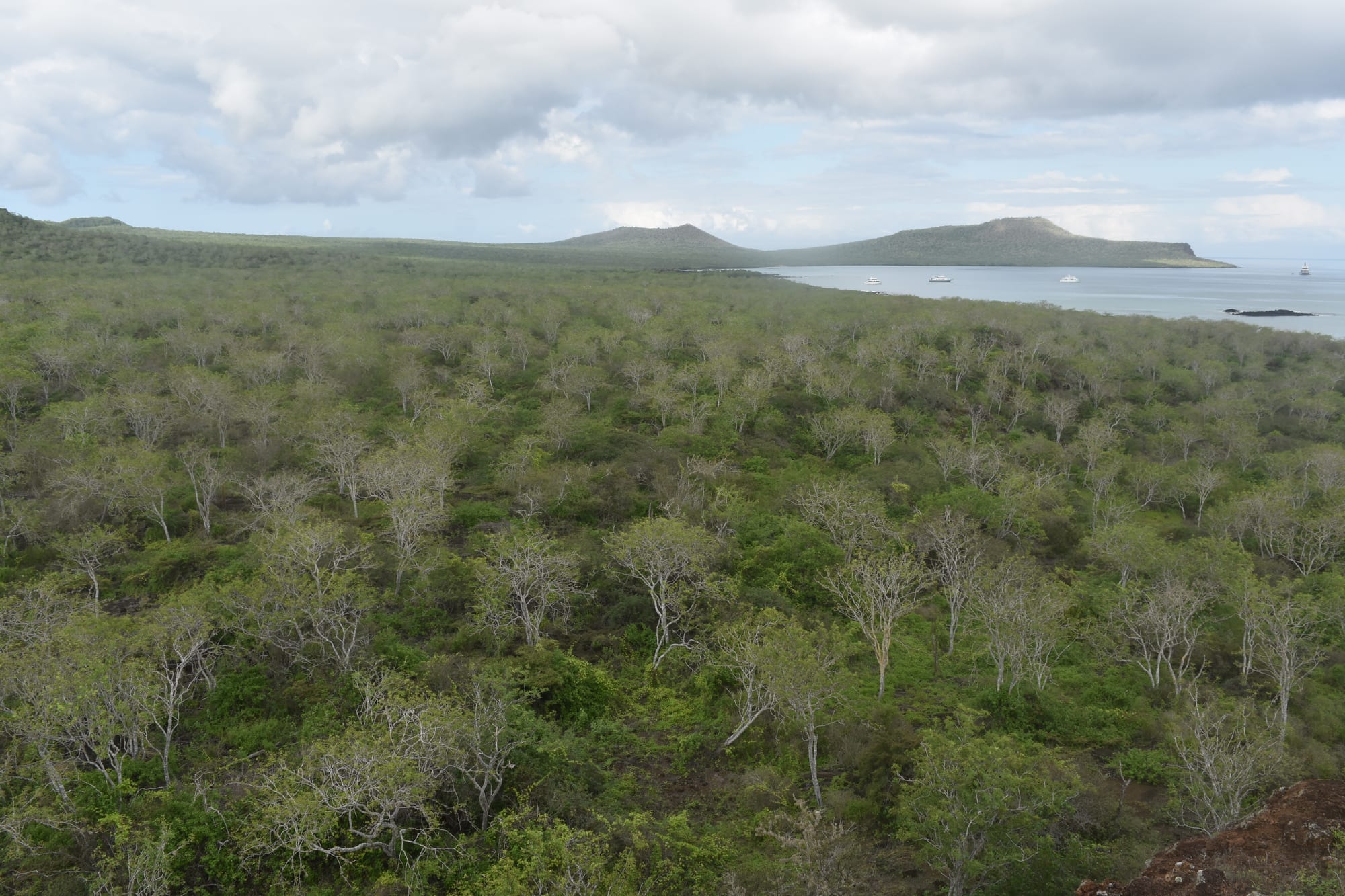
Pale grey-green dry forest sloping to a calm bay with a few anchored boats and low hills under cloud

The Galápagos Islands, Ecuador

Floreana Island

Post Office Bay on Floreana Island, seen from the Baroness's Lookout. (Andrew Katsis / Wikimedia Commons · CC BY 4.0)

The southernmost island of the Galápagos, a volcano of about 173 square kilometres with a single small settlement and a population of about 100. Once a stop for whalers, who left a mail barrel at Post Office Bay, and the stage for a tangle of 1930s settler deaths still unexplained, it is now the focus of a project to restore its lost wildlife.

Neighbourhoods

  • Puerto Velasco Ibarra
    • Places to stay
    • Quiet and residential

    The island's only town, on the north-west coast, where the roughly one hundred islanders live and where the few places offering lodging and food for visitors are found. It is small and quiet, with the sea on one side and the road to the highlands leading inland.

    Open in Maps
  • The highlands
    • History
    • Walks

    Greener, higher ground inland, reached by a road from the town. Here are the spring and caves of Asilo de la Paz, where the first settlers lived, caves and tunnels used by buccaneers, and trails up the hills with views over the island; most groups ride up on benches in the backs of hired trucks.

    Open in Maps

Things to do

The coast and the sea

  • Post Office Baylandmark

    A white-sand beach where whalers set up a wooden barrel more than 200 years ago so that passing ships could carry letters home; visitors still leave postcards without stamps and take others to deliver by hand.

    Open in Maps
  • Punta Cormorantbeach

    A landing with a beach of green olivine crystals, a trail past a saltwater lagoon where American flamingos feed, and a fine white-sand beach beyond where green sea turtles nest.

    Open in Maps
  • Devil's Crownattraction

    An eroded underwater volcanic cone off the north-east point, among the best-known snorkelling and diving sites in the islands, with schools of fish, sea turtles, sharks and sea lions; the current can be strong.

    Open in Maps
  • Championattraction

    A small island just off Floreana where landings are not allowed but snorkelling can be excellent, and where the rare Floreana mockingbird can sometimes be seen from the water.

    Open in Maps

The highlands

  • Asilo de la Pazlandmark

    The site of Floreana's first settlement, beside a spring that was the island's only permanent source of fresh water, where the Wittmer family lived in caves from 1932; now one of the island's most visited places.

    Open in Maps
  • Cerro Pajasviewpoint

    An inactive volcano in the south of the island and its highest point, at 640 metres.

    Open in Maps

Eat and drink

Long-standing places and food districts in Floreana Island. Hours, ratings and directions come from your maps app, always current.

Floreana classics

  • Puerto Velasco Ibarraneighborhood

    The town's handful of places to eat serve the island's visitors and residents — mostly fish and seafood alongside mainland Ecuadorian dishes.

    Open in Maps
  • The Wittmer family's hotelrestaurant

    The Wittmer family run a small hotel in Puerto Velasco Ibarra with a restaurant, a gift shop and a post office.

    Open in Maps

Experience Floreana Island

History

Floreana's flat ground, fresh water, plants and animals made it a favourite stop for whalers and other ships. More than 200 years ago they set up a wooden barrel at Post Office Bay, so that letters could be collected by ships heading home, mainly to Europe and the United States. The first known resident of the Galápagos, Patrick Watkins, lived here from 1807 to 1809, farming and trading with whalers. In 1820 a prank by a crewman of the Nantucket whaler Essex set the island on fire in the dry season, and the blaze burned out of control. Charles Darwin landed in September 1835, when Ecuador kept a prison colony on the island, and heard that tortoise shells differed from island to island. The island is named after Juan José Flores, Ecuador's first president, during whose presidency Ecuador took possession of the archipelago; English-speaking sailors called it Charles Island.

In 1929 Friedrich Ritter and Dore Strauch came from Berlin to settle, and their letters, widely reported in the press, drew others. Heinz and Margret Wittmer arrived from Germany in 1932 and lived in caves at Asilo de la Paz, where their son Rolf was born in 1933, the first person known to have been born in the Galápagos. Later in 1932 the self-styled Austrian "Baroness" Eloise von Wagner Bosquet arrived with two German companions. A series of disappearances and deaths followed, possibly including murders, and only the Wittmers stayed. The story inspired a Simenon novel, the documentary The Galapagos Affair of 2013 and the film Eden of 2024.

Culture & Customs

Floreana's identity rests on its history as the oldest-settled island of the archipelago and on its mysteries. The post barrel is its best-known tradition: visitors leave postcards without stamps and sort through the pile for ones addressed near their own homes, to deliver by hand. Margret Wittmer's account of her life here, Floreana: A Woman's Pilgrimage to the Galápagos, and the books and films about the 1930s settlers keep drawing curious travellers.

Like the rest of the Galápagos, the island lives by conservation. Galapagueños are mostly descendants of settlers from mainland Ecuador, joined by a few Europeans, and the calendar follows the mainland's Catholic feasts. Guides trained and licensed by the national park lead visits to most sites, and the rules — keep about two metres from animals, stay on marked paths, take nothing away — are taken seriously.

The island's wildlife has suffered more than most from people. The endemic Floreana tortoise was declared extinct, and the Floreana mockingbird now survives only on the nearby islets of Champion and Gardiner. Restoring what was lost has become part of local life, and the island is recognised as an Important Bird Area, with one of the main colonies of the critically endangered Galápagos petrel.

Daily Life

About 100 people live on Floreana, almost all in Puerto Velasco Ibarra, the one town on the north-west coast. Daily life is small-scale and quiet, tied to the boats that bring visitors, supplies and mail, and to the few places that offer rooms and meals. As across the islands, almost everything else arrives from the mainland by cargo ship, and moving to the Galápagos from the mainland is restricted by law.

The biggest change in recent years has been the restoration project. A programme to eradicate the animals people brought to the island — feral goats, donkeys, cattle, cats and, above all, rats and mice — has been followed by rewilding. By February 2026, 185 selectively bred tortoises carrying much of the ancestry of the extinct Floreana giant tortoise had been released on the island, and the Galápagos crake was rediscovered here in 2025.

As elsewhere in the archipelago, fresh water is scarce and precious, and the pressures of tourism, invasive species and the cost of living are constant concerns for a community that depends on visitors but lives inside a national park.

Food

Floreana eats as the rest of the Galápagos does: mainland Ecuadorian food with a sea-to-table twist. Almost everything except seafood and some highland produce comes by cargo ship from Guayaquil, so the island's few kitchens rely on fish, shrimp and octopus, on what local farms can grow, and on supplies that arrive with the boats. Lobster and fish are the main catch of the islands' fishing fleets.

The islands' staples are ceviche of fish, shrimp or octopus, "cooked" in citrus; fish in coconut sauce; and grilled fresh catch. Spiny lobster, langosta, is served grilled or with garlic in season. Set lunches of soup, rice and a main course follow the mainland almuerzo pattern.

Fresh fruit juices and batidos, blended with milk, are everywhere in the islands, and most beer is shipped in from the mainland. Visitors who stay eat at the handful of places in Puerto Velasco Ibarra, among them the Wittmer family's small hotel.

Planning tools

Budget

The Galápagos is by far the most expensive part of Ecuador. The flight from the mainland, the national-park entry fee and the transit control card come first, and most food and goods arrive by ship, so prices are high. Floreana has very few places to stay and shop, and most visitors arrive on a day trip or a cruise, which carry their own costs.

Daily Budget Midrange
USD 200–500 (room in town, meals, a guided day trip or boat tour); cruises from about USD 350 per day upwards
Daily Budget Shoestring
USD 90–140 (simple room in town, home-style meals, walks to the free sites; excluding flights, boats and park fee)

Bring enough cash for the whole stay; the island's shop expects cash and charges a premium for its goods.

Best Time to Visit

There is no bad month. The warm season, from about December to May, brings calmer, warmer seas for snorkelling and calmer boat crossings; the cooler garúa season from June to November brings mist, rougher water and more marine life. Flamingos and green sea turtles nest on the island from December to May.

Suggested Number of Days

Most visitors see Floreana on a day trip by boat or as one stop on a cruise. Staying a night or two in the town allows time for the highlands and the coast at a slower pace; sea conditions and boat schedules decide how much can be fitted in.

First Visit
1 day
With Surroundings
2–3 days

Transportation

A road runs from Puerto Velasco Ibarra to the highlands, and groups usually travel on benches in the backs of trucks hired in town. Coastal sites such as Punta Cormorant and Devil's Crown are reached by boat, and most visitor sites in the national park require a licensed guide.

Take seasickness tablets for the speedboat crossing, which can be rough.

Airport & Station Connections

Flights from the mainland land at Baltra, beside Santa Cruz, or at San Cristóbal. Between the inhabited islands, public speedboats take about two hours and can be rough, and small planes also fly between them. Day-trip boats and cruise ships also bring visitors to Floreana.

Walkability

The town is tiny and easily walked. Some of the highland sites can be reached on foot along the road, though it climbs steadily and the sun is strong; most groups go by truck. The coastal sites need a boat.

Safety

The islands are far calmer than mainland Ecuador, with little violent crime, although petty theft occurs in the towns and drug-trafficking routes pass through the surrounding ocean. On Floreana the main risks are natural: strong equatorial sun, rough crossings, strong currents at Devil's Crown, and sea lions that can bite if approached.

Use reef-safe sunscreen and cover up, snorkel with a guide or buddy, keep a distance from wildlife and follow biosecurity checks on arrival. Check current official travel advice before travelling.

Climate

Unusually mild for the equator because of cold ocean currents. The coast is dry and scrubby, the highlands greener. The warm season brings sunshine and short heavy showers; the garúa season brings overcast skies, mist and drizzle.

Summer
December–May: warm, about 26–31°C, sunny with showers; warmer, calmer sea
Winter
June–November: cooler, about 19–26°C, grey and misty; cooler, rougher sea

Local Customs

Floreana is a very small community, and almost all of it lies within the Galápagos National Park. Park rules require licensed guides at most visitor sites and a distance of about two metres from wildlife; nothing may be taken away or brought in that could carry seeds or pests. Islanders are used to visitors but life is quiet, and a greeting in Spanish is appreciated.

Dress is casual, but cover up away from the beach; ask before photographing residents, and never touch or feed the animals.

Common Payment Methods

Ecuador uses the US dollar. Bring cash in small notes, as card machines and cash machines are limited outside Puerto Ayora and Puerto Baquerizo Moreno.