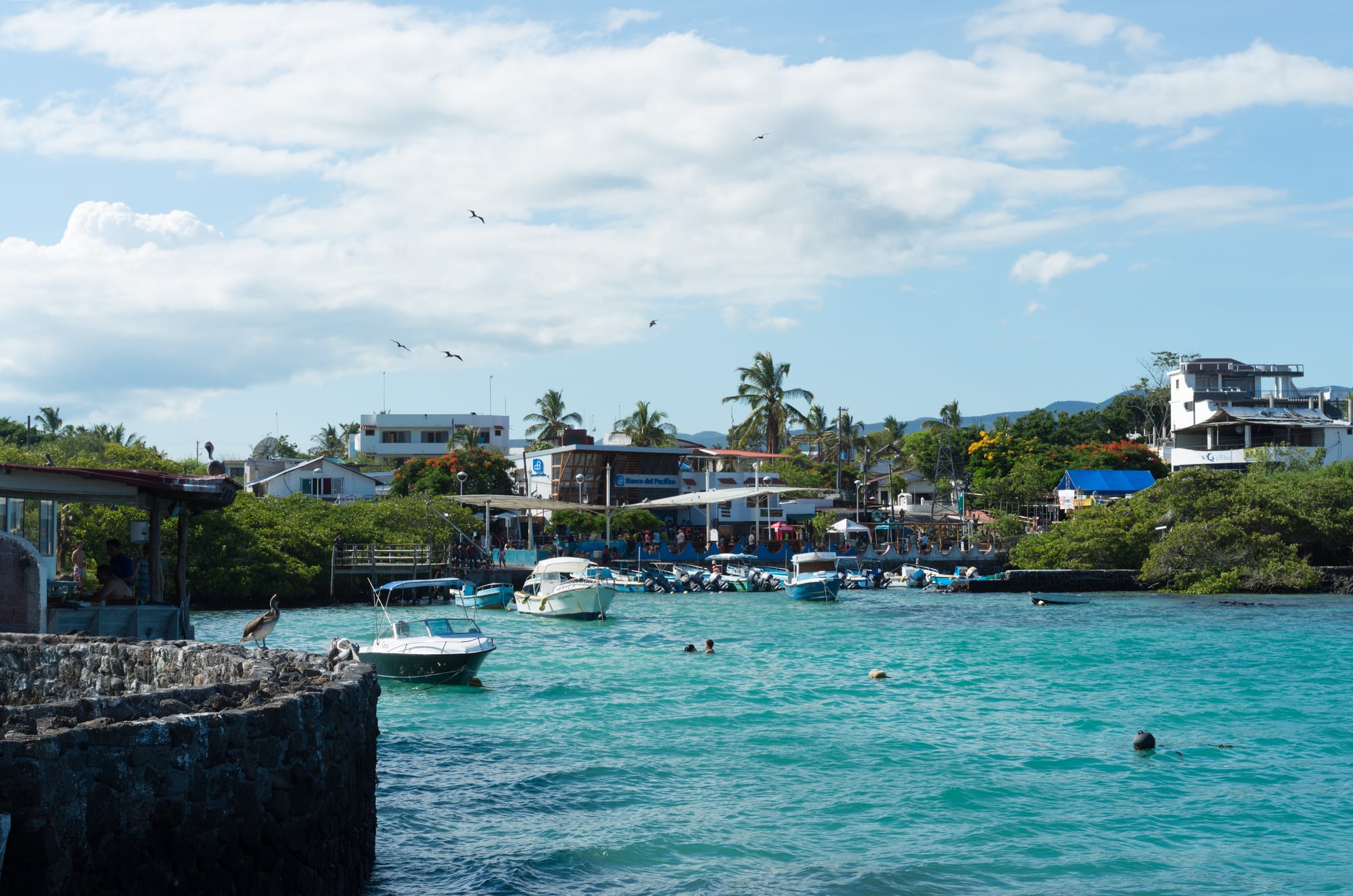
Small motor boats on clear turquoise water in front of a waterfront of palms and low buildings, with a pelican on a stone wall

The Galápagos Islands, Ecuador

Puerto Ayora

The harbour of Puerto Ayora on Academy Bay, Santa Cruz Island. (Victor Gleim / Wikimedia Commons · CC BY-SA 4.0)

The largest town in the Galápagos Islands, on Academy Bay on the south shore of Santa Cruz. Settled by a handful of Norwegians and other Europeans in the early 20th century, it grew into the seat of the Galápagos National Park and the Charles Darwin Foundation and the islands' main tourist base, a small harbour town of dive shops, day-trip boats and sea lions.

Neighbourhoods

  • Avenida Charles Darwin and the waterfront
    • First-time visitors
    • Best for food
    • Nightlife

    The walkable strip along Academy Bay from the main dock to the Charles Darwin Research Station, lined with hotels, restaurants, tour agencies, dive shops, gift shops and the town's bars. Water taxis wait at the dock, and pelicans and sea lions are part of the scene.

    Open in Maps
  • The northern barrios
    • Local life
    • Quiet and residential

    Where most residents live, north of the waterfront, with schools, the market hall, a sports centre, the stadium and the bus terminal. Calle Baltra and Calle Durán hold the hardware and grocery stores, and two modern churches here have colourful wall paintings.

    Open in Maps
  • West of the bay
    • Quiet
    • Snorkelling

    The far shore of Academy Bay, reached by water taxi from the main dock, with a few waterfront places to stay and eat, the small beach of Punta Estrada and the path across lava and past salt pans to Las Grietas.

    Open in Maps
  • The highland villages
    • Nature
    • Farm stays

    Bellavista and Santa Rosa, farming villages in the green, often misty uplands inland from the town, near the wild tortoise reserves, lava tunnels and the twin craters of Los Gemelos.

    Open in Maps

Things to do

In and around the town

  • Charles Darwin Research Stationattraction

    The research station of the Charles Darwin Foundation at the end of Avenida Charles Darwin, with tortoise and iguana breeding areas, exhibits on the islands' natural history and conservation, and the former home of Lonesome George, who died in 2012.

    Open in Maps
  • Academy Bayviewpoint

    The town's natural harbour, named after a 1905 expedition of the California Academy of Sciences, busy with cruise boats, yachts and fishing boats and frequented by pelicans, rays, marine iguanas, sea lions and plunge-diving blue-footed boobies.

    Open in Maps
  • Laguna Las Ninfaspark

    A lagoon in Puerto Ayora with a footpath.

    Open in Maps

Beaches and swimming

  • Tortuga Baybeach

    A long white beach reached by a walking path of about 2.5 km from town, kept for marine iguanas, crabs and birds and closed to swimmers, with a separate sheltered cove where swimmers can see whitetip reef sharks.

    Open in Maps
  • Punta Estrada (German Beach)beach

    A small beach across the bay, reached by water taxi, that is good for snorkelling, especially at high tide.

    Open in Maps
  • Las Grietasattraction

    A deep crevice in the volcanic rock filled with clear, emerald-green water — a mix of seawater and filtered rain — reached by water taxi and a path past the salt pans, and now visited with a guide.

    Open in Maps

Short trips on Santa Cruz and by boat

  • Los Gemelosviewpoint

    Two sunken volcanic craters on a high point of the island in cloud forest, beside the road to Baltra, with vermilion flycatchers, woodpecker finches and short-eared owls.

    Open in Maps
  • El Chato Tortoise Reservepark

    A private reserve in the highlands near Santa Rosa where giant tortoises can be seen in the wild, with two lava tunnels.

    Open in Maps
  • Garrapatero Beachbeach

    A beach of black lava and white sand about half an hour's drive from town, with blue-footed boobies, pelicans and marine iguanas, and flamingos in the small lagoon behind it.

    Open in Maps
  • South Plaza Islandattraction

    A small crescent-shaped island off the east coast of Santa Cruz, visited on day trips from Puerto Ayora, with sea lions, land iguanas, prickly pear cacti and swallow-tailed gulls on its cliffs.

    Open in Maps
  • North Seymour Islandattraction

    A small uninhabited island near Baltra, an hour from Santa Cruz by boat, formed by uplifted lava and visited for its wide array of animals.

    Open in Maps
  • Seymour Airporttransit hub

    The airport for Santa Cruz, on Baltra across the Itabaca Channel from Santa Cruz, rebuilt as what was intended to be the world's first ecological airport.

    Open in Maps

Eat and drink

Long-standing places and food districts in Puerto Ayora. Hours, ratings and directions come from your maps app, always current.

Puerto Ayora classics

  • Evening kiosksneighborhood

    In the evening, kiosks set tables out in the road and grill lobster, fish and meat to order — the town's best-known way to eat.

    Open in Maps
  • Ceviche and island seafoodrestaurant

    Ceviche of fish, shrimp or octopus, fish in coconut sauce, grilled catch and spiny lobster, langosta, served grilled or in garlic.

    Open in Maps

Food districts and bars

  • Avenida Charles Darwinneighborhood

    The waterfront avenue holds most of the town's restaurants, cafés and bars, from seafood grills and pizzerias to relaxed bars with pool tables and salsa.

    Open in Maps
  • The northern market hallmarket

    The market hall in the residential northern part of town, where locals shop for produce.

    Open in Maps

Experience Puerto Ayora

History

There is no firm evidence that people reached the Galápagos before their discovery by the Spanish in 1535. Academy Bay, the town's harbour, takes its name from the California Academy of Sciences, which sent an expedition there in 1905. In the 1920s Norwegians set up a fish cannery on the bay, and they were joined by survivors of a failed Norwegian colony on Floreana. Most left within a few years, but a few stayed, and others followed from Europe, the Americas and mainland Ecuador in search of a simpler life — among them the four Angermeyer brothers from Germany, who arrived in 1935 and whose descendants still live in the town.

The settlement was named Puerto Ayora after Isidro Ayora, an Ecuadorian president. Its growth came with conservation and tourism. The Charles Darwin Foundation, founded in 1959 under the auspices of UNESCO and the World Conservation Union, built its research station at the eastern end of the bay, and the Galápagos National Park also made its headquarters here, making the small settlement the centre of conservation in the islands.

As cruise and land-based tourism grew, so did the town, which became the most populous in the archipelago and the main base for visitors staying on land. A new hospital opened in 2006. In 2012 Lonesome George, a tortoise from Pinta Island believed to be the last of his subspecies and long a symbol of the park, died at the research station.

Culture & Customs

The town's people are mostly settlers or descendants of settlers from mainland Ecuador, with a few long-established families of Norwegian and German origin. Conservation is part of local identity: Puerto Ayora is home to both the Galápagos National Park and the Charles Darwin Foundation, many guides are islanders trained and licensed by the park, and schoolchildren learn the park's rules.

Social life is outdoors and unhurried. In the evenings people gather along Avenida Charles Darwin and at the kiosks, and the town's nightlife is relaxed, with a few bars and discos where locals dance salsa. Football is played at the stadium near the bus terminal and on sand pitches, and beach volleyball is popular. The Iglesia de San Francisco is a modern church built in 1968, and two modern churches in the northern part of town, the Iglesia de Edén and the Iglesia de la Calle E, are known for their colourful wall paintings.

The calendar follows mainland Catholic fiestas, and the islands also mark the anniversary of the Galápagos province each February. Sea lions, pelicans and marine iguanas share the waterfront with people, and the sight of them on benches and docks is part of everyday life.

Daily Life

About 12,700 people lived in Puerto Ayora at the 2022 census, making it the largest town in the archipelago; around 18,000 live on Santa Cruz as a whole, including the highland farming villages. It is the seat of Santa Cruz canton, whose mayor, Fanny Uribe, was elected for 2023–2027.

Tourism is the economy. Hotels, tour agencies, dive shops, boat crews and restaurants employ much of the town, and Puerto Ayora has the most developed infrastructure in the islands, including the larger of the two Galápagos banks. Most residents live in the northern part of town, away from the waterfront, around the schools, the market hall and the sports centre.

Fresh water is the constant concern. It is scarce, residents conserve it and collect rainwater in the wet season, there is a desalination plant, and many buildings run separate water systems, with water for washing that is not safe to drink. Most food and goods arrive by cargo ship from Guayaquil, so prices are high, and days follow the boats — early departures for day trips and quiet streets by late evening.

Food

Almost everything except seafood and some highland produce is shipped from the mainland, so cooking in Puerto Ayora is mainland Ecuadorian food with a strong taste of the sea. Ceviche of fish, shrimp or octopus, fish in coconut sauce and grilled fresh catch are the staples, and spiny lobster, langosta, is served grilled or with garlic.

The town's best-known way to eat is at the evening kiosks, which set tables out in the road and grill lobster, fish and meat to order. Encebollado, the mainland's tuna-and-cassava soup, is a favourite breakfast here too. Along Avenida Charles Darwin, restaurants serve seafood grills, pizza, pasta and sushi to visitors, while set lunches, almuerzos, feed people who work in town.

The Santa Cruz highlands grow coffee, sold under island brands, as well as bananas, papaya and citrus, and cattle are raised for local beef. Fresh juices and batidos are everywhere. Water from the taps may not be drinkable, so bottled water is the norm, and most beer comes from the mainland, though small local breweries have appeared.

Planning tools

Budget

Puerto Ayora is the cheapest and most practical base for seeing the islands from land, but everything costs more than on the mainland because most food and goods are shipped from Guayaquil. The flight, the national park entry fee — raised to USD 200 for foreign adults on 1 August 2024 — and the transit control card come first; after that, the main cost is boat trips to other islands and dives.

Daily Budget Midrange
USD 200–500 (hotel and daily boat tours); cruises from about USD 350 per day upwards
Daily Budget Shoestring
USD 80–130 (guesthouse, kiosk dinners, free beaches and the research station, excluding flights and park fee)

Bring enough cash for the first few days and for the park fee on arrival, in small notes; card machines and cash machines are fewer than on the mainland.

Best Time to Visit

Any month is good. December to May is the warm season, with sunshine, calmer and warmer seas and short heavy showers; June to November is the cooler garúa season, with mist in the highlands, rougher crossings and plankton-rich water that brings more marine life. Christmas, Easter and July to August are the busiest periods.

Suggested Number of Days

Three or four days cover the town, its beaches and the Santa Cruz highlands, with a boat trip or two. Six to eight days allow more boat trips and a few nights on San Cristóbal or Isabela, reached by speedboat. Weather and sea conditions can cancel trips, so spare days help.

First Visit
3–4 days
With Surroundings
6–8 days

Transportation

The town is small enough to explore on foot, and most tourism is along the waterfront. White pick-up trucks work as taxis and shared colectivos into the highlands and across the island, and bicycles can be rented. Water taxis cross Academy Bay from the main dock to the western shore and the boats moored in the harbour. Public speedboats run daily to San Cristóbal and to Puerto Villamil on Isabela.

Speedboat crossings take about two hours and are often rough: take seasickness tablets before boarding and carry water.

Airport & Station Connections

Flights from Quito and Guayaquil, operated by Avianca and LATAM, land at Seymour Airport on Baltra, a separate island off the north of Santa Cruz; others land on San Cristóbal. From Baltra a bus runs to the Itabaca Channel, a short ferry crosses to Santa Cruz, and another bus or a taxi covers the road across the island to Puerto Ayora.

Walkability

Very walkable: Avenida Charles Darwin runs from the main dock to the research station, and the path to Tortuga Bay starts on the edge of town. The northern barrios and the bus terminal are a short walk inland. Pavements are mostly even, but the sun is strong and there is little shade on the trails.

Safety

The islands are far calmer than mainland Ecuador, with little violent crime, although petty theft occurs in the towns and drug-trafficking routes pass through the surrounding ocean. The main risks are natural: strong sun, the undertow on Tortuga Bay's main beach, currents at snorkelling sites and rough speedboat crossings. The town has a hospital, opened in 2006, and a hyperbaric chamber for divers.

Swim only in the sheltered cove at Tortuga Bay, snorkel with a buddy, keep about two metres from wildlife, and drink only bottled or treated water. Check current official travel advice before travelling.

Climate

Mild for the equator because of cold ocean currents, with temperatures in town between about 18 and 29°C. The coast is dry and scrubby, while the highlands inland are green, wet and often misty.

Summer
December–May, the hot season: days up to about 29°C, sunny with short heavy showers, and warmer seas
Winter
June–November, the garúa season: cooler, with lows near 18°C, overcast and misty, and cooler, rougher seas

Local Customs

Puerto Ayora is home to both the Galápagos National Park and the Charles Darwin Foundation, and conservation shapes daily life. Most visitor sites outside town require a licensed guide, and a distance of about two metres from animals is the rule. Fresh water is scarce, and residents conserve it and collect rainwater. Dress is casual; swimwear belongs on the beach.

Never feed or touch wildlife, take nothing from the beaches, and use water sparingly.

Common Payment Methods

Ecuador uses the US dollar. Puerto Ayora has the islands' best banking — Banco del Pacífico and other banks have branches and cash machines — but machines can fail and withdrawals are limited per transaction, so it is wise to arrive with cash. Small notes are easier to use, and USD 100 notes are accepted only in large businesses.