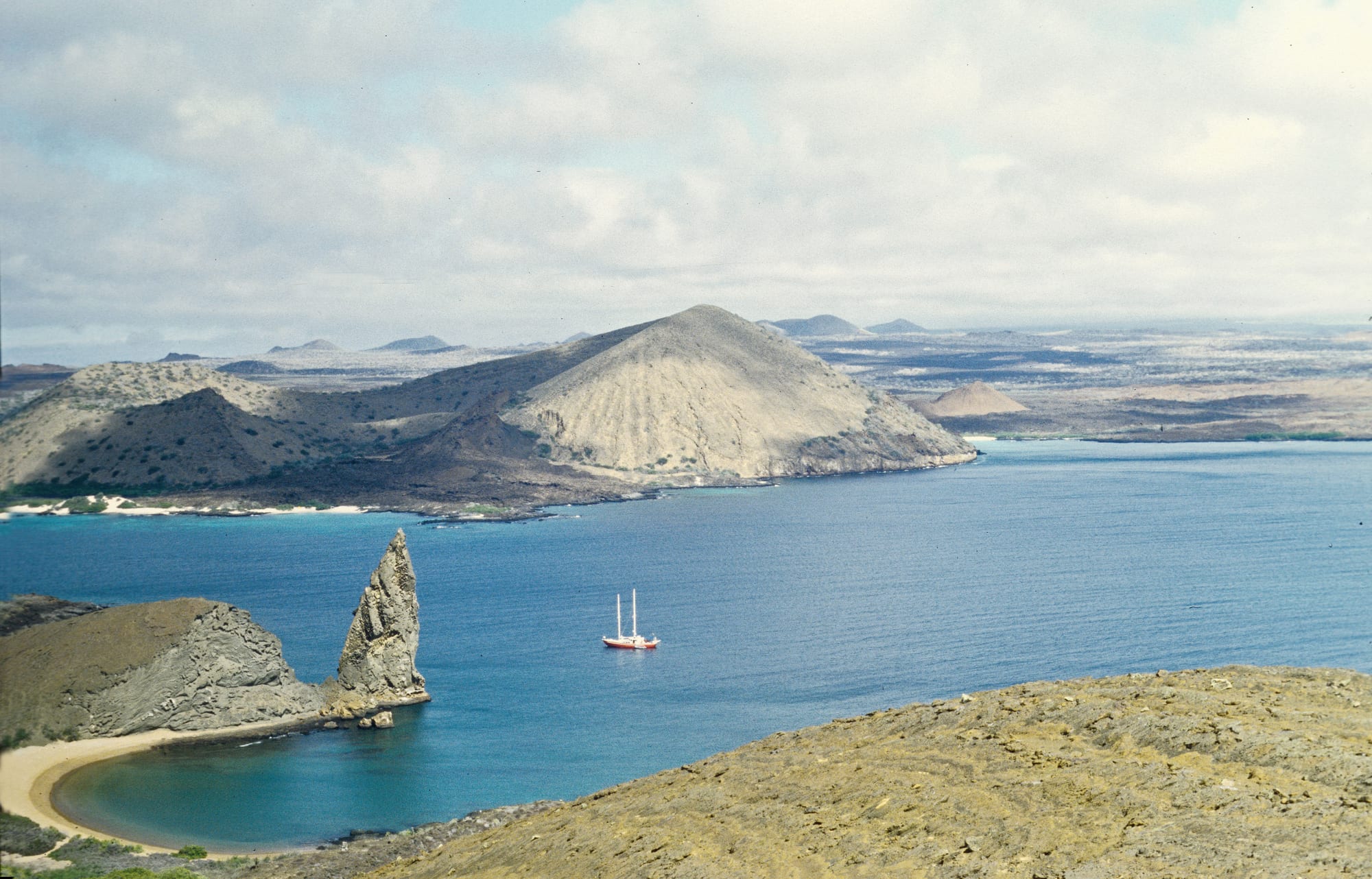
A pointed rock spire beside a curved sandy beach and blue bay, with bare volcanic hills and a sailing boat beyond

Ecuador

The Galápagos Islands

Pinnacle Rock and the bay of Bartolomé Island, off Santiago, in the Galápagos archipelago. (Cayambe / Wikimedia Commons · CC BY-SA 3.0)

A volcanic archipelago on the equator about 900 kilometres west of mainland Ecuador, almost all of it national park and marine reserve — famous for giant tortoises, marine iguanas and fearless seabirds, for Darwin's visit of 1835, and for a small population living in the towns of Santa Cruz, San Cristóbal, Isabela and Floreana.

Explore The Galápagos Islands

History

The islands rose from the sea floor over a volcanic hotspot, the oldest of them a few million years old and the youngest, Fernandina and Isabela, still erupting. Plants and animals arrived by chance, on wind, currents and rafts of vegetation, and evolved in isolation into the species found nowhere else. There is no evidence of permanent human settlement before Europeans.

Tomás de Berlanga, Bishop of Panama, drifted to the islands in 1535 and described their giant tortoises, or galápagos, which gave the islands their name. Pirates and buccaneers used them as a hideout in the seventeenth century, and from the late eighteenth century whalers and sealers took thousands of tortoises as live food, leaving a barrel on Floreana that served as a post office. Ecuador annexed the islands in 1832. Charles Darwin spent five weeks there aboard HMS Beagle in 1835, landing first on San Cristóbal, and the differences he noted between islands later fed into On the Origin of Species in 1859.

Settlement was slow and often grim: a sugar plantation on San Cristóbal ended when workers killed its owner, Manuel Cobos, in 1904; European settlers on Floreana in the 1930s left a tale of disappearances still unsolved; and a penal colony on Isabela forced prisoners to build the Wall of Tears. The United States built an air base on Baltra to guard the approaches to the Panama Canal. The national park was created in 1959, the Charles Darwin Research Station opened in 1964, and in 1978 the islands were among the first UNESCO World Heritage Sites, with the marine reserve added later.

Culture & Customs

Galápagueños are mostly descendants of settlers from mainland Ecuador, who arrived over the twentieth century, joined by a small community of Europeans and North Americans. Island life has a frontier feel and a strong sense of being guardians of a special place, alongside some frustration at the limits that conservation places on fishing and building.

Conservation is the local culture in a very real way: schoolchildren learn the rules of the park, residents join clean-ups and restoration projects, and guides, many of them islanders, are trained and licensed by the park. Tensions have flared over the years, notably in the 1990s, when sea-cucumber fishermen protested against catch limits.

The calendar follows mainland Catholic fiestas, with each town honouring its patron, and the islands celebrate the anniversary of the province, created in 1973, in February. Football on sand pitches, beach volleyball and surfing on San Cristóbal fill the evenings, and sea lions share the town beaches and benches with people.

Daily Life

About 33,000 people live in the islands, on four of them: Puerto Ayora on Santa Cruz is the largest town, Puerto Baquerizo Moreno on San Cristóbal is the provincial capital, Puerto Villamil on Isabela is a small sand-street village, and Floreana has only a few dozen households. Farming communities such as Bellavista on Santa Cruz and El Progreso on San Cristóbal lie in the green highlands.

Tourism is the economy, bringing hundreds of thousands of visitors a year and employing guides, boat crews, hoteliers and cooks; fishing for lobster and fish, and highland farming of cattle, coffee and fruit follow far behind. Residency is controlled under a special law of 1998, so moving to the islands from the mainland is restricted.

Days start early and follow the boats, and the towns are quiet by late evening. Current issues include fresh water, which is scarce, the arrival of invasive species on cargo ships and flights, the pressure of tourist numbers, the cost of living, and plastic waste washed in from the ocean.

Food

Almost everything except seafood and some highland produce arrives by cargo ship from Guayaquil, so island cooking is mainland Ecuadorian food with a sea-to-table twist. Ceviche of fish, shrimp or octopus, fish in coconut sauce, and grilled fresh catch are the staples. Spiny lobster, langosta, is served grilled or in garlic.

In Puerto Ayora, evening kiosks set tables in the road and grill lobster, fish and meat to order. Encebollado, the mainland's tuna-and-cassava soup, is a breakfast favourite here too.

The highlands of Santa Cruz and San Cristóbal grow coffee, sold under island brands, as well as bananas, papaya, citrus and cattle for local beef, and some farms offer tastings. Fresh juices and batidos are everywhere, and most beer is shipped from the mainland, though small local breweries have appeared.

Attractions & Natural Wonders

Santa Cruz is the hub. In Puerto Ayora, the Charles Darwin Research Station runs a tortoise breeding centre where the famous Lonesome George lived until his death in 2012. A paved path leads to Tortuga Bay, a long white beach with marine iguanas and a sheltered cove for swimming. In the highlands, wild tortoises roam the El Chato reserve and neighbouring farms, and Los Gemelos are twin pit craters in scalesia forest.

San Cristóbal has sea lion colonies on the Puerto Baquerizo Moreno waterfront, the interpretation centre, the frigatebird colony of Cerro Tijeretas, the freshwater crater lake of El Junco, the Galapaguera tortoise centre and Kicker Rock, or León Dormido, the split remains of a lava cone. Isabela offers the Sierra Negra caldera hike, the flamingo lagoons near Puerto Villamil, the Wall of Tears and Galápagos penguins.

The wildlife cruises reach what the towns cannot: Bartolomé's viewpoint over Pinnacle Rock and Sullivan Bay's fresh lava on Santiago, blue-footed boobies on North Seymour, land iguanas on South Plaza, the waved albatross on Española, the red-footed boobies of Genovesa, marine iguanas and flightless cormorants on Fernandina, and Post Office Bay on Floreana.

Cities in The Galápagos Islands

Planning basics

Budget

By far the most expensive part of Ecuador. The flight from the mainland, the national-park entry fee and the transit control card come before anything else, and most food and goods are shipped from Guayaquil, so prices in the shops and restaurants are well above mainland levels. Staying in town hotels on the inhabited islands and taking day tours is the cheaper approach; live-aboard cruises cost from a few hundred to well over a thousand dollars a day per person.

Daily Budget Midrange
USD 200–500 (hotel and daily boat tours); cruises from about USD 350 per day upwards
Daily Budget Shoestring
USD 80–130 (guesthouse in Puerto Ayora or Puerto Villamil, kiosk dinners, free beaches, excluding flights and park fee)

Bring cash for the park fee and small purchases, as card machines and cash machines are limited outside Puerto Ayora and Puerto Baquerizo Moreno.

Safety

The islands are far calmer than mainland Ecuador, with little violent crime, although petty theft occurs in the towns and drug-trafficking routes pass through the surrounding ocean. The main risks are natural: strong equatorial sun, rough seas on speedboat crossings, currents at snorkelling sites, heat on volcano hikes, and bull sea lions that can bite if approached. Strict park rules require licensed guides at most visitor sites and a distance of about two metres from wildlife.

Use reef-safe sunscreen and cover up, snorkel with a guide or buddy, keep a distance from wildlife and follow biosecurity checks on arrival. Check current official travel advice before travelling.

Climate

Unusually mild for the equator because of cold ocean currents. From about December to May the warm season brings sunshine, calmer and warmer seas, and short heavy showers; from June to November the garúa season brings overcast skies, mist and drizzle in the highlands, cooler air and cooler, rougher seas. The coasts are dry and scrubby, while the highlands of the larger islands are green and wet.

Summer
December–May: warm, 26–31°C, sunny with showers; sea about 24–26°C, good visibility for snorkelling
Winter
June–November: cooler, 19–26°C, grey and misty; sea about 20–23°C, choppier crossings but plankton-rich water

Transportation

Flights from Quito, usually via Guayaquil, and from Guayaquil land at Baltra, beside Santa Cruz, or at San Cristóbal; from Guayaquil the flight takes about two hours. From Baltra a bus, a short ferry across the Itabaca channel and a road across Santa Cruz reach Puerto Ayora in about an hour. Between the inhabited islands, public speedboats take about two hours and can be rough, and small planes also fly between them. Most uninhabited islands can be visited only by cruise or licensed day boat.

Take seasickness tablets for speedboat crossings, and choose a cruise itinerary for the islands it visits, since the park fixes each boat's route.

Best Time to Visit

There is no bad month. The warm season suits snorkelling and calm crossings. The cooler season brings more marine life, and the waved albatross returns to Española from about March. Christmas, Easter and July to August are the busiest times, and good cruise berths sell out months ahead.