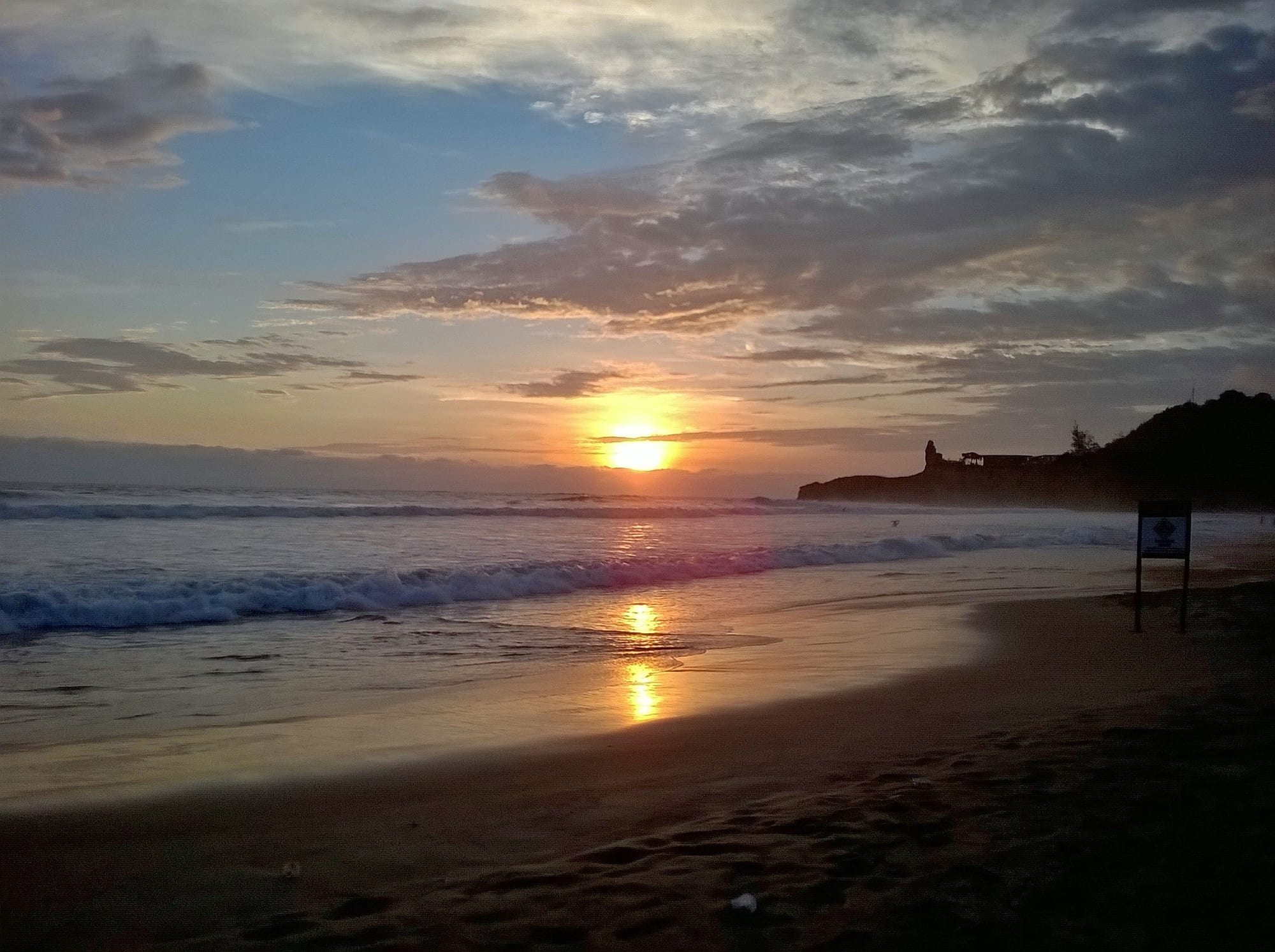
Sun setting over the Pacific on a wide sandy beach, with waves breaking and a dark rocky headland on the right

Ecuador

Guayaquil & the Pacific Coast

Sunset on the beach at Montañita, with the Punta de Montañita headland behind, in Santa Elena province. (Mikaelashamrock / Wikimedia Commons · CC BY-SA 4.0)

Ecuador's lowland west, from the mangroves of Esmeraldas to the banana plantations of El Oro — home to Guayaquil, the country's largest city and port, the surf beaches of Santa Elena and Manabí, whale-watching waters off Puerto López, and the cacao farms of Los Ríos. Much of the region has been hit hard by gang violence since about 2021.

Explore Guayaquil & the Pacific Coast

History

The coast holds some of the oldest settled cultures in the Americas. The Valdivia culture of the Santa Elena peninsula made some of the continent's earliest pottery, around 3500 BC, and was followed by Machalilla, Chorrera, Bahía, Jama-Coaque and La Tolita, whose goldsmiths in Esmeraldas worked platinum. By the Spanish conquest the Manteño-Huancavilca were seafarers who sailed balsa rafts along the Pacific trading spondylus shell, and in 1526 Pizarro's pilot met one of these rafts at sea. In Esmeraldas, Africans who escaped a wrecked slave ship in the 1550s formed free communities under leaders such as Alonso de Illescas, the root of the province's Afro-Ecuadorian culture.

Guayaquil, settled for good in the 1540s on the Guayas river, became the Pacific's great shipyard and was sacked by pirates in the seventeenth century. It declared independence on 9 October 1820. The cacao boom of the late nineteenth century made Guayaquil's planter families rich and the city the country's economic centre; the Liberal Revolution of 1895 was led by Eloy Alfaro, a native of Montecristi in Manabí. Disease hit the cacao plantations in the 1920s, and workers striking in Guayaquil were massacred on 15 November 1922. Bananas brought a new boom in the 1950s, followed by shrimp farms in the mangroves.

A 7.8-magnitude earthquake on 16 April 2016 killed more than 600 people, mostly around Pedernales, Manta and Portoviejo in Manabí. Since about 2021 the region has been at the centre of Ecuador's security crisis, as gangs tied to international cocaine trafficking fought for control of ports and prisons.

Culture & Customs

Coastal Ecuadorians, costeños, see themselves as open, loud, quick-talking and entrepreneurial, and the Guayaquil–Quito rivalry is argued over everything from accent to football. Guayaquil's great club rivalry, Barcelona against Emelec, is the country's fiercest derby. The montubio culture of the rural coast — cowboys, amorfino verse duels and straw hats — is strongest in Manabí, Guayas and Santa Elena, and montubios are recognised as a distinct people in the census.

Esmeraldas is the centre of Afro-Ecuadorian culture: marimba music, song and dance of the southern Colombian and Esmeraldan Pacific, listed by UNESCO as intangible heritage, is played at festivals and wakes. The Chachi and Awá peoples live in the northern forests. In Santo Domingo, the Tsáchila, known for the men's hair stiffened with red achiote, keep their language and healing traditions.

Montecristi and the villages of southern Manabí are where toquilla-straw hats were first woven, and fine hats are still made there. Carnival on the coast means water fights and packed beaches, and the fiestas of each town mix Catholic processions and all-night dances to salsa, cumbia and the local chicha music.

Daily Life

About half of Ecuador's people live on the coast. Guayaquil has around 2.7 million people, with Durán across the river; the other main cities are Santo Domingo, Machala, Manta, Portoviejo, Quevedo, Esmeraldas and Babahoyo. Santa Elena's Salinas is the traditional resort of Guayaquil families.

The coast earns most of Ecuador's non-oil exports: bananas from Los Ríos, Guayas and El Oro, where Machala calls itself the world's banana capital; shrimp from farms in the Gulf of Guayaquil and El Oro; cacao; Manta's tuna fleet and canneries; and the oil refinery and pipeline terminal at Esmeraldas. Zaruma, in the hills of El Oro, is a gold-mining town.

Life starts early and slows in the midday heat, with the day's big meal at lunchtime and evenings spent outdoors. The dominant issue is insecurity: extortion demands on shops, buses and fishermen, curfews at times of emergency, and families leaving the worst-hit neighbourhoods or the country. Floods in El Niño years, coastal erosion and the loss of mangroves to shrimp farms are other concerns.

Food

Coastal cooking runs on seafood, green plantain, coconut and peanuts. Encebollado, a fish soup of albacore tuna, cassava and pickled red onion, is Guayaquil's breakfast and hangover cure; ceviche of shrimp, fish or black clams (conchas negras) comes with popcorn and chifles, thin plantain chips. Guayaquileños gather for cangrejadas, sessions of cracking boiled mangrove crabs, and eat seco de chivo, goat stew, and arroz con menestra, rice with lentils or beans and grilled beef. Breakfast is often a bolón de verde, a ball of mashed green plantain with cheese or pork crackling, or tigrillo, mashed plantain scrambled with egg and cheese, a dish from Zaruma.

Manabí has the most admired regional kitchen, built on peanuts and plantain: viche, a fish and seafood soup thickened with peanut; corviche, fried green-plantain and peanut dough filled with fish; tonga, rice and chicken in peanut sauce wrapped in a leaf; and salprieta, a condiment of toasted maize and peanut. Esmeraldas cooks with coconut milk: encocado of fish or shrimp, tapao, sun-dried fish cooked with plantain, and cocadas, coconut sweets. Pan de yuca, cheese bread made with cassava starch, is a popular snack, and fresh coconut water, batidos and chocolate from the region's own cacao are everywhere.

Attractions & Natural Wonders

In Guayaquil, the Malecón 2000 follows the Guayas river past gardens, museums and the Moorish clock tower; at its northern end the painted houses of Las Peñas climb the 444 steps of Cerro Santa Ana to a lighthouse. Parque Seminario is known for the land iguanas that wander its lawns, and a footbridge crosses to the mangroves of Isla Santay. Guayaquil is also the gateway to the Galápagos.

West of the city, the Santa Elena coast runs from Salinas past Ballenita and Ayangue to Montañita, a surf village with a steady break and a lively night scene, and quieter Olón beyond. North of it, in Manabí, Puerto López is the base for Machalilla National Park: humpback whales breed offshore from mid-June to October, Isla de la Plata has blue-footed boobies and frigatebirds, and Los Frailes is a protected beach. The Agua Blanca community lives on a Manteño archaeological site. Further up the coast lie Montecristi and its hat weavers, Manta, Bahía de Caráquez and Canoa, a surf beach with cliffs, from which the northern beaches continue to Mompiche, Same and Atacames in Esmeraldas.

Inland, the cacao country of Los Ríos centres on Vinces, whose planter mansions earned it the nickname "little Paris", Babahoyo and Quevedo, where farms grow the fine-aroma Nacional cacao, and in El Oro the wooden balconies of Zaruma and the mangroves of the Jambelí archipelago.

Cities in Guayaquil & the Pacific Coast

Planning basics

Budget

Beach towns such as Montañita, Puerto López and Canoa are among the cheapest places to stay in Ecuador, with plenty of hostels and simple cabañas, though prices jump during Carnival, Easter and the Sierra school holidays. Guayaquil's hotels cost more, and secure taxis rather than buses and walking add to city costs. Whale-watching and Isla de la Plata trips are the main extras.

Daily Budget Midrange
USD 70–140 (beach hotel or Guayaquil business hotel, app taxis, boat tours)
Daily Budget Shoestring
USD 25–40 (beach hostel, seafood almuerzos, coastal buses)

Book whale-watching with operators licensed by Machalilla National Park; in Guayaquil, factor app taxis into the budget rather than walking.

Safety

This is the part of Ecuador most affected by organised crime. Rival gangs such as Los Choneros and Los Lobos, fighting over drug-trafficking routes through the ports, have driven up murder rates in Guayaquil, Durán, Manta, Machala, Esmeraldas and parts of Los Ríos, with extortion, armed robbery, kidnapping and prison riots. After armed men stormed a Guayaquil television studio in January 2024, the government declared an "internal armed conflict", designated the gangs as terrorist groups and deployed the military, and states of emergency and curfews have been imposed in coastal provinces at times. The northern border zone of Esmeraldas should be avoided. The beach towns are calmer but not crime-free, and strong currents make some beaches dangerous.

In Guayaquil stay in well-policed areas such as the Malecón, Las Peñas and the northern business districts, use app taxis, avoid displaying phones or valuables, travel only by day between towns, follow curfews and local news, and swim only where locals do. Check current official travel advice before travelling.

Climate

Hot all year, with two distinct seasons that are the reverse of the northern-hemisphere pattern. From about December to May it is hot, humid and sunny between heavy downpours; from June to November the cold Humboldt current brings grey skies, a fine drizzle called garúa and slightly cooler air, especially in the south. Esmeraldas in the north is wetter and greener; the Santa Elena peninsula is the driest part. El Niño years can bring serious floods.

Summer
December–May: hot and humid, 28–33°C, sunny spells and heavy afternoon rain; the sea is warmest
Winter
June–November: overcast and mild, 22–28°C, with drizzle; the whale season and the surf are at their best

Transportation

Guayaquil's airport is the main gateway, with Galápagos flights as well as international ones, and Manta and Esmeraldas have smaller airports. Buses from Guayaquil's large terminal reach Montañita in about three hours, Puerto López in about four and Manta in about four, and the Ruta del Spondylus coastal road links the beach towns from Santa Elena north into Manabí. The northern beaches and Canoa are often reached from Quito via Santo Domingo.

Travel between towns by day, use registered intercity buses from main terminals, and use app or radio taxis in Guayaquil and Manta.

Best Time to Visit

June to October for humpback whales off Puerto López and Machalilla, when skies are grey but the sea is busy. December to April is the traditional beach season, hotter and sunnier, with crowds from the highlands at Carnival and Easter. Guayaquil celebrates its independence on 9 October and its founding on 25 July.