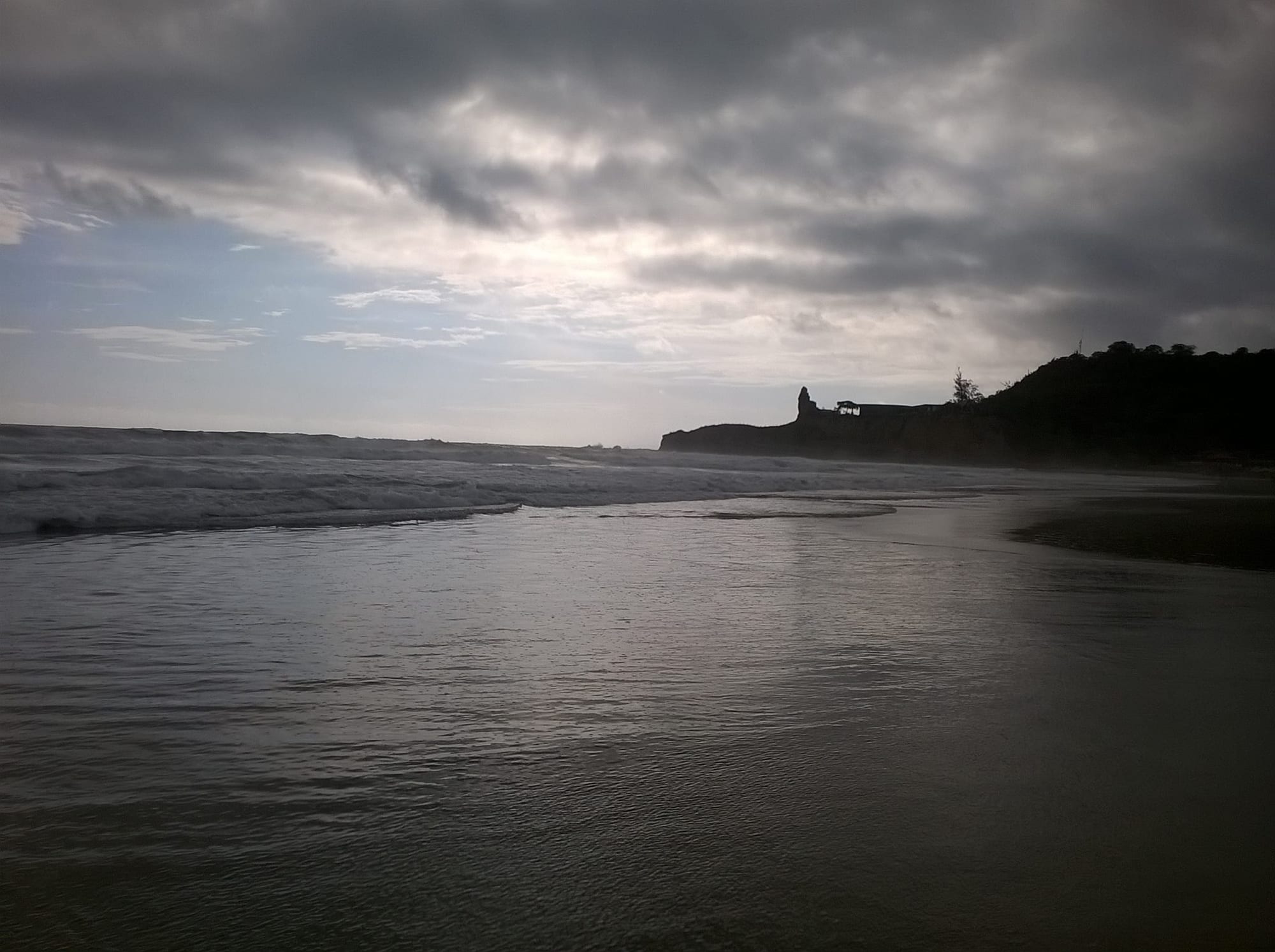
Waves washing over a wide wet beach under heavy grey clouds, with the dark headland of La Punta on the right

Guayaquil & the Pacific Coast, Ecuador

Montañita

The beach at Montañita at dusk, with the headland of La Punta behind. (Mikaelashamrock / Wikimedia Commons · CC BY-SA 4.0)

A former fishing community on Ecuador's Santa Elena coast, about 180 kilometres north-west of Guayaquil on the Ruta del Spondylus. Surfers camped on its beach in the mid-20th century and foreigners settled from the 1960s; today it is an international surf and backpacker village of cane-and-thatch buildings, pedestrian streets and a long party season.

Neighbourhoods

  • The centre and the beachfront
    • First-time visitors
    • Nightlife
    • Beaches

    A small grid of mostly pedestrian streets between the coast road and the sand, crowded with surf shops, craft stalls, restaurants and bars, most with a lane down to the beach. Many restaurants turn into bars after dark and many bars into clubs, so the centre is the loudest place to sleep.

    Open in Maps
  • La Punta
    • Surfing
    • Beaches

    The northern end of the bay, about a kilometre from the centre, where the small hill known as the Point divides the beach from Olón's. The point break is here, and surfers tend to stay at this end of town.

    Open in Maps
  • Tigrillo
    • Quiet and residential

    One of the four areas into which the village is usually divided, a residential neighbourhood with some guesthouses.

    Open in Maps
  • Olón and Manglaralto
    • Quiet and residential
    • Beaches

    Two neighbouring villages a few minutes away by bus or taxi — Olón to the north beyond La Punta, Manglaralto, the parish seat, to the south. Both are calmer bases than Montañita itself, with their own beaches and restaurants.

    Open in Maps

Things to do

Beaches and surf

  • Montañita beachbeach

    The long sandy beach in front of the village, with beach breaks between the centre and La Punta that suit beginners, surf schools and board-rental shops, and sunsets watched from the sand.

    Open in Maps
  • La Punta point breakbeach

    Montañita's main surf spot, a fast right-hand wave over a rocky bottom off the headland north of the village, among the most respected waves in Ecuador and best left to intermediate and advanced surfers.

    Open in Maps
  • Olónbeach

    The next village north, about four kilometres up the coast road, a former fishing village with a quieter beach that has grown with Montañita's tourist boom.

    Open in Maps

Short trips along the coast

  • Ayampebeach

    A small coastal village in Manabí, about 19 kilometres north, whose beach gives powerful waves when Montañita is flat.

    Open in Maps
  • Salangoattraction

    A fishing community in the buffer zone of Machalilla National Park, with a museum of more than 4,500 years of pre-Hispanic heritage and an offshore island that is home to blue-footed boobies, frigatebirds and pelicans.

    Open in Maps
  • Puerto Lópezattraction

    The fishing town up the coast that is the headquarters of Machalilla National Park and the base for whale-watching trips from mid-June to October.

    Open in Maps
  • Machalilla National Parkpark

    A coastal national park established in 1979, with dry forest, beaches, Isla de la Plata and the waters where humpback whales breed.

    Open in Maps

Seasonal events

  • Carnival and the Montañita surf contestFebruary

    Carnival is held in the village each February, and an international surfing competition is held on its waves at the same time.

  • Beach music festivalsthe high season, which peaks in January

    Electronic and house music events on the beach, along with salsa and merengue nights, during the busiest months of the year.

Eat and drink

Long-standing places and food districts in Montañita. Hours, ratings and directions come from your maps app, always current.

Montañita classics

  • Seafood restaurants in the centreneighborhood

    Coastal Ecuadorian cooking — fish, crab, shrimp cocktails and conchas — alongside pizzerias, grills, bakeries and vegetarian kitchens; simple set menus of soup, then fish with rice, fried plantain and salad, are common.

    Open in Maps
  • Breakfast caféscafe

    A long fruit breakfast — pineapple, banana and papaya with yoghurt and granola — is something of a ritual in the village.

    Open in Maps

Nights out

  • Cocktail cartsneighborhood

    On busy evenings a row of small carts sets up along the northernmost street of the centre, mixing fresh fruit juice with spirits, while stalls on the busiest streets sell burgers and hot dogs.

    Open in Maps

Experience Montañita

History

The coast around Montañita holds some of the oldest settled cultures in the Americas. About 10 kilometres to the south is the site of Valdivia, where excavations in the 1950s revealed the Valdivia culture, which flourished on the Santa Elena peninsula between about 3500 and 1500 BC, and earlier still the Las Vegas culture lived along this shore. For most of its later history Montañita was a comuna of fishermen in the parish of Manglaralto, in a cove ringed by hills — its name means "small mountain".

By the middle of the 20th century the beach was known to surfers, though there were only a few fishermen's huts and, in season, one or two surfers' tents. From the 1960s young foreigners linked to surfing and the hippie movement began to settle here, drawn by the waves and finding some affinity with the community's own way of organising itself, and two foreigners who had been camping on the beach built the first cement beach house in the village. Over the following decades Montañita became an international surf resort, while keeping a rustic look of wood, cane and thatch.

Growth brought public lighting and sewerage and a larger role for local government. The 1997–98 El Niño hit Santa Elena province hard, with floods and landslides along the coast. The old Ruta del Sol coast road has since been renamed the Ruta del Spondylus, and since about 2021 the coast as a whole has been at the centre of Ecuador's security crisis.

Culture & Customs

Surfing is the village's identity. La Punta's right-hand wave can reach two metres or more, local people give surf lessons, and Montañita has produced surfers of national and international standing, among them Dominic "Mimi" Barona and Israel Barona. An international surf competition is held each February during Carnival, and brands sponsor surf championships every year. Bodyboarding, paragliding and diving have been added to the list over time.

The atmosphere is shaped by the 1960s settlers and the foreigners who have kept arriving — Argentinians, Americans, Europeans and many others — and by young Ecuadorians and families on holiday. Reggae plays on street corners, and banners with peace symbols or the faces of Che Guevara, John Lennon and Bob Marley hang in the bars. During the high season there are electronic and house music events on the beach, as well as salsa and merengue. The village has been the subject of a 2014 Ecuadorian film, Sexy Montañita, and of a song by the band One Drop.

Craft is part of the street life: artisans sell jewellery from the area's tagua nut, known as vegetable ivory, and traders from Otavalo bring highland textiles. Several schools teach Spanish to foreign visitors, and some combine lessons with surfing or volunteering.

Daily Life

Montañita lives almost entirely from tourism — food, surfing, accommodation and craft sales. The tourist season peaks in January and reaches its low point in June. Montañita is still a comuna, a community with its own organisation, and alongside its families live Ecuadorians from elsewhere and foreigners who came on holiday and settled.

The village is laid out on a grid of small streets running parallel and at right angles to the coast road, with the beach at the end of most of them. It is usually described in four parts: the beach, La Punta, the Tigrillo neighbourhood and the centre. Streets are paved with brick and cobbles and mostly closed to cars, and people get around on foot, by bicycle or by pedicab, while buses and taxis connect it with Olón, Manglaralto and the towns of the peninsula.

Daytime belongs to the beach and the surf; evenings move to the restaurants and bars, which grow louder as the night goes on. Like the rest of the coast, the village lives with Ecuador's security crisis, with states of emergency and curfews imposed at times in the coastal provinces.

Food

Montañita eats like the coast it belongs to. Restaurants serve fish, crab, shrimp cocktails and conchas — clams — alongside the region's ceviche, made with shrimp or fish and served with popcorn and chifles, thin plantain chips. Many places offer a simple set lunch of vegetable soup followed by fish with rice, fried plantain and salad. Encebollado, the fish and cassava soup with pickled red onion, is eaten as a hangover cure across the coast, and breakfast is often a bolón de verde, a ball of mashed green plantain with cheese or pork crackling.

Because so many visitors come from abroad, the village also has pizzerias, grills, bakeries, vegetarian restaurants and international menus. Breakfast is a long affair of tropical fruit — pineapple, banana and papaya — with yoghurt and granola.

Drinking is part of the night: on busy evenings a row of carts on the northernmost street mixes daiquiris and cocktails from fresh fruit juices and spirits, stalls sell burgers and hot dogs, and fresh juices are sold by day.

Planning tools

Budget

Montañita is an inexpensive beach town, with plenty of hostels, simple cabañas and set-menu seafood lunches. Prices rise in the high season, which peaks in January and at Carnival. Board rental and surf lessons are the main extras.

Daily Budget Midrange
USD 70–120 (beach hotel or cabaña with a private bathroom, seafood dinners, board rental, taxis to nearby beaches)
Daily Budget Shoestring
USD 25–40 (hostel bed or camping, set-menu lunches, local buses)

Bring small dollar notes; for a quieter night's sleep, look at rooms in Olón or Manglaralto or at the La Punta end of the beach.

Best Time to Visit

The beach season runs from about November to April, when it is hot and sunny between showers, and the tourist season peaks in January and at Carnival in February. The surf works all year. June is the quietest month; from June to November skies are often grey and drizzly, but that is also when humpback whales can be seen up the coast.

Suggested Number of Days

Two or three days cover the village and the beach. Surfers, Spanish-course students and anyone adding the beaches and national park further up the coast often stay a week or more.

First Visit
2–3 days
With Surroundings
4–6 days

Transportation

The village is small and walkable, and its streets are mostly pedestrian; bicycles and pedicabs are the other ways around. Local buses and taxis on the coast road link Montañita with Olón, Manglaralto and the villages further along the Ruta del Spondylus, and buses run south to Santa Elena and La Libertad.

Travel between towns by day and use registered buses and taxis.

Airport & Station Connections

Most visitors fly into Guayaquil's José Joaquín de Olmedo International Airport and continue by road; Montañita lies about 180 kilometres north-west of the city. Direct buses from Guayaquil take about three to four hours; otherwise buses run to Santa Elena or La Libertad, where local buses continue up the coast. Buses from the north arrive via Puerto López.

Walkability

Everything in the village is within a short walk, and the beach runs the whole length of it; La Punta is about a kilometre north of the centre. The streets are paved with brick and cobbles and closed to most traffic. Mosquitoes can be a nuisance at night.

Safety

Ecuador's security has deteriorated sharply since about 2019, with a surge in organised crime, gang violence, and prison unrest, especially in Guayaquil, Esmeraldas, Manta, and the northern border with Colombia. The coast is the part of the country most affected, and UK government advice warns against all but essential travel to most of the coastal provinces, Santa Elena among them. The beach towns are calmer but not crime-free, and strong currents make some beaches dangerous.

Keep valuables out of sight in the crowded streets at night, travel between towns by day, follow any curfews and local news, and swim only where locals do. Check current official travel advice before travelling.

Climate

Tropical and coastal, with an average temperature around 28°C. The rainy season runs from December to May, but rain is light here and usually falls in the evening or at night; from June to November the cold Humboldt current brings grey skies and drizzle.

Summer
December–May, the hot season: hot and humid, 28–33°C, with sunny spells and showers; the sea is warmest
Winter
June–November: overcast and mild, 22–28°C, with drizzle called garúa

Local Customs

Montañita is far more relaxed than most of Ecuador: beachwear is normal in the village, and it is one of the few Ecuadorian beaches where some women sunbathe topless, though it is not a nudist beach.

Cover up when leaving the beach for nearby villages, ask before photographing residents, and keep noise down in the residential streets late at night.

Common Payment Methods

Ecuador uses the US dollar. Bring small, clean notes: breaking a USD 20 can be hard and damaged bills are refused. Cards are accepted in tourist areas, but cash is needed for buses, street stalls and the smaller places.