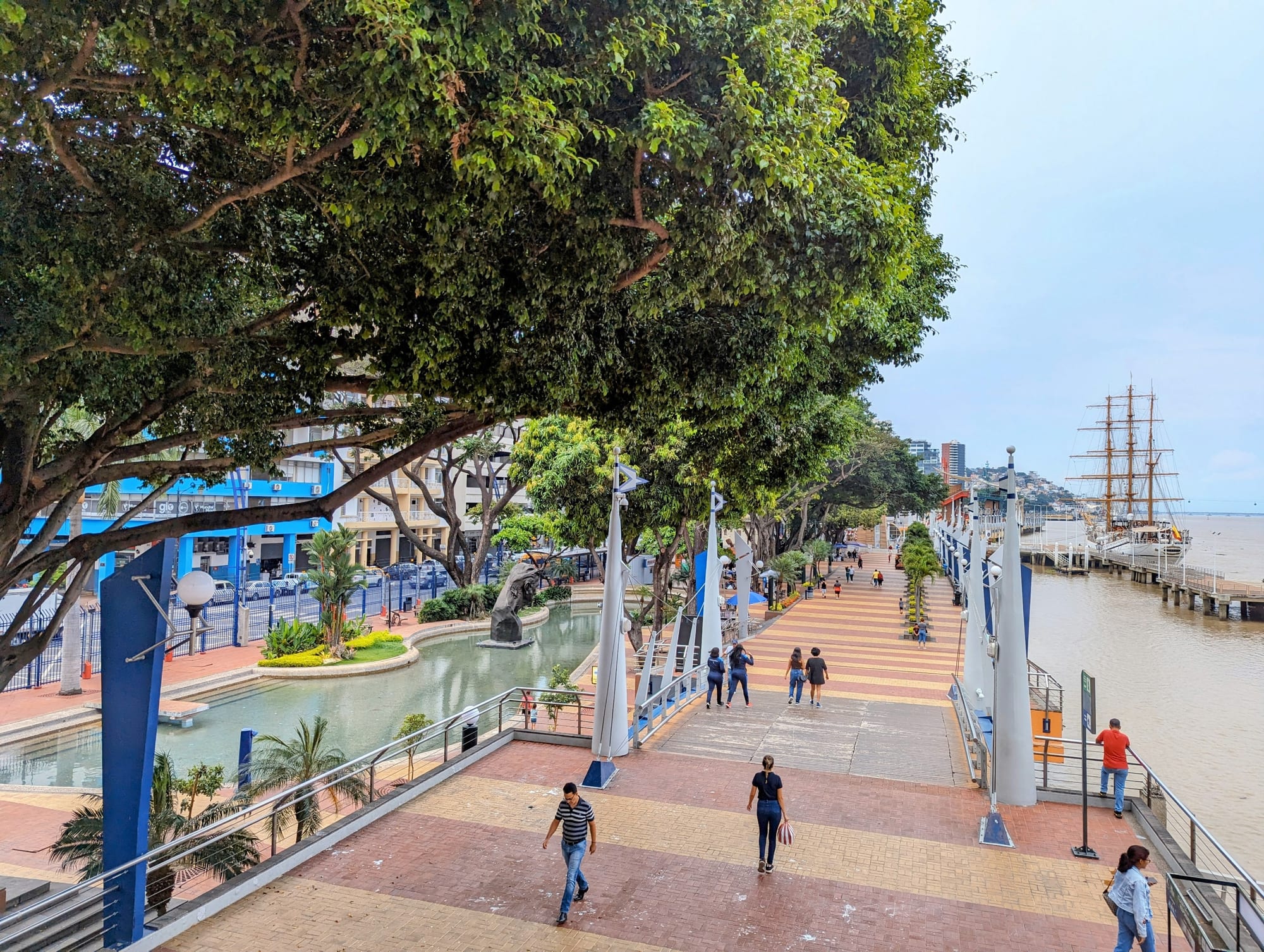
A tree-shaded riverside promenade with fountains and walkers, a tall sailing ship moored on the brown river

Guayaquil & the Pacific Coast, Ecuador

Guayaquil

The Malecón 2000 along the Guayas river in central Guayaquil. (Freddy eduardo / Wikimedia Commons · CC BY-SA 4.0)

Ecuador's largest city and main port, on the west bank of the Guayas river near the Pacific. Founded by the Spanish as a shipyard and port, it grew rich on cacao and bananas and is the country's commercial capital. A long riverside promenade and the painted hillside quarter of Las Peñas sit at its heart, while gang violence has made it the centre of Ecuador's security crisis.

Neighbourhoods

  • Centro and the Malecón
    • First-time visitors
    • Historic district
    • Close to public transport

    The oldest part of the city, between the Guayas river and the Estero Salado, with the cathedral, the municipal palace, Parque Seminario and the Malecón 2000. Metrovía stations serve the main sights, and several hotels face the river. It is busy by day and much quieter at night.

    Open in Maps
  • Las Peñas and Cerro Santa Ana
    • Historic district
    • Views

    The hillside quarter at the northern end of the Malecón where the city was first founded, rebuilt and painted in bright colours. About 444 steps lined with ice-cream and snack sellers climb to a lighthouse and a viewpoint over the river.

    Open in Maps
  • Puerto Santa Ana
    • Modern architecture
    • River views

    A redeveloped riverside district just north of Las Peñas, with flats, offices, restaurants and The Point, the second-tallest building in Ecuador.

    Open in Maps
  • Urdesa
    • Best for food
    • Nightlife
    • Quiet and residential

    A leafy residential district north-west of the centre whose main street, Víctor Emilio Estrada, is lined with restaurants, bars, banks and shops, while the side streets stay residential.

    Open in Maps
  • The northern business districts
    • Business travel
    • Close to the airport

    The newer commercial north of the city, including the area around Kennedy Norte, with office towers and business hotels, close to the airport and the main bus terminal.

    Open in Maps
  • Samborondón
    • Shopping
    • Upmarket dining

    Across the Daule river by bridge, the La Puntilla area of Samborondón is one of the most exclusive residential and entertainment districts in Ecuador, a place of gated communities, shopping centres and restaurants.

    Open in Maps

Things to do

Famous landmarks

  • Malecón 2000park

    The riverside promenade of about 2.5 km along the Guayas, a model of urban regeneration, lined with monuments, gardens, fountains, museums, restaurants and docks for river tours.

    Open in Maps
  • Las Peñasneighborhood

    The restored, brightly painted quarter where the city began, climbed by a long stairway from the north end of the Malecón.

    Open in Maps
  • Cerro Santa Ana lighthouseviewpoint

    The lighthouse at the top of the Las Peñas steps, with wide views over the river and the city.

    Open in Maps
  • Parque Seminariopark

    A square in the centre, also called Iguana Park for the hundreds of land iguanas that roam its lawns and trees.

    Open in Maps
  • Guayaquil Metropolitan Cathedrallandmark

    The neo-Gothic cathedral of Saint Peter, built between 1924 and 1937 to replace an earlier wooden cathedral destroyed by fire in 1892.

    Open in Maps

Museums

  • MAACmuseum

    The Anthropological and Contemporary Art Museum on the Malecón, opened in 2003, with about 50,000 archaeological pieces and more than 3,000 modern works of art.

    Open in Maps
  • Nahim Isaías Museummuseum

    A museum of colonial paintings and art from the 16th to the 19th centuries, listed among Guayaquil's main sights.

    Open in Maps
  • Parque Históricomuseum

    A park in the Entre Ríos area between the Daule and Babahoyo rivers, set in mangrove wetland, that recreates early 20th-century Guayaquil — its buildings, people and food.

    Open in Maps

Parks and the river

  • Santay Islandpark

    A 2,200-hectare island in the Guayas river, about 1,000 hectares of it mangrove, linked since 2013 by pedestrian bridges to the city and to Durán for day trips.

    Open in Maps
  • Malecón del Saladopark

    A second waterfront along the Estero Salado estuary, with fountains, bridges, food pavilions and evening sunsets.

    Open in Maps
  • Parque Samanespark

    A large sports and ecological park in the north of the city with courts, two lakes, a football stadium and an open-air amphitheatre.

    Open in Maps
  • Aerovíatransit hub

    A 4.1 km cable car across the Guayas to Durán, opened in January 2021, taking 17 minutes from one end to the other.

    Open in Maps

Markets

  • Mercado Artesanalmarket

    A craft market near the Malecón selling souvenirs from all regions of Ecuador.

    Open in Maps
  • La Bahíamarket

    A huge market district of shops and stalls just off the southern end of the Malecón, selling almost anything imaginable.

    Open in Maps

Football

  • Estadio George Capwellattraction

    The home ground of Emelec, founded in 1929 and named after George Capwell, the American head of the electric company who founded the club.

    Open in Maps
  • Estadio Monumentalattraction

    The home of Barcelona Sporting Club, the most popular club in Ecuador and Emelec's rival in the Clásico del Astillero, the only Ecuadorian derby FourFourTwo counted among the world's 34 greatest football rivalries.

    Open in Maps

Short trips from the city

  • Bosque Protector Cerro Blancopark

    A protected tropical dry forest at km 16 of the road from Guayaquil to Salinas, with nature trails and picnic and camping areas.

    Open in Maps

Seasonal events

  • Founding of Guayaquil25 July

    The anniversary of the city's Spanish founding, after several attempts from 1534 before it was established for good in 1547.

  • Independence of Guayaquil9 October

    The anniversary of the almost bloodless uprising of 1820 that made Guayaquil independent from Spain, the city's great civic holiday.

  • CarnivalFebruary or March

    Carnival celebrations, held between early February and early March depending on the year.

Eat and drink

Long-standing places and food districts in Guayaquil. Hours, ratings and directions come from your maps app, always current.

Guayaquil classics

  • Encebollado for breakfastrestaurant

    Small restaurants serving encebollado, the fish soup of albacore tuna, cassava and pickled red onion, from early in the morning; it is a common hangover cure.

    Open in Maps
  • Cangrejadasrestaurant

    Crab houses for cangrejadas, gatherings to crack red mangrove crabs, a weekend tradition in the city.

    Open in Maps
  • Bolón and tigrillocafe

    Breakfast places serving bolón de verde, balls of mashed green plantain with cheese or pork crackling, and tigrillo, mashed plantain scrambled with egg and cheese.

    Open in Maps

Food districts

  • Víctor Emilio Estrada, Urdesaneighborhood

    Urdesa's main street of restaurants and bars, one of the city's main areas for international restaurants.

    Open in Maps
  • Malecón del Salado food pavilionsmarket

    Local food stalls in a market pavilion beside the Estero Salado waterfront.

    Open in Maps

Experience Guayaquil

History

Guayaquil takes its name from the lands of a chief called Guayaquile, and local tradition remembers native resistance to the Spanish conquest. The Spanish made several attempts to found a city here from 1534; Francisco de Orellana is credited with one in 1538, and after several moves and fires the city was established for good in 1547 as Santiago de Guayaquil, named after its patron saint, St James. It became the Pacific's great shipyard and a key port of the Spanish colony, and was sacked by pirates in the 17th century.

On 9 October 1820, almost without bloodshed, civilians backed by soldiers of the Granaderos de Reserva battalion arrested the Spanish authorities, and the Free Province of Guayaquil was declared, with the poet José Joaquín de Olmedo at its head. From here Antonio José de Sucre led the army that won the Battle of Pichincha, and on 26 July 1822 Bolívar and San Martín met in the city. Guayaquil was annexed to Gran Colombia and has been part of Ecuador since 1830.

The cacao boom that began in the 1770s made Guayaquil one of the world's main cacao-exporting centres, and cacao growers and merchants later founded a powerful bank there, though a fire destroyed large parts of the city in 1896. Workers striking in Guayaquil were massacred on 15 November 1922, and bananas brought a new boom to Ecuador from 1948. An urban regeneration plan rebuilt the waterfront as the Malecón 2000; the Metrovía followed in 2006, pedestrian bridges to Santay Island in 2013 and the Aerovía cable car in 2021. Since about 2021 the city has been at the centre of Ecuador's security crisis, as gangs tied to cocaine trafficking fought for control of its port and prisons.

Culture & Customs

Guayaquil was the first Ecuadorian city to win its independence from Spain for good, in 1820. The city anthem, the Song to the Ninth of October, with words by Olmedo, was officially adopted in 1898, and the independence anniversary each October is the great civic holiday.

Football is a passion. Barcelona Sporting Club, founded in 1925 by a Spanish immigrant and named after his home city, is the most popular club in Ecuador and plays at the Estadio Monumental; Emelec, founded in 1929 by George Capwell, the American head of the electric company, plays at the stadium named after him. Their matches, the Clásico del Astillero, are the only Ecuadorian derby that FourFourTwo magazine counted among the world's 34 greatest football rivalries.

The city's cultural life centres on the Malecón, with the MAAC's collections of archaeology and contemporary art, and on the universities, among them the University of Guayaquil, founded in 1867, and ESPOL. The montubio culture of the rural coast, with its cowboys and amorfino verse duels, is part of the city's wider identity.

Daily Life

The 2022 census counted 2,746,403 people in Guayaquil canton, and the wider conurbation, which takes in nearby cities and parishes, has about 3.6 million. It is the country's commercial capital: about 70 per cent of Ecuador's private exports leave through its port, along with bananas, shrimp and cacao from the surrounding provinces. Most commerce is in small and medium businesses, and the informal economy employs thousands.

The city is sharply divided. Most of Guayaquil's upper-class families live in the gated communities of La Puntilla in Samborondón, across the river, and many of them work in the city. The centre is a place of offices, shops and markets by day.

The dominant issue is insecurity. Since the port became a key point in the cocaine trade, rival gangs such as Los Choneros and Los Lobos have fought over it, and extortion demands on shops, buses and small businesses, curfews during states of emergency and families leaving the worst-hit neighbourhoods are part of daily life. Floods in El Niño years and earthquake risk are other concerns.

Food

Guayaquil cooks with seafood, green plantain, coconut and peanuts. Encebollado, a fish soup of albacore tuna, cassava and pickled red onion, is eaten from early morning and is a common hangover cure. Ceviche of shrimp, fish or clams is usually served with chifles, thin plantain chips, and encocado, cooked in coconut sauce, is one of the main dishes of the coast.

Guayaquileños gather for cangrejadas, family sessions of cracking red mangrove crabs, a weekend tradition. Seco de chivo, goat stew, and arroz con menestra, rice with lentils or beans and grilled beef, are everyday dishes, and breakfast is often a bolón de verde, a ball of mashed green plantain with cheese or pork crackling, or tigrillo, mashed plantain scrambled with egg and cheese.

Pan de yuca, a bread roll made from cassava flour and eaten hot, is a popular snack, and bollos de pescado, green plantain, fish and peanuts wrapped in a banana leaf, are another coastal favourite. Urdesa, the centre and the road to Samborondón are the main areas for international restaurants.

Planning tools

Budget

Guayaquil is pricier than the beach towns, with business hotels in the north and a smaller choice of hotels near the Malecón. Secure transport — app taxis rather than buses and long walks — adds to daily costs. Street food, almuerzos and cangrejadas keep eating cheap, and the Malecón, Las Peñas and Parque Seminario are free.

Daily Budget Midrange
USD 70–140 (business hotel, restaurant dinners in Urdesa or Samborondón, app taxis, a river tour)
Daily Budget Shoestring
USD 30–50 (budget hotel or guesthouse, encebollado and almuerzos, Metrovía and some app taxis)

Budget for app taxis for every journey after dark rather than walking or hailing cabs in the street.

Best Time to Visit

June to November is cooler and drier, with grey skies and garúa drizzle, and more comfortable for walking. December to May is hot, humid and sunny between heavy downpours, the traditional beach season on the coast. The city celebrates its founding on 25 July and its independence on 9 October.

Suggested Number of Days

One or two days cover the centre and the riverfront. Allow three or four to add the parks and districts further out and a trip to the coast. Many travellers pass through on the way to the Galápagos or Cuenca and stay a single night.

First Visit
1–2 days
With Surroundings
3–4 days

Transportation

The Metrovía bus rapid transit system, opened in 2006, links the centre with the main bus terminal and, a short walk away, the airport, and has a stop at Las Peñas. The Aerovía cable car crosses the river to Durán. Uber and Cabify operate, and app or radio taxis are the safer way to get around; most street taxis have no meter and not all are safe.

Use app or radio taxis, especially at night, rather than hailing yellow cabs in the street; on buses keep a close eye on belongings.

Airport & Station Connections

José Joaquín de Olmedo International Airport, Ecuador's second-busiest, is on Avenida de las Américas about 5 km north of the centre, with international flights and flights to the Galápagos; a taxi to the Malecón is short. The main bus terminal is beside it, with buses to Cuenca in about four hours, to Montañita in about three and to Puerto López in about four.

Walkability

The centre is flat and the Malecón, Las Peñas, the cathedral and Parque Seminario are within easy walking distance of each other by day. Heat and humidity make long walks tiring, distances to the northern districts are large, and walking between districts or after dark is not advised.

Safety

Ecuador's security has deteriorated sharply since about 2019, with a surge in organised crime, gang violence, and prison unrest, especially in Guayaquil, Esmeraldas, Manta, and the northern border with Colombia. Rival gangs fighting over drug-trafficking routes through the ports have driven up murder rates in Guayaquil and Durán, with extortion, armed robbery and kidnapping. After armed men stormed a Guayaquil television studio in January 2024 the government declared an 'internal armed conflict', and states of emergency and curfews have been imposed in the coastal provinces at times. UK government advice warns against all but essential travel to Guayas province, airside transit at Guayaquil airport excepted.

Stay in well-policed areas such as the Malecón, Las Peñas and the northern business districts, use app taxis, keep to the main staircase in Las Peñas, avoid displaying phones or valuables, follow curfews and local news, and travel between towns only by day. Check current official travel advice before travelling.

Climate

Hot all year, with two seasons. From about December to May it is hot, humid and sunny between heavy downpours; from June to November the cold Humboldt current brings grey skies, a fine drizzle called garúa and slightly cooler air. El Niño years can bring serious floods.

Summer
December–May: hot and humid, 28–33°C, with sunny spells and heavy afternoon rain
Winter
June–November: overcast and milder, 22–28°C, with drizzle

Local Customs

Guayaquil is a commercial city, ranked in one survey as the easiest in Latin America in which to start a business. Football loyalties — Barcelona or Emelec — run deep. Dress is light and casual because of the heat.

Ask before photographing people, dress modestly in churches, and keep phones out of sight in the street.

Common Payment Methods

The currency is the US dollar, alongside Ecuador's own coins. Cards are widely accepted in hotels, shopping centres and larger restaurants; markets, street food and many taxis take cash. Use ATMs inside banks or shopping centres by day, and carry small notes.