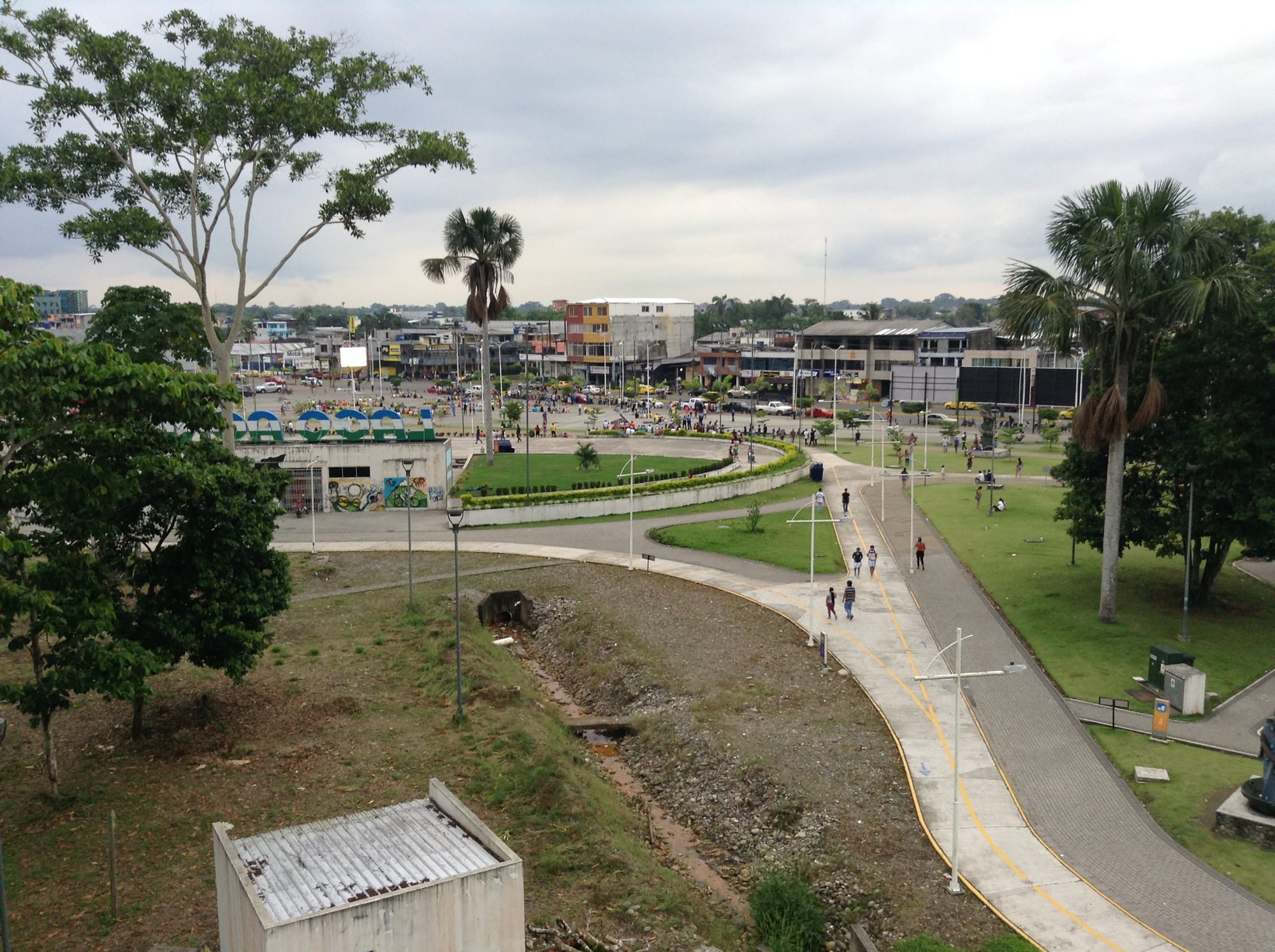
A landscaped park with curving paths and lawns, palm trees and low town buildings beyond under a grey sky

The Amazon, Ecuador

Nueva Loja

A park and the low-rise centre of Nueva Loja, the capital of Sucumbíos province. (DIOHER_PAVAL / Wikimedia Commons · CC BY 3.0)

The capital of Sucumbíos province in Ecuador's northern Amazon, better known as Lago Agrio — a town founded in the 1960s as a Texaco base camp after oil was found in the forest. It is now the largest city of the Ecuadorian Amazon, an oil and trading centre and the usual starting point for canoe trips into the Cuyabeno Wildlife Reserve.

Neighbourhoods

  • Town centre
    • First-time visitors
    • Close to public transport

    The grid of streets around the Parque Central, which began as a hill the first settlers levelled into the town's first football pitch. Avenida Quito and Avenida 20 de Junio are among the main avenues, and most visitors on their way to Cuyabeno pass through here.

    Open in Maps
  • The Aguarico riverside
    • Nature
    • Quiet and residential

    The town stands on a broad plain on the left bank of the Aguarico River, one of the most important rivers of Sucumbíos. The riverside and the Avenida Río Aguarico side of town are greener and quieter, with the surrounding low hills of forest and farmland in view.

    Open in Maps
  • The outer barrios
    • Local life
    • Quiet and residential

    New neighbourhoods that keep spreading over the surrounding hills as the town grows, many with gravel rather than paved streets. They are residential, with little for visitors beyond a sense of how fast the town has expanded since the 1970s.

    Open in Maps

Things to do

Parks and town sights

  • Parque Ecológico Recreativo Lago Agrio (PERLA)park

    A municipal ecological park of about 110 hectares around the Lago Agrio lagoon, with forest trails, canoeing, a zip line, cycling paths and play areas — the town's best-known recreation spot.

    Open in Maps
  • Estadio Carlos Vernazaattraction

    The town's football stadium, opened in 1990 with room for about 8,000 spectators, home ground of local clubs including Caribe Junior and a venue for concerts.

    Open in Maps

Arriving and leaving

  • Lago Agrio Airporttransit hub

    The airport serving Nueva Loja, with daily flights from Quito, used by many visitors on their way to the Cuyabeno lodges.

    Open in Maps

Short trips from the town

  • Cuyabeno Wildlife Reservepark

    One of Ecuador's largest protected areas, a flooded forest of blackwater rivers and lagoons with river dolphins, giant otters and many birds, and Siona, Secoya and Cofán communities, visited on lodge stays of several nights.

    Open in Maps
  • Limoncocha National Biological Reservepark

    A reserve of about 44 square kilometres around a lagoon in Shushufindi canton, one of the reserves reached from Lago Agrio.

    Open in Maps

Eat and drink

Long-standing places and food districts in Nueva Loja. Hours, ratings and directions come from your maps app, always current.

Nueva Loja classics

  • Maitorestaurant

    The signature dish of the Ecuadorian Amazon — fish or chicken wrapped in leaves and grilled over coals, served with boiled cassava.

    Open in Maps
  • Chicha de yuca and guayusacafe

    Two Amazonian drinks: chicha de yuca, a thick fermented cassava drink offered to guests in Indigenous homes, and guayusa, a caffeinated leaf brewed like tea.

    Open in Maps

Food districts

  • Around the Parque Centralneighborhood

    The central streets around the park and along Avenida Quito, where set-lunch places and grills serve the town's workers and travellers.

    Open in Maps

Experience Nueva Loja

History

Until the middle of the 20th century, the forest along the Aguarico River was home to the Cofán and other Indigenous peoples, with only a few missionaries and rubber tappers among them. In 1964 Texaco began exploring for oil in north-eastern Ecuador, and a Texaco–Gulf consortium struck oil in 1967. A base camp grew up at the drilling site, and Texaco named it Lago Agrio, Spanish for Sour Lake, after the town of Sour Lake in Texas. Settlers followed, led by colonists from the southern province of Loja, and the official name, Nueva Loja, honours them.

The settlement grew fast and without planning. Its first school opened in 1971, the year Nueva Loja was legally founded, on 5 May, and full-scale oil production began in 1972; the crude is piped across the country to a marine terminal on the coast. Within half a century the camp had become the largest and most populous city of the Ecuadorian Amazon and the capital of Sucumbíos.

Oil also brought severe damage. Over Texaco's years of operation, waste water and crude were dumped in open pits and spread through the forest, and in 1993 residents began the class action Aguinda v. Texaco. Chevron, which acquired Texaco in 2001, was ordered by a court in Lago Agrio in 2011 to pay billions of dollars in damages, a ruling confirmed by Ecuador's highest court in 2013; in 2018 an arbitration tribunal in The Hague ruled in Chevron's favour, finding the judgment had been obtained through fraud and corruption. The case remains one of the most widely covered disputes involving Chevron.

Culture & Customs

Nueva Loja is a frontier town in its make-up. Most residents descend from settlers who came from the highlands and the coast with the oil roads, and the town's very name records the province of Loja that sent many of the first families. Around it live the Cofán, whose homeland the oil field occupies, and the Siona and Secoya of the Cuyabeno region, some of whom still keep knowledge of forest medicine and now run community tourism with the lodges.

The town calls itself the oil capital of Ecuador, and the industry shapes its identity as much as its economy. Football is the passion, as everywhere in the country: Nueva Loja is the home town of Antonio Valencia, the former Manchester United player, who started at the local club Caribe Junior. The Carlos Vernaza stadium, opened in 1990, hosts the provincial clubs and also serves for concerts and other cultural events.

The town has worked to change its image from an industrial camp to a place with ecological tourism, centred on the PERLA park and its lagoon, and on the reserves beyond. Sister-city ties with Iquitos in Peru reflect its place in the wider Amazon.

Daily Life

About 56,000 people lived in the city at the 2022 census, making it the most populous city in the Ecuadorian Amazon, and the wider urban area around it holds more than 80,000. It is the administrative centre of Sucumbíos, with the provincial government and the municipality of Lago Agrio canton, whose mayor, Abraham Freire Paz, was re-elected for 2023–2027.

The economy rests on the oil industry, followed by trade, cattle ranching and farming, and the town serves as the commercial and financial centre for the surrounding oilfields and settlements. Since 2016 the Universidad Estatal Amazónica has had a campus here. A small but growing municipal bus network serves the expanding barrios, many of which still have gravel streets, and the schools follow the highland calendar, running from September to July.

Days start early and are shaped by heat and rain. The legacy of oil pollution remains a public issue, and life near the Colombian border carries the security problems of the northern border zone, with armed groups and drug trafficking active in parts of Sucumbíos.

Food

Food in Nueva Loja mixes the cooking the settlers brought from the highlands and the coast with the traditions of the Amazon. Set lunches, or almuerzos, are the everyday meal, as everywhere in Ecuador.

The Amazonian dish to look for is maito: river fish, or sometimes chicken, wrapped in leaves and cooked over coals, served with boiled cassava. Ayampaco is another cassava-based dish of the region. Chontacuros, the fat larvae of the palm weevil, are eaten grilled as a traditional delicacy, and caldo de carachama is a soup of armoured catfish.

The drinks are as distinctive. Chicha de yuca, a thick, mildly fermented cassava drink, is offered to visitors in Indigenous homes, and guayusa, the leaf of a caffeinated holly, is brewed like tea. Naranjilla is made into juice throughout the region, and Amazonian fruits include the tart arazá and the peach-palm fruit, chonta. Fine-aroma cacao is grown across the Amazon, and several community cooperatives in the region make their own chocolate.

Planning tools

Budget

The town itself is cheap by Ecuadorian standards, with basic hotels, set lunches and inexpensive buses. The real cost of a visit is the trip into Cuyabeno: lodges there sell all-inclusive packages of several nights with transport, guides and meals, and the price depends mostly on the lodge.

Daily Budget Midrange
USD 100–350 (per person per day at a Cuyabeno jungle lodge, all-inclusive)
Daily Budget Shoestring
USD 25–45 (basic hotel, almuerzos, local buses)

Compare what lodge packages include — transfers, park fees, guide ratios — and book through established operators rather than on the street in town.

Best Time to Visit

The town can be visited all year, and there is no true dry season. Rain falls heavily in every month; the period from October to April is the warmer one, and May to September is slightly cooler. For Cuyabeno, water levels matter more than temperature, since some lagoons can partly dry out in the drier months, roughly mid-December to March.

Suggested Number of Days

The town itself needs no more than a day, usually as an overnight stop on the way in or out of the forest. A stay in the Cuyabeno reserve normally takes three or four nights, and a buffer day is wise because rain and river levels can delay canoes and flights.

First Visit
1 day
With Surroundings
4–5 days

Transportation

Nueva Loja is one of the few Amazonian towns with an urban bus service, though its network is small; taxis cover most short trips. Inter-parish and inter-cantonal buses run to nearby towns, and the Troncal Amazónica road links the town with Colombia to the north and the other Amazon provinces to the south. Most central streets are paved, while many on the edge of town are gravel.

Cuyabeno lodges arrange their own transfers from Nueva Loja; travel to the reserve with them rather than independently.

Airport & Station Connections

Lago Agrio Airport serves the town with daily flights from Quito. By road, the town is about seven hours from Quito over the Andes, and there are also bus services from Baños. Most visitors arrive by air or overnight bus and are met by their lodge.

Walkability

The centre is compact and flat enough to walk, with the main avenues, the Parque Central and the bus traffic within a few blocks. Heat, humidity and sudden downpours make walking tiring, and streets on the edge of town are unpaved and muddy after rain. Taxis are the usual way to the airport and the outer neighbourhoods.

Safety

Ecuador's security has deteriorated sharply since about 2019, with a surge in organised crime, gang violence, and prison unrest, especially in Guayaquil, Esmeraldas, Manta, and the northern border with Colombia. Nueva Loja has more crime than the foothill towns, and Sucumbíos along the Colombian border is part of the northern border zone where armed groups and drug trafficking operate. UK government advice warns against all but essential travel to areas within 20 km of the Colombian border, with a few exceptions.

Stay with established lodges and licensed guides, avoid the border areas of Sucumbíos, take registered taxis after dark, get a yellow fever vaccination and use insect repellent. Check current official travel advice before travelling.

Climate

A hot, wet equatorial climate with heavy rain throughout the year and little change in temperature between months. The average is about 24°C, but humidity of around 85–90 per cent makes it feel much hotter.

Summer
October–April, the warmer half: February, the warmest month, averages about 25°C, and April has the most rainy days
Winter
May–September, slightly cooler: July averages about 23°C, though rain still falls regularly

Local Customs

Nueva Loja is a town of settlers from the highlands and the coast — its name honours the first colonists from Loja province — living alongside Cofán, Siona, Secoya and Kichwa peoples whose territories surround it. Dress is light and casual because of the heat. In Indigenous communities visited from the lodges, chicha de yuca is offered to guests as hospitality.

Ask before photographing people, especially in Indigenous communities, and follow guides' instructions on behaviour in villages and the reserve.

Common Payment Methods

Ecuador uses the US dollar. Cards are accepted in some hotels and larger shops, but cash is needed for buses, taxis, small restaurants and the communities, so it is best drawn in town before leaving for the reserve. Carry small, clean notes, as damaged bills are refused and change for a USD 20 note can be hard to find.