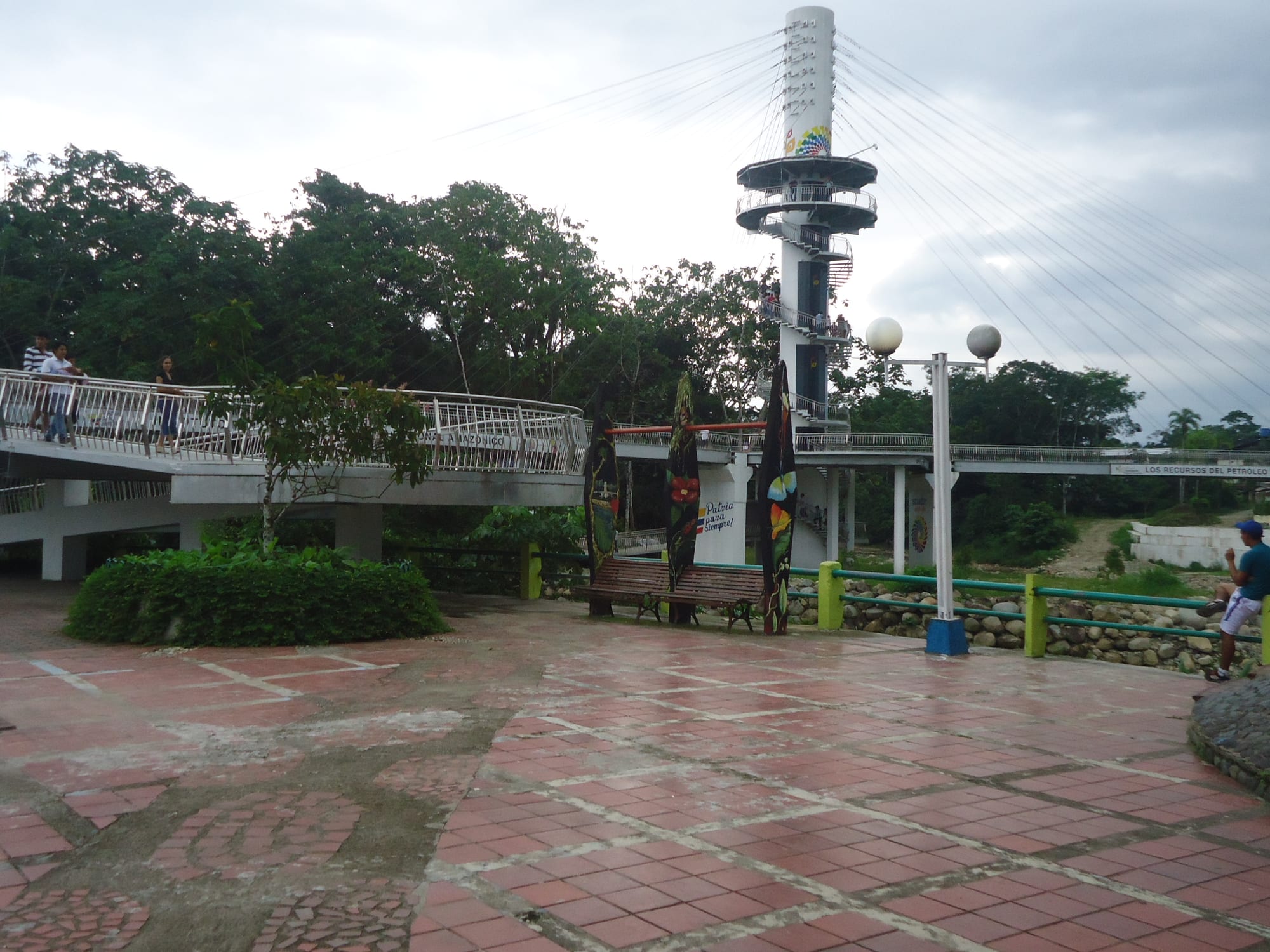
A tiled riverside plaza with a curving footbridge and a tall white cable-stayed tower among green trees under a grey sky

The Amazon, Ecuador

Tena

The malecón in Tena and the cable-stayed footbridge over the river. (David C. S. / Wikimedia Commons · CC BY-SA 4.0)

The capital and largest city of Napo province, a town of about 30,000 people where the Tena and Pano rivers meet on the eastern flank of the Andes. A mission settlement of the Kichwa country that grew into a provincial capital, it is now a backpacker base known for whitewater rafting, kayaking and trips into the forest and to Kichwa communities.

Neighbourhoods

  • The centre and the malecón
    • First-time visitors
    • Close to public transport
    • Nightlife

    The blocks around the confluence of the Tena and Pano rivers, with the riverside promenade, the footbridge to Parque Amazónico La Isla, and the tour agencies, cheap hotels and restaurants that serve backpackers. The bars and discos that fill at weekends are here too.

    Open in Maps
  • Avenida 15 de Noviembre
    • Close to public transport
    • Local life

    Tena's main road, running through town past the bus terminal, with supermarkets, shops and many of the tour operators' offices — practical rather than pretty.

    Open in Maps
  • Puerto Misahuallí
    • Quiet and residential
    • Nature

    A small river port at the meeting of the Misahuallí and Napo rivers, a short ride away, the original jungle-tourism outpost of the region. It has craft shops, cafés, tour operators and a troop of capuchin monkeys in the central square.

    Open in Maps

Things to do

In town

  • Parque Amazónico La Islapark

    A park on the island where the Tena and Pano rivers join, opened in 1995 as an environmental interpretation centre showing the plants of the Amazonian forest, reached by footbridge from the centre.

    Open in Maps
  • The malecóntrail

    The riverside promenade built from 2014 along the Tena river, with a cable-stayed footbridge over the river.

    Open in Maps

On the rivers

  • Rafting and kayakingattraction

    The rivers on the Amazon side of the Andes are bigger and flow more consistently than those to the west, which has made Tena a popular launching point for rafting and kayaking trips; the World Rafting Championships were held in the area in 2005.

    Open in Maps
  • Napo Riverattraction

    The great Amazon tributary that rises on the Andean volcanoes and flows east to Peru; the Tena river joins the Misahuallí just below the town, and that in turn joins the Napo.

    Open in Maps

Short trips from Tena

  • Archidonaattraction

    A colonial town north of Tena, founded in 1560, still a missionary centre and a meeting place for the Kichwa communities around it, known for its Kichwa beauty and culture pageants.

    Open in Maps
  • Cuevas de Jumandyattraction

    A labyrinth of natural caves and tunnels north of Archidona on the road to Quito, explored with a guide, with some swimming and squeezing through narrow passages.

    Open in Maps
  • Jatun Sachapark

    A biological station and nature reserve founded in 1985 on the south bank of the Napo, whose Kichwa name means 'big forest', run for rainforest research and conservation.

    Open in Maps
  • Sumaco Napo-Galeras National Parkpark

    A protected area of isolated forest around the 3,732-metre Sumaco volcano, whose summit can only be reached with a guide.

    Open in Maps

Seasonal events

  • Kichwa pageants in Archidonaseveral times a year, with the final usually in April

    Contestants from Kichwa communities around Archidona compete for the title of Queen of the Kichwa, with songs and dances in the Kichwa language.

Eat and drink

Long-standing places and food districts in Tena. Hours, ratings and directions come from your maps app, always current.

Tena classics

  • Comida típica restaurantsrestaurant

    Restaurants that cook in the traditional ways of the local peoples — maito of fish or chicken wrapped in leaves and grilled over coals, served with boiled cassava.

    Open in Maps
  • Riverside restaurants on the malecónneighborhood

    Restaurants and bars along the river in the centre, serving river fish and chicken, with open-air tables over the water.

    Open in Maps

Nights out

  • Weekend bars and discosneighborhood

    On Friday and Saturday nights guides, volunteers and local young people fill the centre's bars and discotecas, which play reggaeton, salsa and pop.

    Open in Maps

Experience Tena

History

The upper Napo was the land of the Quijos people, who kept their independence when the Inca conquered the highlands. Spanish colonisation began in the late 1550s under Gil Ramírez Dávalos, who founded Baeza in 1559, and towns such as Archidona and Ávila followed. Abuses by the colonists provoked a great revolt in 1578 led by Jumandy, a Quijos leader chosen by the chiefs; it was defeated at Baeza, and Jumandy and the other leaders were captured and executed in Quito. His statue now marks the entrance to Tena.

Tena itself grew out of the Jesuit missions, which from 1638 were based in Archidona and spread down the rivers, giving rise to settlements such as Tena, Puerto Napo and Misahuallí. The city celebrates its founding on 15 November 1560 and credits Ramírez Dávalos, but historians point out that he had already left the region by then and that the date was fixed by the town council in the 20th century. A mission census of 1892 counted 200 families in Tena, behind Archidona and Loreto.

The 20th century made Tena a capital. A cathedral was inaugurated in 1945, and in 1947 the Colegio San José became the first secondary school in the Ecuadorian Amazon. By 2001 Tena, with about 16,600 people, had fallen to fourth place among Amazon towns behind Lago Agrio, Coca and Puyo. From 2014 a programme of urban renewal built the malecón and new sewers, and a linear park opened in 2017.

Culture & Customs

Tena is officially San Juan de los Dos Ríos de Tena — the town of two rivers — and its life is tied to the water. The rivers on the Amazon side of the Andes are bigger and more reliable than those to the west, and Tena has become a popular launching point for rafting, kayaking and forest tours; guides, both Indigenous and foreign, are part of the town's population.

The Kichwa of Napo are the dominant Indigenous presence. Tena is home to their federation and to an association of Indigenous shamans, and Ecuador's Indigenous peoples are among the most politically organised in Latin America. Around the town, community tourism, reforestation and volunteer projects bring visitors into Kichwa villages, where guayusa tea, chicha de yuca and the chakra forest garden are part of daily life. In nearby Archidona, Kichwa pageants several times a year crown a Queen of the Kichwa, with songs and dances in the language.

At weekends the town loosens up: on Friday and Saturday nights guides, volunteers and local young people fill the bars and discos, which play reggaeton, salsa and pop.

Daily Life

At the 2022 census Tena had about 29,700 people, with more than 40,000 in the wider urban area that includes nearby parishes. It is the capital and largest city of Napo province and the seat of its canton, with the provincial offices and a regional hospital.

The economy rests on commerce, agriculture and tourism. Timber and farming, including fish farming and poultry, are the main productive activities, and formal and informal trade employs many people. Tourism shapes the centre, with its agencies, hostels and restaurants. Oil prospecting in the Pungarayacu heavy oil field has been a point of contention, and illegal mining of sand and gold in and near the rivers is a major concern for residents.

Days start early and are punctuated by rain; much of life happens outdoors along the rivers, in the market and on the malecón, and the town is generally regarded as calm and orderly.

Food

Tena eats from the forest and the river. Maito is the signature dish of the Amazon: fish, or sometimes chicken, wrapped in bijao leaves and grilled over coals, served with boiled cassava. Ayampaco is another cassava-based dish of the region, and caldo de carachama is a soup of armoured catfish. Chontacuros, the fat larvae of the palm weevil, are a traditional food.

Drinks come from the chakra. Chicha de yuca, a thick fermented cassava drink prepared by women, is offered to visitors in Kichwa homes, and guayusa, the leaf of a caffeinated holly, is brewed like tea. Chicha de chonta is made from the fruit of the peach palm when it ripens. Naranjilla juice is everywhere, and the tart arazá is another Amazon fruit. Fine-aroma cacao is grown in the area, and several community cooperatives make chocolate.

Restaurants in the centre serve comidas típicas cooked in the traditional ways of the local peoples alongside the usual almuerzo set lunch, river fish and chicken.

Planning tools

Budget

Tena is as cheap as anywhere in Ecuador, with simple hostels, set lunches and cheap buses and taxis. Rafting, kayaking and guided forest trips are the main extras, and nights at lodges outside town, sold as packages with meals and guides, cost far more than staying in town.

Daily Budget Midrange
USD 60–150 in town (comfortable hotel, restaurant meals, a guided rafting or forest day trip); USD 100–350 per person per day at an all-inclusive lodge
Daily Budget Shoestring
USD 25–45 (hostel, almuerzos, buses; a day's rafting extra)

Raft only with certified operators, and check that boats are not overloaded and a safety kayaker comes along.

Best Time to Visit

Tena can be visited year-round; it rains in every month, and June and November are the wettest. Rafting is possible most of the year, though flash floods can close rivers after heavy rain. Ecuadorian holiday periods fill the town.

Suggested Number of Days

Two or three days allow time for the town and a day on the river. Stays grow longer for multi-day rafting or kayaking, nights at a forest lodge or a visit to Kichwa communities.

First Visit
2–3 days
With Surroundings
4–6 days

Transportation

The centre is compact. Small yellow pick-up taxis are everywhere and cheap, and local buses run to Archidona, Puerto Misahuallí and other nearby villages. Tour operators provide transport for rafting and forest trips.

Agree the fare before taking a taxi to places outside town.

Airport & Station Connections

Tena is about 195 kilometres from Quito by a paved road that climbs over the Papallacta Pass, above 4,000 metres, and descends via Baeza; buses take around four to six hours, private transport about three and a half. Jumandy Airport, about 27 kilometres east near Ahuano, lost its only scheduled flight in 2016 and is used by flying schools and general aviation, so most visitors fly into Quito.

Walkability

The centre, the malecón and the park on the island are all within an easy walk, linked by footbridges over the rivers. Heat, humidity and sudden downpours are the main obstacles; the bus terminal and the outlying districts are best reached by taxi.

Safety

Ecuador's security has deteriorated sharply since about 2019, with a surge in organised crime, gang violence, and prison unrest, especially in Guayaquil, Esmeraldas, Manta, and the northern border with Colombia. The foothill towns and the lodge circuit are generally calm. The real risks around Tena are natural: rivers rise fast after rain, rafting accidents have happened with operators who cut corners, and malaria and dengue occur in parts of the lowlands. Unregulated ayahuasca ceremonies carry risks of their own.

Raft only with certified operators, get a yellow fever vaccination and use repellent, and do not swim in rivers after heavy rain. Check current official travel advice before travelling.

Climate

An equatorial rainforest climate at about 510 metres above sea level: warm and very wet all year, with an average temperature around 23°C and some 4,900 millimetres of rain a year. Temperatures change very little from month to month, and humidity makes it feel hotter.

Summer
September to November are the warmest months, with September averaging about 23°C; November is one of the wettest
Winter
July is the coolest month, averaging about 22°C; June is one of the wettest

Local Customs

Tena is a Kichwa town as well as a settler one: two major Indigenous organisations, the Kichwa federation of Napo and an association of Indigenous shamans, are based here, and Kichwa is widely spoken in the surrounding communities. When visiting a community, follow the guide's lead; a bowl of chicha de yuca may be offered as a welcome.

Ask before photographing people in Kichwa communities and buy crafts directly from the makers where possible.

Common Payment Methods

Ecuador uses the US dollar. Bring small, clean notes: breaking a USD 20 can be hard and damaged bills are refused. Cards are accepted by many tourist businesses in town, but cash is needed for taxis, buses, set lunches and in the communities.