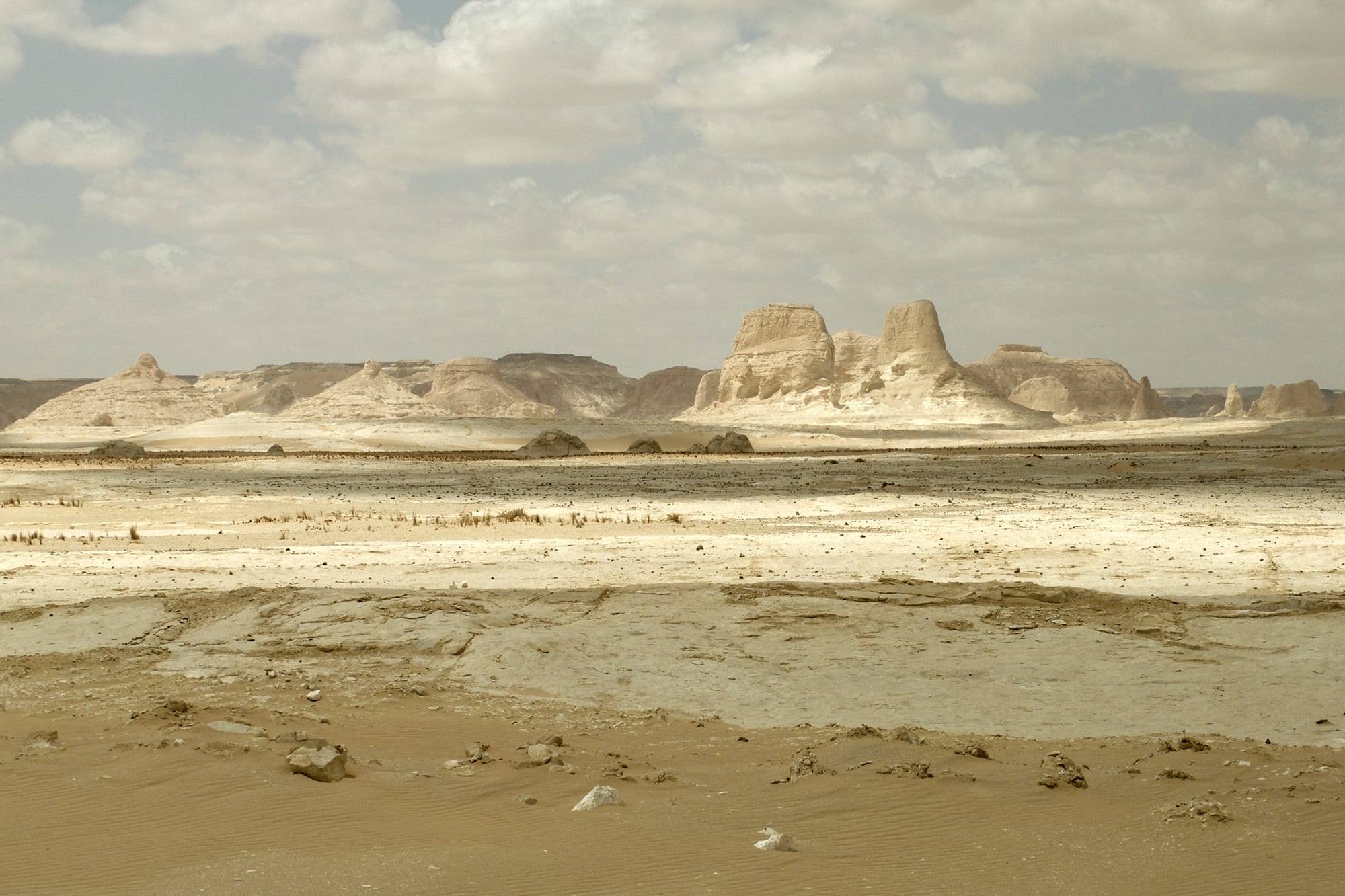
Pale chalk outcrops rising from a flat sand and gravel plain under a cloudy sky in the White Desert

The Western Desert & Oases, Egypt

Farafra

Chalk formations on the plain of the White Desert, near Farafra. (Vyacheslav Argenberg / Wikimedia Commons · CC BY 4.0)

The least populated and most isolated of Egypt's main Western Desert oases, a town of palm gardens and low houses in a wide depression between Dakhla and Bahariya. Its people are largely Bedouin in origin, its water comes from hot wells, and it serves as the usual base for trips into the chalk formations of the White Desert to the north.

Neighbourhoods

  • Qasr el-Farafra
    • First-time visitors
    • Local life
    • Close to transport

    The town itself, a low settlement of plastered and mud-brick houses around a small centre with shops, a bus stop and a mosque. Remnants of the old fortified village stand on the rise above, and nearly all of the oasis's services are here.

    Open in Maps
  • The palm gardens
    • Quiet stays
    • Walks
    • Springs

    The belt of date palms, olive trees and small fields below the town, watered by wells and threaded with sandy tracks. Guesthouses and camps sit among the gardens, and several of the oasis's springs are within walking or cycling distance.

    Open in Maps
  • The desert road north
    • Desert trips
    • Camping

    The road towards Bahariya, along which the desert camps, 4x4 operators and the approach to the White Desert are found. There is nothing here but sand, chalk and the occasional checkpoint.

    Open in Maps

Things to do

The oasis

  • Qasr el-Farafra old villagelandmark

    The remains of the mud-brick settlement on the rise above the modern town, once fortified against desert raids, now largely eroded.

    Open in Maps
  • Badr's Museummuseum

    A small adobe museum founded by the local artist Badr Abdel Moghny, born in Farafra in 1958, where his sculpture and other work are on show.

    Open in Maps
  • The palm gardens and orchardsattraction

    Date palms, olives and small irrigated plots that make up the green heart of the oasis, crossed by tracks and walled gardens.

    Open in Maps
  • Bir Sittaattraction

    A hot spring a few kilometres from the town, where sulphurous water from a deep well feeds an open pool used by residents and desert travellers.

    Open in Maps
  • Ain Bishayattraction

    A Roman-era spring rising from a hillock on the north-west edge of the town, developed into a shaded grove of date palms, citrus, olive, apricot and carob trees tended by several families.

    Open in Maps

The desert

  • The White Desertattraction

    A national park of white chalk pillars, wind-carved mushroom shapes and open plains, protected since 2002 and beginning about 45 kilometres north of the town, usually visited by 4x4 with an overnight camp.

    Open in Maps
  • Crystal Mountainlandmark

    A small arch of barite and calcite crystals set in eroded chalk beside the Bahariya road, within the White Desert north of the town.

    Open in Maps
  • The Black Desertattraction

    Widely spaced mounds capped with dark basalt, spread along about 30 kilometres of the road north between the White Desert and Bahariya, the visual opposite of the chalk country.

    Open in Maps

Short trips from the oasis

  • Bahariya Oasisneighborhood

    The next oasis north, some 170 kilometres away, known for its springs, the Greco-Roman cemetery called the Valley of the Golden Mummies and the road on to Cairo.

    Open in Maps
  • Dakhla Oasisneighborhood

    The larger oasis to the south, with the mud-brick town of Al-Qasr, the Roman temple of Deir el-Hagar and the Old Kingdom governors' town at Ayn Asil.

    Open in Maps

Seasonal events

  • Desert camping seasonOctober to April

    The cool months bring almost all of the oasis's visitors, with 4x4 trips and overnight camps among the chalk formations of the White Desert.

  • Date harvestSeptember to November

    The gardens are worked hard as dates are picked, dried and sorted, and olives follow later in the year.

  • Ramadanvaries by year

    Days are quiet and the evening meal brings the town together; desert trips continue but timings shift around the fast.

Eat and drink

Long-standing places and food districts in Farafra. Hours, ratings and directions come from your maps app, always current.

Oasis food

  • Town cafés and grillsneighborhood

    A handful of simple places around the centre serving chicken, rice, stewed vegetables, lentil soup, ful and ta'meya, with tea afterwards.

    Open in Maps
  • Camp and guesthouse kitchensneighborhood

    Desert camps and small lodges cook for their guests, typically bread baked in the embers, grilled or slow-cooked meat, rice and vegetables.

    Open in Maps
  • Dates and olives from the gardensmarket

    The oasis's own produce, sold dried, fresh or pressed into oil in the town's small shops.

    Open in Maps

Experience Farafra

History

Farafra has been inhabited far longer than its size suggests. Prehistoric peoples lived around the depression when the Sahara was wetter, and archaeological evidence places people here from the late Pleistocene onwards, thousands of years before the pharaohs. Ancient Egyptian texts knew the oasis as the land of cattle, and it was familiar to the Egyptian state at least from the Middle Kingdom. It lay at the far western edge of the Egyptian world, watched as a route by which Libyan tribes could approach the Nile Valley.

Under Rome and in the Christian centuries the oasis was farmed and taxed like its neighbours, though it was never wealthy and never large. In the Islamic period the population lived in a single fortified village, Qasr el-Farafra, built on a rise so that families could shelter behind its walls when raiders came out of the desert. For centuries this was a place of a few hundred people, supplied by camel caravans from Dakhla and Bahariya, with a reputation within Egypt for isolation.

The modern oasis dates from the second half of the 20th century. The New Valley project sank deep wells and opened new land for farming, bringing settlers from the Nile Valley, and the paved road linking Bahariya and Dakhla ended the town's dependence on caravans. That road also brought visitors: the chalk formations 45 kilometres north of the town, protected from 2002 as the White Desert National Park, became one of the best-known landscapes of the Egyptian Sahara, and a small tourism economy of camps, guides and 4x4 drivers grew up in a town that had never had one.

Culture & Customs

Farafra's older families are Bedouin in descent, and the oasis keeps a strongly tribal social order in which family, lineage and reputation decide much of ordinary life. It has long had a name in Egypt for being unusually self-contained: for generations nearly everyone in the oasis was related to nearly everyone else, houses were left unlocked, and disputes were settled locally rather than through the state. Settlers who arrived with the New Valley schemes brought Nile Valley customs and dialects, and the two strands now mix.

Hospitality is the central social rule. Tea, heavily sugared and served in small glasses, is offered to every arrival and refused by nobody, and guests are fed before they are questioned. Men gather in the evening in cafés and in front of houses; women's lives are largely private and domestic, and foreign women are treated courteously but are expected to dress modestly, as men are.

Building is the oasis's most visible tradition. Whole quarters of the town keep their plain, smooth, mud-coloured architecture, and the old methods of building and repairing houses have been sustained partly because visitors value them. The local artist Badr Abdel Moghny, a former teacher, has decorated several houses with murals and shows his work in his own small museum. Otherwise culture here is domestic: weddings with drumming and communal cooking, saints' days, palm-fibre and wool crafts, and the long storytelling evenings of the desert camps.

Daily Life

Farafra is home to a few thousand people — an estimated 5,000 at the last published count — across the town and the farming land around it, the smallest population of any of Egypt's main Western Desert oases, though the depression is the second largest of them in area. Life runs on water pumped from deep wells, much of it hot when it reaches the surface and cooled in open tanks before it reaches the fields. Dates and olives are the traditional crops, and the newer irrigated farms grow wheat, alfalfa, vegetables and fruit, with poultry, sheep and goats kept by most families.

The rest of the economy is small: government jobs, schools and a clinic, building work, a few shops, and tourism, which supports drivers, guides, cooks and a handful of camps and guesthouses and rises and falls with the season and with Egypt's fortunes generally. Groundwater levels and the cost of pumping are the perennial anxieties of the farmers.

Daily rhythm is set by heat and by the road. Work is done early and late, the middle of the day is spent indoors or in shade, and evenings are social. The buses passing through in each direction are events in themselves, carrying goods, mail and the students who travel to university in the Nile Valley. Isolation still defines the place: the nearest hospital of any size, the nearest bank of any size and the nearest city are all several hours away across empty desert.

Food

Farafra eats what the gardens give and what the road brings. Dates are the staple sweet and snack, eaten fresh in autumn and dried the rest of the year, and olives and olive oil come from the same plots. Bread is flat and dense, baked at home in clay ovens, and in the desert camps it is buried in hot sand and embers and knocked clean before serving.

Meals are simple and mostly vegetarian by default: lentil soup, ful medames cooked long and slow and dressed with oil, cumin and lemon, ta'meya fried from crushed fava beans, rice, pasta, tomato and okra stews, and salads of tomato, cucumber and onion. Chicken is the usual meat, with lamb or goat slaughtered for guests, weddings and feast days, often cooked slowly with onions and potatoes until it falls off the bone. Guides on desert trips grill meat and vegetables over the fire and cook rice in a single pot.

Tea is constant, green or black, strong and very sweet, often with mint or with desert herbs, and several rounds are served in succession to a guest. Coffee is taken in small cups on formal occasions, hibiscus is drunk chilled in the heat, and the oasis's own dates, figs and guavas end most meals. Alcohol is neither sold nor drunk here.

Planning tools

Budget

Farafra is very cheap on the ground and there is little to spend money on in the town itself. The real expense is the desert: a 4x4, a driver and guide, camping equipment, food and permits for an overnight trip into the White Desert, usually priced per vehicle, so costs fall sharply when shared between several people.

Daily Budget Midrange
USD 70–170 (guesthouse or lodge, meals, a share of a 4x4 desert trip with camping, transfers)
Daily Budget Shoestring
USD 20–35 (basic room or camp bed, local food, bus travel between the oases)

Bring all the cash needed, since there is little banking in the oasis and desert operators expect payment in notes.

Best Time to Visit

October to April, and November to March above all, when days are warm and the nights cold but bearable for camping. Summer is extreme, often above 40°C, and desert trips are uncomfortable and slow. Spring can bring sandstorms that cancel excursions.

Suggested Number of Days

The town takes very little time. Most visitors stay one night and add a further night for a camping trip into the desert, which is the reason almost everyone comes. Travel times between the oases are long.

First Visit
1 day
With Surroundings
2–3 days

Transportation

The town is small and walkable, and bicycles cover the gardens. Everything beyond requires a vehicle: buses run north to Bahariya and Cairo and south to Dakhla, a few services a day at most, and shared cars cover the same routes. Desert travel is by 4x4 with a licensed driver and guide, arranged in the town or in advance.

Confirm bus times locally on arrival, as schedules change, and carry a passport for the checkpoints on the desert roads.

Airport & Station Connections

There is no airport and no railway. Buses from Cairo take roughly eight to ten hours by way of Bahariya, and buses from Dakhla three to four hours from the south; shared long-distance cars run the same roads. Many visitors arrive instead as part of a desert tour driven from Bahariya or Cairo.

Walkability

The town can be crossed on foot in a quarter of an hour, and the nearest gardens and springs are a short walk or cycle beyond it. Everything else is desert distance, with no shade, so walking out of town is not practical.

Safety

The oasis is quiet and crime is essentially unknown, but the desert around it is unforgiving: heat, dehydration, getting lost and vehicle breakdowns are the real risks, and there is no mobile coverage over much of it. Security is tight on the roads, with checkpoints and registration, and the far south-west of the desert is restricted.

Keep to authorised routes, carry a passport for checkpoints, and travel in the deep desert only with licensed operators and permits. Check current official travel advice before travelling.

Climate

Hyper-arid, with effectively no rain, fierce summer heat and a very large swing between day and night. Winter nights in the open desert can fall to around freezing, so camping needs warm clothing and a proper sleeping bag.

Summer
extremely hot, often above 40°C by day, with hot nights and very dry air
Winter
warm days around 20–23°C and cold nights, close to freezing in the desert

Local Customs

Farafra is small, conservative and largely Bedouin in background, and everybody knows everybody. Modest dress covering shoulders and knees is expected of visitors, including at the hot springs, where men bathe in shorts and a T-shirt and women rarely bathe in public at all. Alcohol has no place in the town. Hospitality is immediate and genuine, and an offer of tea is not a preamble to a sale.

Ask before photographing people, especially women, and take rubbish out of the desert rather than leaving it at a camp site.

Common Payment Methods

The currency is the Egyptian pound and the oasis works in cash. Banking facilities are minimal and cards are not accepted by camps, drivers or shops, so money should be drawn in Cairo, Bahariya or Dakhla before arriving, in small notes where possible.