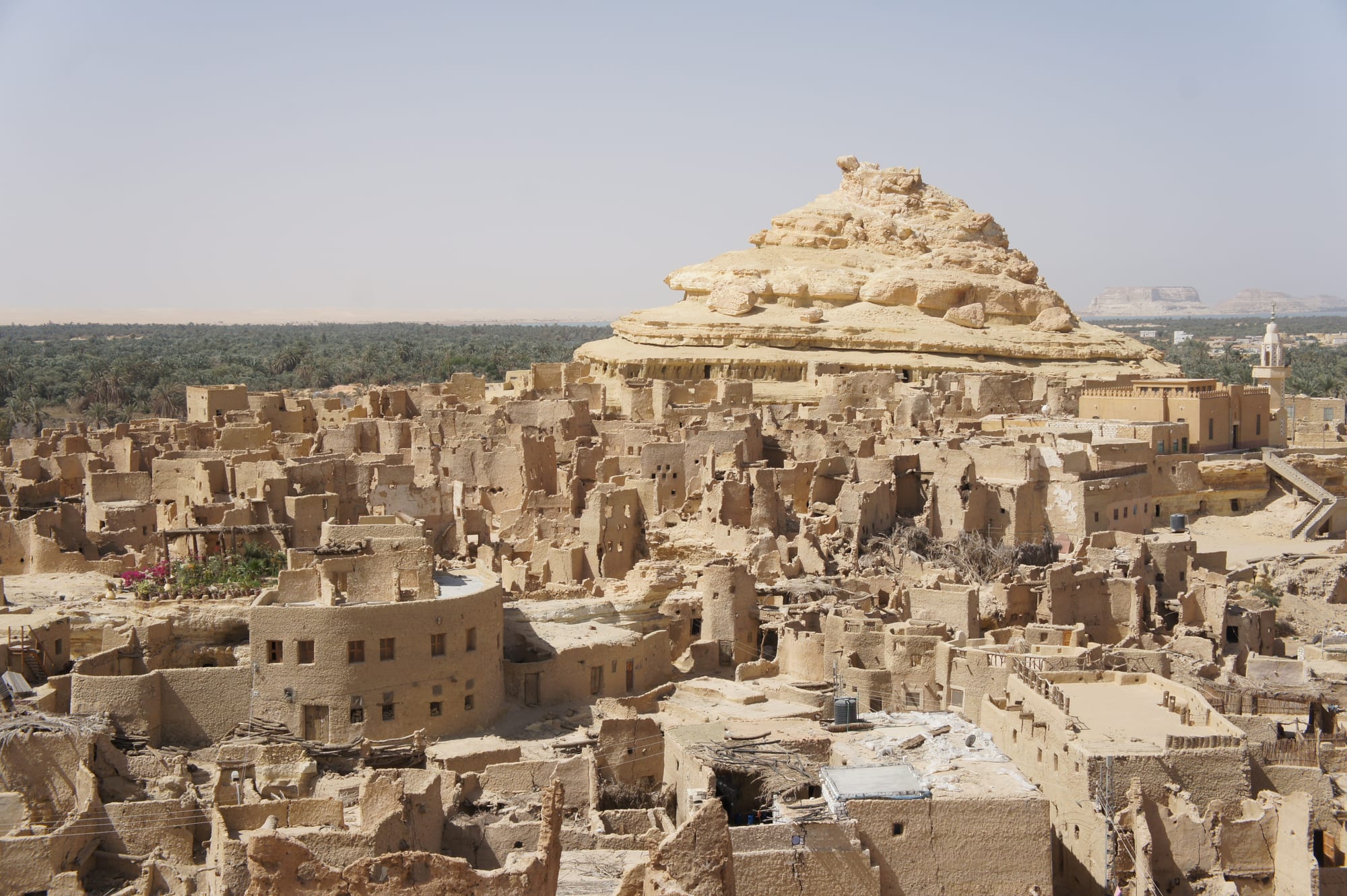
Roofless mud-brick ruins packed around a pale rock outcrop, with palm groves and desert hills beyond

The Western Desert & Oases, Egypt

Siwa Oasis

The ruined mud-brick fortress town of Shali in the centre of Siwa Oasis. (Michael Hermann / Wikimedia Commons · CC BY-SA 4.0)

A depression of palm groves, olive orchards and salt lakes in Egypt's Western Desert, several hundred kilometres from the Nile and close to the Libyan border. Its people speak Siwi, a Berber language, and its landmarks include the ruined mud-brick fortress of Shali and the temple whose oracle Alexander the Great came to consult.

Neighbourhoods

  • Siwa town and Shali
    • First-time visitors
    • Historic district
    • Markets

    The centre of the oasis, a market square of shops, cafés and craft stalls below the eroded mud-brick fortress of Shali. Almost everything a visitor needs is within a short walk, and donkey carts and bicycles outnumber cars in the lanes.

    Open in Maps
  • Aghurmi
    • History
    • Quiet and residential

    An old settlement on a rock a few kilometres east, crowned by the temple of the oracle of Amun and the remains of a mud-brick village. Palm gardens, springs and small farms surround it.

    Open in Maps
  • The palm gardens
    • Cycling
    • Springs
    • Quiet stays

    The irrigated belt of date palms and olive trees that fills the floor of the depression, threaded with tracks, walled gardens and natural springs. Small lodges and guesthouses sit among the groves, away from the town.

    Open in Maps
  • The lakes and the western edge
    • Sunsets
    • Swimming
    • Desert views

    The salt lakes at the edges of the oasis, ringed with white crusted flats and reed beds, with the dunes of the Great Sand Sea rising behind them. Salt pools cut for extraction are used for floating, and the sunsets draw everyone who is staying in the oasis.

    Open in Maps

Things to do

Ancient sites

  • Temple of the Oraclelandmark

    The temple of Amun on the rock of Aghurmi, whose oracle drew Greeks as well as Egyptians and where Alexander the Great was pronounced a son of Amun.

    Open in Maps
  • Gebel al-Mawtalandmark

    The Mountain of the Dead, a conical hill north of the town honeycombed with dozens of rock-cut tombs of the Roman period.

    Open in Maps
  • Temple of Umm Ubaydalandmark

    The ruins of a second temple of Amun some 400 m south of the Temple of the Oracle, probably built by Nectanebo around 380 BC; its stone was blasted in 1897 to build a police station.

    Open in Maps

The oasis

  • Shalilandmark

    The medieval fortified town of kershif, salt-crusted mud and palm logs on a rock outcrop, abandoned after three days of heavy rain in 1926 and now a maze of eroded walls above the market square.

    Open in Maps
  • Cleopatra's Bathattraction

    A stone-lined natural spring pool near the road to Aghurmi, one of many springs that water the oasis, used for bathing and edged by cafés.

    Open in Maps
  • The salt lakesattraction

    Shallow, highly saline lakes at the edges of the depression, with white salt flats, cut pools used for floating and flat horizons at sunset.

    Open in Maps
  • Fatnas Islandattraction

    An island about 6 km west of the town, also called Fantasy Island, where people come to swim and to watch the sun go down over the oasis.

    Open in Maps

Short trips from the oasis

  • The Great Sand Seaattraction

    The dune field that stretches west of the oasis and runs into Libya, visited on 4x4 trips to hot and cold springs, fossil beds and overnight camps.

    Open in Maps
  • Gebel Dakrurviewpoint

    A low red hill south-east of the town, known for hot sand treatments in summer and as the site of the oasis's annual Siyaha gathering.

    Open in Maps

Seasonal events

  • Siyaha festivalautumn

    A three-day gathering at Gebel Dakrur after the date harvest, at which Siwans share communal meals and settle disputes as a feast of reconciliation, ending with a march into the town.

  • Date harvestSeptember to November

    The busiest weeks of the year in the gardens, when the palms are stripped, dates are dried and sorted in the yards and trucks leave for the markets of the Nile Valley.

  • Olive harvestNovember to January

    Olives are picked and pressed across the oasis, and Siwan olive oil is bottled for sale around Egypt.

  • Sand bathing seasonJuly and August

    In the hottest weeks, visitors come to be buried in the hot sand at Gebel Dakrur, a traditional treatment for joint pain that draws Egyptians from far away.

Eat and drink

Long-standing places and food districts in Siwa Oasis. Hours, ratings and directions come from your maps app, always current.

Siwa classics

  • Dates and olivesmarket

    The two crops the oasis lives by, sold fresh, dried, stuffed or pressed into oil in shops around the market square.

    Open in Maps
  • Market square restaurantsneighborhood

    Simple places serving grilled chicken, vegetable stews, lentil soup, salads and rice to the town and to visitors, with tea and shisha afterwards.

    Open in Maps
  • Lodge kitchens in the gardensneighborhood

    Guesthouses among the palm groves cook oasis food for their guests, usually slow-cooked meat and vegetables baked in clay ovens with oasis bread.

    Open in Maps

Experience Siwa Oasis

History

Siwa has been inhabited for thousands of years, watered by natural springs in a depression that reaches nineteen metres below sea level and holds some two hundred springs. Its fame in the ancient world came from the oracle of Amun at Aghurmi, consulted by Greeks as well as Egyptians. Herodotus recorded that an army sent by Cambyses II around 525 BC to subdue the oracle vanished in a sandstorm, and Alexander the Great crossed the desert during his months in Egypt to question the oracle, which pronounced him a son of Amun. Under the Ptolemies and Rome the oasis grew dates, olives and grain, and its dead were buried in the rock tombs of Gebel al-Mawta.

Christianity and then Islam reached Siwa, but its isolation kept it half independent. Raiding forced the population into a single fortified town: Shali was built in the Middle Ages, tight on its rock in kershif, blocks of salt-laden mud and palm logs that set hard, with lanes so narrow that loaded donkeys could barely pass. For centuries the oasis was governed by its own councils of elders and defended by its own rules, trading dates for grain with the coast and with Libya.

Muhammad Ali brought Siwa under Cairo's control in 1820 after several campaigns. During the Second World War the oasis sat behind the desert front, and both sides passed through it. Heavy rain in 1926 dissolved much of Shali and drove families to build new houses on the flat ground below, leaving the old town to erode into the shape seen today. A paved road to Marsa Matruh arrived only in the 1980s, and with it came electricity, television, state schools and, gradually, tourism.

Culture & Customs

Siwa is Berber, not Arab, in its oldest identity. Its people speak Siwi, the easternmost surviving Berber language, alongside Arabic, and keep customs that have no parallel in the Nile Valley. Society is organised by families and by the families, and councils of elders still settle many matters locally.

Craft carries much of the culture. Siwan embroidery, worked in silk on black cotton in dense geometric patterns, and heavy silver jewellery, especially the large disc a girl wore until she gave it up on her wedding day, are distinctive to the oasis, and baskets of palm fibre banded with wool are made in the gardens. Weddings run for days, with drumming, processions and communal cooking, and songs in Siwi are passed on within families.

The Siyaha, held at Gebel Dakrur each autumn after the date harvest, is the oasis's own festival: three lunar days of shared meals on the hill at which disagreements are settled and peace is renewed between families, honouring the town's patron saint Sidi Sulayman, and ending in a march to Sidi Sulayman square in the centre of Siwa. Religion is Sunni Islam, observed strictly, and social rules are firm. Women are largely absent from public space, unmarried couples should behave discreetly, dress is expected to be modest for everyone including at the springs, and photographing Siwan women is not acceptable. Visitors who respect these limits find the oasis welcoming and unhurried.

Daily Life

About twenty-five thousand people live in Siwa town and the villages scattered across the depression, a small population spread over a wide green floor of gardens between salt flats and desert. Life turns on water and on the two crops it supports: dates, which Siwa grows in enormous quantity and sells across Egypt, and olives, pressed here into oil. Springs and wells feed the gardens through old channels, and the drainage that carries salty water away to the lakes is a constant concern, since rising salinity and falling groundwater threaten the palms.

Around farming sit small-scale trade, handicrafts, government jobs and tourism, which has grown since the road was paved and which supports guesthouses, mud-brick lodges, drivers and desert guides. The oasis was one of the first places in Egypt where eco-lodges built of kershef found an international audience, and craft cooperatives sell embroidery and basketwork.

The day is shaped by heat: early mornings in the gardens, a long pause through the afternoon, and evenings in the market square, where men sit over tea while donkey carts and motorbikes come and go. Isolation is felt in everything from the price of goods trucked in from the coast to the shortage of specialist medical care and the number of young people who leave for Marsa Matruh and Alexandria. Border security is a permanent presence, with checkpoints on the only paved road out.

Food

Siwan cooking is oasis cooking, built on what the gardens give. Dates appear at every stage of ripeness, eaten fresh in late summer, dried for the rest of the year, stuffed with almonds, pressed into paste or boiled down into syrup, and Siwan olives and the oil pressed from them go into nearly every meal. Bread is baked flat in clay ovens or in the embers, and dried on racks in the sun.

The dish visitors meet most often is meat and vegetables slow-cooked in a covered clay pot in a pit or an oven, usually lamb, goat or chicken with onions, tomatoes, potatoes and oasis herbs, served with rice or bread. Lentil soup, molokhia, stuffed vegetables, and salads of tomato, cucumber and olives fill out the table, and the wider Egyptian staples of ful medames and ta'meya are eaten at breakfast here as everywhere else in the country.

Tea is the centre of hospitality. It is served very sweet in small glasses, often green and with mint, and guests are offered several rounds in sequence; refusing the first is unusual. Hibiscus, or karkadeh, is drunk chilled in the heat. Honey from the gardens, dried figs and dates are the usual sweet, and alcohol has no place in Siwan social life.

Planning tools

Budget

Siwa is among the cheapest places in Egypt to stay and eat, with simple guesthouses, mud-brick eco-lodges and small restaurants. The costs that matter are getting there, which is a long bus ride or a private car, and the desert trips, which require a 4x4, a driver and permits arranged through a licensed operator.

Daily Budget Midrange
USD 70–180 (eco-lodge or good hotel, restaurant meals, a shared 4x4 desert trip, transfers)
Daily Budget Shoestring
USD 20–40 (guesthouse room, local food, bicycle hire, walking in the gardens)

Bring enough cash for the whole stay, as card payments and reliable ATMs are scarce in the oasis.

Best Time to Visit

October to April, when days are warm and dry and the nights are cool to cold. November and March are the most comfortable, and the date and olive harvests fall in autumn. Summer is very hot, above 40°C, though it is the season for hot-sand treatments at Gebel Dakrur and the oasis stays busy with Egyptian visitors.

Suggested Number of Days

Two or three days suit a first visit, given how long it takes to get here. Allow four or five for desert trips and a slower pace. The journey in and out takes the best part of a day at each end.

First Visit
2–3 days
With Surroundings
4–5 days

Transportation

Within the oasis, people move by bicycle, donkey cart and the local motorbike taxis, and distances between the town, the springs and the lakes are short enough for all three. Buses run to Marsa Matruh on the coast in about four hours and on to Alexandria and Cairo, and shared cars and private drivers cover the same route. Desert travel beyond the oasis needs a 4x4 with a licensed guide.

Book onward bus seats as soon as arriving, since services are few, and carry a passport for the checkpoints on the road.

Airport & Station Connections

There is no passenger airport. Almost everyone arrives by road from Marsa Matruh, roughly 300 kilometres north across empty desert and about four hours by bus or car; buses continue to Alexandria in eight to nine hours and Cairo in ten to twelve. A rougher desert road links Siwa with Bahariya oasis and requires a 4x4 and permits.

Walkability

The town is small, flat and easily walked, and the ruins of Shali rise straight out of the market square. The oasis itself is spread over many kilometres, so springs, the temple and the lakes are usually reached by bicycle or motorbike taxi. Tracks through the palm gardens are sandy and unlit after dark.

Safety

The oasis is calm and crime is rare, but this is a border area. Security is tight, with checkpoints on the roads and registration at hotels, and the zone beyond Siwa towards the Libyan border and the far south-west is restricted. Heat, dehydration and breakdowns are the real risks on desert trips, and springs and salt pools can be slippery.

Keep to authorised routes, carry a passport for checkpoints, and travel in the deep desert only with licensed operators and permits. Check current official travel advice before travelling.

Climate

One of the driest places in the Sahara, with almost no rain, fierce summer heat and a wide swing between day and night temperatures. Winter days are warm in the sun while nights can approach freezing, so warm clothes are needed for desert camping.

Summer
extremely hot, often above 40°C by day, with warm nights and very low humidity
Winter
warm days around 20–24°C and cold nights that can fall close to freezing in the desert

Local Customs

Siwa is the most conservative place most visitors will go to in Egypt, and its Siwi Berber customs are distinct from those of the Nile Valley. Women here are rarely seen in public and are often veiled entirely when they are. Visitors, men and women alike, are expected to cover shoulders and knees everywhere, including at the springs, where swimming in a T-shirt and shorts is the norm and women often swim only at pools set aside for them. Alcohol is not generally available or appropriate in public.

Ask permission before photographing anyone, and never photograph Siwan women; greet people, keep public behaviour between couples restrained, and buy crafts directly from the workshops.

Common Payment Methods

The currency is the Egyptian pound and the oasis runs on cash. A couple of banks and ATMs exist in the town but can be out of service or out of notes, and most guesthouses, restaurants, drivers and craft shops do not take cards. Draw money in Marsa Matruh or Alexandria before travelling in.