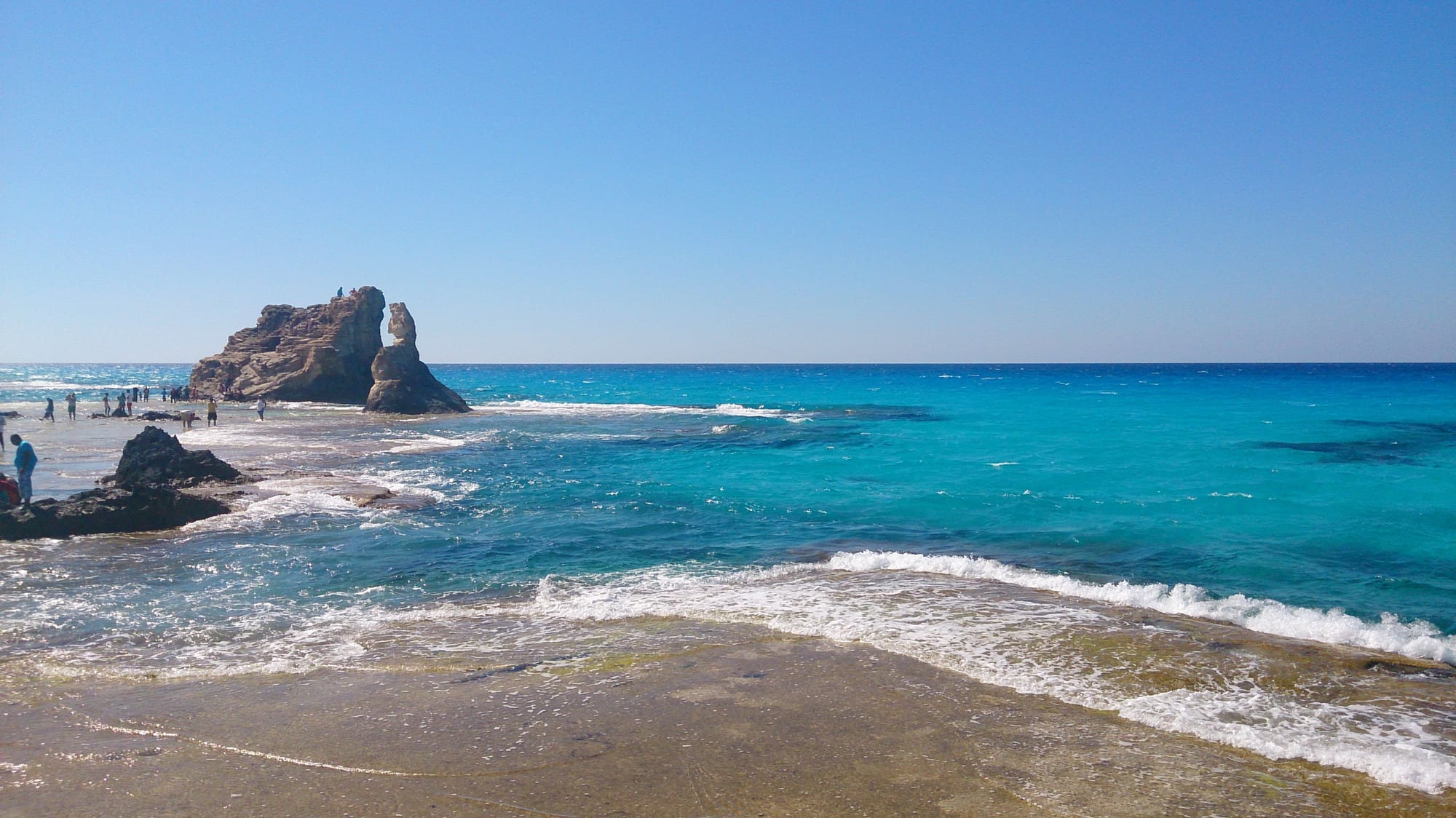
A weathered rock stack standing in shallow turquoise water off a flat rocky shore, with waves breaking around it

The Western Desert & Oases, Egypt

Marsa Matruh

The rock formation known as Cleopatra's Bath on the coast west of Marsa Matruh. (Mia / Wikimedia Commons · CC BY-SA 4.0)

The main town of Egypt's north-western coast, built around a long, shallow lagoon of exceptionally clear water between Alexandria and the Libyan border. An ancient harbour under the Ptolemies and a front-line base in the Second World War, it is now a summer resort filled by Egyptian families and the gateway to the road south to Siwa.

Neighbourhoods

  • The town centre and the corniche
    • First-time visitors
    • Best for food
    • Close to transport

    A grid of low blocks, shops and cafés behind the seafront road that curves around the lagoon. The bus station, markets and most of the year-round life of the town are here, and the promenade fills with families on summer evenings.

    Open in Maps
  • The lagoon beaches
    • Families
    • Swimming
    • Beaches

    The sheltered inner shore of the bay, where a reef across the mouth keeps the water flat and shallow for a long way out. Hotels and beach cafés line it, and this is where most Egyptian holidaymakers spend their days.

    Open in Maps
  • The western bays
    • Beaches
    • Day trips
    • Photography

    A series of coves and headlands running west out of town, including the rocks known as Cleopatra's Bath and the cliff-backed bay at Agiba. Facilities are limited, and most visitors come by microbus or car for the day.

    Open in Maps
  • The eastern coast road
    • Quiet stays
    • Resorts

    The shore towards Alexandria, where holiday compounds and new resort developments spread along the coast. It is quiet outside the summer season and largely car-dependent.

    Open in Maps

Things to do

Beaches and the coast

  • Cleopatra's Beachbeach

    A rocky cove west of the town with a natural stone basin in the sea, linked by legend to Cleopatra; swimming is possible but the water breaks hard on the rocks.

    Open in Maps
  • Agiba Beachbeach

    A small crescent of white sand below limestone cliffs about 28 kilometres west, known for the caves along its shore and reached by a stairway from the clifftop viewpoint.

    Open in Maps
  • Al-Obayed Beachbeach

    A quieter stretch of sand about 20 kilometres west of the town, on the same line of coves and headlands as Agiba.

    Open in Maps
  • The lagoon shorebeach

    The long, shallow, sheltered stretch of sand inside the bay in front of the town, the easiest swimming on this coast.

    Open in Maps
  • Rommel Beachbeach

    The bay on the eastern side of the harbour named after the German commander, quieter than the town beaches and close to the cave museum.

    Open in Maps

History and museums

  • Rommel Museummuseum

    The caves above the eastern bay that the German commander Erwin Rommel used as a headquarters during part of the El Alamein campaign, opened as a museum in 1977 with belongings given by his son and reopened in 2017 after restoration work.

    Open in Maps
  • Matrouh Archaeology Museummuseum

    The town's archaeology museum, covering the long history of this stretch of the Mediterranean coast.

    Open in Maps
  • Temple of Ramesses IIlandmark

    The scant remains of a pharaonic temple near the lagoon, evidence that this harbour was in use long before the Greeks and Romans developed it.

    Open in Maps

Short trips from the town

  • Ras El Hekmaneighborhood

    A Bedouin village on a cape about 70 kilometres east of the town, where an agreement signed in 2024 with an Abu Dhabi state investment company covers a development described as the largest foreign investment in Egypt's history.

    Open in Maps
  • Siwa Oasisneighborhood

    The Berber-speaking oasis roughly 300 kilometres south across the desert, reached by the road and buses that start from Marsa Matruh.

    Open in Maps

Seasonal events

  • Egyptian summer seasonJune to September

    The town's population multiplies as families arrive from Cairo, Alexandria and the Delta, filling the beaches, hotels and corniche cafés for the school holidays.

  • Ramadanvaries by year

    Days are quiet and the evenings sociable, with cafés and restaurants busy after sunset; the coast is at its calmest if the month falls outside the summer.

  • Eid holidaysvaries by year

    Both Eid feasts bring short, intense bursts of domestic tourism, with the beaches and the coast road crowded for several days.

Eat and drink

Long-standing places and food districts in Marsa Matruh. Hours, ratings and directions come from your maps app, always current.

Food districts

  • Corniche fish restaurantsneighborhood

    Mediterranean fish and squid, grilled or fried and sold by weight, in the seafront places that fill with families through the summer.

    Open in Maps
  • The town marketmarket

    Figs, watermelon, olives, dates and vegetables from the rain-fed farms along the coast, alongside butchers, bakeries and spice stalls.

    Open in Maps
  • Alexandria Street grills and cafésneighborhood

    The everyday eating of the town centre, with kofta and chicken grills, koshari counters, ful and ta'meya stands and tea houses.

    Open in Maps

Experience Marsa Matruh

History

The bay that shelters Marsa Matruh has been used for as long as ships have sailed this coast. Blocks and inscriptions found near the lagoon point to a pharaonic presence, and under the Ptolemies the harbour became a working port known as Paraetonium, handling grain and trade between Egypt and Cyrenaica. The Romans kept it as a garrison and customs post on the road west, and Christian communities followed; the coast then passed to Arab rule after the 7th century and became Bedouin country, the harbour reduced to a fishing anchorage for centuries.

The town's modern shape dates from the 19th and early 20th centuries, when the Egyptian state took an interest in the coast; the railway from Alexandria was extended to the town in 1936. Its best-known chapter is the Second World War. The Western Desert Campaign swept back and forth along this shore between 1940 and 1942, the town changed hands, and Erwin Rommel used a cave above the eastern bay as a headquarters. The decisive battles were fought at El Alamein, on the coast to the east, in the summer and autumn of 1942, and the cemeteries and memorials there are the campaign's lasting mark on this coastline.

After the war Marsa Matruh grew as a governorate capital and then, from the 1970s onwards, as a summer resort for Egyptians, drawn by water clearer than anything near Alexandria. The paved road south to Siwa, completed in the 1980s, made the town the gateway to the oasis. Since the 2010s the coast either side has been transformed by holiday developments, and a large investment deal for Ras El Hekma, signed with an Abu Dhabi state investment company in 2024, promises more building along the shore east of town.

Culture & Customs

Matruh is Bedouin country. The Awlad Ali, whose tribal territory stretches from around Alexandria to the Libyan border and across it, dominate the region, and their customs shape daily life: tribal mediation alongside state courts, an unusually strong code of hospitality, and family and lineage as the first markers of identity. Bedouin Arabic here is closer to the speech of eastern Libya than to the Egyptian of the Nile Valley, and cross-border family ties are normal.

Poetry, sung and recited, is the region's own art form, performed at weddings and gatherings, and weddings themselves are large, multi-day affairs with drumming, processions and communal cooking of sheep. Silverwork, weaving and embroidery in dark red and black patterns are the traditional crafts, and rugs and blankets woven from sheep's wool are still made inland.

The summer season imposes a second, different culture on the town for three months, when Egyptian families from Cairo and the Delta fill the beaches and the corniche and the streets stay busy until the small hours. Social rules remain conservative through all of it: modest dress, swimming in clothes for most local women, little public alcohol, and a clear separation between the holiday shore and the life of the town behind it.

Daily Life

Marsa Matruh is a modest town for most of the year whose population multiplies several times over in July and August. As the capital of Matrouh Governorate it holds the courts, hospitals, schools and government offices for an enormous, thinly populated stretch of coast and desert, and those jobs, along with tourism, fishing and trade, are the mainstay of the local economy.

Away from the sea, the coastal strip is farmed by rain rather than irrigation: barley, figs, olives and almonds grown in shallow valleys where run-off collects, with sheep and goats grazed on the desert margin. It is a precarious system, sensitive to years of poor rain, and many families combine it with work in the town or in Libya. Smuggling across the western border, and the policing of it, are facts of life in the region.

The rhythm of the year is sharper here than in most Egyptian towns: an intense, crowded, profitable summer, then eight quiet months in which many hotels and beach cafés close, students return to Alexandria and the seafront empties. New resort construction along the coast in both directions has brought work and also pressure on water, roads and the beaches themselves.

Food

The coast eats fish. Mediterranean catch — bass, bream, mullet, sardines and squid — is chosen at the counter, weighed and then grilled over charcoal or fried, served with rice, tahina, salads and baladi bread. Sayadeya, fish served on rice cooked with browned onion, tomato and spices, is the classic dish of the Egyptian coasts, and fish soup with cumin and tomato is common in the cooler months.

Bedouin cooking sits behind it. Lamb or goat slow-cooked for guests is the centre of hospitality, served on rice with bread baked on a domed metal sheet or in the embers, and yoghurt, buttermilk and clarified butter from sheep and goats are everyday foods. The coast's rain-fed farms give figs, olives, almonds and watermelon, which appear in the summer markets along with dates trucked up from Siwa.

The standard Egyptian repertoire fills out the rest: ful medames and ta'meya at breakfast, koshari at lunch, kofta and grilled chicken in the evening, molokhia and stuffed vegetables at home. Tea is drunk strong and very sweet, Bedouin tea often flavoured with sage or mint, and coffee is served in small cups; karkadeh and fresh juices are the summer drinks on the corniche.

Planning tools

Budget

Marsa Matruh is a domestic resort, so prices are moderate by Egyptian standards but rise steeply in July and August, when rooms on the lagoon can double. Outside the summer the town is cheap and half empty. Food, transport and beach costs are low; the expensive options are the newer compounds along the coast east of town.

Daily Budget Midrange
USD 70–170 (hotel on the bay, restaurant meals, a car or taxi for the western beaches, day trips)
Daily Budget Shoestring
USD 20–40 (simple hotel away from the seafront, local food, microbuses, public beaches)

Book well ahead for July and August, and carry cash, as smaller hotels, microbuses and beach cafés rarely take cards.

Best Time to Visit

June to September for swimming and the full life of the resort, though that is also when the town is most crowded and most expensive. May and early October give warm sea with far fewer people. Winter is mild, sometimes wet and windy, and much of the seafront closes down, but the coast and the battlefields are still worth seeing.

Suggested Number of Days

A day or two covers the town and its beaches. Allow three or four to take in the coast to the west and the battlefield sites east along the Mediterranean road. Many travellers stop here only to change buses for the desert.

First Visit
1–2 days
With Surroundings
3–4 days

Transportation

The centre is walkable and microbuses, taxis and pickup trucks serve the beaches west of town and the coast road east. Long-distance buses run to Alexandria and Cairo and south to Siwa, and shared taxis cover the same routes. A hire car or a driver makes the western bays much easier to reach, since services thin out well before Agiba.

Agree fares before setting off, and check the last bus times back from the western beaches, which stop running early outside the summer.

Airport & Station Connections

Most visitors arrive by road. Buses and shared taxis run from Alexandria in around four hours and from Cairo in seven to eight, and a railway line links the town with Alexandria. The road south to Siwa takes about four hours across empty desert. Marsa Matruh has an international airport, though most travellers come overland.

Walkability

The town centre and the corniche are flat and easy to walk, and the lagoon beaches are a short stroll from most hotels. Anything beyond that — the western bays, the eastern resorts, the battlefields — is too far to walk, and summer heat and traffic make longer walks unpleasant in the middle of the day.

Safety

The town is safe and the summer crowds are family crowds, though petty theft is possible on busy beaches. The sea is the main hazard: currents and undertow are strong outside the sheltered lagoon and drownings happen each summer at unguarded bays. Security on the coastal and desert roads is tight, with checkpoints, and the zone towards the Libyan border is restricted.

Keep to authorised routes, carry a passport for checkpoints, and travel in the deep desert only with licensed operators and permits. Check current official travel advice before travelling.

Climate

A Mediterranean climate, milder and more humid than the desert inland, with hot dry summers cooled by a sea breeze and mild winters that bring what little rain this coast gets, mostly between December and February.

Summer
warm rather than fierce, generally about 29–31°C by day, with a steady breeze and warm sea
Winter
mild, about 18–20°C by day, cooler at night, with occasional rain and wind

Local Customs

This is a conservative Bedouin coast, and the resort is Egyptian rather than international. Most local women swim fully dressed, and foreign visitors in swimwear are conspicuous outside the hotel beaches; covering shoulders and knees in town is expected. Alcohol is not widely sold. Hospitality among the Awlad Ali Bedouin of the region is taken seriously, and invitations to tea are genuine.

Ask before photographing people, especially women and family groups on the beach, and dress modestly away from the hotels.

Common Payment Methods

The currency is the Egyptian pound. Cash is the norm for beaches, microbuses, markets and small hotels, while larger hotels and some restaurants take cards. ATMs are available in the town centre but not on the coast road or at the western bays, and they are least reliable at holiday weekends.