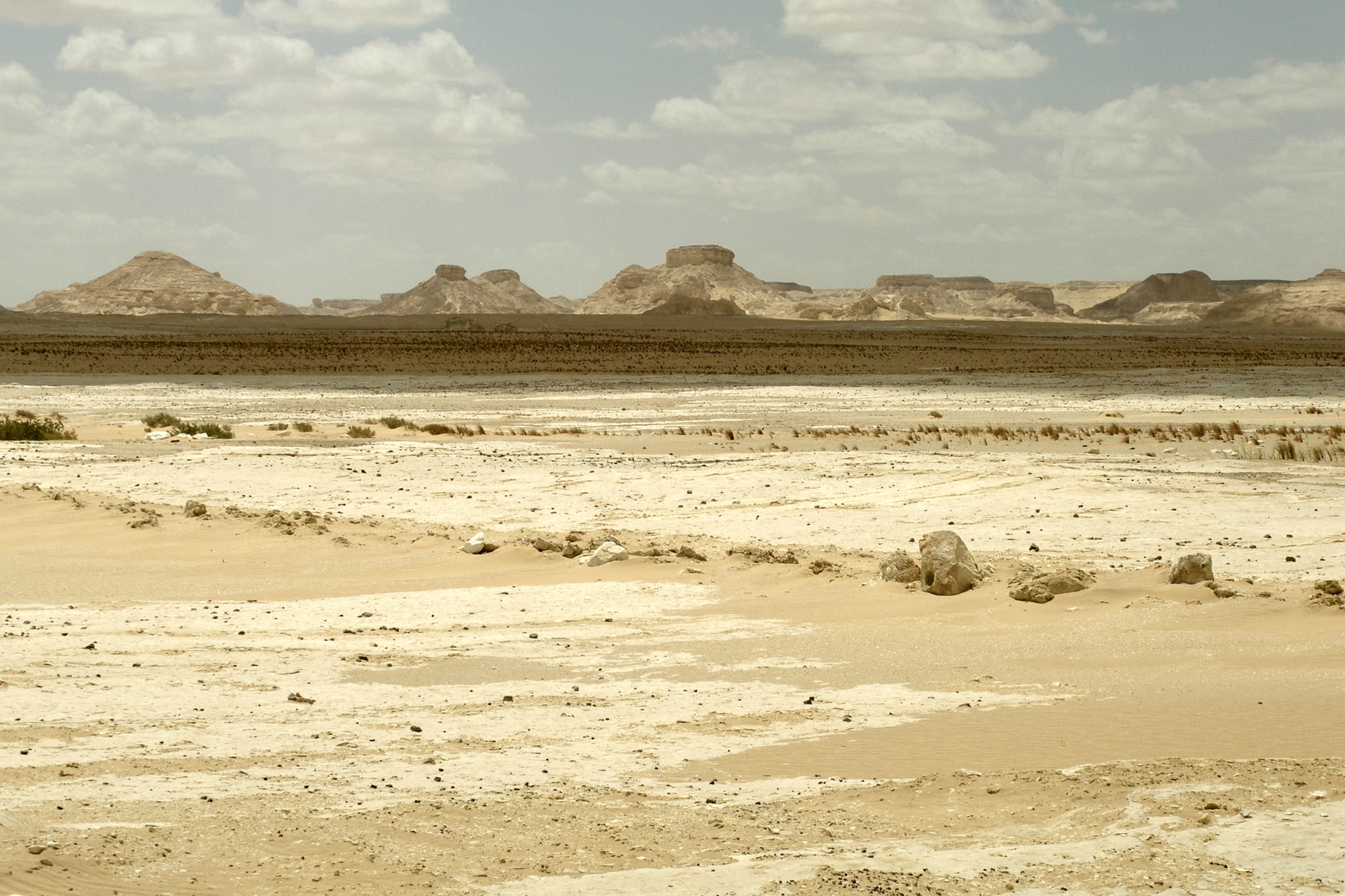
A flat plain of white chalk and pale sand scattered with rocks, with flat-topped hills on the horizon under clouds

Egypt

The Western Desert & Oases

Chalk plains and eroded hills in the White Desert, near Farafra oasis in the New Valley. (Vyacheslav Argenberg / Wikimedia Commons · CC BY 4.0)

The vast, empty western two-thirds of Egypt, covered by the New Valley and Matrouh governorates — a chain of oases from Kharga and Dakhla to Farafra and Siwa, chalk and sand landscapes, and a Mediterranean coast running from El Alamein past Marsa Matruh towards Libya. Egypt's least populated region and its largest.

Explore The Western Desert & Oases

History

The oases have been inhabited for thousands of years, lying on routes between the Nile, Libya and Sudan. Balat in Dakhla preserves the remains of an Old Kingdom governors' palace, and Kharga stood on the Darb el-Arbain, the Forty Days Road, a caravan route bringing goods and slaves north from Darfur to Asyut. The Persian king Darius I helped build the Temple of Hibis at Kharga, and Herodotus told the story of an army sent by Cambyses to attack Siwa that vanished in the sands.

Siwa's oracle of Amun was famous across the Greek world, and Alexander the Great travelled there to consult it. Under Rome the oases grew grain, wine and olives, protected by forts, and early Christians at Kharga left the domed tombs of Bagawat. The fortified Islamic towns of Al-Qasr in Dakhla and Shali in Siwa were built of mud-brick for defence, and Siwa was brought under Cairo's control by Muhammad Ali in 1820.

The coast became a battlefield in the Second World War. After months of fighting across Libya, the British Eighth Army under Montgomery defeated Rommel's German and Italian forces at El Alamein in late 1942, a turning point in North Africa. The government's New Valley project, which aims to irrigate parts of the desert,, gave the governorate its name. Since the 2010s the coast has been transformed by holiday developments such as New Alamein and a large Emirati investment deal for Ras El Hekma, announced in 2024.

Culture & Customs

Siwa is culturally distinct: its people speak Siwi, a Berber language, alongside Arabic, and keep customs unlike those of the Nile Valley. Women's traditional dress is heavily embroidered and silver jewellery is richly worked, while outsiders are expected to dress and behave conservatively. The Siyaha, a gathering of Siwi men on Gebel Dakrur, is a festival of reconciliation and shared meals. Siwa's buildings of kershef, salt-crusted mud, give the oasis its look.

The coast and the northern desert belong to Bedouin tribes, above all the Awlad Ali, whose ties reach into Libya. Tribal law, poetry and hospitality remain strong, and family reputation matters greatly. The southern oases, settled since pharaonic times and joined by migrants from the valley under the New Valley scheme, are closer to rural Nile culture, though each keeps its own local dialects and customs.

Religion is overwhelmingly Sunni Muslim, and Siwa honours its patron saint, Sidi Sulayman, at the Siyaha.

Daily Life

Together New Valley and Matrouh cover well over half of Egypt's land area but hold only a small share of its population, under a million people in total. Kharga, the capital of New Valley, and Mut in Dakhla are small towns; Marsa Matruh is the main town on the coast and swells in summer; Siwa is smaller still.

In the oases, life still revolves around water: wells and springs irrigate dates, olives, wheat and vegetables, and farmers struggle with falling groundwater and salinity. Tourism matters in Siwa and on the coast, while trade and government jobs support the New Valley. The coast depends on summer resorts and farming by rain, with barley, figs and olives.

The oasis day starts early and pauses through the midday heat, with evening gatherings over tea. Isolation, limited jobs and the long distances to services send many young people to the cities, while the Mediterranean coast has boomed with construction.

Food

Dates are the staple and pride of the oases. Siwa grows dates and olives in huge numbers and presses its own olive oil, and Siwan dates are sold across Egypt. Dakhla and Kharga are also date country, and fresh dates are eaten in late summer while dried ones last through the year.

Oasis meals are simple: bread, lentils, beans, rice, vegetables grown under the palms and chicken or lamb on feast days. In Siwa, mint tea is served green and sweet, with rounds of tea offered to every guest, and dates, olives and bread are the basic welcome. Desert camps cook bread in the embers and grill meat over fires under the stars.

Among the Bedouin of the coast, lamb cooked for guests and weddings is the centre of hospitality, served with rice and bread, and milk and yoghurt from sheep and goats are daily foods. Marsa Matruh's restaurants serve fresh fish, and figs and watermelon from the coast appear in the summer markets.

Attractions & Natural Wonders

Siwa is the region's gem: the crumbling mud-brick town of Shali, the Temple of the Oracle at Aghurmi, where Alexander came, the tombs of Gebel al-Mawta, natural springs such as Cleopatra's Bath, and two large salt lakes. Beyond lie the dunes of the Great Sand Sea.

In the New Valley, the White Desert near Farafra, a protected area, has white chalk formations shaped by the wind, best seen at sunset or on an overnight camp. Bahariya oasis, further north on the same road, belongs to Giza Governorate and lies outside this region. Farafra has hot springs and a small village. Dakhla's Al-Qasr is a medieval mud-brick town, with the Roman temple of Deir el-Hagar and the Old Kingdom site at Balat nearby. Kharga has the Temple of Hibis, the Bagawat necropolis and the desert forts of Qasr el-Ghueita and Dush. The far south-west includes the Gilf Kebir plateau and its prehistoric rock art, reachable only on permitted expeditions.

On the coast, El Alamein has war cemeteries and a war museum. Marsa Matruh has white beaches and clear water, including Agiba beach, and the Rommel museum in a cave; the resorts of the North Coast stretch towards Alexandria.

Cities in The Western Desert & Oases

Planning basics

Budget

Travel in the oases is cheap on the ground, with simple hotels, eco-lodges in Siwa and local restaurants, but the distances are great and the desert trips are the real expense: a 4x4, driver, guide and permits for the White Desert or deep desert trips. The Matrouh coast is the opposite, with expensive summer resorts built for wealthy Egyptians.

Daily Budget Midrange
USD 75–190 (eco-lodge or good hotel, a shared 4x4 desert trip with camping, private transfers)
Daily Budget Shoestring
USD 25–40 (simple hotel or guesthouse, local food, buses between the oases)

Book desert trips through licensed operators who handle permits, and carry cash — card machines and ATMs are few beyond the main towns.

Safety

The main oases and the coast are generally safe, but security is tight: there are frequent checkpoints, and in some years foreigners have been given police escorts. The Libyan border area, including the zone beyond Siwa and the far south-west, is restricted. Security forces have fought militants and smugglers in the desert, and in 2015 a group of tourists was killed by mistake during a security operation. Heat, dehydration and breakdowns in remote areas are real risks.

Keep to authorised routes, carry a passport for checkpoints, and travel in the deep desert only with licensed operators and permits. Check current official travel advice before travelling.

Climate

The oases lie in one of the driest parts of the Sahara, with almost no rain, blazing summer heat and large differences between day and night. Winter nights in the desert can fall close to freezing. The Mediterranean coast is milder and humid, with some winter rain and pleasant summers that draw Egyptian holidaymakers.

Summer
extremely hot in the oases, often above 40°C; about 29–31°C and breezy on the coast
Winter
warm days around 20–24°C in the oases and cold desert nights; mild, sometimes rainy weather on the coast

Transportation

Roads are long and empty. Buses run from Cairo and Alexandria to Marsa Matruh and on to Siwa, which is several hours further inland; Kharga is linked by road to Asyut and Luxor and to Dakhla and Farafra, and the loop road runs north to Bahariya and Cairo. El Alamein and Marsa Matruh have airports. Deep desert travel needs a 4x4, an experienced driver and permits.

Allow a full day for each long desert drive, and never drive off-road without a guide, spare fuel and water.

Best Time to Visit

October to April for the oases and desert camping, with November and March the best months for mild days and nights that are not too cold. The Mediterranean coast is at its busiest from June to September, when Egyptian families fill the resorts. Siwa's Siyaha, a yearly feast of reconciliation, is held on Gebel Dakrur.